


Synonym name:
Catalogue No.: BP1117
Cas No.: 94079-81-9
Formula: C35H46O19
Mol Weight: 770.734
Botanical Source: Barleria lupulina, Brandisia hancei, Buddleja officinalis, Dicliptera riparia, Eremophila forrestii, Jasminum mesnyi, Jasminum nudiflorum, Penstemon linarioides, Syringa afghanica, Teucrium belion, Teucrium polium and Teucrium yemense. Pre
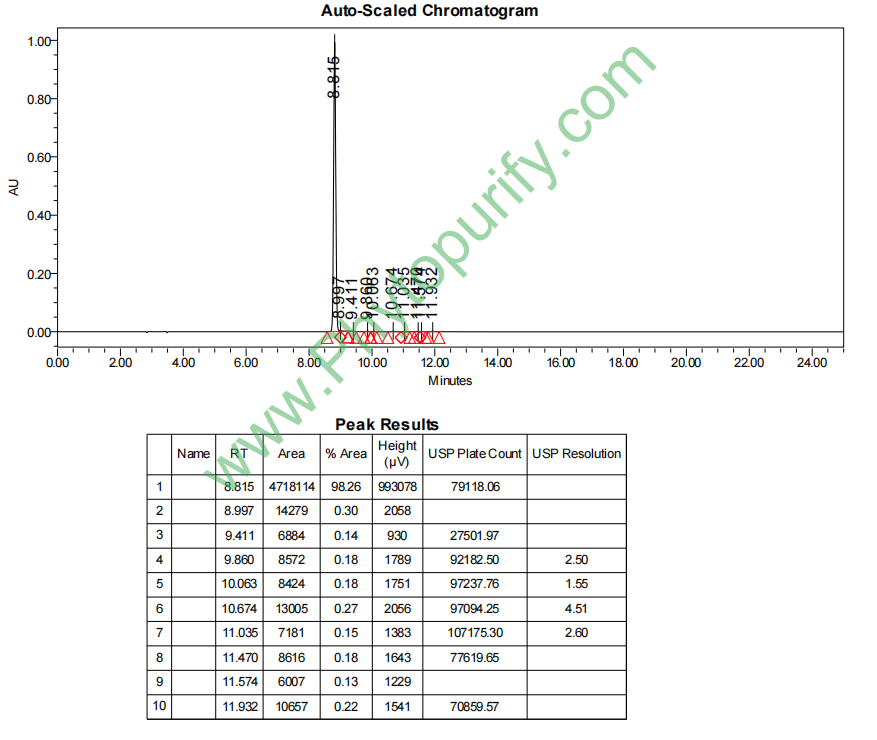
Purity: 95%~99%
Analysis Method: HPLC-DAD or/and HPLC-ELSD
Identification Method: Mass, NMR
Packing: Brown vial or HDPE plastic bottle
Can be supplied from milligrams to grams.
For Reference Standard and R&D, Not for Human Use Directly.
Inquire for bulk scale.
HPLC of Poliumoside
Storage conditions:Short-term storage at 2~8℃, long-term storage at -20 ~ -80℃
304.2100
-.0038
-.0130
6.7028
.4573
.0910
Low
73.9652
5.3562
No
No
No
No
No
No
0.0
Yes
No
Yes
Yes
In the treasure trove of natural products, phenylpropane compounds have always been a research hotspot in the field of drug discovery due to their extensive biological activity and structural diversity. Polimoside, as a unique caffeinated phenylpropane glycoside, has attracted much attention due to its significant activities in anti-inflammatory, antioxidant, anti diabetes complications and other aspects since it was isolated and identified from plants. With the deepening of research, its potential anti-tumor activity has gradually become a new focus, revealing its enormous potential in multi-target and multi-path intervention of complex diseases. The purpose of this article is to systematically review the chemical properties, plant sources, pharmacological activities, especially the anti-tumor mechanism and molecular targets of Epinepheline, and to scientifically evaluate and prospect its pharmacological properties and clinical application prospects, in order to provide comprehensive academic references for the in-depth research and future development of this compound.
The chemical name of Jinshi Serin (CAS number: 94079-81-9) is (2R, 3R, 4S, 5S, 6R) -2- [2- [(2E) -3- (3,4-dihydroxyphenyl) acryloyloxy] -4,5-dihydroxyphenyl] ethoxy-6- [(2R, 3R, 4R, 5R, 6S) -3,4,5-trihydroxy-6-methyloxytetrahydro-2H-pyran-2-yl] oxy] methyl] tetrahydro-2H-pyran-3,4,5-triol. Its molecular formula is C35H46O19 and its molecular weight is 770.7340 g/mol.
Structurally, the core of Jin Shi silkworm glycosides is a phenylethanolic glycoside mother nucleus, and its phenylethanolic portion is connected to caffeic acid (3,4-dihydroxycinnamic acid) through ester bonds, forming a caffeic acid group. The sugar moiety is usually connected to xylose and glucose, forming a highly hydrophilic glycosidic structure. This structural feature directly determines its physicochemical properties: its calculated lipid water partition coefficient (LogP) is about -0.0038, indicating excellent hydrophilicity; The topologically polar surface area (TPSA) is as high as 304.21 Å ², further confirming the presence of numerous hydrogen bond donor and acceptor sites on its molecular surface. The predicted value of its water solubility is 6.7028 mg/mL, which belongs to the soluble range. These properties suggest that the distribution of epigallocatechin gallate in organisms may be more inclined towards aqueous environments, making it difficult to penetrate the lipid bilayer. For example, its blood-brain barrier permeability is predicted to be "low". In addition, preliminary pharmacological risk assessment showed that the hERG inhibition risk and Ames mutagenicity risk were both negative (0.0), providing preliminary positive signals for its safety research.
Golden stone sericin was originally derived from the Scrophulariaceae plant, Wisteria tenuifolia(Brandisia hancei Separated from the stem and leaves of Hook. f. As a traditional medicinal plant, Laijiangteng has a certain history of application in folk culture, which provides clues for the discovery of gold and stone sericin. Subsequent research has found that epigallocatechin gallate is also widely present in various other plants, especially in plants of the Lamiaceae and Scrophulariaceae families, such as the medicinal plant verbascoides(Verbascum Spp.) and certain Teucrium This provides more possibilities for the acquisition of resources for the plant (Caryophyllum).
At present, the extraction of gold and stone sericin mainly adopts organic solvent extraction method. The common process is to extract plant materials (usually dried and crushed stems and leaves) by cold soaking or heating reflux with polar solvents such as methanol or ethanol. After the extraction solution is concentrated under reduced pressure, the obtained extract is subjected to gradient extraction using solvents such as petroleum ether, ethyl acetate, and n-butanol. Due to its strong hydrophilicity, the extract of gold and silver sericin is mainly enriched in the n-butanol extraction site. Further purification relies on column chromatography techniques, often using silica gel column chromatography, macroporous adsorption resin (such as D101, AB-8) column chromatography, and reverse phase silica gel (such as ODS) column chromatography for separation. High performance liquid chromatography (HPLC), especially preparative HPLC, is the final key step in obtaining high-purity gold silk fibroin monomers. In recent years, modern technologies such as ultrasound assisted extraction and microwave-assisted extraction have also been applied to improve extraction efficiency and shorten extraction time.
The pharmacological activity research of Jin Shi silkworm glycoside has revealed its various biological effects, mainly covering the following aspects:
Antidiabetic activity This is one of the earliest and most extensively studied activities of gold and stone sericin. Research has shown that it can effectively inhibit the formation of advanced glycation end products (AGEs), with an IC50 value of 19.69 μ M. The accumulation of AGEs is one of the core pathological mechanisms of chronic complications such as diabetes nephropathy, retinopathy and neuropathy. At the same time, Jin Shi silkworm glycosides exhibited potent inhibitory activity against rat crystalline lens aldose reductase (RLAR), with an IC50 of 8.47 μ M. Aldose reductase is the key rate limiting enzyme in the polyol pathway, and its over activation will lead to sorbitol accumulation and oxidative stress, and participate in the complications of diabetes. Therefore, chrysotin shows the potential to prevent and treat complications of diabetes through a dual mechanism.
Anti inflammatory and antioxidant activity The caffeoyl structure of gold and stone sericin is the material basis for its antioxidant activity. In vitro experiments have confirmed that it has the ability to scavenge free radicals such as DPPH and ABTS, and can inhibit lipid peroxidation. In various inflammatory cell models (such as lipopolysaccharide induced macrophages) and animal models (such as carrageenan induced rat foot swelling and acetic acid induced increased intra-abdominal capillary permeability in mice), hesperidin can significantly inhibit the production of pro-inflammatory mediators (such as TNF - α, IL-6, IL-1 β, PGE2) and the release of nitric oxide (NO), and its mechanism is related to the inhibition of inflammatory signaling pathways such as NF - κ B.
Antitumor activity In recent years, the anti-tumor potential of epigallocatechin gallate has become a new research hotspot. In vitro experiments show that it has different degrees of proliferation inhibition and apoptosis promoting effects on a variety of human cancer cell lines, including breast cancer, liver cancer, colon cancer, lung cancer, etc. Its anti-tumor effect is not achieved through a single pathway, but involves multiple steps such as inducing cell cycle arrest, triggering mitochondrial apoptosis pathways, and inhibiting cell invasion and metastasis. These effects are closely related to their regulation of multiple key tumor related targets.
Other activities In addition, the study also reported that Jin Shi silkworm glycosides have neuroprotective, hepatoprotective, antiviral (such as anti herpes simplex virus) and other activities, demonstrating their broad pharmacological spectrum of action.
The multiple pharmacological activities of Jin Shi silkworm glycosides, especially their anti-tumor activity, stem from their regulation of multiple key signaling molecules and pathways within cells. According to existing research, its mechanism of action involves the following core targets and pathways:
Regulating apoptosis balance (BCL2 family and MCL1)BCL2 and MCL1 are important anti apoptotic proteins, and their overexpression is the main mechanism by which tumor cells resist apoptosis. Research has shown that epigallocatechin gallate can downregulate the expression of BCL2 and MCL1, and may upregulate the expression of pro apoptotic proteins such as BAX, thereby disrupting mitochondrial membrane potential, promoting cytochrome C release, activating Caspase cascade reaction, and ultimately inducing intrinsic pathway apoptosis in tumor cells.
Inhibition of transcription factor STAT3 Signal transducer and activator of transcription factor 3 (STAT3) is a key hub connecting inflammation and tumors. In various tumors, STAT3 continues to be abnormally activated, promoting cell proliferation, survival, angiogenesis, and immune escape. Jinshizin has been proven to inhibit the phosphorylation (activation) of STAT3, block its nuclear translocation, and inhibit the transcription of downstream target genes (such as Cyclin D1, Survivor, VEGF), thereby exerting anti-tumor effects.
Intervention of cell invasion and metastasis (MMP2, HIF1A)Matrix metalloproteinase-2 (MMP2) is a key enzyme that degrades extracellular matrix and promotes tumor invasion and metastasis. Hypoxia inducible factor-1 alpha (HIF1A) is stably expressed under hypoxic conditions in the tumor microenvironment, and subsequently upregulates genes such as MMP2 and VEGF. Jinshizin can inhibit the protein expression and transcriptional activity of HIF1A, and directly or indirectly reduce the activity or expression of MMP2, thereby inhibiting the migration and invasion ability of tumor cells.
Affects DNA metabolism and repair (TOP1, TOP2A)Topoisomerase I (TOP1) and II α (TOP2A) are key enzymes that regulate DNA topology and are targets of various chemotherapy drugs such as irinotecan and etoposide. Jinshizin may interfere with the function of these enzymes, causing irreparable damage during DNA replication and transcription, thereby inhibiting tumor cell proliferation.
Regulating the kinase signaling pathway (MAPK1/ERK2)Mitogen activated protein kinase 1 (MAPK1, ERK2) is a core member of the MAPK/ERK pathway, involved in regulating cell growth and differentiation. Jinshizin may interfere with the proliferation signal of tumor cells by affecting the activation state of this pathway.
Intervention in hormone related pathways (ESR1, CYP19A1): For hormone dependent tumors, such as breast cancer, chrysotin may interfere with the signal transduction or synthesis of estrogen by acting on estrogen receptor α (ESR1) or aromatase (CYP19A1, the key enzyme that converts androgen into estrogen), thus inhibiting tumor growth.
In summary, Jin Shi silk glycosides exert anti-tumor effects through a multi-target, networked mode of action, which may give them unique advantages in addressing tumor heterogeneity and drug resistance.
Despite exhibiting good biological activity in vitro and some in vivo models, the development of medicinal properties of Jin Shi silkworm glycosides still faces challenges, and related pharmacokinetic studies are relatively limited.
Absorption and distribution Jinshi sericin has a high molecular weight and strong hydrophilicity (high TPSA, low LogP), which may lead to its low oral bioavailability. Hydrophilic macromolecules are often difficult to cross the intestinal epithelial cell membrane through passive diffusion. Its blood-brain barrier permeability is predicted to be "low", indicating that its direct therapeutic effect on central nervous system diseases may be limited. It may be more inclined to be distributed in aqueous environments such as blood and extracellular fluid.
Metabolism and excretion As a glycosidic compound, gold silk glycosides are likely to be hydrolyzed by glycosidases in gut microbiota or tissues in the body, producing aglycones (caffeoylphenylethanol) and glycosides. Glycosides have enhanced lipid solubility and may be more easily absorbed, but their activity may differ from the prototype drug. The prototype drug and its metabolites may be mainly excreted from urine through the kidneys.
Preliminary evaluation of safety Current computational predictions indicate that there is no significant risk of hERG channel inhibition (no risk of cardiac toxicity leading to QT interval prolongation) or Ames mutagenicity associated with Jin Shi silk glycosides, which is a positive preliminary safety signal. However, comprehensive preclinical safety evaluations such as acute toxicity, chronic toxicity, and reproductive toxicity still need to be carried out.
Pharmaceutical Science Challenge In order to improve its bioavailability, advanced drug delivery technologies such as nano formulations (liposomes, polymer nanoparticles), phospholipid complexes, cyclodextrin inclusion complexes, etc. may be needed to enhance its membrane permeability, stability, and targeting.
The diverse pharmacological activities of Jin Shi silkworm glycosides have brought potential application prospects in multiple therapeutic fields:
Future research should focus on the following directions: firstly, using modern molecular biology techniques such as CRISPR and proteomics to more accurately elucidate their direct targets and signaling networks; Secondly, the system conducts preclinical pharmacokinetic and safety evaluation studies that comply with standards; Thirdly, efforts should be made to address the bottleneck of drug development by improving its bioavailability and targeting through structural modifications (optimizing physicochemical properties while retaining pharmacophores) or developing novel drug delivery systems; Finally, promote high-quality in vivo pharmacological validation and gradually transition to clinical research.
As a natural source of caffeoyl phenylpropanoid glycoside, Jin Shi silkworm glycoside has become an important molecule in the pharmacological research of natural products due to its outstanding pharmacological activities such as inhibiting the formation of AGEs, aldose reductase, and multi-target anti-tumor effects. Its chemical structure is clear, and the study of its mechanism of action is deepening from the description of phenomena to the analysis of molecular targets and pathways, especially its role in regulating apoptosis, STAT3 signaling, tumor invasion and metastasis, revealing its networked intervention ability in combating complex diseases. Although there are challenges in developing drug properties such as oral bioavailability, these obstacles are expected to be overcome through the optimization of modern medicinal chemistry and pharmacology methods. To sum up, chrysotin is a leading compound with great development value. Its follow-up research not only helps to reveal the mysteries of the role of natural products, but also provides important candidate molecules and scientific basis for the development of new drugs to treat complications of diabetes, inflammatory diseases and malignant tumors.
