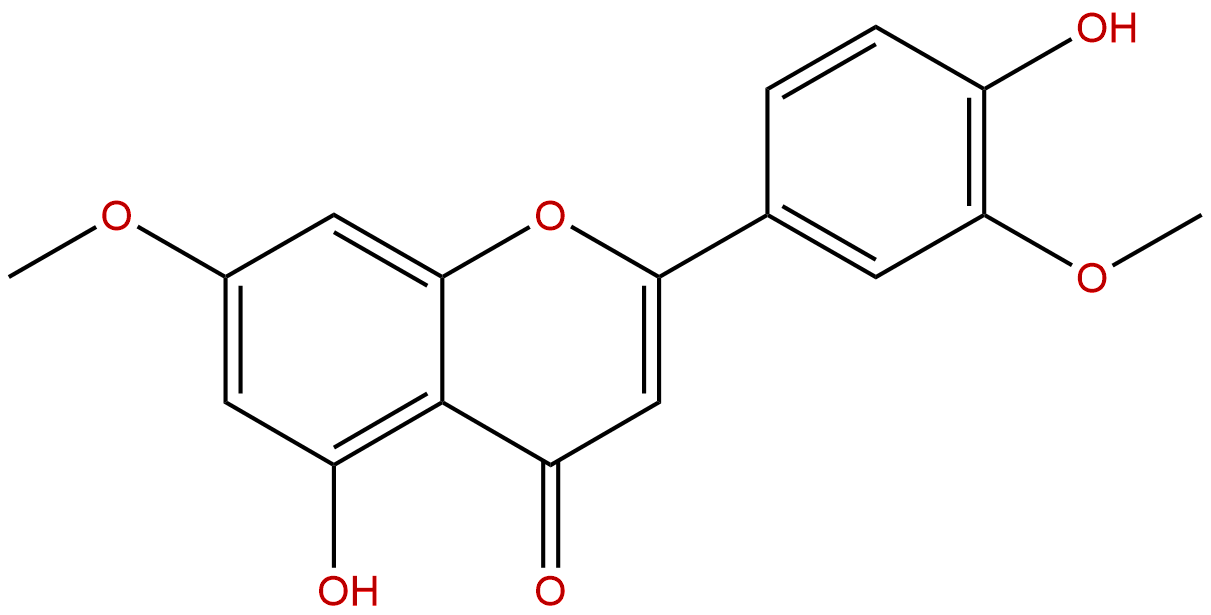


Product name: Velutin
Synonym name:
Catalogue No.: BP3395
Cas No.: 25739-41-7
Formula: C17H14O6
Mol Weight: 314.293
Botanical Source:
Physical Description: Yellow powder
Type of Compound: Flavonoids
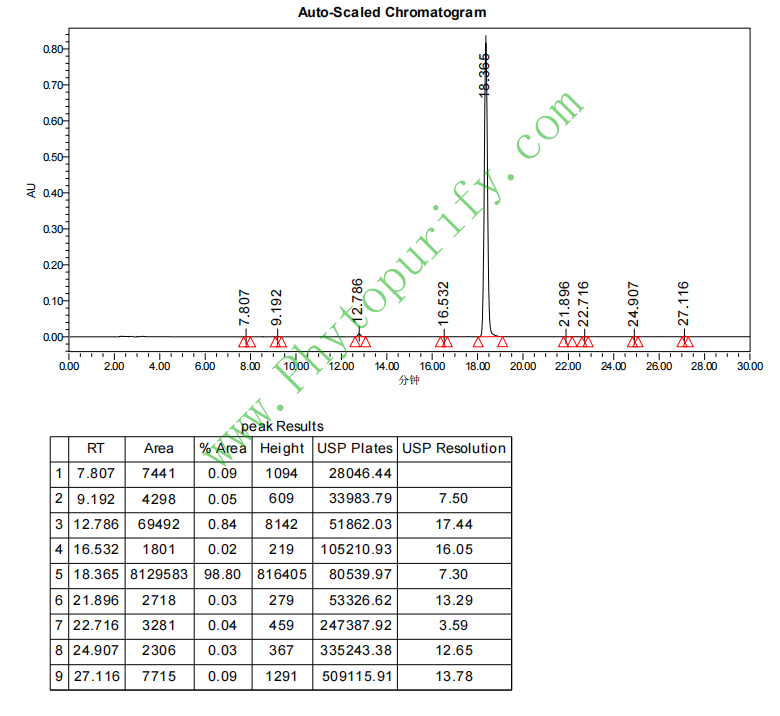
Purity: 95%~99%
Analysis Method: HPLC-DAD or/and HPLC-ELSD
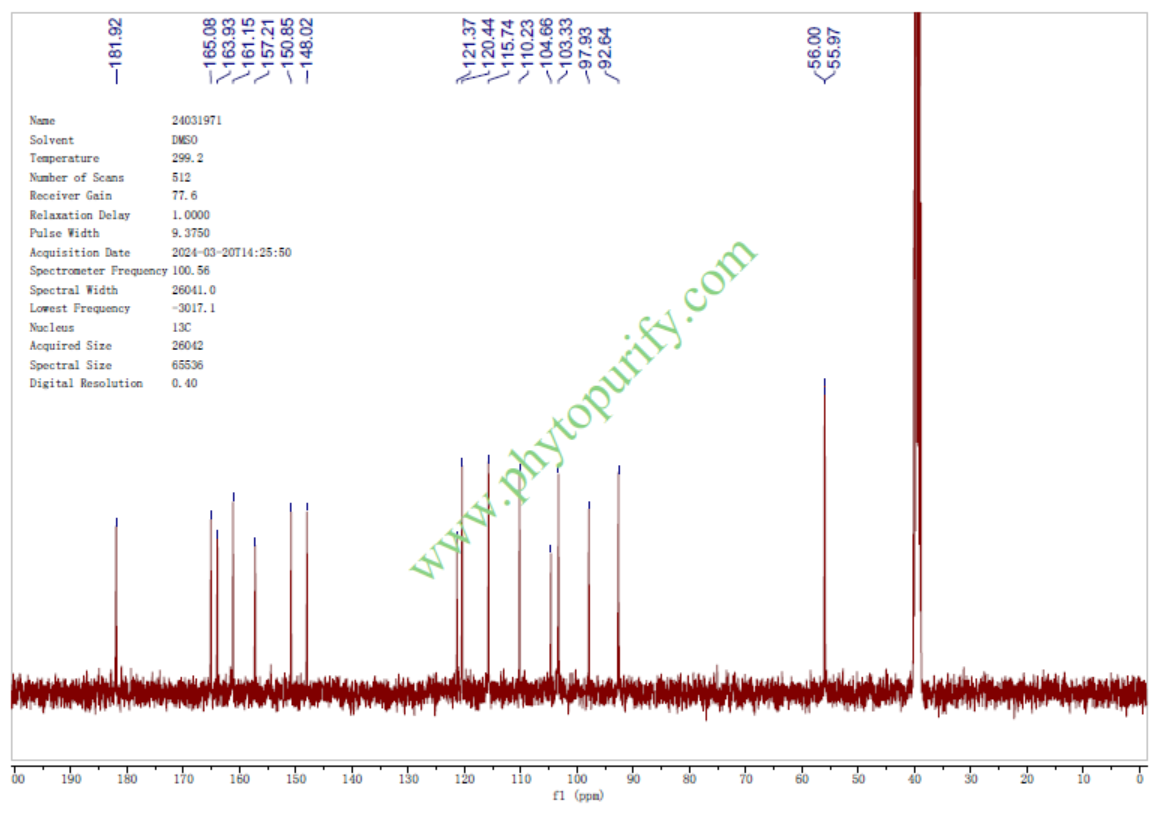
Identification Method: Mass, NMR
Packing: Brown vial or HDPE plastic bottle
The product could be supplied from milligrams to grams. Inquire for bulk scale.
We provide solution to improve the water-solubility of compounds, thereby facilitating the variety of activity tests and clinic uses.
For Reference Standard and R&D, Not for Human Use Directly.
NMR of Velutin
HPLC of Velutin
Storage conditions:Short-term storage at 2~8℃, long-term storage at -20 ~ -80℃
89.1300
2.5328
2.5045
.0328
4.8234
38.9192
Low
91.2644
2.2525
Yes
No
Yes
No
Yes
No
0.6
No
No
Yes
No
As an important treasure trove for drug discovery and development, natural products continue to provide modern medicine with lead compounds with novel structures and diverse activities. Flavonoids, as one of the major categories, have attracted much attention due to their wide range of biological activities, such as antioxidant, anti-inflammatory, anti-tumor, and neuroprotective effects. Velutin, also known as 5,7-dihydroxy-2- (3-hydroxy-4-methoxyphenyl) -4H benzopyran-4-one, is a structurally unique dimethylated flavonoid glycoside. Since its first isolation and identification from Flammulina velutipes, its various pharmacological activities have gradually been revealed, especially in the fields of anti-inflammatory, inhibition of melanin production, and regulation of bone metabolism, showing significant potential. With the development of modern molecular pharmacology and structural biology, the study of the mechanism of action of epicatechin gallate has deepened to the level of signaling pathways and molecular targets, laying a scientific foundation for its transformation from natural active molecules to potential therapeutic drugs. This article aims to systematically review the chemical properties, plant sources, pharmacological activities, mechanisms of action, and medicinal properties of epicatechin gallate, and prospects its clinical application prospects.
Felt haired epicatechin is a type of dimethoxyflavonoid with a classical 2-phenylchromenone structure as its parent nucleus. Specifically, it is a methylated derivative of luteolin, which undergoes methoxy substitution on the hydroxyl groups at positions 7 and 3 ', forming a structure of 5,7-dihydroxy-2- (3-hydroxy-4-methoxyphenyl) -4H - benzopyran-4-one. Its CAS number is 25739-41-7, molecular formula is C17H14O6, and molecular weight is 314.29 g/mol.
From the analysis of physical and chemical properties, the calculated lipid water partition coefficient (LogP) is 2.53, indicating that the compound has moderate lipophilicity, which is beneficial for its penetration of cell membranes, but may also affect its water solubility. Its topological polar surface area (TPSA) is 89.13 Å ², reflecting the characteristics of hydrogen bond donors/acceptors in the molecule. Experimental data shows that its water solubility is low (about 0.0328 mg/mL), which may be a limiting factor for its oral bioavailability. In the preliminary screening of medicinal properties, epicatechin gallate showed a lower risk of hERG inhibition (negative), indicating a lower potential risk of arrhythmia. The Ames test result is 0.6, indicating a low risk of mutagenicity. In addition, its blood-brain barrier permeability is predicted to be "low", suggesting that it may not easily enter the central nervous system, which may be an advantage for the treatment of peripheral diseases, but also limits its direct application to central nervous system diseases.
Felt haired epicatechin was originally isolated from the edible fungus Flammulina velutipes, which is also the origin of its English name "Velutin". As a widely cultivated and edible mushroom, Flammulina velutipes is not only a nutritious food, but also a valuable resource for discovering bioactive substances. Subsequent studies have found that the compound is also present in various other plants, such as Morus alba bark and some Asteraceae plants, indicating its distribution in the plant kingdom.
Organic solvent extraction is commonly used to extract epicatechin from natural materials. The classic process includes crushing the dried fruiting body of Flammulina velutipes or other plant materials, and using polar solvents such as methanol, ethanol, or acetone for extraction or reflux extraction. After filtration and concentration, the crude extract was sequentially subjected to liquid-liquid distribution extraction using solvents such as petroleum ether and ethyl acetate. The main enrichment of epicatechin in felt was in the ethyl acetate fraction. Further purification depends on various chromatographic techniques, such as silica gel column chromatography, Sephadex LH-20 gel column chromatography and high performance liquid chromatography (HPLC). In recent years, in order to improve extraction efficiency and environmental friendliness, some modern extraction techniques such as ultrasound assisted extraction, microwave-assisted extraction, and supercritical fluid extraction have also been applied. The structure can be accurately identified by nuclear magnetic resonance (NMR), mass spectrometry (MS), and comparison with standard samples.
Felt American catechins exhibit diverse pharmacological activities, providing the possibility for their multi-target applications.
anti-inflammatory activity This is one of the most extensively studied activities of epicatechin in felt fibers. In various acute and chronic inflammation models, such as lipopolysaccharide (LPS) - induced macrophage inflammation model and carrageenan induced mouse paw swelling model, epicatechin gallate can significantly inhibit the production of pro-inflammatory mediators such as tumor necrosis factor - α (TNF - α), interleukin-6 (IL-6), nitric oxide (NO), and prostaglandin E2 (PGE2). Its anti-inflammatory efficacy is often compared to classical anti-inflammatory drugs such as indomethacin or dexamethasone.
Inhibition of melanin biosynthesis In the field of skin pigmentation, epicatechin gallate has shown significant ability to inhibit tyrosinase activity. Tyrosinase is the rate limiting enzyme for melanin synthesis. By inhibiting the enzyme activity, epicatechin can effectively reduce melanin production in B16F10 melanoma cells or human epidermal melanocytes, and its cytotoxicity is low, indicating its potential value as a skin whitening agent or treatment for hyperpigmentation diseases such as melasma.
Regulating bone metabolism Research has found that epicatechin can inhibit osteoclast differentiation induced by receptor activator of nuclear factor kappa B ligand (RANKL). Overactivation of osteoclasts is a key link in diseases such as osteoporosis and rheumatoid arthritis with bone destruction. Felt hair epicatechin has shown anti osteoporosis potential by intervening in the fusion and differentiation of osteoclast precursor cells, reducing the formation of bone resorption pits.
antioxidant activity As a flavonoid compound, epicatechin has the ability to scavenge free radicals such as DPPH and ABTS. Its antioxidant capacity originates from its phenolic hydroxyl structure, which can provide hydrogen atoms or electrons to neutralize free radicals and protect cells from oxidative stress damage.
Antibacterial and anti allergic activity Preliminary studies have shown that epicatechin gallate has inhibitory effects on certain Gram positive and Gram negative bacteria. In addition, in allergy models, it can inhibit mast cells from releasing histamine and other allergic mediators, alleviating symptoms of allergic reactions.
The various pharmacological activities of epicatechin gallate are closely related to its regulation of multiple key signaling pathways and molecular targets.
Nuclear factor kappa B (NF - κ B) pathway This is the core mechanism of the anti-inflammatory effect and inhibition of osteoclast differentiation of epicatechin gallate. NF - κ B is a key transcription factor that regulates the expression of inflammatory genes. Felt epicatechin can inhibit the activation of I κ B kinase (IKK, especially IKBKB), prevent the phosphorylation and degradation of I κ B α, and thus inhibit the translocation of NF - κ B subunits (such as RELA/p65) to the nucleus. This leads to downregulation of downstream genes such as TNF - α, IL-6, inducible nitric oxide synthase (iNOS/NOS2), and cyclooxygenase-2 (COX-2/PTGS2) expression.
Signal transduction and transcription activator 3 (STAT3) pathway STAT3 is another important pro-inflammatory and pro survival signaling pathway. Felt epicatechin can inhibit the phosphorylation (activation) of STAT3, thereby interfering with its mediated inflammatory response and cell proliferation signals.
Hypoxia inducible factor-1 alpha (HIF-1 alpha)In the study of osteoclast differentiation, it has been confirmed that epicatechin gallate can downregulate the expression of HIF-1 α. HIF-1 α is a core regulatory factor for cells to adapt to low oxygen environments and also participates in the differentiation and function of osteoclasts. Its downregulation helps to suppress excessive bone resorption.
Inflammasome and caspase-1 (CASP1)The activation of inflammasomes (such as NLRP3) leads to the activation of CASP1, which then cleaves interleukin-1 β (IL-1 β) and pre-IL-18, producing mature pro-inflammatory cytokines. Research has shown that epicatechin may reduce the release of IL-1 β by inhibiting the assembly of inflammasomes or the activity of CASP1.
Ion channels and receptors Felt epicatechin has also been reported to regulate transient receptor potential vanillic acid subtype 1 (TRPV1) and transient receptor potential anchor protein subtype 1 (TRPA1). These two channels are important mediators of pain and neurogenic inflammation. Inhibiting the activity of these channels may be one of the mechanisms by which they exert analgesic and anti neuroinflammatory effects.
Cyclooxygenase-1 (PTGS1/COX-1)As a constitutive enzyme, COX-1 is involved in maintaining physiological levels of prostaglandins. Felt epicatechin has a certain inhibitory effect on it, which may be related to its regulation of the underlying inflammatory state.
In summary, the synergistic effects of epicatechin gallate are achieved through multiple targets and pathways, forming the molecular basis for its pharmacological activities such as anti-inflammatory, whitening, and bone protection.
Although the in vitro activity of epicatechin gallate is significant, its potential as a drug still requires systematic pharmacological evaluation.
Absorption, distribution, metabolism, excretion (ADME):
Pharmacokinetic study At present, there are few reports on the pharmacokinetics of the epicatechin system in felt hair. Limited animal experiments suggest that the exposure of the prototype drug in plasma may be low and its half-life may be short, which is related to its possible rapid metabolism. Improving its bioavailability is the focus of future formulation development.
Preliminary evaluation of safety HERG inhibition negative and Ames test negative results are positive signals of its early safety. However, comprehensive preclinical toxicology studies are still needed, including acute toxicity, subchronic toxicity, reproductive toxicity, etc., to evaluate its safety window.
Formulation strategy To overcome the problems of poor water solubility and fast metabolism, the following formulation strategies can be considered: ① preparing solid dispersions or cyclodextrin inclusion complexes to improve solubility; ② Developing nano formulations (such as liposomes, nanoparticles) to enhance their stability, targeting, and bioavailability; ③ Perform prodrug modification to improve its pharmacokinetic properties.
The multi-target pharmacological properties of epicatechin gallate have brought potential application prospects in multiple therapeutic fields.
Dermatology field Based on its potent tyrosinase inhibition and anti-inflammatory activity, epicatechin gallate is expected to be developed as a novel topical preparation for the treatment of pigmentation disorders (such as melasma and post inflammatory pigmentation) or as a whitening ingredient in functional cosmetics. Its anti-inflammatory properties may also be beneficial for inflammatory skin diseases such as acne.
Orthopedics and Rheumatology and Immunology Its inhibitory effect on osteoclast differentiation makes it a potential candidate drug for the prevention and treatment of osteoporosis, especially postmenopausal osteoporosis and glucocorticoid induced osteoporosis. In rheumatoid arthritis, it has a dual effect of anti-inflammatory and bone destruction inhibition, which may bring better joint protection.
Inflammatory diseases: For chronic low-grade inflammation related diseases, such as metabolic syndrome, atherosclerosis, neurodegenerative diseases (the contribution of peripheral inflammation), etc., the anti-inflammatory and antioxidant properties of tapeta americana may provide adjuvant treatment value.
Challenges and Future Directions Faced:
As a natural dimethylated flavonoid derived from Flammulina velutipes, epicatechin has attracted widespread attention in the field of pharmacology due to its significant anti-inflammatory, melanin synthesis inhibiting, and bone metabolism regulating pharmacological activities. The study of its mechanism of action has progressed from describing phenomena to finely regulating key signaling pathways such as NF - κ B, STAT3, HIF-1 α, as well as molecular targets such as IL-6, TNF - α, and CASP1. Despite facing challenges such as low water solubility and fast metabolism in drug development, modern medicinal chemistry and pharmaceutical technology provide the possibility to overcome these obstacles. In the future, through interdisciplinary collaboration and in-depth research, epicatechin gallate is expected to be successfully transformed from a potential natural active molecule into innovative drugs or lead compounds for the treatment of skin pigmentary diseases, osteoporosis, and chronic inflammation related diseases, demonstrating the sustained vitality of natural products in drug development.
