Introduction/Overview
Natural products have always been an important source of innovative drug discovery, and their structural diversity and wide range of biological activities provide unique molecular frameworks and lead compounds for the treatment of various diseases. As an important component of traditional Chinese medicine, Schisandra plants have a complex chemical composition and diverse pharmacological effects, and have long been of great concern. Benzoylgomisin O (CAS number: 130783-32-3) is a lignan compound isolated from Schisandra chinensis. In recent years, with the deepening of research on its biological activity, benzoyl gomisine O has shown various pharmacological potentials, especially in the fields of anti-inflammatory and antiviral. Preliminary studies have shown that the compound can inhibit key inflammatory mediator synthases such as 15 lipoxygenase, cyclooxygenase-1, and cyclooxygenase-2, indicating its significant anti-inflammatory activity. At the same time, the potential targets of its antiviral spectrum involve key proteins of various viruses, such as UL42, UL54, ICP27, TK, gD proteins of herpes virus, as well as CCR5, CXCR4, HIV1 protease and integrase of human immunodeficiency virus, showing broad spectrum antiviral application prospects. This article aims to provide a systematic review of the chemical structure, plant origin, pharmacological activity, mechanism of action, pharmacological properties, and clinical application prospects of benzoyl gomisine O, in order to provide comprehensive scientific references for the in-depth research and development of this compound.
Chemical structure and physicochemical properties
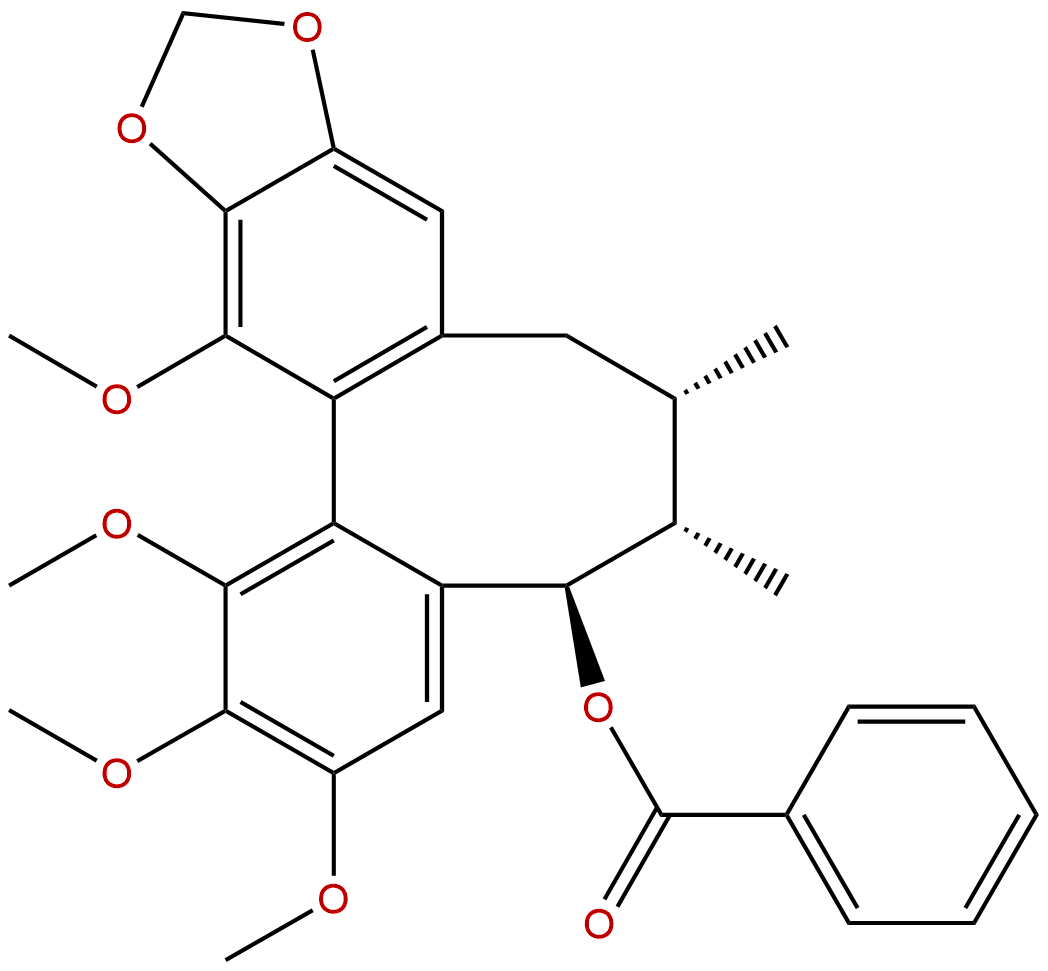
Benzoylgomisine O belongs to the class of lignans in the biphenyl cyclooctene group, which is a characteristic chemical composition category of Schisandra plants. Its molecular formula is C30H32O8 and its molecular weight is 520.5780. Structurally, it consists of a biphenyl cyclooctene core, which is connected by two benzene rings through an eight membered carbon ring. One of the benzene rings is connected to substituents such as methoxy and methylenedioxy, while the other benzene ring is connected to a benzoyloxy group through an ester bond, which is the origin of its name "benzoyl gomisine" and a key structural feature that distinguishes it from other gomisine compounds. This benzoyl modification has a significant impact on its biological activity and physicochemical properties.
In terms of physical and chemical properties, benzoyl gomisine O exhibits typical lignan like compound characteristics. The LogP value of its lipid water partition coefficient is 5.0250, indicating that the compound has high lipophilicity. The topological polarity surface area is relatively low, at 81.68 Å ². These parameters collectively determine its extremely low water solubility, approximately 0.0006 mg/mL, making it a poorly soluble compound. High lipophilicity also indicates that it may have good membrane permeability, and its blood-brain barrier permeability is predicted to be "high", suggesting that the compound has the potential to act on central nervous system related targets. In early safety screening, the compound did not show significant hERG potassium channel inhibitory activity (predicted as' no '), and the Ames test predicted a result of 0.0, indicating that it may not have mutagenicity, providing preliminary safety evidence for its further drug development.
Plant sources and extraction methods
Benzoylgomisin O is mainly derived from the Schisandra genus of the Schisandraceae family, Schisandra chinensis. Red flowered Schisandra chinensis is mainly distributed in southwestern China and other regions. Its dried and mature fruits or stems have a certain medicinal history in folk culture. Biphenylcyclooctene lignans are characteristic secondary metabolites of this genus of plants, but their content and species vary significantly among different species and parts. Benzoyl gomisine O, as one of the specific components, has a relatively low content in Schisandra chinensis, and its isolation and identification is a delicate task in natural product chemistry research.
At present, the extraction and separation of benzoyl gomisine O from plant materials mainly adopt the following process: firstly, dry and crushed plant materials (usually fruits or stems) are extracted with organic solvents, commonly including methanol, ethanol, or alcohol water mixed solvents in different ratios. Reflux extraction or ultrasound assisted extraction is used to improve efficiency. After obtaining the crude extract, the system solvent extraction method (such as sequentially extracting with petroleum ether, ethyl acetate, and n-butanol) is used for preliminary separation. Benzoyl gomisine O is usually enriched in the ethyl acetate extraction site due to its equal polarity. Subsequently, a variety of modern chromatographic techniques need to be used for fine purification, including silica gel column chromatography, reverse phase silica gel column chromatography, dextran gel column chromatography and high performance liquid chromatography. During the separation process, thin-layer chromatography or high-performance liquid chromatography is often used for online or offline monitoring, and positioning is performed by comparing standard samples or based on their characteristic UV absorption. The final monomer compound needs to be structurally confirmed through techniques such as nuclear magnetic resonance, mass spectrometry, infrared spectroscopy, and X-ray single crystal diffraction. With the development of synthetic biology and plant cell culture technology, it may be possible to selectively produce this rare compound through biosynthetic pathways in the future to solve the problem of limited plant sources.
Pharmacological activity research
The pharmacological activity research of benzoyl gomisine O mainly focuses on anti-inflammatory and antiviral aspects, reflecting its multi-target properties.
1. Anti inflammatory activity
Inflammation is the fundamental pathological process by which the body responds to injury or infection, but excessive or chronic inflammation is a common pathological basis for many diseases. The anti-inflammatory activity of benzoyl gomisine O is first reflected in its inhibitory effect on key inflammatory mediator synthase. Research has shown that the compound exhibits inhibitory activity against 15 lipoxygenase, cyclooxygenase-1, and cyclooxygenase-2. 15-LOX is involved in the generation of pro-inflammatory mediators such as leukotrienes, while COX-1 and COX-2 are rate limiting enzymes for prostaglandin synthesis, with COX-2 being particularly closely related to inflammatory response. By inhibiting these enzymes, benzoyl gomisine O can reduce the production of pro-inflammatory mediators at multiple nodes of the arachidonic acid metabolism pathway. In cell model experiments, this compound can significantly inhibit the production of inflammatory factors such as nitric oxide, tumor necrosis factor alpha, and interleukin-6 induced by stimuli such as lipopolysaccharides in macrophages. Animal model studies have also preliminarily confirmed that benzoyl gomisine O can alleviate paw swelling induced by carrageenan or Freund's complete adjuvant in rats, exhibiting anti-inflammatory effects in vivo.
2. Antiviral activity
The antiviral potential of benzoyl gomisine O is another highlight of its pharmacological research. Although the direct virus suppression experimental data still needs further enrichment, its molecular target prediction suggests a broad antiviral spectrum. For herpesvirus, its potential targets cover several key links in the virus replication cycle: UL42 is the auxiliary subunit of DNA polymerase, UL54 is the catalytic subunit of DNA polymerase, ICP27 is an important post transcriptional regulatory protein, TK is the key enzyme of nucleotide metabolism, and gD is the glycoprotein of virus invading cells. Interference with these targets may effectively inhibit the replication and transmission of herpes virus. What is even more remarkable is its potential for action against the human immunodeficiency virus. The predicted targets include the co receptors CCR5 and CXCR4 required for virus invasion into host cells, as well as HIV-1 protease and integrase necessary for virus replication. These targets are important sites of action for existing anti HIV drugs, suggesting that benzoyl gomisine O or its structurally optimized derivatives may become novel anti HIV lead compounds. In addition, its potential inhibitory effect on myeloperoxidase may also indirectly affect the viral infection process by regulating the host's immune inflammatory response.
Mechanism of action and molecular targets
The multiple pharmacological activities of benzoyl gomisine O stem from its interactions with multiple biomolecules, and its mechanism of action involves direct inhibition of enzyme activity and regulation of cellular signaling pathways.
1. Anti inflammatory mechanism
The core mechanism of its anti-inflammatory effect lies in its dual inhibition of the arachidonic acid metabolic pathway. On the one hand, by inhibiting the activity of 15-LOX, the production of pro-inflammatory mediator leukotrienes is reduced. On the other hand, by inhibiting COX-1 and COX-2, especially inducible COX-2, the synthesis of inflammatory prostaglandins such as prostaglandin E2 is reduced. This dual blockade of the LOX and COX pathways may result in a synergistic anti-inflammatory effect and theoretically have advantages over single pathway inhibitors. In addition, research suggests that it may exert its effect by inhibiting the activation of the nuclear factor kappa B signaling pathway. NF - κ B is a key transcription factor that regulates the expression of numerous inflammatory cytokine genes. Benzoyl golimicin O may downregulate the expression of genes such as TNF - α, IL-6, iNOS, etc. by preventing the degradation of I κ B or affecting the nuclear translocation of NF - κ B, thereby achieving more upstream inflammation regulation.
2. Mechanism of antiviral action
The antiviral mechanism varies depending on the target. For herpes virus, it may interfere with the assembly or function of viral DNA polymerase complexes by directly binding to viral proteins such as UL42 or UL54, thereby inhibiting viral genome replication. Inhibition of TK may affect the replication ability of the virus in resting cells. Interference with gD may block the binding of viruses to host cell receptors. For HIV, its mechanism is more complex: it acts on CCR5 or CXCR4, which may block the binding of viral envelope proteins to co receptors, similar to entry inhibitors such as Malavero, preventing the virus from fusing with the cell membrane; Acting on HIV-1 protease, it may inhibit the cleavage and maturation of viral precursor proteins, leading to the production of non infectious viral particles; When acting on viral integrase, it may prevent viral cDNA from integrating into the host genome, which is a key step in establishing long-term viral infection. These mechanisms of action together constitute its potential broad-spectrum antiviral blueprint.
Evaluation of drug properties and pharmacokinetics
Based on its physicochemical properties and preliminary in vitro data, a preliminary evaluation of the pharmacological properties of benzoyl gomisine O can be conducted.
Advantages:
1. Clear activity Exhibiting inhibitory activity against multiple inflammatory and viral targets, it has the potential for multi-target therapy.
2. Preliminary safety warning is good The absence of hERG inhibition and Ames mutagenicity warning reduces the risk of cardiac toxicity and genetic toxicity in early development.
3. Possible better permeability High LogP values and predicted high blood-brain barrier permeability are beneficial for their distribution to tissues, especially the central nervous system, which may be advantageous for the treatment of certain viral encephalitis or neuroinflammatory diseases.
Challenge aspect:
1. Very poor water solubility This is the biggest obstacle to its development as an oral formulation. Extremely low water solubility may lead to low oral bioavailability and irregular absorption.
2. Metabolic stability unknown Lignin compounds often undergo extensive phase I and phase II metabolism in the body, and their metabolic rate, main metabolites, and activity need to be further studied.
3. Potential drug interactions As inhibitors of multiple enzymes, it is important to be cautious of potential interactions when used in combination with other drugs, especially through the CYP450 enzyme system.
4. The selectivity needs further verification The inhibition intensity ratio (COX-2/COX-1 selectivity index) of COX-1 and COX-2 is not yet clear, which is related to the risk of gastrointestinal side effects.
There is currently a lack of systematic in vivo research data on pharmacokinetics. Based on its properties, it is speculated that after oral administration, its absorption may be limited due to low solubility and high lipophilicity, but if it can be absorbed, it may have a larger distribution volume due to high lipophilicity. Its metabolic pathway may involve oxidation, hydrolysis, and subsequent glucuronidation or sulfation binding reactions of the liver CYP450 enzyme system. The main pathways of excretion may be through bile and feces. Future research needs to clarify key pharmacokinetic parameters such as absolute bioavailability, half-life, tissue distribution, and major excretion pathways through animal experiments.
Clinical application prospects and prospects
Benzoylgomisine O, as a natural compound with multiple biological activities, has broad clinical application prospects, but also faces many challenges.
Potential application directions:
1. Inflammatory diseases Based on its dual inhibition of LOX/COX anti-inflammatory mechanism, it is expected to be developed for the treatment of chronic inflammatory diseases such as rheumatoid arthritis, osteoarthritis, and inflammatory bowel disease. Especially its inhibition of COX-2 may provide therapeutic effects similar to nonsteroidal anti-inflammatory drugs, but it needs to be clarified whether its gastrointestinal safety is better.
2. Viral infectious diseases Its broad-spectrum antiviral target prediction makes it highly attractive in the field of antiviral therapy. It may be possible to explore combination therapy for herpes simplex virus, cytomegalovirus infections, especially HIV/AIDS. If its activity in inhibiting HIV entry or integration can be confirmed, it may provide a new option to overcome the problem of drug resistance in existing drugs.
3. Neuroinflammatory related diseases Its predicted high blood-brain barrier permeability, combined with its anti-inflammatory activity, provides the possibility for treating diseases closely related to neuroinflammation such as Alzheimer's disease, Parkinson's disease, and multiple sclerosis.
4. combination therapy As a multi-target drug, it can be used in combination with other drugs with stronger specificity to achieve synergistic effects, reduce dosage, and minimize toxic side effects.
Future research prospects and challenges:
1. Structural optimization and derivative design To address the issue of poor water solubility, structural modifications can be made through medicinal chemical methods, such as introducing hydrophilic groups, preparing prodrugs, or developing nano formulations, to improve its pharmaceutical properties.
2. In depth study on the mechanism of action At present, many targets are still in the prediction or preliminary verification stage, and surface plasmon resonance, co crystallization, gene knockout/knock in and other technologies need to be used to confirm their direct interaction with target proteins and precise binding sites.
3. Preclinical evaluation of the system It is urgent to conduct comprehensive in vivo pharmacological, pharmacokinetic, and toxicological studies, establish reliable animal models of diseases, and evaluate their therapeutic window and long-term safety.
4. Clear treatment positioning It is necessary to choose the most advantageous and feasible direction among numerous potential indications for key breakthroughs, such as focusing on anti-inflammatory or antiviral, or targeting a specific type of virus.
Conclusion
Benzoylgomisin O is a lignin compound with significant biological activity isolated from the traditional medicinal plant Schisandra chinensis. Its unique chemical structure endows it with the ability to inhibit 15-LOX, COX-1, COX-2, and potentially interfere with various viral key proteins, demonstrating dual pharmacological potential of anti-inflammatory and broad-spectrum antiviral effects. Although it has obvious shortcomings in drug development, especially in terms of water solubility, its clear multi-target mechanism of action and preliminary good safety prediction make it a highly valuable lead compound for development. Future research should focus on optimizing the physicochemical properties of drugs through rational drug design, utilizing modern biological techniques to elucidate their molecular mechanisms of action, and conducting systematic preclinical development studies. With the continuous deepening of research, benzoyl gomisine O is expected to provide new candidate drugs or important structural templates for the treatment of inflammatory and viral diseases, further demonstrating the immortal value of natural products in innovative drug development.