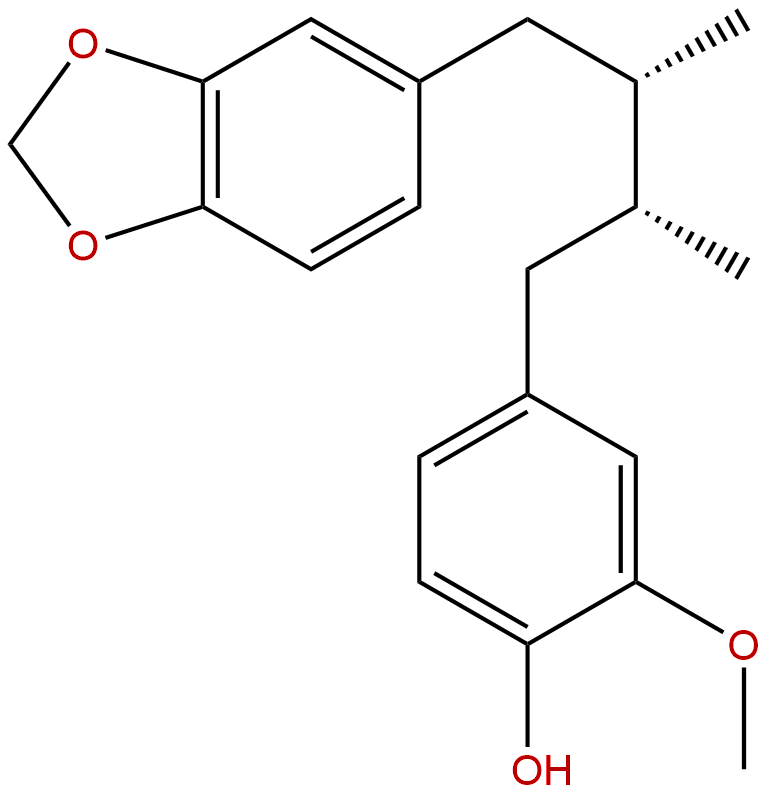


Synonym name: Macelignan; Calophyn
Catalogue No.: BP0176
Cas No.: 107534-93-0
Formula: C20H24O4
Mol Weight: 328.408
Botanical Source: Myristica fragrans (nutmeg), bark of Kadsura longipedunculata and Schizandra sphenanthera
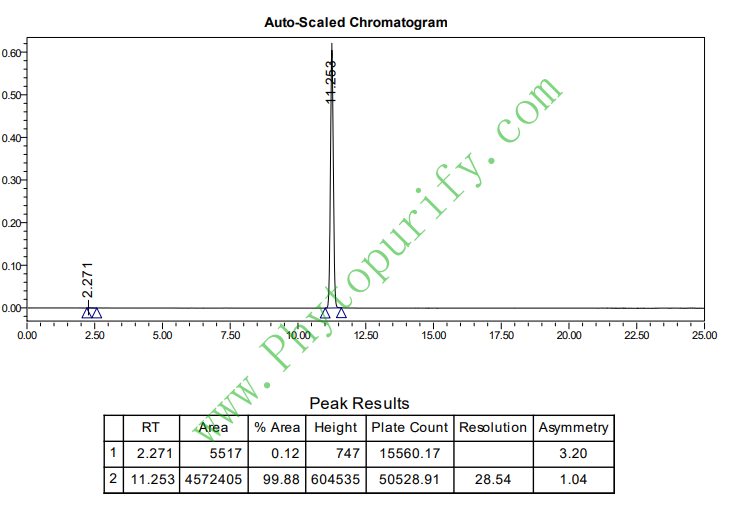
Purity: 95%~99%
Analysis Method: HPLC-DAD or/and HPLC-ELSD
Identification Method: Mass, NMR
Packing: Brown vial or HDPE plastic bottle
Can be supplied from milligrams to grams.
For Reference Standard and R&D, Not for Human Use Directly.
Inquire for bulk scale.
HPLC of Anwuligan
Storage conditions:Short-term storage at 2~8℃, long-term storage at -20 ~ -80℃
Anwuligan, CAS number 107534-93-0, is a typical natural lignan product, mainly isolated from traditional Chinese medicinal herbs such as Schisandra chinensis. As a natural compound with multiple biological activities, Amphotericin has shown significant pharmacological effects in antioxidant, anti-inflammatory, and metabolic regulation, and has attracted widespread attention in the fields of pharmacology and natural medicinal chemistry in recent years. Especially in the adjuvant treatment of liver dysfunction and chemical liver injury, Amphotericin has shown good protective effects. In addition, the latest research suggests that Amphotericin may participate in the pathological mechanisms of neurological diseases such as migraine disorders by regulating multiple molecular targets, providing new ideas and potential value for its clinical application. This article aims to systematically review the chemical structure, plant origin, pharmacological activity, mechanism of action, pharmacological evaluation, and future clinical application prospects of Amphotericin, with the hope of providing comprehensive and in-depth reference materials for researchers in related fields.
Anwuzhisu belongs to the lignan class of compounds, with a molecular formula of C20H24O4 and a molecular weight of 328.40. Its structural features are mainly typical diphenylpropane skeleton, with multiple hydroxyl substituents and methoxy groups, endowing it with good antioxidant activity. In terms of physical and chemical properties, the LogP value of Amphotericin is about 4.21, indicating its good lipid solubility, which is beneficial for cell membrane penetration and bioavailability. The topological polar surface area (TPSA) is 55.12 Å ² and the number of hydrogen bond acceptors is 4, indicating its moderate polarity and hydrogen bond binding ability in drug design.
The blood-brain barrier (BBB) permeability assessment shows that the BBB penetration ability of Amphotericin is relatively low, which may limit its direct action in central nervous system diseases, but also reduce the potential risk of central nervous system toxicity. In terms of toxicological evaluation, Amphotericin did not exhibit hepatotoxicity, cardiotoxicity, or hERG channel inhibition, demonstrating a good safety profile. The data of Ames mutagenicity test is not yet clear, and further experiments are needed to verify its genetic toxicity risk.
Amphotericin is mainly isolated from Schisandra chinensis. Schisandra chinensis is a plant of the Schisandraceae family, widely distributed in Northeast China, North China, and the Korean Peninsula. It has always been used as a traditional Chinese medicine to regulate liver function, enhance immunity, and resist fatigue. In addition to Schisandra chinensis, some plants containing lignans can also detect Amphotericin, but the content is relatively low.
The extraction process usually uses organic solvent extraction combined with column chromatography for separation and purification. The specific process includes:
1. Reflux extraction of dried Schisandra chinensis fruits using ethanol or methanol as extraction agents;
2. Concentrate the extract by reducing pressure;
3. Separate and purify using silica gel column chromatography and reverse phase high performance liquid chromatography (RP-HPLC);
4. Finally, the structure and purity were confirmed through techniques such as nuclear magnetic resonance (NMR) and mass spectrometry (MS).
In recent years, the application of ultrasound assisted extraction and microwave-assisted extraction technologies has improved the extraction efficiency and purity of Amphotericin, and is more in line with the principles of green chemistry.
Amphotericin exhibits significant antioxidant activity, effectively scavenging free radicals and inhibiting lipid peroxidation. In vitro DPPH free radical scavenging experiments and cell models, Amphotericin significantly reduced oxidative stress indicators and enhanced intracellular antioxidant enzyme activity (such as superoxide dismutase (SOD) and glutathione peroxidase (GSH Px)). Its antioxidant mechanism is closely related to the electron donor ability of the polyhydroxy and methoxy groups in its structure.
Multiple in vitro and in vivo experiments have shown that Amphotericin can inhibit the production and release of inflammatory mediators. It reduces the expression of pro-inflammatory cytokines (such as TNF - α, IL-1 β, IL-6) and alleviates inflammatory responses by downregulating the NF - κ B signaling pathway. In mouse models, Amphotericin significantly alleviates inflammatory liver injury and tissue edema, demonstrating good anti-inflammatory effects.
Anwuzhisu has a regulatory effect on liver lipid metabolism and can improve liver steatosis and lipid accumulation. By activating the AMPK signaling pathway, it promotes fatty acid oxidation, inhibits lipid synthesis, and reduces fat deposition in liver cells. In addition, anwuzhisu also affects glucose metabolism, showing a potential anti diabetes effect.
Amphotericin has shown significant protective effects in various liver injury models. In chemical liver injury (such as carbon tetrachloride and alcohol induced models), Amphotericin can reduce serum transaminase (ALT, AST) levels, alleviate liver cell necrosis and inflammatory infiltration, and promote liver tissue repair. Its liver protective effect is mainly attributed to multiple mechanisms such as antioxidant, anti-inflammatory, and regulation of cell apoptosis.
Although the blood-brain barrier permeability of Amphotericin is low, it may have the potential to assist in the treatment of migraine disorders by regulating the peripheral nervous system and inflammatory response. Related studies have shown that Amphotericin acts on multiple targets such as ALOX15, BCHE, ACHE, EDNRA, DRD1, ADRA1A, TAAR1, EP300, and P2RX7, regulating inflammation, neurotransmitter metabolism, and vascular tone, thereby alleviating migraine symptoms.
The multi-target mechanism of action of Amphotericin is the basis of its pharmacological activity. The following are the main targets and their related mechanisms:
Overall, Amphotericin exerts a wide range of pharmacological effects through multi-target and multi pathway synergistic effects, regulating inflammatory responses, neurotransmitter metabolism, and vascular function.
The pharmacological evaluation of Anwuzhisu shows that it has good potential for drug development. The molecular weight of 328.4 conforms to Lipinski's rule, with a moderate LogP of 4.21, indicating good membrane permeability and in vivo distribution characteristics. The TPSA is 55.12 Å ², indicating that its polarity is moderate and beneficial for oral absorption.
Toxicological data shows that Amphotericin has no significant hepatotoxicity, cardiotoxicity, or hERG channel inhibition, and has good safety. However, the low permeability of the blood-brain barrier limits its direct role in central nervous system diseases, but also reduces the risk of adverse reactions in the central nervous system.
In terms of pharmacokinetics, existing research is relatively limited. In vivo animal experiments have shown that Amphotericin is absorbed quickly after oral administration, with a moderate plasma half-life. It is mainly metabolized through the liver and excreted through bile and urine. Further systematic pharmacokinetic and metabolic studies are needed in the future to clarify its in vivo behavior and the activity of metabolites.
Based on the multiple pharmacological activities of Amphotericin, especially its significant effects in liver protection, anti-inflammatory, and metabolic regulation, it has broad application prospects in the adjuvant treatment of liver dysfunction, chemical liver injury, metabolic syndrome, and other diseases. In recent years, with a deeper understanding of the pathogenesis of migraine, Amphotericin has provided new ideas for the treatment of neurological diseases such as migraine by regulating multiple targets to participate in neuroinflammation and vascular function regulation.
Future research priorities should include:
1. Systematically evaluate the efficacy and safety of Amphotericin in neurological diseases, especially its clinical efficacy verification for migraine;
2. Optimize extraction and synthesis processes to increase the yield and purity of Amphotericin and reduce production costs;
3. Deeply analyze its molecular mechanism of action, explore more potential targets and signaling pathways;
4. Conduct pharmacokinetic, toxicological, and preclinical safety evaluations to lay the foundation for clinical trials;
5. Explore the development of preparations for Amphotericin, such as nanocarriers and sustained-release formulations, to improve its bioavailability and targeting.
In summary, as a natural lignan compound with multi-target effects, Amphotericin has good pharmacological activity and safety, and is expected to become an important drug candidate in the treatment of liver and nervous system diseases in the future.
As an important active ingredient in plants such as Schisandra chinensis, Amphotericin has shown broad research and application value in the field of natural product pharmacology due to its unique chemical structure and diverse biological activities. Its antioxidant, anti-inflammatory, and metabolic regulatory effects provide theoretical and practical basis for liver protection and treatment of neurological diseases. Although the research on its pharmacokinetics and clinical application is still in its preliminary stage, with the continuous revelation of molecular target mechanisms and the improvement of drug efficacy evaluation, Amphotericin is expected to become an important direction for the development of natural medicines in the future. We look forward to more high-quality basic and clinical research to promote the transition of Amphotericin from laboratory to clinical use, bringing new treatment options for patients with related diseases.
