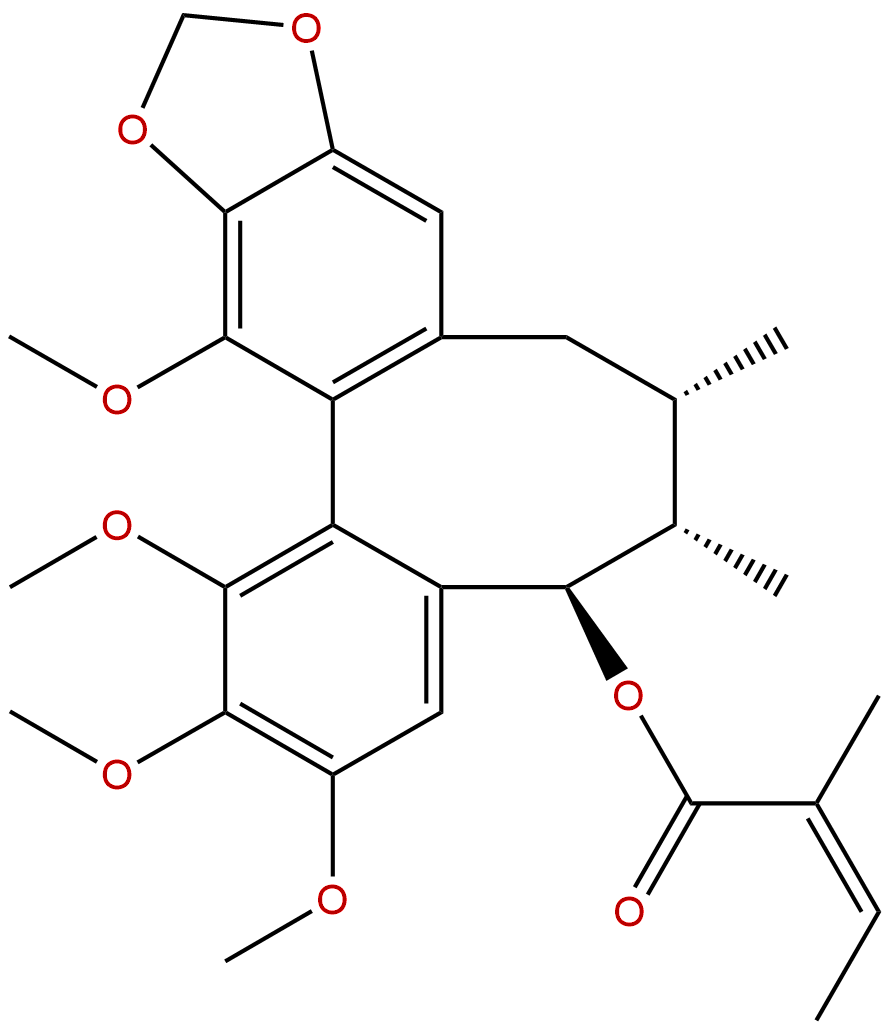
Danggui acyl gomisine O: a natural anti-inflammatory lignan derived from Schisandra chinensis
1. Overview
Angeloylgomisin O is a natural lignan compound with the chemical name Angeloylgomisin O and English name Angeloylgomisin O. Its CAS number is 83864-69-1 and product number is BP3069. The molecular formula of this compound is C28H34O8, with a molecular weight of 498.5720 g/mol. It is mainly extracted and isolated from Schisandra chinensis. Schisandra chinensis, as a traditional Chinese medicinal herb, has been used for thousands of years in East Asia and is commonly used to treat cough, asthma, insomnia, and liver diseases. In recent years, with the deepening of research on the chemistry and pharmacology of natural products, the active ingredients in Schisandra chinensis have gradually become a research hotspot, among which Angelica sinensis glycosides O has attracted much attention due to its significant anti-inflammatory activity.
Danggui acyl gomisine O belongs to the lignan class of compounds, which typically possess complex polycyclic structures and diverse biological activities. Lignin is widely present in plants, especially in the Schisandra genus, with abundant content. It has various pharmacological effects such as antioxidant, anti-inflammatory, anti-tumor, and hepatoprotective effects. The structure of Angeloyl Gomisin O contains both Angeloyl and Gomisin skeletons, and this unique structure may be closely related to its biological activity. Current research indicates that Danggui acyl gomisine O exerts anti-inflammatory effects by regulating multiple inflammation related targets, such as TNF, PTGS2, NFKB1, IL6, and IL1B. Therefore, it has potential application value in the treatment of inflammatory diseases such as arthritis.
This article will provide a comprehensive introduction to Danggui acyl gomisin O from the aspects of chemical structure, plant origin, pharmacological activity, mechanism of action, drug evaluation, and research status, aiming to provide a professional and rigorous reference material for researchers and pharmaceutical researchers.
2. Chemical structure and physicochemical properties
The molecular formula of Danggui acyl gomisine O is C28H34O8, with a molecular weight of 498.5720 g/mol. Its SMILES representation is: C/C=C (/C) C (=O) O [C @ H] 1c2cc (OC) c (OC) c (OC) c2-c2c (cc3c (c2OC) OCO3) C C@H[C@@H]1C。 From SMILES, it can be seen that the compound has multiple chiral centers (represented by the @ symbol), indicating its complex stereochemical structure, which may have important implications for its biological activity and pharmacological effects.
In terms of physical and chemical properties, the lipophilic water partition coefficient (LogP) and LogD of Angelica sinensis glycosaminoglycan O are 4.5162 and 4.5162, respectively, indicating that the compound has high lipophilicity and is easy to penetrate cell membranes, but low water solubility (water_stolubility is 0.0061). The topologically polar surface area (TPSA) is 81.6800 Å ², which is moderate and suggests that the compound may have some membrane permeability. The permeability of Caco-2 cells is 15.3226, indicating good performance in intestinal absorption. The blood-brain barrier (BBB) has high penetrability, which means that Angelica sinensis glycosaminoglycan O may enter the central nervous system, providing a possibility for the treatment of neuroinflammatory related diseases.
In addition, the plasma protein binding rate (PPB) was 91.6909%, indicating that the compound mostly binds to plasma proteins in the blood, which may affect its free concentration and efficacy. In terms of toxicity, the Ames test result was 0.0, with negative results for chromosomal aberration, hERG inhibition, skin sensitization, respiratory sensitization, and phototoxicity, indicating a low risk of genetic and cardiac toxicity for this compound. However, the detection results of serum alkaline phosphatase (Ser_LK), gamma glutamyltransferase (Ser_GGT), aspartate aminotransferase (Ser_ST), and alanine aminotransferase (Ser_LT) were positive, indicating that they may have some impact on liver function and further evaluation of their hepatotoxicity is needed in subsequent studies.
Overall, Angelica sinensis glycosaminoglycan O has high lipophilicity and good membrane permeability, but its water solubility is low and its plasma protein binding rate is high. These characteristics need to be comprehensively considered in drug development.
3. Plant sources and traditional applications
Danggui acyl gomisine O is mainly derived from Schisandra chinensis, a perennial woody vine belonging to the Schisandraceae family. Schisandra chinensis is mainly distributed in regions such as China, Russia, South Korea, and Japan. Its fruit is called "Schisandra chinensis" and is named after its five flavors: sour, sweet, bitter, spicy, and salty. In traditional Chinese medicine, Schisandra chinensis is widely used to treat various diseases such as cough, asthma, night sweats, insomnia, diarrhea, and liver diseases. According to traditional Chinese medicine theory, Schisandra chinensis has the effects of astringency, tonifying qi and generating fluids, nourishing the kidneys and calming the heart. It is commonly used for symptoms such as chronic cough due to lung deficiency, nocturnal emission, spontaneous sweating, and thirst caused by fluid damage.
Modern pharmacological studies have shown that Schisandra chinensis contains various active ingredients, including lignans, volatile oils, organic acids, and polysaccharides. Among them, lignans are the main active ingredient of Schisandra chinensis, with various pharmacological effects such as antioxidant, anti-inflammatory, anti-tumor, hepatoprotective, and neuroprotective properties. As a lignan in Schisandra chinensis, Danggui acyl gomisine O has particularly outstanding anti-inflammatory activity. Traditionally, Schisandra chinensis has been commonly used to treat inflammatory diseases such as arthritis, which is consistent with the anti-inflammatory effects of Angelica sinensis glycosaminoglycan O.
In addition to Schisandra chinensis, Danggui acyl gomisin O may also be present in other Schisandra plants, such as Schisandra rubriflora. However, current research mainly focuses on Schisandra chinensis, so Schisandra chinensis is still the main plant source of Angelica sinensis glycoside O. With the advancement of extraction and separation technology, the yield and purity of Danggui acyl gomisine O have been continuously improved, laying the foundation for its further research and application.
4. Pharmacological activity and mechanism of action
Danggui acyl gomisine O has significant anti-inflammatory activity, and its mechanism of action involves multiple inflammation related targets. According to existing data, the main targets of Angelica sinensis glycosaminoglycan O include TNF (tumor necrosis factor), PTGS2 (prostaglandin endoperoxide synthase 2, also known as COX-2), NFKB1 (nuclear factor kappa B1), IL6 (interleukin 6), and IL1B (interleukin 1 β). These targets play a crucial role in the inflammatory response, therefore Angelica sinensis glycosaminoglycan O can effectively inhibit the inflammatory process by regulating these targets.
Firstly, TNF is an important pro-inflammatory cytokine that plays a central role in the inflammatory response. TNF can activate the NF - κ B signaling pathway, thereby inducing the expression of other inflammatory factors such as IL6 and IL1B. Danggui acyl gomisine O may block the initiation of inflammatory response by inhibiting the production or signaling of TNF. Secondly, PTGS2 is a key enzyme in prostaglandin synthesis, which is upregulated during inflammation, leading to the production of inflammatory mediators such as prostaglandin E2 (PGE2). Inhibiting PTGS2 activity can reduce the synthesis of prostaglandins, thereby alleviating inflammation and pain. Danggui acyl gomisine O may exert anti-inflammatory and analgesic effects by inhibiting the expression or activity of PTGS2.
NFKB1 is an important component of the NF - κ B signaling pathway, which plays a critical role in regulating inflammation, immunity, and cell survival. In an inflammatory state, NF - κ B is activated and translocated into the nucleus, promoting the transcription of inflammatory cytokine genes. Danggui acyl gomisine O may reduce the expression of downstream inflammatory factors such as IL6 and IL1B by inhibiting the activation of NF - κ B. IL6 and IL1B are two important pro-inflammatory cytokines involved in the pathogenesis of various inflammatory diseases. Inhibiting the production of IL6 and IL1B can alleviate inflammation and tissue damage.
In terms of related diseases, the anti-inflammatory activity of Angelica sinensis glycosaminoglycan O makes it potentially valuable in the treatment of inflammatory diseases such as arthritis. Arthritis is a common chronic inflammatory disease characterized by joint pain, swelling, and functional impairment. Inflammatory factors such as TNF, IL6, and IL1B play important roles in the pathogenesis of arthritis. At present, biologics such as TNF inhibitors have been widely used in the treatment of arthritis, but there are problems such as high cost and side effects. Therefore, the development of new anti-inflammatory drugs has important clinical significance. Danggui acyl gomisine O, as a natural compound, inhibits inflammatory response through a multi-target mechanism, which may provide a new option for the treatment of arthritis.
In addition, the anti-inflammatory effect of Danggui acyl gomisine O may also have therapeutic potential for other inflammation related diseases such as inflammatory bowel disease, asthma, and neuroinflammation. However, current research mainly focuses on in vitro and animal models, and further clinical studies are needed to verify its safety and effectiveness.
5. Evaluation of drug properties
Drug efficacy assessment is a critical step in the drug development process, involving the absorption, distribution, metabolism, excretion, and toxicity (ADMET) characteristics of compounds. Based on the provided pharmacological parameters, we can conduct a preliminary evaluation of the potential of Danggui acyl Gomixin O as a drug.
Firstly, according to the Lipinski Rule of Five, a compound with good oral bioavailability typically needs to meet the following conditions: molecular weight (MW) less than 500, lipid water partition coefficient (LogP) less than 5, hydrogen bond donor number (HBD) less than 5, and hydrogen bond acceptor number (HBA) less than 10. The molecular weight of Danggui acyl gomisine O is 498.5720, which is close to but not exceeding 500; LogP is 4.5162, less than 5; The number of hydrogen bond donors (inferred from the molecular formula) may be low, while the number of hydrogen bond acceptors (oxygen atoms) is 8, less than 10. Therefore, Danggui acyl gomisine O basically conforms to Lipinski's five rules, indicating that it may have good oral absorption potential.
However, the water solubility is 0.0061, indicating that the compound has a low solubility in water, which may affect its oral absorption and formulation development. The permeability of Caco-2 cells is 15.3226, which is a relatively high level, indicating good absorption in the intestine. The blood-brain barrier (BBB) penetration is high, indicating that the compound can enter the central nervous system, which is beneficial for treating neuroinflammatory related diseases, but may also increase the risk of central side effects.
The plasma protein binding rate (PPB) is 91.6909%, indicating that most compounds bind to plasma proteins in the blood, which may reduce their free concentration and affect drug efficacy. In terms of toxicity, Ames test, chromosomal aberration, hERG inhibition, skin sensitization, respiratory sensitization, and phototoxicity were all negative, indicating that the compound has a low risk of genetic toxicity and cardiac toxicity. However, the detection results of serum alkaline phosphatase, gamma glutamyltransferase, aspartate aminotransferase, and alanine aminotransferase were positive, indicating that they may have some impact on liver function and further evaluation of their hepatotoxicity is needed in subsequent studies.
In addition, the effective permeability (Peff) is 4.2996, and the synthetic accessibility (SyneAccessibility) is 4.0654, which further supports the potential of the compound as a drug. The maximum recommended therapeutic dose (MRTD) is not determined, indicating that its clinical dose has not yet been determined.
Overall, Danggui acyl gomisine O exhibits certain advantages in drug formulation, such as good membrane permeability and compliance with Lipinski's five rules, but also faces challenges such as low water solubility and potential liver toxicity. In subsequent drug development, it may be necessary to improve its water solubility and safety through structural modification or formulation optimization.
6. Research Status and Application Prospects
At present, research on Danggui acyl gomisine O is still in its early stages, mainly focusing on chemical extraction, structural identification, and preliminary pharmacological activity screening. Previous studies have shown that Danggui acyl GOMIXIN O has significant anti-inflammatory activity and inhibits inflammatory responses through a multi-target mechanism of action. However, most studies are in vitro experiments or animal models, lacking systematic clinical research data.
In terms of extraction and separation, Schisandra chinensis, as the main source of Angelica sinensis glycoside O, has a relatively mature extraction process. Common extraction methods include solvent extraction, ultrasound assisted extraction, and supercritical fluid extraction. Through chromatographic techniques such as silica gel column chromatography and high performance liquid chromatography (HPLC), Angelica sinensis acyl gomisine O can be further purified to obtain high-purity samples. However, natural extraction has lower yields and higher costs, so chemical synthesis or biosynthesis may be future research directions.
In terms of pharmacological research, the anti-inflammatory activity of Danggui acyl GOMIXIN O has been preliminarily validated, but its specific mechanism of action and signaling pathway still need to be further explored. For example, further research is needed to investigate how Danggui acyl gomisine O regulates targets such as TNF, PTGS2, NFKB1, IL6, and IL1B, and whether it involves other signaling pathways such as MAPK or JAK-STAT. In addition, the activity of Danggui acyl GOMIXIN O in other disease models, such as anti-tumor, antioxidant, or neuroprotective effects, also needs to be explored.
In terms of application prospects, Danggui acyl GOMIXIN O, as a natural anti-inflammatory compound, has potential value in the treatment of inflammatory diseases such as arthritis. With the increasing demand for natural and plant-based medicines, Angelica sinensis glycosaminoglycan O may become a candidate molecule for novel anti-inflammatory drugs. However, challenges in drug formulation, such as low water solubility and potential liver toxicity, need to be addressed through pharmaceutical chemical optimization or formulation techniques. For example, introducing hydrophilic groups through structural modification or developing delivery systems such as nanomaterials and liposomes may improve their water solubility and bioavailability.
In addition, the multi-target mechanism of action of Angelica sinensis glycosaminoglycan O may provide advantages for its application in complex diseases such as autoimmune diseases or chronic inflammation. However, multi-target drugs may also bring off target effects and side effects, so it is necessary to balance their efficacy and safety in subsequent research.
In summary, as a potential natural anti-inflammatory compound, Danggui acyl gomisine O deserves further research and development. Future research directions should include in-depth exploration of the mechanism of action, optimization of drug properties, preclinical safety evaluation, and clinical trials. Through interdisciplinary collaboration, it is expected to push Danggui acyl GOMIXIN O from laboratory research to clinical application, providing new options for the treatment of inflammatory diseases.
Disclaimers This article is based on existing scientific data and is for reference only. It does not constitute any medical or investment advice. Compound research is still in its early stages and requires rigorous clinical trials and safety assessments before clinical application.