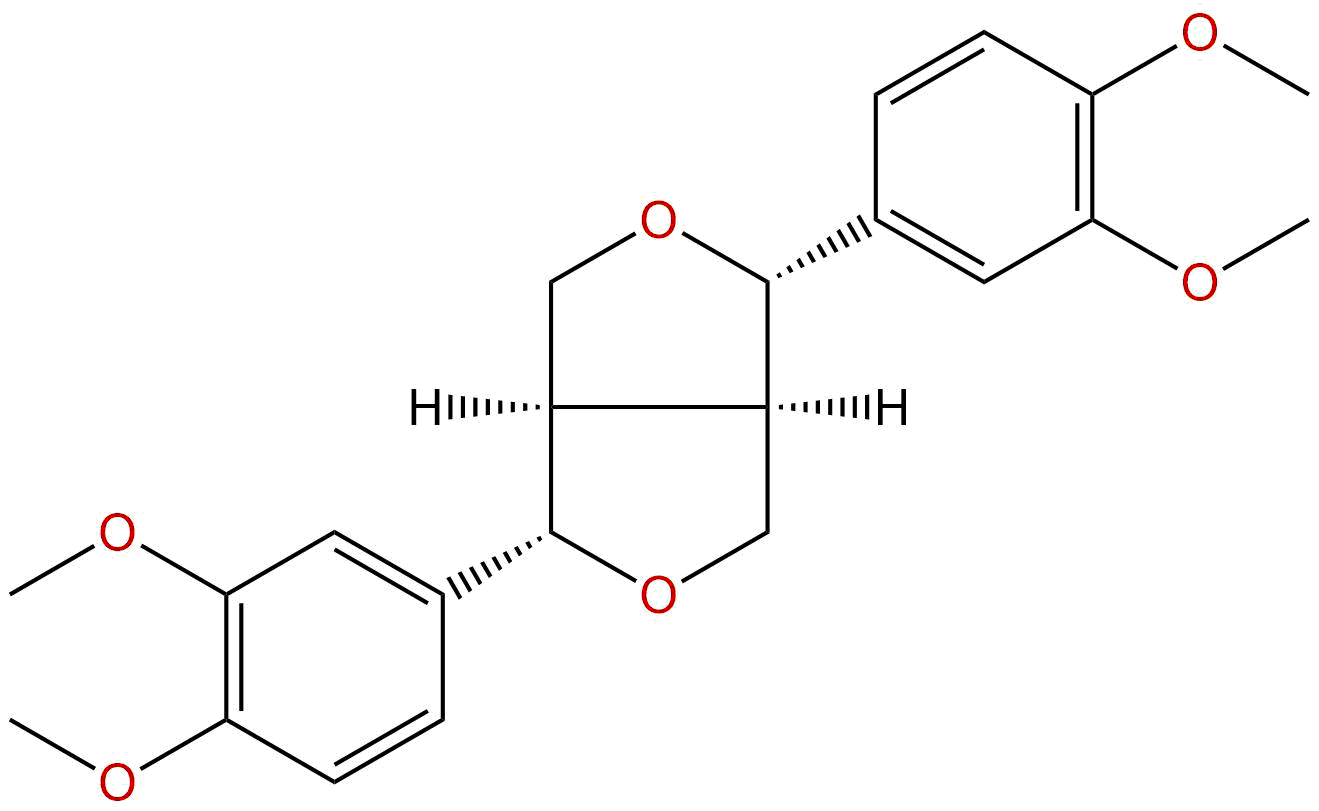


Product name: Pinoresinol dimethyl ether
Synonym name: (+)-Eudesmin; 25305-05-9
Catalogue No.: BP3318
Cas No.: 29106-36-3
Formula: C22H26O6
Mol Weight: 386.444
Botanical Source:
Physical Description:
Type of Compound: Lignans
Purity: 95%~99%
Analysis Method: HPLC-DAD or/and HPLC-ELSD
Identification Method: Mass, NMR
Packing: Brown vial or HDPE plastic bottle
The product could be supplied from milligrams to grams. Inquire for bulk scale.
We provide solution to improve the water-solubility of compounds, thereby facilitating the variety of activity tests and clinic uses.
For Reference Standard and R&D, Not for Human Use Directly.
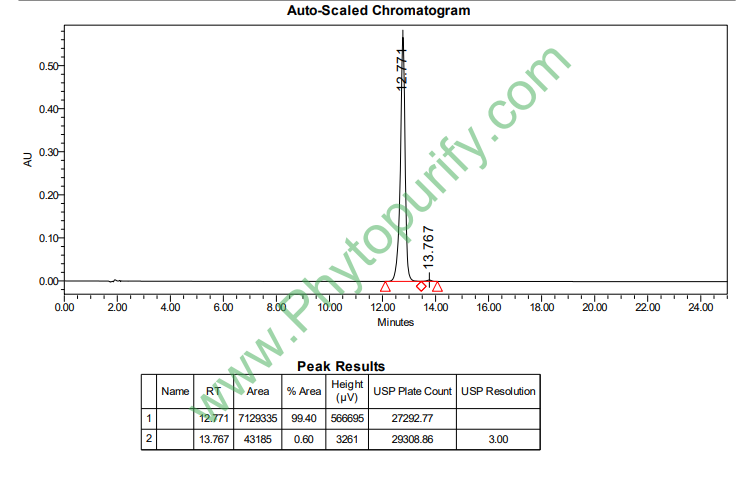
HPLC of Pinoresinol dimethyl ether
Storage conditions:Short-term storage at 2~8℃, long-term storage at -20 ~ -80℃
55.3800
3.2682
3.2682
.0117
6.1505
10.9895
High
90.9711
3.4876
No
No
Yes
No
No
No
0.0
No
No
No
No
Pinorsinol dimethyl ether, also known as (+) - Eudesmin, is a non phenolic natural product of furan lignin with unique biological activity. Its CAS number is 29106-36-3, molecular formula is C22H26O6, and molecular weight is approximately 386.44 g/mol. This compound is mainly isolated from Magnoliaceae plants, especially the traditional Chinese medicine Xinyi(Magnolia biondii)One of the important active ingredients. Modern pharmacological studies have shown that turpentine dimethyl ether exhibits various biological activities, including activating upstream signaling pathways such as MAPK, PKC, and PKA, inhibiting nitric oxide (NO) levels, and demonstrating significant neuroprotective effects. More notably, recent studies have revealed its interactions with multiple key tumor related targets, such as TP53, CASP3, MYC, etc., suggesting its potential application value in the field of anti-tumor therapy. As a natural small molecule discovered from traditional medicinal plants, turpentine dimethyl ether not only provides an example for understanding the biological functions of lignin compounds, but also provides a lead compound structure for developing new anti-tumor or neuroprotective drugs. This article will provide a systematic professional popularization of this natural product from the aspects of its chemical structure, plant origin, pharmacological mechanism, medicinal evaluation, and research prospects.
The chemical structure of turpentine dimethyl ether belongs to tetrahydrofuran type lignin dimer. Its SMILES string (COc1ccc ([C @ H] 2OC [C @ H] 3 [C @ @ H] 2CO [C @ @ H] 3c2ccc (OC) c (OC) c2) cc1OC) clearly displays its core skeleton: two phenylpropanoid units are connected by β - β 'and form a tetrahydrofuran ring structure, and the phenolic hydroxyl groups on the benzene ring are all replaced by methoxy groups (- OCH3), which is the origin of its "dimethyl ether" name and also determines its "non phenolic" characteristics. Multiple chiral centers in a molecule (such as [C @ H], [C @ @ H]) indicate that it has a specific stereoconfiguration, which is often closely related to its biological activity.
According to the analysis of drug parameters, its molecular weight (MW) is 386.4440, slightly higher than the recommended upper limit of 500 Da in Lipinski's Five Rules, but still within the common molecular weight range for orally administered drugs. The calculated logarithm of the lipid water partition coefficient (LogP/LogD) is 3.2682, indicating that the compound has moderate lipophilicity, which is beneficial for its penetration into cell membranes. The topological polar surface area (TPSA) is 55.38 Å ², far below the threshold commonly believed to affect membrane permeability (140 Å ²), which is consistent with its high Caco-2 cell permeability (10.9895) and predicted high blood-brain barrier (BBB) permeability, providing a physicochemical basis for its potential central nervous system activity. The water solubility parameter (0.0117) suggests poor water solubility, which may be a limitation of its natural form and preliminary physicochemical properties, but can be improved through formulation methods in drug development. The plasma protein binding rate (PPB) is as high as 90.97%, indicating that most of it binds to plasma proteins in the body, which may affect its free drug concentration and pharmacokinetic characteristics, and needs to be considered in drug design.
The main plant source of turpentine dimethyl ether is Magnoliaceae plants magnolia, specifically referring to the Jade Orchid of Wangchun(Magnolia biondii Dried flower buds of Pamp. Xinyi, as a traditional Chinese medicine, has a long history of application. It was first recorded in the "Shennong Bencao Jing" and is listed as a top-grade medicine. It is warm in nature, pungent in taste, and belongs to the lung and stomach meridians. It has the effects of dispersing wind cold and promoting nasal opening. In clinical Chinese medicine, it is mainly used to treat nasal related diseases such as wind cold headache, nasal congestion and runny nose, nasal congestion, and nasal sinusitis. Modern research in traditional Chinese medicine has shown that the chemical composition of Xinyi is complex, mainly including volatile oils, lignans, alkaloids, etc. Among them, lignans are considered as one of its important pharmacological substances.
As a representative lignan isolated from Magnolia officinalis, the discovery of pine resin dimethyl ether closely links the efficacy of traditional Chinese medicine with modern natural product chemistry. Although ancient medical practitioners were not aware of its specific chemical structure, the practice of Xinyi in treating various head and facial diseases in compound formulas may be related to the anti-inflammatory and neuromodulatory activities of components such as turpentine dimethyl ether contained in it. This research model of tracking, isolating, and identifying active natural products from traditional medicinal plants is an important approach for contemporary natural medicinal chemistry and new drug discovery. The in-depth study of Xinyi not only verifies and elucidates the scientific connotation of its traditional efficacy, but also uncovers compounds with new pharmacological activities such as pine resin dimethyl ether, achieving the modernization value enhancement of traditional Chinese medicine resources.
The pharmacological activity study of pine resin dimethyl ether reveals its multi-target and multi pathway characteristics, especially showing potential in anti-tumor and neuroprotective aspects.
Antitumor activity and related mechanisms:
Database information shows that pine resin dimethyl ether is associated with multiple key tumor related targets, including TP53, CASP3, MYC, BAX, and CDKN1A. These targets form a complex network that regulates the cell cycle, apoptosis, and proliferation.
- TP53 (tumor protein p53)Famous tumor suppressor genes are the core regulators of cellular stress response, which can induce cell cycle arrest, DNA repair, or apoptosis. Pine resin dimethyl ether may initiate the inhibitory program of tumor cells by stabilizing or activating p53 protein.
- CASP3 (cysteine protease-3)The key executor of cell apoptosis. Its activation is an irreversible sign of apoptosis process. The compound may promote the activation of CASP3 through upstream signaling, directly inducing tumor cell apoptosis.
- BAX (Bcl-2 related X protein)Pro apoptotic proteins play an important role in mitochondrial pathway apoptosis. It can lead to an increase in mitochondrial outer membrane permeability, release cytochrome c, and activate CASP3. Pine resin dimethyl ether may upregulate BAX expression and promote apoptosis.
- MYC (oncogene)An important transcription factor that drives cell proliferation and growth, its abnormal expression is associated with the occurrence of various tumors. Compounds may inhibit the transcriptional activity of MYC or promote its degradation through a certain mechanism, thereby suppressing abnormal proliferation of tumor cells.
- CDKN1A(p21)It is one of the important downstream target genes of p53, encoding p21 protein. As a cyclin dependent kinase inhibitor, it can cause G1 phase arrest of the cell cycle. Pine resin dimethyl ether may force tumor cells to stagnate at the cycle checkpoint through the p53-p21 axis.
Overall, turpentine dimethyl ether may act synergistically on the "master switch" p53, upregulating p21 to induce cell cycle arrest, and activating CASP3 to perform apoptosis by regulating the balance of BAX/Bcl-2. At the same time, it may inhibit MYC driven proliferation signals, thereby exerting anti-tumor effects through multi tube coordination. This multi-target mode of action may have advantages in overcoming drug resistance in tumor cells.
Neuroprotective activity and related mechanisms:
The description mentions that it can activate MAPK, PKC, and PKA upstream pathways, and inhibit NO levels. This is closely related to its neuroprotective activity.
- MAPK/PKC/PKA pathway These are important signaling pathways within cells that are involved in regulating the survival, growth, differentiation, and synaptic plasticity of neurons. In nerve damage or degenerative diseases, abnormalities in these pathways are associated with cell death. Activation of these pathways by pine resin dimethyl ether may help maintain neuronal function, promote survival, or trigger protective gene expression.
- Inhibit NO levels Nitric oxide (NO) is a neurotransmitter under physiological conditions, but in pathological conditions such as ischemia and inflammation, excessive production of NO (especially from inducible nitric oxide synthase iNOS) has neurotoxicity and can lead to oxidative stress and cell death. Inhibiting the excessive production of NO is one of the important strategies for neuroprotection.
In addition, its predicted high BBB penetration provides the possibility for it to directly act on the central nervous system, further supporting its potential as a neuroprotective agent.
Other activities:
The English description mentions its activity as an inhibitor of cyclic adenosine phosphodiesterase (cAMP PDE). CAMP is an important second messenger, and inhibiting its degradation (i.e. inhibiting PDE) can increase intracellular cAMP levels, thereby widely affecting various physiological processes including inflammation, smooth muscle relaxation, and cardiac function. This may be one of the mechanisms underlying the potential anti-inflammatory and vasodilatory activities of turpentine dimethyl ether.
Based on the provided pharmacological parameters, we can conduct a preliminary evaluation of the potential development prospects of turpentine dimethyl ether as a drug, and combine it with classical methods Lipinski's Five Rules Conduct analysis:
Therefore, turpentine dimethyl ether Fully comply with Lipinski's five rules This indicates that it has good oral absorption potential.
Analysis of other key pharmacological parameters:
- Permeability and Distribution The extremely high Caco-2 permeability (10.9895) and predicted high BBB permeability indicate its excellent membrane penetration ability, which can be effectively absorbed by the intestine and may enter the central nervous system to exert its function. This is particularly advantageous for its expected neuroprotective activity.
- solubility Poor water solubility (0.0117) may be a challenge in its pharmaceutical development. In subsequent formulation research, it may be necessary to use solubilization techniques (such as making cyclodextrin inclusion complexes, nanocrystals, solid dispersions, etc.) to improve their bioavailability.
- Metabolism and toxicity The plasma protein binding rate is high (90.97%), which may affect its distribution volume and clearance rate, and detailed pharmacokinetic studies are needed. In terms of safety, Ames test, chromosome aberration test, and hERG inhibition were all negative or "no", indicating a low risk of genetic toxicity and cardiac toxicity. However, it should be noted that the prompt for 'Resp_Sens' indicates' yes', which requires special attention and verification in preclinical safety evaluations.
Overall, turpentine dimethyl ether exhibits good drug like properties in terms of molecular size, lipophilicity, and permeability, meeting the basic physical and chemical requirements for oral drug development. The main challenges lie in water solubility and potential specific toxicity risks, which need to be addressed through in-depth pharmaceutical research, toxicological evaluation, and structural optimization.
At present, research on pine resin dimethyl ether is still in progress Preclinical stage Mainly focused on natural product chemistry, pharmacological activity screening, and mechanism of action exploration. The study confirmed its multiple biological activities such as anti-tumor, neuroprotective, and anti-inflammatory effects, and preliminarily revealed its molecular mechanism of action on key targets such as p53 and caspase. These findings serve as lead compound The development of new drugs has laid a solid foundation.
Future research and application directions may include:
Conclusion:
Pine resin dimethyl ether is a natural lignan with clear biological activity discovered from the traditional Chinese medicine Xinyi. It conforms to the basic physicochemical rules of drug development and demonstrates the potential to exert anti-tumor and neuroprotective effects through multi-target mechanisms. Although developing it into a new drug still faces many challenges and a lengthy research process, it is undoubtedly a highly valuable lead compound, providing important clues and starting points for the discovery of innovative drugs, especially for the development of anti-tumor and neuropsychiatric drugs based on natural products. With the advancement of chemical biology, computational pharmacy, and high-throughput screening technology, in-depth research on pine resin dimethyl ether and its derivatives is expected to give rise to new therapeutic drugs with independent intellectual property rights in the future.
