


Product name: Fargesin
Synonym name: Methyl pluviatilol; (+)-Fargesin,68296-27-5
Catalogue No.: BP0583
Cas No.: 31008-19-2
Formula: C21H22O6
Mol Weight: 370.401
Botanical Source: Magnoliae flos
Physical Description:
Type of Compound: Lignans
Purity: 95%~99%
Analysis Method: HPLC-DAD or/and HPLC-ELSD
Identification Method: Mass, NMR
Packing: Brown vial or HDPE plastic bottle
Storage: Store in a well closed container, protected from air and light. Put into refrigerate or freeze for long term storage.
Whenever possible, you should prepare and use solutions on the same day. However, if you need to make up stock solutions in advance, we recommend that you store the solution as aliquots in tightly sealed vials at -20℃. Generally, these will be useable for up to two weeks.
The product could be supplied from milligrams to grams
Inquire for bulk scale.
Description:
Fargesin has anti-inflammatory, anti-cancer, antihypertensive , and anti-bone-resorbing effects, it is widely used in the treatment of managing rhinitis, inflammation, histamine, sinusitis, and headache. Fargesin improves lipid and glucose metabolism in 3T3-L1 adipocytes and high-fat diet-induced obese mice by activating Akt and AMPK in WAT. It as a potential β1 adrenergic receptor antagonist protects the hearts against ischemia/reperfusion injury in rats via attenuating oxidative stress and apoptosis.
References:
Fitoterapia. 2015 May 27;105:16-25.
Fargesin as a potential β1 adrenergic receptor antagonist protects the hearts against ischemia/reperfusion injury in rats via attenuating oxidative stress and apoptosis.
Fargesin displayed similar chromatographic retention peak to metoprolol in the cardiac muscle/cell membrane chromatography (CM/CMC) and β1 adrenergic receptor/cell membrane chromatography (β1AR/CMC) models.
METHODS AND RESULTS:
To provide more biological information about Fargesin, we investigated the effects of Fargesin on isoproterenol-(ISO-) induced cells injury in the high expression β1 adrenergic receptor/Chinese hamster ovary-S (β1AR/CHO-S) cells and occluding the left coronary artery- (LAD-) induced myocardial ischemia/reperfusion (MI/R) injury in rats. The results in vitro showed that ISO-induced canonical cyclic adenosine monophosphate (cAMP) and protein kinase A (PKA) levels were decreased by Fargesin in β1AR/CHO-S cells. Fargesin attenuated the serum creatine kinase (CK), lactate dehydrogenase (LDH), and improved histopathological changes of ischemic myocardium compared with the I/R rats. Similar results were obtained with Evans Blue/TTC staining, in which Fargesin notably reduced infarct size. Moreover, compared with the I/R group, Fargesin increased COX release and the activities of some endogenous antioxidative enzymes including superoxide dismutase (SOD), catalase (CAT), glutathione peroxidase (GSH-Px), but suppressed malondialdehyde (MDA), and intracellular ROS release. Additionally, terminal deoxynucleotidyl transferase dUTP nick end labeling (TUNEL) assay demonstrated Fargesin suppressed myocardial apoptosis, which may be related to inhibition of caspase-3 activity.
CONCLUSIONS:
Taken together, these results provided substantial evidences that Fargesin as a potential β1AR antagonist through cAMP/PKA pathway could protect against myocardial ischemia/reperfusion injury in rats. The underlining mechanism may be related to inhibiting oxidative stress and myocardial apoptosis.
Phytomedicine. 2017 Jan 15;24:96-103.
Fargesin exerts anti-inflammatory effects in THP-1 monocytes by suppressing PKC-dependent AP-1 and NF-ĸB signaling.
Fargesin is a lignan from Magnolia fargesii, an oriental medicine used in the treatment of nasal congestion and sinusitis. The anti-inflammatory properties of this compound have not been fully elucidated yet. This study focused on assessing the anti-inflammatory effects of Fargesin on phorbal ester (PMA)-stimulated THP-1 human monocytes, and the molecular mechanisms underlying them.
METHODS AND RESULTS:
Cell viability was evaluated by MTS assay. Protein expression levels of inflammatory mediators were analyzed by Western blotting, ELISA, Immunofluorescence assay. mRNA levels were measured by Real-time PCR. Promoter activities were elucidated by Luciferase assay. It was found that pre-treatment with Fargesin attenuated significantly the expression of two major inflammatory mediators, cyclooxygenase-2 (COX-2) and inducible nitric oxide synthase (iNOS). Fargesin also inhibited the production of pro-inflammation cytokines (IL-1β, TNF-α) and chemokine (CCL-5). Besides, nuclear translocation of transcription factors nuclear factor-kappa B (NF-ĸB) and activator protein-1 (AP-1), which regulate multiple pro-inflammatory genes, was suppressed by Fargesin in a PKC-dependent manner. Furthermore, among the mitogen-activated protein kinases (MAPKs), only c-Jun N-terminal kinase (JNK) was downregulated by Fargesin in a PKC-dependent manner, and this reduction was involved in PMA-induced AP-1 and NF-ĸB nuclear translocation attenuation, demonstrated using a specific JNK inhibitor.
CONCLUSIONS:
Taken together, our results found that Fargesin exhibits anti-inflammation effects on THP-1 cells via suppression of PKC pathway including downstream JNK, nuclear factors AP-1 and NF-ĸB. These results suggest that Fargesin has anti-inflammatory properties with potential applications in drug development against inflammatory disorders.
Invest New Drugs. 2014 Feb;32(1):1-13.
Tetrahydrofurofuran-type lignans inhibit breast cancer-mediated bone destruction by blocking the vicious cycle between cancer cells, osteoblasts and osteoclasts.
Breast cancer frequently spreads to bone. The interaction between bone metastases and microenvironment, referred as the "vicious cycle", increases both tumor burden and bone destruction. Therefore, inhibition at any point in this "vicious cycle" can reduce malignant osteolytic lesions in patients with advanced breast cancer.
METHODS AND RESULTS:
In this study, we evaluated whether tetrahydrofurofuran-type lignans derived from Magnoliae Flos, commonly used in traditional Asian medicine to treat inflammatory diseases, could block breast cancer-mediated bone loss. Aschatin, Fargesin, lirioresinol B dimethyl ether, and magnolin at noncytotoxic concentrations suppressed mRNA expression and secretion of osteolytic factor PTHrP in MDA-MB-231 metastatic human breast cancer cells. Fargesin inhibited TGF-β-stimulated cell viability, migration, and invasion and decreased TGF-β-induced PTHrP production in MDA-MB-231 cells. In addition, these lignans reduced RANKL/OPG ratio in PTHrP-treated hFOB1.19 human osteoblastic cells and inhibited RANKL-mediated osteoclast differentiation in mouse bone marrow macrophages. Aschatin, Fargesin, lirioresinol B dimethyl ether, and magnolin substantially reduced bone-resorbing activity of osteoclasts by inhibiting MMP-9 and cathepsin K activities. Furthermore, orally administered Fargesin inhibited tumor growth and cancer-mediated bone destruction in mice with MDA-MB-231 cells injected into calvarial tissues. Aschatin, Fargesin, lirioresinol B dimethyl ether, and magnolin blocked initiation and progression of the "vicious cycle" between breast cancer metastases and bone microenvironment by inhibiting PTHrP production in breast cancer cells and osteoclastic bone resorption.
CONCLUSIONS:
Therefore, these tetrahydrofurofuran-type lignans have the potential to serve as beneficial agents to prevent and treat cancer-induced bone destruction in breast cancer patients.
Can J Physiol Pharmacol. 2016 Aug;94(8):900-6.
Antihypertensive effects of fargesin in vitro and in vivo via attenuating oxidative stress and promoting nitric oxide release.
Fargesin, a bioactive neolignan isolated from magnolia plants, is widely used in the treatment of managing rhinitis, inflammation, histamine, sinusitis, and headache. To provide more biological information about Fargesin, we investigated the effects of Fargesin on rat aortic rings and 2-kidney, 1-clip (2K1C) hypertensive rats.
METHODS AND RESULTS:
In vitro, Fargesin caused concentration-dependent vasorelaxation in rat isolated aortic rings induced by KCl and norepinephrine. The effect was weakened by endothelium denudation and nitric oxide (NO) synthesis inhibition. In vivo, the evolution of systolic blood pressure (SBP) was followed by weekly measurements. Angiotensin II (Ang II) and endothelin (ET) levels, NO and nitric oxide synthase (NOS), and plasma and liver oxidative stress markers were determined at the end of the experimental period. After 5 weeks of Fargesin treatment, we found that Fargesin treatment reduced SBP, cardiac hypertrophy, and Ang II and ET levels of hypertensive rats. Increased NOS activity and NO level were observed in Fargesin-treated rats. Normalisation of plasma MDA concentrations and improvement of the antioxidant defence system in plasma and liver accompanied the antihypertensive effect of Fargesin.
CONCLUSIONS:
Taken together, these results provided substantial evidences that Fargesin has antihypertensive effect in 2K1C hypertensive rats via inhibiting oxidative stress and promoting NO release.
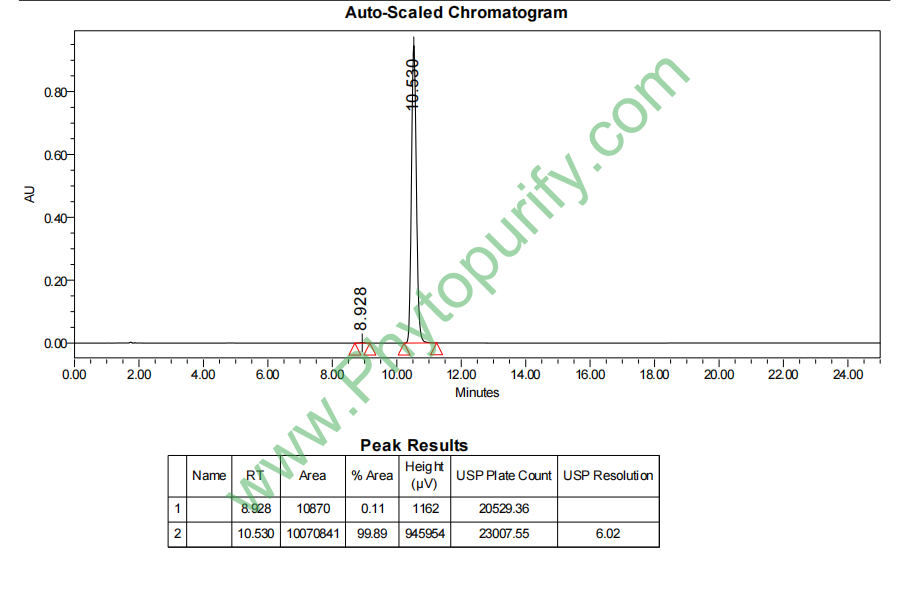
HPLC of Fargesin
Storage conditions:Short-term storage at 2~8℃, long-term storage at -20 ~ -80℃
Fargesin (CAS number: 31008-19-2), as a new natural lignan product, was first isolated from Magnoliaceae plants and has attracted widespread attention in recent years due to its significant biological activity. Lignin compounds are an important class of secondary metabolites in plants, with diverse pharmacological activities including anti-inflammatory, antioxidant, anti-tumor, and neuroprotective effects. Xinyi Zhisu, as a typical representative, exhibits unique anti hypertensive and anti-inflammatory activities, especially in the field of anti allergy, showing potential clinical application value.
With the in-depth study of the pharmacological mechanisms of natural products, the molecular targets of dioscin have gradually been revealed, involving multiple immune regulatory factors and signaling pathways, such as ALOX5, HRH1, IL4, IL5, IL13, FCER1A, TBXA2R, STAT6, and TSLP. These targets play a key role in the occurrence and development of allergic reactions. This article will provide a systematic review of the chemical structure and physicochemical properties, plant sources and extraction methods, pharmacological activity and mechanism of action, pharmacological evaluation and pharmacokinetic characteristics of Xinyi Zhisu. Finally, the clinical application prospects of Xinyi Zhisu will be discussed, providing theoretical basis and reference for subsequent research and development.
Xinyi lignan belongs to the class of new lignans, with a molecular formula of C22H26O5 and a molecular weight of 370.4010. Its structural features include two benzene rings connected by an oxygen bridge, forming a typical lignin skeleton, and containing multiple methoxy and hydroxyl substituents, endowing it with certain polarity and biological activity. The LogP value of Xinyi Zhisu is 2.7511, indicating that it has moderate lipid solubility, which is beneficial for cell membrane penetration and bioavailability. The polar surface area (TPSA) is 55.38 Å ², indicating that it has a certain polarity that facilitates binding to target proteins.
The water solubility is relatively low (0.0058 mg/mL), which to some extent limits its oral bioavailability, but it has good lipid solubility and is suitable for drug delivery through liposomes or nanocarriers. The high permeability of the blood-brain barrier suggests its potential for central nervous system action. The hERG channel inhibition experiment result was negative, indicating that the risk of cardiac toxicity of Xinyi lipid is relatively low. The Ames test score is 0.9, which basically eliminates the risk of genotoxicity and has good safety.
Xinyi lignans mainly come from Magnoliaceae plants, especially Magnolia biondii Pamp., which is abundant in flower buds and bark. As a traditional Chinese medicinal herb, Xinyi has always been used to treat symptoms such as rhinitis, headache, and colds. The research on its active ingredients has promoted the discovery and development of Xinyi lipin.
The extraction method often uses organic solvent extraction combined with chromatographic separation technology. Common extraction solvents include ethanol, methanol, and ethyl acetate. Ultrasonic assisted extraction or reflux extraction can be used to improve extraction efficiency. The extraction solution was subjected to liquid-liquid distribution, silica gel column chromatography, and high-performance liquid chromatography (HPLC) purification to ultimately obtain high-purity magnolia resin. In recent years, supercritical CO2 extraction and microwave-assisted extraction techniques have also been applied to the extraction of magnolia resin, further improving the extraction efficiency and environmental friendliness.
The pharmacological activity research of Xinyi Zhisu covers multiple aspects such as anti hypertension, anti-inflammatory, and anti allergic effects.
Research has shown that quercetin can significantly reduce blood pressure levels by dilating vascular smooth muscle, inhibiting angiotensin-converting enzyme activity, and regulating endothelial function. Its mechanism of action may involve regulating the synthesis of nitric oxide (NO) and the opening of calcium ion channels, thereby improving vascular contractile function. Animal model experiments have shown that Xinyi Zhisu can effectively reduce systolic and diastolic blood pressure in a rat hypertension model without significant toxic side effects.
Xinyi Zhisu exhibits significant anti-inflammatory activity and can inhibit the release of various inflammatory mediators, such as tumor necrosis factor - α (TNF - α), interleukin-6 (IL-6), and nitric oxide (NO). Its anti-inflammatory mechanism mainly involves inhibiting the activation of the nuclear factor kappa B (NF - κ B) signaling pathway and reducing the expression of inflammatory genes. In addition, Xinyi Zhisu can also inhibit macrophage activation induced by lipopolysaccharide (LPS) and alleviate inflammatory reactions.
The research on Xinyi Zhisu in anti allergy is particularly outstanding. Its targets involve key allergy mediators and signaling molecules such as ALOX5 (5-lipoxygenase), HRH1 (histamine H1 receptor), IL4, IL5, IL13, etc. By inhibiting ALOX5 activity, berberine reduces leukotriene production in allergic reactions, alleviates airway inflammation and bronchoconstriction. The antagonistic effect on histamine H1 receptor reduces histamine mediated vascular permeability and itching symptoms. In addition, Xinyi lipid regulates the secretion of IL4, IL5, and IL13 by Th2 cells, inhibits IgE mediated immune responses, and alleviates allergic inflammation.
The mechanism of action of Xinyi Zhisu involves the synergistic regulation of multiple targets and pathways, reflecting its characteristic of being a multifunctional drug.
ALOX5 is a key enzyme in leukotriene synthesis and is involved in the occurrence of allergic inflammation. Xinyi Zhisu directly inhibits ALOX5 activity, reduces the production of leukotriene B4 (LTB4) and leukotriene C4 (LTC4), and alleviates airway inflammation and tissue damage.
The histamine H1 receptor mediates vasodilation and itching in allergic reactions, and the antagonistic effect of berberine on HRH1 effectively alleviates allergic symptoms, with the potential of antihistamines.
IL4, IL5, and IL13 are key cytokines secreted by Th2 cells, promoting IgE synthesis and eosinophil activation. Xinyi Zhisu inhibits the STAT6 signaling pathway, reduces the expression of these cytokines, regulates immune balance, and alleviates allergic inflammation.
Fc ε RI is a high affinity receptor for IgE, mediating the initiation of allergic reactions. Xinyi Zhisu can inhibit the expression and activation of Fc ε RI, block the degranulation reaction of mast cells and eosinophils, and reduce the release of mediators such as histamine.
Xinyi Zhisu also affects the platelet pro vasoconstrictor receptor TBXA2R, regulating vascular tone and inflammatory response. TSLP (thymic stromal lymphopoietin) serves as an upstream inflammatory mediator, and its expression is inhibited by quercetin, further reducing allergic inflammation.
The pharmacological evaluation of Xinyi Zhisu shows that it has good potential for drug development.
The molecular weight of Xinyi lipid is moderate, and the LogP value indicates that it has good lipid solubility, which is beneficial for cell membrane penetration. TPSA is moderate, supporting its effective binding with target proteins. Low water solubility suggests the need to improve bioavailability through formulation optimization.
The hERG channel inhibition experiment results were negative, reducing the risk of arrhythmia. The Ames test results showed no significant genotoxicity and high safety. In animal toxicology studies, there were no significant toxic side effects observed with Xinyi Zhisu, supporting its safety foundation for clinical development.
Xinyi Zhisu has a high blood-brain barrier permeability, suggesting that it may play a role in the central nervous system. Oral absorption is limited by water solubility and has low bioavailability, but it is expected to be improved through new delivery systems such as liposomes and nanoparticles. The metabolic pathway mainly involves the liver enzyme system, with a moderate half-life and suitable for daily administration.
Xinyi lipid, as a multi-target natural product, has broad clinical application potential. Its anti hypertensive and anti-inflammatory effects provide new ideas for the treatment of cardiovascular diseases and chronic inflammatory diseases. Especially in allergic diseases such as asthma, allergic rhinitis, and atopic dermatitis, berberine has shown promising therapeutic prospects by regulating immune responses and inhibiting allergic mediators.
Future research should focus on the following aspects:
Optimization of dosage form and exploration of administration route Given the poor water solubility of Xinyi lipid, new carrier systems such as nanoparticles and liposomes have been developed to improve its bioavailability and targeting.
In depth mechanism research Using multi omics techniques and molecular simulations, further elucidate the interaction mechanism between Xinyi lipid and targets, and explore potential synergistic targets.
Preclinical and clinical research Conduct systematic pharmacokinetic, toxicological, and pharmacodynamic evaluations, advance clinical trials, and validate their safety and efficacy.
Combination therapy strategy Explore the combined application of Xinyi Zhisu with existing anti allergic and anti hypertensive drugs to achieve synergistic effects and reduce side effects.
Xinyi lignan, as a new natural lignan derived from Magnoliaceae plants, has shown broad prospects for drug development due to its unique chemical structure and multi-target pharmacological activity. Its potential applications in the fields of anti hypertension, anti-inflammatory, and anti allergy, especially in regulating immune inflammatory responses, provide a new paradigm for natural product pharmacology research. In the future, through in-depth mechanism analysis, dosage form optimization, and clinical validation, Xinyi Zhisu is expected to become an innovative drug for treating related diseases, promoting the process of natural product translation into clinical practice.
