


Synonym name: Asarinin
Catalogue No.: BP0199
Cas No.: 133-04-0
Formula: C20H18O6
Mol Weight: 354.358
Botanical Source: Asarum, Boronia and Xanthoxylum spp.
Purity: 95%~99%
Analysis Method: HPLC-DAD or/and HPLC-ELSD
Identification Method: Mass, NMR
Packing: Brown vial or HDPE plastic bottle
Can be supplied from milligrams to grams.
For Reference Standard and R&D, Not for Human Use Directly.
Inquire for bulk scale.
HPLC of Asarinin
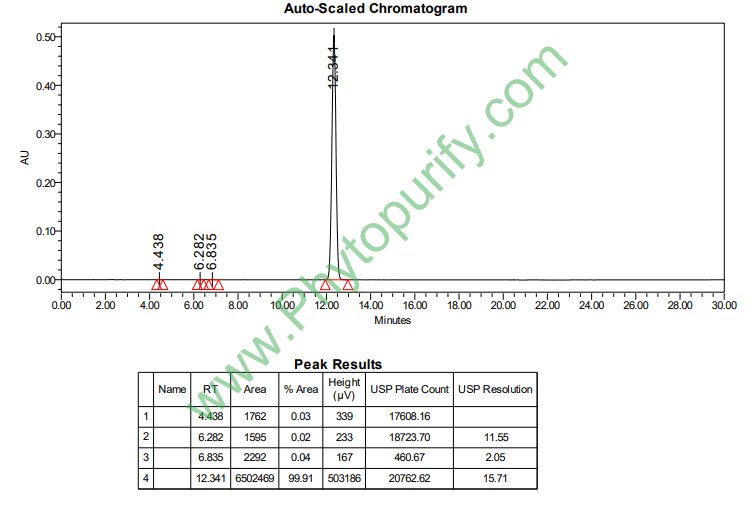
Storage conditions:Short-term storage at 2~8℃, long-term storage at -20 ~ -80℃
L-Asarinin (CAS number: 133-04-0) is a natural product belonging to the aromatic stilbene dimer class, mainly found in plants of the Asarinia genus. As one of the active ingredients of traditional Chinese medicine Asarum spp., Asarin has received widespread attention in the field of natural product pharmacology in recent years due to its diverse biological activities and potential pharmacological effects. Especially in the prevention and treatment of cardiovascular diseases, asarone shows significant protective effects, especially for atherosclerosis, the main cardiovascular pathological state, showing good therapeutic potential. This article will provide a systematic review of the chemical structure, plant origin, pharmacological activity, mechanism of action, and pharmacological evaluation of Asaxin, aiming to provide theoretical basis and research direction for its clinical application and new drug development.
The molecular formula of asarone is C21H18O6, with a molecular weight of 354.36. Its chemical structure is a symmetrical dimer formed by the specific dimerization of two aromatic stilbene monomers. Asarin has a relatively stable aromatic ring structure and multiple hydroxyl and methoxy substituents, which endow it with certain polarity and biological activity. Its physicochemical properties show that the LogP value of asarone is 2.4, indicating that it has moderate lipid solubility, which is beneficial for cell membrane penetration and in vivo distribution. The topological polar surface area (TPSA) is 69.18 Å ², and the number of hydrogen bond acceptors is 6, indicating its strong ability to form hydrogen bonds in intermolecular interactions.
In addition, Asaxin exhibits high blood-brain barrier permeability (Blood Brain Barrier: High), which provides potential applications for its use in central nervous system related diseases. In terms of toxicological evaluation, Asaxin did not exhibit hepatotoxicity, cardiotoxicity, or hERG channel inhibition, and the Ames mutagenicity test result was negative, indicating its high safety and good pharmacological basis.
Asarin is mainly distributed in plants of the Asarum genus, such as Asarum heterotropoides and Asarum sieboldii. As a traditional Chinese medicine, Asarum is widely used in the treatment of diseases such as rheumatism, headache, and rhinitis. Its active ingredients are complex, and Asarin is an important pharmacological substance based on it.
The common methods for extracting asarone include solvent extraction, ultrasound assisted extraction, and chromatographic separation techniques. Generally, ethanol or methanol is used as solvents to obtain crude extracts through reflux extraction, followed by purification using column chromatography (such as silica gel column, reverse phase high performance liquid chromatography). In recent years, the application of supercritical fluid extraction and microwave-assisted extraction technology has improved extraction efficiency and purity, reduced the use of organic solvents, and complied with the principles of green chemistry.
During the extraction process, temperature, solvent polarity, and extraction time are key factors that affect the yield of asarone. Optimizing the extraction process is of great significance for ensuring the quality and activity of asarone.
Asaxin has shown good effects in various pharmacological activities, especially in the fields of anti-inflammatory, antioxidant, anti-tumor, and cardiovascular protection, where significant progress has been made.
Atherosclerosis is the main pathological basis leading to cardiovascular and cerebrovascular diseases. Asarins significantly inhibit the progress of atherosclerosis by regulating lipid metabolism, anti-inflammatory and antioxidant pathways. In vitro and in vivo studies have shown that asarone can reduce plasma cholesterol and low-density lipoprotein (LDL) levels, promote high-density lipoprotein (HDL) production, and improve blood lipid abnormalities.
Asaxin reduces chronic inflammatory response by inhibiting pro-inflammatory factors such as TNF - α, IL-6, and NF - κ B signaling pathways. In addition, its inhibitory effect on immune regulatory enzyme IDO1 (indoleamine 2,3-dioxygenase 1) suggests its potential value in regulating immune tolerance and inflammatory microenvironment.
Asarins can clear free radicals, enhance the activity of intracellular antioxidant enzymes, reduce oxidative stress damage, protect the function of vascular endothelial cells, and prevent the formation of atherosclerotic plaque.
Some studies have also reported that Asaxin has anti-tumor, neuroprotective, and antibacterial activities, demonstrating its multi-target and multi pathway pharmacological properties.
The pharmacological effects of asarone involve multiple molecular targets and signal pathways, especially in the prevention and treatment of atherosclerosis.
Asarins regulate energy metabolism and lipid metabolism, promote fatty acid oxidation, inhibit lipid synthesis, improve dyslipidemia and slow down the development of atherosclerosis by activating AMPK signaling pathway.
EHMT2, as an epigenetic regulatory factor, is involved in inflammation and cell apoptosis processes. Asarin regulates EHMT2 activity, affects related gene expression, inhibits inflammatory response and cell damage.
Asarin enhances cell viability and protects vascular endothelial cells from oxidative stress and inflammation induced apoptosis by regulating the expression of anti apoptotic proteins MCL1 and BCL2.
Asaxin may promote DNA damage repair, maintain genomic stability, and prevent cellular dysfunction by regulating RECQ1.
LOX-1 is a receptor for oxidized low density lipoprotein (ox LDL), which is involved in inflammatory reaction and plaque formation of atherosclerosis. Asaxin inhibits LOX-1 expression and reduces ox LDL mediated vascular damage.
Asaxin promotes the expression of ABCA1, enhances cholesterol efflux and high-density lipoprotein (HDL) production, promotes cholesterol metabolism balance, and prevents lipid deposition.
By inhibiting IDO1, Asaxin regulates the immune microenvironment, alleviates chronic inflammation, and promotes tissue repair.
To sum up, asarone exerts its comprehensive pharmacological effect on preventing atherosclerosis and related diseases through multi target and multi way synergistic action.
The pharmacological evaluation of asarone shows that it has good drug properties. Molecular weight 354.36, LogP 2.4, Compliant with Lipinski's rules, beneficial for oral absorption and in vivo distribution. The TPSA is 69.18 Å ², indicating that its polarity is moderate and conducive to membrane penetration.
The high permeability of the blood-brain barrier suggests its potential application in central nervous system diseases. Toxicological evaluation showed no hepatotoxicity, cardiotoxicity, or hERG channel inhibition, and Ames test was negative, indicating good safety.
In terms of pharmacokinetics, asarone is well absorbed after oral administration and widely distributed in the body. Its metabolism is mainly through the liver enzyme system, and its excretion pathways are mainly through bile and urine. Further research is needed on the activity of its metabolites and potential drug interactions.
At present, there is limited preclinical pharmacokinetic data for asarone, and in the future, systematic in vivo kinetics, metabolic kinetics, and toxicology studies are needed to provide support for clinical translation.
Asarins, as a natural product with multiple biological activities, show good application potential in the prevention and treatment of atherosclerosis and related cardiovascular diseases. The multi-target regulatory mechanism provides a theoretical basis for the development of novel multi-target drugs.
The future clinical application prospects include:
Prevention and treatment of cardiovascular diseases Asarone is expected to become an adjuvant drug for atherosclerosis and coronary heart disease by regulating lipid metabolism, anti-inflammatory and antioxidant effects.
Immune regulation and anti-inflammatory effects Its regulation of immune targets such as IDO1 provides new ideas for the treatment of autoimmune diseases and chronic inflammatory diseases.
Central nervous system diseases The high blood-brain barrier permeability makes it potential for research in neurodegenerative diseases such as Alzheimer's disease and Parkinson's disease.
Combination therapy strategy Asaxin can synergize with existing drugs, enhance therapeutic efficacy, and reduce side effects.
However, the clinical translation of asarone still faces many challenges, such as unclear pharmacokinetic properties, formulation development, clinical safety and efficacy verification, etc. In the future, it is necessary to strengthen multi center and large sample clinical research, combined with modern drug design and formulation technology, to promote its clinical application.
Asarins, as a natural product derived from traditional Chinese medicine Asarum, show broad application prospects in the prevention and treatment of atherosclerosis and related diseases by virtue of its unique chemical structure and multi-target pharmacological activity. Its good drug efficacy and safety have laid a solid foundation for the development of new drugs. In the future, through in-depth analysis of its mechanism of action, optimization of extraction and purification processes, and systematic pharmacokinetic and clinical research, asarone is expected to become an important breakthrough in the field of natural product pharmacology, providing new strategies and choices for the treatment of cardiovascular diseases.
