
| Catalog No | Package | Original Price | Price | Inventory | Quantity | Operating |
|---|---|---|---|---|---|---|
| BP0319-100mg | 100mg | $20.00 | Sign in |
|


Synonym name: 2-Hydroxycymene; Cymophenol; p-Cymen-2-ol; 5-Isopropyl-o-cresol
Catalogue No.: BP0319
Cas No.: 499-75-2
Formula: C10H14O
Mol Weight: 150.221
Botanical Source: many essential oils. Esp. found in the Labiatae. Thyme oil (
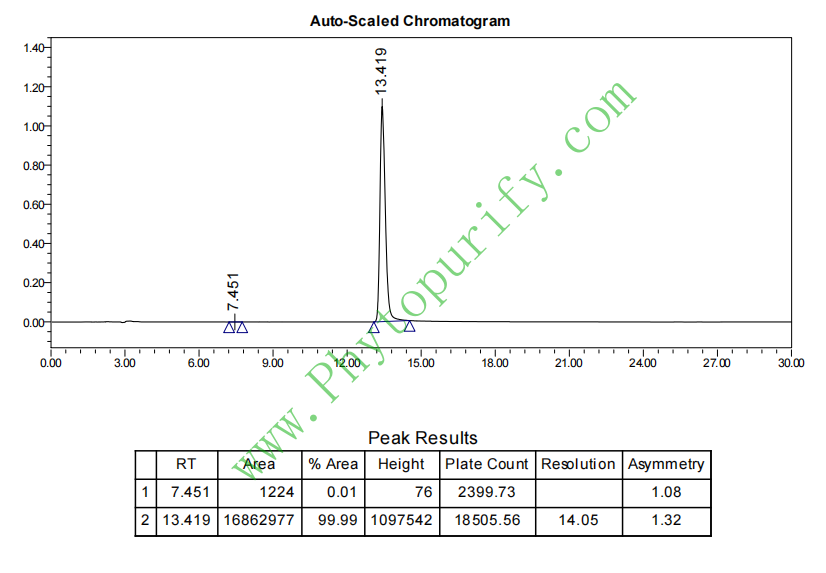
HPLC of Carvacrol
Storage conditions:Short-term storage at 2~8℃, long-term storage at -20 ~ -80℃
Carvacrol (CAS number: 499-75-2) is a natural monoterpene phenolic compound widely found in various aromatic plants, particularly abundant in Thymus vulgaris and Origanum vulgare. As a natural compound with significant biological activity, carvacrol not only has good oral bioavailability, but also effectively penetrates the blood-brain barrier, demonstrating its potential application value in the treatment of central nervous system diseases. In recent years, with the advancement of natural product pharmacology and molecular biology technology, the multiple pharmacological activities and mechanisms of action of carvacrol have been deeply analyzed, covering multiple functions such as antioxidant, antibacterial, antifungal, anticancer, anti-inflammatory, hepatoprotective, antispasmodic, and vascular relaxation. Its role in cell cycle regulation and apoptosis induction, especially by downregulating key molecules Notch-1 and Jagged-1 in the Notch signaling pathway, further reveals its anti-tumor potential. This article aims to systematically review the chemical structure, sources, pharmacological activities, mechanisms of action, medicinal properties, and clinical application prospects of carvacrol, providing theoretical basis and research direction for its development as a new natural medicine.
The chemical name of carvacrol is 5-isopropyl-2-cresol, with a molecular formula of C10H14O and a molecular weight of 150.22. Its structure belongs to monoterpene phenols, with a benzene ring as the core and hydroxyl (- OH) and isopropyl side chains. This structure endows carvacrol with strong hydrophobicity, with a LogP value of 3.48, indicating its good lipid solubility, which is beneficial for penetrating cell membranes and the blood-brain barrier. The topological polar surface area (TPSA) is 20.23 Å ², and the number of hydrogen bond acceptors is only 1, further supporting its high permeability and oral absorption capacity. At room temperature, carvacrol is a colorless to pale yellow liquid with a characteristic aromatic odor. It is easily soluble in ethanol, ether, and other organic solvents, but has poor water solubility. It has high chemical stability and is suitable for the development of various forms of formulations.
Schizophenol is mainly found in the essential oils of plants in the family Lamiaceae, particularly represented by thyme and frankincense. Its content varies depending on the plant variety, geographical environment, harvesting time, and extraction process. The traditional extraction methods mainly include distillation and solvent extraction. Steam distillation is the most commonly used industrial extraction technique, which can effectively separate the coumarin component in plant essential oils. In recent years, the application of green technologies such as supercritical CO2 extraction and microwave-assisted extraction has improved extraction efficiency and purity, while reducing the use of organic solvents, which is in line with the environmental trend of modern natural product extraction. After extraction, the content and purity of carvacrol are usually qualitatively and quantitatively analyzed by gas chromatography-mass spectrometry (GC-MS) technology.
Schizophenol exhibits significant free radical scavenging ability, which can inhibit lipid peroxidation and protect cells from oxidative stress damage. In vitro DPPH and ABTS free radical scavenging experiments, as well as cell models, have confirmed their antioxidant effects. The relevant mechanisms involve regulating the expression and activity of endogenous antioxidant enzymes such as superoxide dismutase (SOD) and glutathione peroxidase (GPx).
Fentanol exhibits potent inhibitory effects on various Gram positive and Gram negative bacteria, targeting bacterial membrane structures and metabolic enzyme systems. Its targets include bacterial anti apoptotic protein MCL1, immune regulatory receptor TLR4, tyrosine phosphatase PTPN1, etc. It can disrupt bacterial membrane integrity, interfere with DNA replication and protein synthesis. Fungi such as Candida albicans also have the ability to inhibit growth and biofilm formation, demonstrating broad-spectrum antimicrobial potential.
Schizophenol induces cell cycle arrest in various tumor cell lines, mainly in the G0/G1 phase, and inhibits cell proliferation. The mechanism involves downregulating key proteins Notch-1 and Jagged-1 in the Notch signaling pathway, blocking the signal transduction of tumor cell proliferation, and promoting cell apoptosis. Cinnamomum camphora can also activate the mitochondrial pathway, regulate the expression of Bcl-2 family proteins, and induce cell apoptosis. In addition, carvacrol indirectly exerts anti-tumor effects by inhibiting tumor associated inflammatory factors and oxidative stress.
Fentanol reduces inflammatory response by inhibiting inflammatory mediators such as TNF - α, IL-6, and NF - κ B signaling pathways. Its hepatoprotective effect is reflected in reducing liver enzyme levels, alleviating tissue pathological damage, and providing antioxidant protection in liver injury models. Related studies have shown that carvacrol can regulate the antioxidant defense system in liver cells and inhibit the progression of liver fibrosis.
Schizophenol has a smooth muscle relaxation effect and can alleviate spastic diseases by regulating calcium ion channels and the NO (nitric oxide) signaling pathway. Its vasodilatory effect helps improve microcirculation, lower blood pressure, and demonstrates cardiovascular protective potential.
The multi-target mechanism of action of carvacrol is the basis for its broad pharmacological activity. In response to bacterial infections, carvacrol exerts its effects by regulating the following key proteins:
In tumor cells, carvacrol mainly inhibits cell cycle progression and induces apoptosis by downregulating key molecules Notch-1 and Jagged-1 in the Notch signaling pathway. In addition, carvacrol regulates Bcl-2 family proteins and mitochondrial membrane potential, activating the intracellular apoptotic signaling pathway.
The molecular weight of carvacrol is 150.22, which conforms to Lipinski's rule. The LogP is 3.48, indicating good lipid solubility and cell membrane permeability. TPSA is only 20.23 Å ², indicating its high blood-brain barrier penetration ability and suitability for drug development in central nervous system diseases. Its hydrogen bond receptor number is 1, further supporting good oral absorption.
Toxicological evaluation shows that the LD50 of carvacrol is about 980 mg/kg, with low toxicity and no significant hepatotoxicity, cardiotoxicity, or hERG channel inhibition. The Ames test result is negative, indicating no mutagenic risk. These safety data lay the foundation for its clinical application.
Pharmacokinetic studies have shown that carvacrol is rapidly absorbed after oral administration, with a moderate plasma half-life, and can effectively distribute in brain tissue, demonstrating good in vivo stability and bioavailability. Its metabolism is mainly carried out through the liver enzyme system, and the metabolites have good safety.
As a multifunctional natural product, carvacrol has broad clinical application potential. Its antibacterial and antifungal properties make it an ideal choice for natural preservatives and food additives, especially in dealing with drug-resistant strains. The anticancer activity provides the possibility for its application in adjuvant therapy for tumors, especially in combination chemotherapy or targeted therapy to exert synergistic effects. Its anti-inflammatory, hepatoprotective, and vasodilatory effects provide new ideas for the treatment of chronic inflammatory diseases, liver diseases, and cardiovascular diseases.
Future research should focus on the preclinical in vivo pharmacodynamics and safety evaluation of carvacrol, optimize its drug formulation and administration route, and enhance its bioavailability and targeting. At the same time, based on its multi-target mechanism of action and combined with modern molecular targeting technology, its derivatives or compound preparations can be developed to expand its clinical indications. The application of carvacrol in neurological diseases also deserves further exploration, especially its ability to penetrate the blood-brain barrier, which provides an opportunity for the development of drugs for neurodegenerative diseases.
As a widely sourced, structurally simple, and biologically active natural monoterpene phenol, carvacrol exhibits various pharmacological activities and good medicinal properties. Its multiple mechanisms of action, including antibacterial, anticancer, anti-inflammatory, and neuroprotective effects, provide a solid foundation for its development as a new natural medicine. In the future, through in-depth mechanism research, pharmacokinetic optimization, and clinical translation, carvacrol is expected to become an important member in the development of natural product drugs, promoting the application and development of natural products in modern medicine.
