


Product name: Casticin
Synonym name: Vitexicarpin
Catalogue No.: BP0320
Cas No.: 479-91-4
Formula: C19H18O8
Mol Weight: 374.345
Botanical Source: Yitex negundo fructus
Physical Description:
Type of Compound: Flavonoids
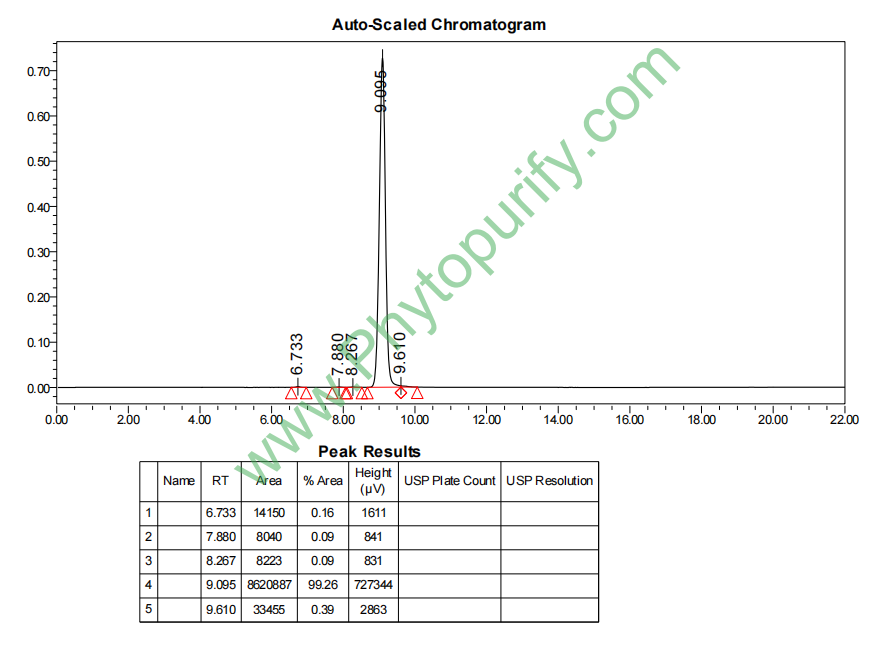
Purity: 95%~99%
Analysis Method: HPLC-DAD or/and HPLC-ELSD
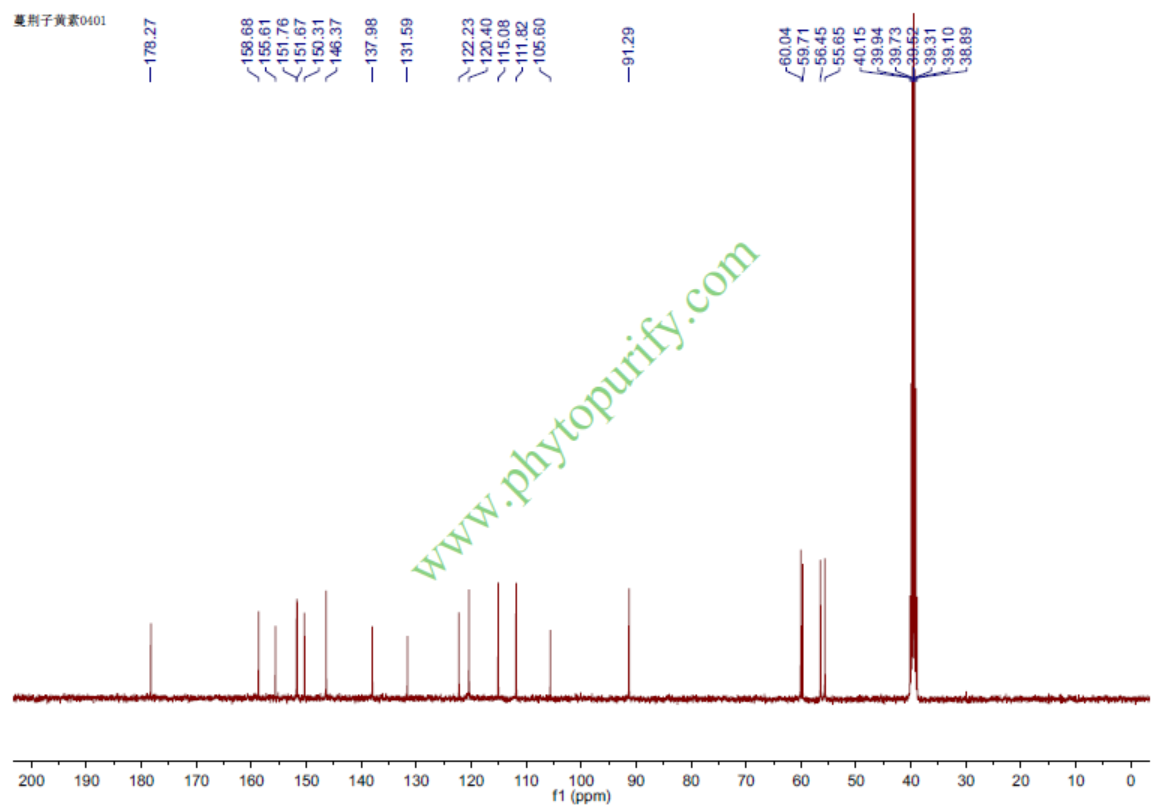
Identification Method: Mass, NMR
Packing: Brown vial or HDPE plastic bottle
Storage: Store in a well closed container, protected from air and light. Put into refrigerate or freeze for long term storage.
Whenever possible, you should prepare and use solutions on the same day. However, if you need to make up stock solutions in advance, we recommend that you store the solution as aliquots in tightly sealed vials at -20℃. Generally, these will be useable for up to two weeks.
The product could be supplied from milligrams to grams
Inquire for bulk scale.
Description:
Vitexicarpin has shown antitumor, cytotoxicity, anti-inflammatory, analgesic and immunoregulatory properties.Vitexicarpin can act as a novel angiogenesis inhibitor, it exerts good antiangiogenic effects by inhibiting vascular-endothelial-growth-factor-(VEGF-) induced endothelial cell proliferation, migration, and capillary-like tube formation on matrigel in a dose-dependent manner. It can significantly reduce vascular inflammation, through inhibition of ROS-NF-κB pathway in vascular endothelial cells.
References:
Asian Pac J Cancer Prev. 2012;13(12):6369-74.
Vitexicarpin induces apoptosis in human prostate carcinoma PC-3 cells through G2/M phase arrest.
Vitexicarpin (3', 5-dihydroxy-3, 4', 6, 7-tetramethoxyflavone), a polymethoxyflavone isolated from Viticis Fructus (Vitex rotundifolia Linne fil.), has long been used as an anti-inflammatory herb in traditional Chinese medicine. It has also been reported that Vitexicarpin can inhibit the growth of various cancer cells. However, there is no report elucidating its effect on human prostate carcinoma cells.
METHODS AND RESULTS:
The aim of the present study was to examine the apoptotic induction activity of Vitexicarpin on PC-3 cells and molecular mechanisms involved. MTT studies showed that Vitexicarpin dose-dependently inhibited growth of PC-3 cells with an IC50~28.8 μM. Hoechst 33258 staining further revealed that Vitexicarpin induced apoptotic cell death. The effect of Vitexicarpin on PC-3 cells apoptosis was tested using prodium iodide (PI)/Annexin V-FITC double staining and flow cytometry. The results indicated that Vitexicarpin induction of apoptotic cell death in PC-3 cells was accompanied by cell cycle arrest in the G2/M phase. Furthermore, our study demonstrated that Vitexicarpin induction of PC-3 cell apoptosis was associated with upregulation of the proapoptotic protein Bax, and downregulation of antiapoptotic protein Bcl-2, release of Cytochrome c from mitochondria and decrease in mitochondrial membrane potential.
CONCLUSIONS:
Our findings suggested that Vitexicarpin may become a potential leading drug in the therapy of prostate carcinoma.
Planta Med. 2002 Nov;68(11):1047-9.
Tracheospasmolytic activity of viteosin-A and vitexicarpin isolated from vitex trifolia.
METHODS AND RESULTS:
The n-hexane extract that has shown activity in the tracheospasmolytic bioassay was fractionated by solvent extraction and from the major active fraction two compounds were isolated and identified as viteosin-A and Vitexicarpin. These compounds blocked spontaneous contraction of isolated male guinea pig trachea induced by histamine; however only Vitexicarpin was active in a model using sensitized guinea pig trachea stimulated by ovalbumin up to minimum dose of 1.3 x 10(-5) M.
CONCLUSIONS:
The result suggests that Vitexicarpin is able to block effects of histamine released from sensitized mast cells possibly by stabilizing the mast cells membrane function.
HPLC of Casticin
NMR of Casticin
Storage conditions:Short-term storage at 2~8℃, long-term storage at -20 ~ -80℃
107.5900
2.4713
2.4059
.0314
4.2705
23.1850
Low
87.2791
2.4653
Yes
No
Yes
No
Yes
No
1.2
Yes
No
Yes
No
Natural products have always been an important treasure trove for innovative drug discovery, among which flavonoids have attracted much attention due to their wide range of biological activities. Casticin, also known as 3 ′, 5-dihydroxy-3,6,7,4 ′ - tetramethoxyflavone, is a multi methoxyflavone with significant pharmacological activity. It was originally derived from the traditional Chinese medicine Wisteria gracilis(Vitex trifolia L. Or Vitex rotundifolia L. F.) is isolated from the fruit and later distributed in various plants such as Eremophila mitchellii It has also been discovered. Modern pharmacological research has revealed that resveratrol exhibits multiple biological activities, including anti-inflammatory, anti-tumor, anti mitotic, and antimicrobial effects, particularly demonstrating great potential in the field of anti-tumor. In recent years, with the development of molecular biology technology, its mechanism of action has been gradually elucidated, especially in regulating key signaling pathways such as STAT3, making it a potential candidate molecule for the treatment of malignant tumors such as liver cancer. This article aims to systematically review the chemical properties, plant sources, pharmacological activities, molecular mechanisms of action, pharmacological evaluation, and clinical application prospects of resveratrol, in order to provide comprehensive scientific references for the in-depth research and development of this compound.
The molecular formula of quercetin (CAS number: 479-91-4) is C19H18O8, with a molecular weight of 374.3450. Its chemical structure is based on flavonoids as the parent nucleus, specifically a derivative of quercetin. The four hydroxyl groups at positions 3, 6, 7, and 4 'of the quercetin structure are all replaced by methoxy groups (- OCH3), forming a unique tetramethoxy flavonoid structure, while two free hydroxyl groups are retained at positions 3' and 5. This specific substitution pattern has a decisive impact on its biological activity and physicochemical properties.
From the analysis of physical and chemical properties, resveratrol exhibits typical flavonoid compound characteristics. The calculated lipid water partition coefficient (LogP) is 2.4713, indicating that the compound has moderate lipophilicity, which is beneficial for its penetration of cell membranes, but may also affect its water solubility. Its topological polar surface area (TPSA) is 107.5900 Å ², reflecting the number of hydrogen bond acceptors in the molecule. The water solubility measured in the experiment is relatively low, about 0.0314 mg/mL, which to some extent limits its bioavailability. In addition, the predictive model shows that its ability to cross the blood-brain barrier is low, suggesting that its application in central nervous system diseases may be limited. In the early safety screening, its Ames test value was 1.2, indicating a low risk of mutagenicity and no significant inhibitory effect on hERG potassium channels, reducing the potential risk of heart QT interval prolongation. These basic pharmacological parameters provide key basis for subsequent formulation design and structural optimization.
The main source of vitexin is from plants in the family Verbenaceae and the genus Vitex. The main traditional source of it is the traditional Chinese medicine, Quercus acutissima, also known as single leaf Quercus acutissima(Vitex rotundifolia)Or vine vine(Vitex trifolia)Dry and ripe fruits. As a commonly used traditional Chinese medicine, Fructus Sophorae has the effects of dispersing wind and heat, clearing and benefiting the head. It is commonly used to treat headaches, eye redness, swelling and pain, and its active ingredient group includes Fructus Sophorae flavanone. In addition, this compound is endemic to plants in Australia Eremophila mitchellii(Commonly known as "fake sandalwood") and other plant species have also been reported to be isolated.
The extraction of quercetin from plant materials is usually carried out using organic solvent extraction method. The conventional process includes crushing the dried fruit of the vine vine, first defatting it with petroleum ether or n-hexane to remove non-polar impurities such as oil and chlorophyll. Subsequently, medium polarity solvents such as ethyl acetate, ethanol, or methanol were used for repeated extraction. The commonly used methods are hot reflux extraction or ultrasound assisted extraction, the latter of which can improve extraction efficiency and shorten time. After obtaining the crude extract, a series of separation and purification steps are required to obtain high-purity quercetin. These steps usually involve modern chromatographic technologies such as silica gel column chromatography, polyamide column chromatography, Sephadex LH-20 column chromatography, and high-performance liquid chromatography (HPLC) preparation. Solvent systems often use gradient elution methods such as chloroform methanol and petroleum ether ethyl acetate. With the development of technology, green extraction methods such as supercritical fluid extraction are also being explored to improve extraction selectivity and efficiency.
Numerous in vitro and in vivo studies have confirmed that resveratrol has diverse and significant pharmacological activities.
The pharmacological effects of quercetin, especially its anti liver cancer activity, are achieved by regulating multiple key signaling pathways and molecular targets, forming a multi-target, networked mode of action.
Core target: STAT3 signaling pathway Signal transducer and activator of transcription factor 3 (STAT3) is one of the most critical molecular targets of resveratrol. STAT3 is continuously activated (phosphorylated) in various liver cancer cells, promoting cell proliferation, survival, invasion, and inhibiting apoptosis. Vitexin can effectively inhibit tyrosine phosphorylation of STAT3 (such as Tyr705 site), block its nuclear translocation and binding to DNA, thereby downregulating the expression of downstream target genes such as Bcl-2, Survivor, Cyclin D1, and VEGF, ultimately inducing cancer cell apoptosis and inhibiting growth.
Apoptosis related targets:
Proliferation and invasion related targets:
Microenvironment and stress-related targets:
In summary, resveratrol acts synergistically on multiple signaling axes such as STAT3, NF - κ B, MAPK, PI3K/Akt, and affects key effector molecules such as BCL2, MMP9, and HIF1A, forming a multi-level anti-tumor network. This may be the molecular basis for its high efficiency and low toxicity characteristics.
Although resveratrol has shown excellent biological activity in vitro, its pharmacological properties still face challenges, mainly due to its class of drugs.
Absorption, distribution, metabolism, excretion (ADME):
Formulation strategy and structural optimization:
safety The current in vitro toxicology data (such as negative hERG inhibition and preliminary negative Ames test) provide some support for its safety, but comprehensive preclinical safety evaluations such as acute toxicity, long-term toxicity, and reproductive toxicity still need to be systematically carried out.
Vitexin has shown broad clinical application potential, especially in the field of tumor treatment.
However, its future development also faces challenges: firstly, it needs to complete systematic and standardized preclinical pharmacological, pharmacokinetic, and toxicological studies to provide solid data for its clinical trial application. Secondly, the core challenges of poor water solubility and low oral bioavailability must be addressed, and advanced drug delivery technology will be the key breakthrough. Finally, it is necessary to further explore its optimal indications, dosing regimen, and potential resistance mechanisms.
As a natural tetramethoxy flavonoid derived from traditional Chinese medicine, quercetin has shown great development value in the field of anti-tumor, especially anti liver cancer, due to its unique chemical structure and multi-target pharmacological mechanism. From inhibiting STAT3 activation to regulating multiple signaling pathways related to apoptosis, inflammation, invasion, and metastasis, its molecular network of action is becoming increasingly clear. Despite the challenge of low bioavailability in drug development, modern medicinal chemistry and pharmaceutical methods, such as nanotechnology and prodrug design, have the potential to overcome these obstacles. In the future, with deeper preclinical research and subsequent clinical translational exploration, resveratrol is expected to develop from a promising lead compound into a new drug for treating malignant tumors and other diseases, becoming another successful example connecting traditional medical wisdom with modern drug development.
