


Synonym name: 1,2-Dimethoxynoraporphine; N-Nornuciferine; N-Desmethylnuciferine; Sanjoinine Ia; Daechualkaloid E
Catalogue No.: BP1000
Cas No.: 4846-19-9
Formula: C18H19NO2
Mol Weight: 281.355
Botanical Source: Alkaloid from Nelumbo lutea (Nelumbonaceae) and Colubrina faralaotra (Rhamnaceae), also from the Annonaceae, Magnoliaceae, Menispermaceae and Monimiaceae
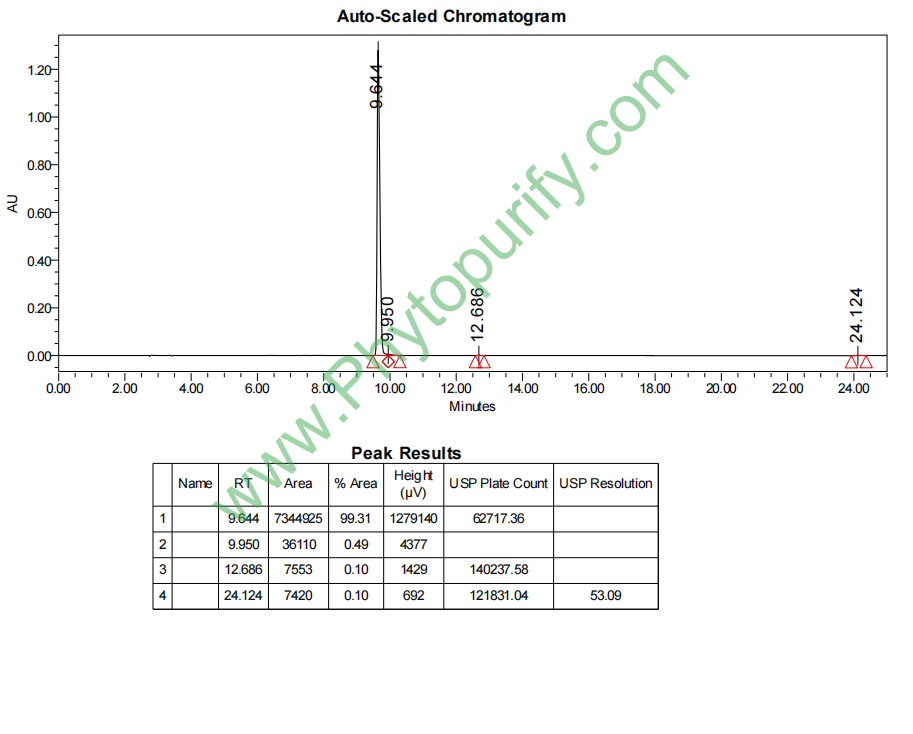
Purity: 95%~99%
Analysis Method: HPLC-DAD or/and HPLC-ELSD
Identification Method: Mass, NMR
Packing: Brown vial or HDPE plastic bottle
Can be supplied from milligrams to grams.
For Reference Standard and R&D, Not for Human Use Directly.
Inquire for bulk scale.
HPLC of N-nornuciferine
Storage conditions:Short-term storage at 2~8℃, long-term storage at -20 ~ -80℃
Natural products, as an important source of drug discovery, occupy an irreplaceable position in modern pharmacological research. Nelumbo nucifera Gaertn, as a traditional Chinese medicinal herb, has been widely studied for its various bioactive components. N-nornuciferine (CAS number: 4846-19-9) is an important aporphine alkaloid in lotus leaves, which has attracted attention in recent years due to its significant pharmacological activity and potential clinical application value. This compound not only exhibits regulatory ability on multiple cardiovascular related targets, but also shows strong inhibitory effects on drug metabolizing enzyme CYP2D6, suggesting its potential role in drug interactions and cardiovascular disease treatment.
The purpose of this article is to systematically review the chemical structure, physicochemical properties, plant sources, and extraction methods of N-demethylated lotus leaf alkaloids, deeply explore their pharmacological activities and mechanisms of action, evaluate their pharmacological properties and pharmacokinetic characteristics, and finally look forward to their clinical application prospects, providing theoretical basis and reference for subsequent basic and applied research.
N-demethylated lotus leaf alkaloid belongs to the aporphine alkaloids, with a molecular formula of C19H23NO2 and a molecular weight of 281.3550. Its structural characteristic is a typical alkaloid skeleton, containing a demethylated nitrogen atom that endows it with unique chemical activity. In terms of physical and chemical properties, the LogP value of N-demethylated lotus leaf alkaloid is 3.2819, indicating its moderate lipid solubility, which is beneficial for cell membrane penetration and in vivo distribution. Its topological polar surface area (TPSA) is 30.4900, and lower polarity helps to pass through the blood-brain barrier (BBB), which is consistent with its high blood-brain barrier permeability. In addition, the compound has low water solubility (0.2494), indicating that it may exist in the form of liposomes or binding proteins in vivo.
It is worth noting that N-demethylated lotus leaf alkaloid has hERG channel inhibitory activity, indicating that it may pose a risk to cardiac electrophysiological safety and should be given special attention in the drug development process. In addition, the Ames test result was 0.6, indicating a low risk of genotoxicity and a good safety basis.
N-demethylamine mainly exists in the leaves of lotus leaves (Nelumbo nucifera Gaertn) and is an important component of aporphine alkaloids in lotus leaves. As a traditional Chinese medicinal herb, lotus leaves are widely distributed in many regions of Asia, especially in China, Japan, and India. Its medicinal history is long, mainly used to treat obesity, hyperlipidemia, and cardiovascular diseases.
The common methods for extracting N-demethylated lotus leaf alkaloids include organic solvent extraction, acid-base adjustment, liquid-liquid distribution, and column chromatography purification. Generally, ethanol or methanol is used as the extraction solvent, and the extraction efficiency is improved by ultrasound assisted extraction or reflux extraction. Subsequently, the alkaloids were separated from the plant matrix using acid-base regulation, and purified using techniques such as silica gel column chromatography and reverse phase high performance liquid chromatography (RP-HPLC). In recent years, supercritical fluid extraction and molecular imprinting techniques have also been explored to improve extraction purity and efficiency.
The optimization of extraction process not only affects the yield of N-demethylamine, but also relates to the maintenance of its biological activity and the removal of impurities, which is a key link in achieving its large-scale production and clinical application.
The pharmacological activity research of N-demethylated lotus leaf alkaloid focuses on its protective effect on the cardiovascular system and its ability to regulate drug metabolizing enzymes. Multiple in vitro and in vivo experiments have shown that this compound can significantly inhibit the activity of cytochrome P450 enzyme CYP2D6, with an IC50 of 3.76 μ M and a Ki value of 2.34 μ M, demonstrating strong enzyme inhibitory effects. This characteristic suggests that N-demethylamine may affect the metabolism of various CYP2D6 substrate drugs, with potential drug interaction risks.
In terms of cardiovascular protection, N-demethylamine exerts its effects by regulating multiple key targets, including selectins (SELP), peroxisome proliferator activated receptor gamma (PPARG), angiotensin-converting enzyme (ACE), protein kinase B (AKT1), β 2-adrenergic receptor (ADRB2), potassium channel protein KCNH2, nitric oxide synthase type 3 (NOS3), intercellular adhesion molecule (ICAM1), vascular cell adhesion molecule (VCAM1), and sodium calcium exchange protein (SLC8A1). The regulation of these targets involves multiple aspects such as vasodilation, inflammatory response, myocardial protection, and hemodynamic regulation.
Animal model studies show that N-norepine can reduce blood pressure, improve myocardial ischemia-reperfusion injury, inhibit inflammatory reaction of vascular endothelial cells, alleviate atherosclerosis, and has significant cardiovascular protection potential. In addition, its antioxidant and anti-inflammatory effects also provide important mechanistic support for its cardiovascular protective effects.
The mechanism of action of N-demethylated lotus leaf alkaloid is complex and diverse, mainly achieved through the synergistic regulation of multiple targets and pathways to achieve its pharmacological effects. Its inhibitory effect on CYP2D6 may be achieved through competitive binding with enzyme active sites, affecting the pharmacokinetics of drugs and suggesting potential risks in combination therapy.
In terms of cardiovascular protection, N-demethylamine reduces the adhesion and migration of inflammatory cells and inhibits vascular inflammatory responses by regulating cell adhesion molecules such as SELP, ICAM1, and VCAM1. By activating the PPARG and AKT1 signaling pathways, it promotes endothelial cell survival and functional recovery, and enhances vasodilation ability. The inhibitory effect of ACE helps to reduce levels of angiotensin II, alleviate vasoconstriction and hypertension.
The activation of ADRB2 regulates myocardial contractility and heart rate, the regulation of KCNH2 channels affects cardiac repolarization, and NOS3 promotes nitric oxide production, improving endothelial function. SLC8A1 regulates the intracellular calcium homeostasis of cardiomyocytes and protects them from calcium overload injury. The comprehensive regulation of these targets enables N-demethylamine to play a protective role in multiple pathological stages of cardiovascular disease.
Molecular docking and analysis of cell signaling pathways further confirmed the high affinity and regulatory ability of N-demethylamine to the aforementioned targets, providing a molecular basis for its pharmacological effects.
From the perspective of medicinal properties, N-demethylamine has certain advantages and challenges. Its moderate molecular weight (281.3550) and LogP value (3.2819) comply with Lipinski's rule, which is beneficial for oral absorption and in vivo distribution. The lower TPSA (30.4900) and high blood-brain barrier permeability suggest that it may play a role in the central nervous system, expanding its potential indications.
However, its low water solubility (0.2494) may limit its bioavailability and requires improvement in solubility through formulation techniques. Inhibition of hERG channels suggests a potential risk of cardiac toxicity and requires safety assessment and structural optimization in the early stages of drug development. The Ames test results show that its genotoxicity risk is low, providing a certain guarantee for clinical development.
Pharmacokinetic studies are still in the preliminary stage, and the metabolic pathways and clearance mechanisms in vivo have not been fully elucidated. Given its strong inhibitory effect on CYP2D6, N-demethylamine may affect its own and other drug metabolism, and drug interactions and dosage adjustments need to be given special attention.
Future research should focus on conducting systematic evaluations of in vivo pharmacokinetics, toxicology, and pharmacodynamics, and optimizing their safety and efficacy in combination with drug design.
As a natural aporphine alkaloid, N-norepine shows broad clinical application potential by virtue of its multi target cardiovascular protection and significant inhibition of CYP2D6. Its therapeutic value in hypertension, atherosclerosis, myocardial ischemia and inflammation related cardiovascular diseases deserves further exploration.
In addition, due to its high blood-brain barrier permeability, N-demethylamine may be applied in the treatment of neurological and cardiovascular diseases, such as cerebrovascular disease and neurogenic heart disease, expanding its indications.
However, clinical translation still faces many challenges, including improving water solubility and bioavailability, controlling the risk of cardiac toxicity, and evaluating drug interactions. In the future, these limitations need to be overcome through structural modification, dosage form optimization, and combination therapy strategies.
The implementation of multicenter clinical trials will be a key step in verifying their safety and effectiveness. At the same time, by combining modern drug design and systems biology techniques, in-depth analysis of its action network and molecular mechanism will promote the clinical application of N-demethylazine.
N-demethylamine, as an important aporphine alkaloid in lotus leaves, has attracted widespread attention due to its unique chemical structure and significant pharmacological activity, especially in cardiovascular protection and inhibition of drug metabolism enzymes. Its multi-target regulatory mechanism provides new ideas and strategies for the comprehensive treatment of cardiovascular diseases.
Despite facing challenges such as insufficient water solubility and potential cardiac toxicity, N-demethylamine still has a good pharmaceutical foundation and development potential. In the future, through systematic pharmacokinetics, safety evaluation, and clinical research, it is expected to achieve the transformation from natural products to clinical drugs, benefiting a large number of patients.
In summary, N-demethylated lotus leaf alkaloid not only enriches the research content of natural product pharmacology, but also provides valuable molecular templates and theoretical support for innovative drug development of cardiovascular diseases. Looking forward to more in-depth basic and applied research in the future to promote its clinical application.
