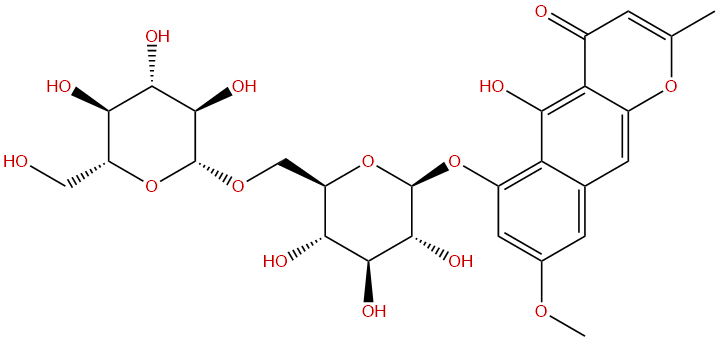


Product name: Rubrofusarin gentiobioside
Synonym name: Rubrofusarin-6-O-β-gentiobioside; Rubrofusarin-6-O-beta-gentiobioside
Catalogue No.: BP4016
Cas No.: 24577-90-0
Formula: C27H32O15
Mol Weight: 596.538
Botanical Source:
Physical Description:
Type of Compound:
Purity: 95%~99%
Analysis Method: HPLC-DAD or/and HPLC-ELSD
Identification Method: Mass, NMR
Packing: Brown vial or HDPE plastic bottle
Storage: Store in a well closed container, protected from air and light. Put into refrigerate or freeze for long term storage.
Whenever possible, you should prepare and use solutions on the same day. However, if you need to make up stock solutions in advance, we recommend that you store the solution as aliquots in tightly sealed vials at -20℃. Generally, these will be useable for up to two weeks.
The product could be supplied from milligrams to grams
Inquire for bulk scale.
For Reference Standard and R&D, Not for Human Use Directly.
Storage conditions:Short-term storage at 2~8℃, long-term storage at -20 ~ -80℃
Rubrofusarin-6-O - β - gentiioside (CAS number: 24577-90-0) is a natural product belonging to the glycoside class. Due to its unique chemical structure and potential biological activity, it has attracted widespread attention in the field of natural product pharmacology in recent years. This compound was originally derived from Rubrofusarin and combines the structural characteristics of glycosides and disaccharides, exhibiting unique advantages in water solubility, bioavailability, and pharmacological activity. With the gradual revelation of its pharmacological mechanism of action, red streptomycin gentiopicroside has shown great potential for application in various disease models such as anti-inflammatory, anti-tumor, and neuroprotective effects.
This article aims to systematically review the chemical structure and physicochemical properties, plant sources and extraction methods, pharmacological activity research, mechanism of action and molecular targets, pharmacological evaluation and pharmacokinetic characteristics of red streptomycin gentiopicroside. Finally, it explores its clinical application prospects and future development directions, in order to provide theoretical basis and practical guidance for related research and drug development.
The chemical name of Rubrofusarin-6-O - β - gentiobioside is Rubrofusarin-6-O - β - gentiobioside, with a molecular weight of 596.5380 Da. Its molecular structure consists of a glycoside moiety of red streptomycin connected to a β - gentiobiose via a 6-position hydroxyl group to form a glycosidic bond. This structure endows it with good water solubility (3.4339, water solubility index) and a LogP value of -0.3395, indicating low lipid solubility and high hydrophilicity.
Its topological polar surface area (TPSA) reaches 238.2 Å ², indicating that the molecule has strong polarity and may affect its cell membrane penetration ability. The blood-brain barrier (BBB) has low penetration ability and is suitable for drug development targeting peripheral targets. The hERG channel inhibition experiment result was negative, indicating that the compound has a low risk of cardiac toxicity. The Ames test score is 0.9, indicating a low risk of genotoxicity.
Overall, the physicochemical properties of red streptomycin gentiopicroside are suitable for development as a naturally occurring drug molecule with good water solubility and low toxicity. However, its high polarity and low lipid solubility may limit its oral bioavailability and central nervous system applications.
Red Streptomycin Gentianacide is mainly found in certain Streptomyces genera and some traditional Chinese medicinal plants, especially those that contain abundant glycoside compounds, such as Gentianaceae plants. The diversity of its natural sources provides a rich raw material foundation for its pharmacological research and drug development.
The extraction method usually uses organic solvent extraction combined with chromatographic separation technology. The specific process includes:
In recent years, emerging technologies such as ultrasound assisted extraction (UAE) and microwave-assisted extraction (MAE) have also been applied to the extraction of red streptomycin gentiopicroside, significantly improving extraction efficiency and purity.
The pharmacological activity research of red streptomycin gentian glycoside mainly focuses on anti-inflammatory, anti-tumor, antioxidant, and neuroprotective directions.
Multiple in vitro and in vivo studies have shown that erythromycin gentiopicroside can significantly inhibit the release of inflammatory mediators such as tumor necrosis factor - α (TNF - α), interleukin-6 (IL-6), and nitric oxide (NO). In a mouse acute inflammation model, the compound reduced tissue inflammation by inhibiting the nuclear factor kappa B (NF - κ B) signaling pathway, demonstrating good anti-inflammatory effects.
Red streptomycin gentian glycoside exhibits the ability to inhibit cell proliferation and induce apoptosis in various tumor cell lines. The mechanism involves activation of the mitochondrial pathway, which promotes the release of cytochrome C, activates the caspases family, and ultimately leads to programmed cell death. In addition, the compound can also block the tumor cell cycle, inhibit tumor cell migration and invasion, and demonstrate potential anti metastatic ability.
Red streptomycin gentian glycoside has strong free radical scavenging ability, which can reduce oxidative stress levels and protect nerve cells from oxidative damage. In a neurodegenerative disease model, this compound exhibits potential neuroprotective effects by regulating the intracellular antioxidant enzyme system (such as superoxide dismutase (SOD) and glutathione peroxidase (GPx)), reducing neuroinflammation and cell apoptosis.
The mechanism of action of red streptomycin gentiopicroside involves multiple signaling pathways and molecular targets, mainly including:
NF - κ B signaling pathway This pathway plays a crucial role in inflammation and tumor development. Red streptomycin gentian glycoside inhibits the phosphorylation and degradation of I κ B α, preventing NF - κ B transcription factors from entering the nucleus and reducing the expression of inflammatory cytokine genes.
Mitochondrial apoptosis pathway By regulating the balance of Bcl-2 family proteins, promoting changes in mitochondrial membrane permeability, releasing cytochrome C, activating caspase-9 and caspase-3, and inducing tumor cell apoptosis.
MAPK signaling pathway Red streptomycin gentian glycoside can regulate the phosphorylation status of p38 and ERK1/2, affecting cell proliferation and stress response.
Antioxidant enzyme system By upregulating the expression of antioxidant enzymes such as SOD and GPx, reducing the level of reactive oxygen species (ROS), and protecting cells from oxidative damage.
Cell cycle regulatory proteins Inhibit the expression of Cyclin D1 and CDK4, block the G1/S phase transition of the cell cycle, and suppress tumor cell proliferation.
The synergistic effect of these mechanisms enables red streptomycin gentiopicroside to exert multi-target and multi pathway pharmacological effects in various pathological states.
From the perspective of medicinal properties, red streptomycin gentiopicroside exhibits certain advantages and limitations:
In terms of pharmacokinetics, current research is relatively limited. Preliminary in vivo experiments have shown that the compound has poor oral absorption and is mainly absorbed through passive diffusion and active transport in the intestine. Its plasma half-life is moderate and it is mainly metabolized by the liver. The metabolites still need further identification. Due to its high polarity and large molecular weight, improving bioavailability is a key direction for future drug development.
Red streptomycin gentian glycoside has shown broad clinical application potential due to its multi-target pharmacological activity. Its anti-inflammatory and anti-tumor effects make it valuable in the fields of chronic inflammatory diseases and adjuvant therapy for tumors. The neuroprotective effect provides new ideas for the treatment of neurodegenerative diseases such as Alzheimer's disease and Parkinson's disease.
However, currently the compound is still in the stage of pharmacological activity and mechanism research, lacking systematic preclinical toxicology and pharmacokinetic data. Future research should focus on:
In summary, as a potential natural drug molecule, erythromycin gentiopicroside is expected to become an important candidate drug in the fields of anti-inflammatory, anti-tumor, and neuroprotective effects in the future.
Red streptomycin gentian glycoside, as a natural glycoside compound, has shown significant research value in the field of natural product pharmacology due to its unique chemical structure and diverse pharmacological activities. Its multiple biological effects such as anti-inflammatory, anti-tumor, and neuroprotective provide new ideas and potential drug candidate molecules for the treatment of related diseases.
Although the compound still faces certain challenges in terms of drug development and clinical application, with the advancement of extraction and purification technology, the deepening of pharmacokinetic research, and the development of new drug delivery systems, red streptomycin gentiopicroside is expected to be transformed from laboratory to clinical use, becoming an important direction for future natural drug development. We look forward to more systematic research in the future to reveal its mechanism of action and safety, laying a solid foundation for its clinical application.
