Introduction/Overview
Xylotetraose (CAS number: 22416-58-6), as a hydrolysis product of xylan, has attracted widespread attention in the field of natural product pharmacology in recent years. Xyloglycans are a type of polysaccharide abundant in plant cell walls, mainly composed of β - D-xylose units connected by β -1,4-glycosidic bonds. Wood tetrasaccharides, as its oligosaccharide form, have unique structural characteristics and biological functions, especially showing significant potential in prebiotic effects. With the deepening of research on gut microbiota, the regulatory effect of wood tetrasaccharides on gut health and their molecular targets related to immune regulation have gradually been revealed, becoming important candidate molecules in the development of natural products.
This article will provide a systematic review of the chemical structure and physicochemical properties, plant sources, and extraction methods of wood tetrasaccharides. The focus will be on exploring their pharmacological activity, mechanism of action, and related molecular targets. Combined with the evaluation of drug properties and pharmacokinetic characteristics, the clinical application prospects will be discussed, aiming to provide a theoretical basis and reference for the in-depth research and development of wood tetrasaccharides.
Chemical structure and physicochemical properties
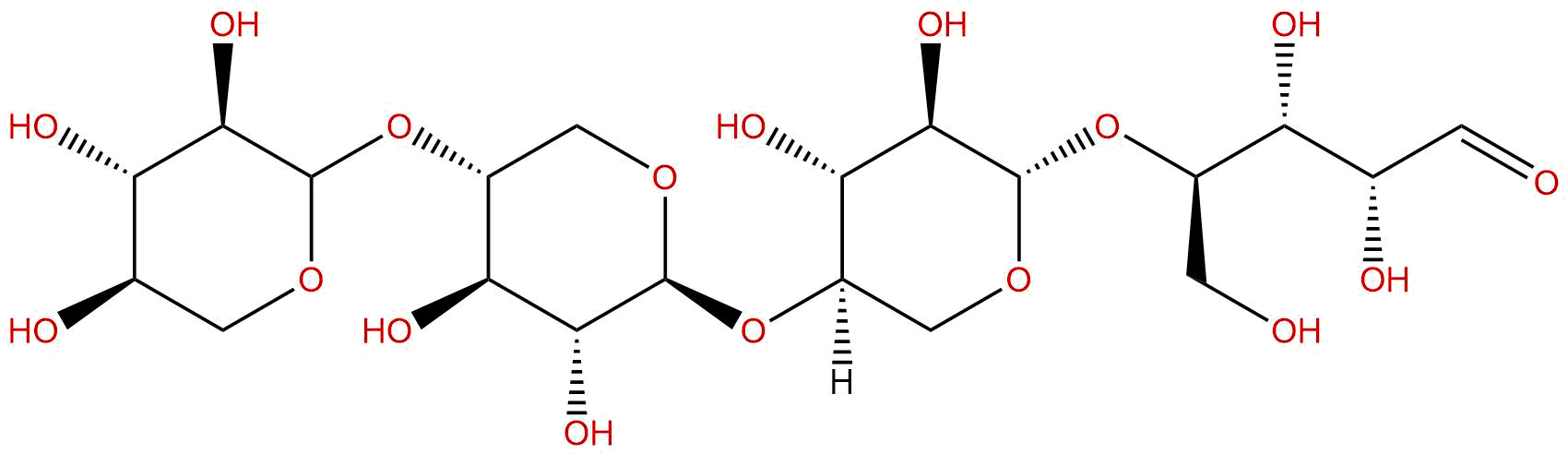
Xylose belongs to oligosaccharides, with a chemical formula of C20H34O19 and a molecular weight of 546.4750. Its structure consists of four β - D-xylose units linearly connected by β -1,4-glycosidic bonds, with high polarity and water solubility. The physicochemical properties of wood tetrasaccharides are as follows:
- molecular weight:546.4750 Da, Belonging to oligosaccharides with medium molecular weight.
- LogP-3.1128, showing its strong hydrophilicity and difficulty in penetrating lipid membranes.
- Polarized surface area (TPSA)274.7500 Å ² indicates high molecular polarity, which facilitates the formation of hydrogen bonds with water molecules.
- Water solubility:145.2948 mg/mL, Highly soluble in water, suitable for the study of aqueous biological systems.
- Blood-brain barrier permeability Low, indicating that wood tetrasaccharides are difficult to enter the central nervous system.
- HERG inhibition None, indicating a low risk of cardiac toxicity.
- Ames test 0.3, showing low mutagenicity.
The structural characteristics of wood tetrasaccharides make them mainly exert local intestinal functions in organisms, which are difficult to be decomposed by human digestive enzymes, thus possessing the potential as prebiotics.
Plant sources and extraction methods
Wood tetrasaccharides mainly come from the polysaccharides in plant cell walls and are widely present in grasses such as corn, wheat straw, rice straw, and wood. Xylan, as the main hemicellulose component of plant cell walls, can reach a content of 20% -35%. Xylose, as a hydrolysis product of xylan, is usually obtained through enzymatic or acid hydrolysis methods.
extraction method
-
Acid hydrolysis method
Using dilute acids (such as dilute hydrochloric acid and dilute sulfuric acid) to partially hydrolyze xylan under high temperature conditions, resulting in varying degrees of polymerization of xylose oligomers. This method is easy to operate, but it can lead to excessive hydrolysis of the product and the generation of by-products, resulting in low purity.
-
Enzymatic hydrolysis
Xylanase is used for specific enzymatic cleavage of xylan, which can control the degree of hydrolysis and obtain high-purity tetrasaccharides. This method is mild, highly selective, and has a uniform product structure, making it suitable for preparing functional oligosaccharides.
-
Separation and purification
The enzymolysis products were separated and purified by membrane filtration, ion exchange chromatography, gel permeation chromatography and other technologies to obtain high-purity xylotetraose. The key to the purification process is to remove monosaccharides, disaccharides, and other impurities to ensure functional activity.
resource advantage
Wood four sugar has a wide range of raw material sources, especially agricultural waste such as straw and sawdust, which have sustainable and economic advantages, in line with the concepts of green chemistry and circular economy.
Pharmacological activity research
The pharmacological activity of wood tetrasaccharides is mainly reflected in their prebiotic function and regulatory effects on the intestinal barrier and immune system. In recent years, relevant studies have gradually revealed its potential in maintaining intestinal health, immune regulation, and anti-inflammatory effects.
Probiotic effect
Wood tetrasaccharides, as prebiotics, can selectively promote the growth of beneficial gut microbiota such as Bifidobacterium and Lactobacillus, improve gut microbiota structure, and enhance gut microbiota balance. Research has shown that wood tetrasaccharides can serve as a carbon source for specific probiotics, promoting their metabolic activity and producing short chain fatty acids (SCFAs) such as acetic acid, propionic acid, and butyric acid, thereby exerting multiple physiological effects.
Improvement of intestinal barrier function
Wood tetrasaccharides enhance the barrier function between intestinal epithelial cells, reduce intestinal permeability, and prevent the invasion of harmful substances and pathogens by regulating the expression of tight junction proteins such as Occludin, Claudin-1, and ZO-1. Related in vitro and animal model studies have shown that wood tetrasaccharides can significantly upregulate the expression of OCTN, CLDN1, and ZO1 genes, promoting intestinal barrier repair.
Immune regulation and anti-inflammatory effects
Wood tetrasaccharides can promote the formation and repair of mucosal immune barriers by regulating intestinal immune related factors such as IL-22. IL-22, as a key mucosal repair factor, can promote epithelial cell proliferation and secretion of antimicrobial peptides. Wood tetrasaccharides have also been found to activate pattern recognition receptors TLR2 and TLR4, regulate immune cell activity, balance inflammatory responses, and alleviate intestinal inflammatory damage.
metabolic regulation
Xylose promotes the generation of SCFAs, activates G protein coupled receptors GPR41 and GPR43, and participates in energy metabolism regulation, lipid metabolism, and inflammation response regulation. SCFAs, as signal molecules, can affect the metabolic homeostasis of the host and have potential anti obesity and anti diabetes effects.
Mechanism of action and molecular targets
The biological function of wood tetrasaccharides mainly depends on their interaction with gut microbiota and host molecular targets. Its mechanism of action involves multiple signaling pathways and targets, as follows:
1. Probiotics promote and regulate metabolites
Wood tetrasaccharides, as prebiotics, promote the growth of beneficial bacteria such as Bifidobacterium bifidum (BIFIDO), enhance their metabolic activity, and produce SCFAs. SCFAs regulate intestinal immunity and metabolic function by activating GPR41 and GPR43 receptors.
2. Immune regulation: TLR2 and TLR4 signaling pathways
Wood tetrasaccharides can regulate TLR2 and TLR4 receptors on the surface of intestinal epithelial cells and immune cells, affect downstream NF - κ B signaling pathways, regulate the balance of pro-inflammatory and anti-inflammatory factors, and alleviate intestinal inflammatory responses.
3. Intestinal barrier repair: tight junction protein regulation
Xylose upregulates the expression of intestinal tight junction proteins MUC2 (mucin 2), OCLN (Occludin), ZO1 (Zonula occludin-1), and CLDN1 (Claudin-1), enhancing tight junctions between epithelial cells, maintaining the integrity of the intestinal barrier, and preventing the infiltration of pathogens and toxins.
4. Regulation of IL-22, a pro mucosal immune factor
IL-22 is an important cytokine that maintains the intestinal mucosal barrier and promotes epithelial cell repair. Wood tetrasaccharides regulate the intestinal immune environment, promote the expression of IL-22, and enhance mucosal defense ability.
5. Other potential targets
The study also suggests that wood tetrasaccharides may affect other signaling pathways, such as AMPK and PPAR γ, by regulating gut microbiota metabolites, participating in energy metabolism and inflammation regulation. However, the specific mechanism still needs further clarification.
Evaluation of drug properties and pharmacokinetics
As a natural oligosaccharide, wood tetrasaccharide has the following characteristics in terms of medicinal properties:
Absorption and distribution
- Due to its large molecular weight and strong polarity (LogP=-3.11, TPSA=274.75), wood tetrasaccharides are difficult to be directly absorbed by small intestinal epithelial cells after oral administration, and are mainly fermented and metabolized by intestinal microorganisms in the colon.
- The low permeability of the blood-brain barrier limits its function in the central nervous system.
Metabolism and excretion
- Wood tetrasaccharides are not easily broken down by human digestive enzymes and are mainly metabolized by gut microbiota to produce small molecule metabolites such as SCFAs.
- Metabolites can be absorbed by the host and participate in energy metabolism and immune regulation.
- Unabsorbed xylose and its metabolic residues are excreted from the body through feces.
safety evaluation
- The hERG channel inhibition experiment showed a negative result, indicating a low risk of cardiac toxicity.
- The Ames test results showed low mutagenicity and good safety.
- At present, there are no reports of serious toxic side effects that meet the safety requirements of prebiotic natural products.
Drug interactions
- Due to the fact that wood tetrasaccharides mainly act on the gut microbiota, they may affect the intestinal absorption and metabolism of shared drugs, and potential drug microbe interactions need to be considered.
In summary, wood tetrasaccharides have good safety and potential for medicinal use, especially as intestinal health regulators and functional food ingredients.
Clinical application prospects and prospects
With the in-depth study of the relationship between gut microbiota and host health, wood tetrasaccharides have broad prospects for development as a new type of prebiotic. It has potential application value in the following fields:
1. Adjuvant treatment for intestinal diseases
Wood tetrasaccharides have the potential to be used as adjunctive therapy for intestinal diseases such as inflammatory bowel disease (IBD) and irritable bowel syndrome (IBS) by regulating gut microbiota and enhancing intestinal barrier function, reducing inflammatory reactions and promoting mucosal repair.
2. Prevention and intervention of metabolic diseases
By promoting the production of SCFAs and activating GPR41/GPR43, xylotetraose may regulate lipid and sugar metabolism, and assist in the prevention and management of metabolic syndrome such as obesity and diabetes.
3. Immune regulation and anti-inflammatory effects
Wood tetrasaccharides regulate the TLR signaling pathway, balance immune responses, and have potential anti-inflammatory and immunomodulatory effects, making them suitable for adjuvant intervention in immune related diseases.
4. Functional foods and nutritional supplements
Wood tetrasaccharides, as a safe prebiotic ingredient, can be widely used in functional foods, nutritional supplements, and intestinal health products, meeting the market's demand for natural health products.
5. Future research directions
- In depth analysis of the mechanism Further elucidate the interaction mechanism between wood tetrasaccharides, gut microbiota, and host immune system.
- Clinical trial validation Conduct systematic clinical research to verify its safety and effectiveness.
- Structural modification and functional optimization By chemical or enzymatic modification, optimize the functional properties of wood tetrasaccharides and expand their application fields.
- Joint therapy development Combined application with probiotics, drugs, etc. to enhance treatment efficacy.
Conclusion
As an oligosaccharide hydrolysis product of xylan, wood tetrasaccharides exhibit significant prebiotic functions and potential for regulating intestinal health due to their unique chemical structure and good biocompatibility. It has broad application prospects in the prevention and adjuvant treatment of intestinal diseases and metabolic syndrome by regulating gut microbiota, enhancing intestinal barrier, regulating immune response, and promoting metabolic health. In the future, with the deepening of molecular mechanism research and the advancement of clinical verification, wood tetrasaccharide is expected to become an important functional component in the field of natural product pharmacology, providing new support for human health.
In summary, as a safe and efficient natural oligosaccharide, wood tetrasaccharide has good medicinal properties and application potential, and deserves continuous attention and in-depth exploration in basic research and clinical development.