Ganxi Salvia Acid A: A Potential Anti Pulmonary Fibrosis Natural Phenolic Acid Derived from Salvia miltiorrhiza
1. Overview
Przewalskinic acid A, CAS number 136112-75-9, is a natural phenolic acid compound isolated from plants of the Salvia genus in the family Lamiaceae. Its first report comes from Salvia przewalskii(Salvia przewalskii Maxim), But it is worth noting that in more well-known and widely used medicinal plants Salvia miltiorrhiza There may also be or be structurally similar compounds present in Salvia miliotrhiza Bunge. Danshen, as a core member of traditional Chinese medicine, is known for its ability to promote blood circulation, remove blood stasis, and relieve pain. Its chemical composition and pharmacological activity have always been a hot topic in the field of natural medicinal chemistry. The discovery of Salvia miltiorrhiza acid provides a new chemical basis and mechanism of action for the medicinal value of Salvia miltiorrhiza and its related plants.
The existing research description indicates that Ganxi Salvia acid methyl is a Water solubility、Significant biological activity Rare ingredients. Preliminary pharmacological studies have shown that these phenolic acid compounds exhibit Powerful antioxidant activity And it has the ability to protect the heart and brain from damage Ischemia-reperfusion injury The potential. Further research has revealed its relationship with Pulmonary fibrosis The potential association of this major disease is to intervene in the fibrosis process by acting on multiple key targets. This article will provide a systematic professional popular science interpretation of this natural product with potential for development from the aspects of its chemical essence, plant origin, pharmacological mechanism, medicinal evaluation, and research prospects.
2. Chemical structure and physicochemical properties
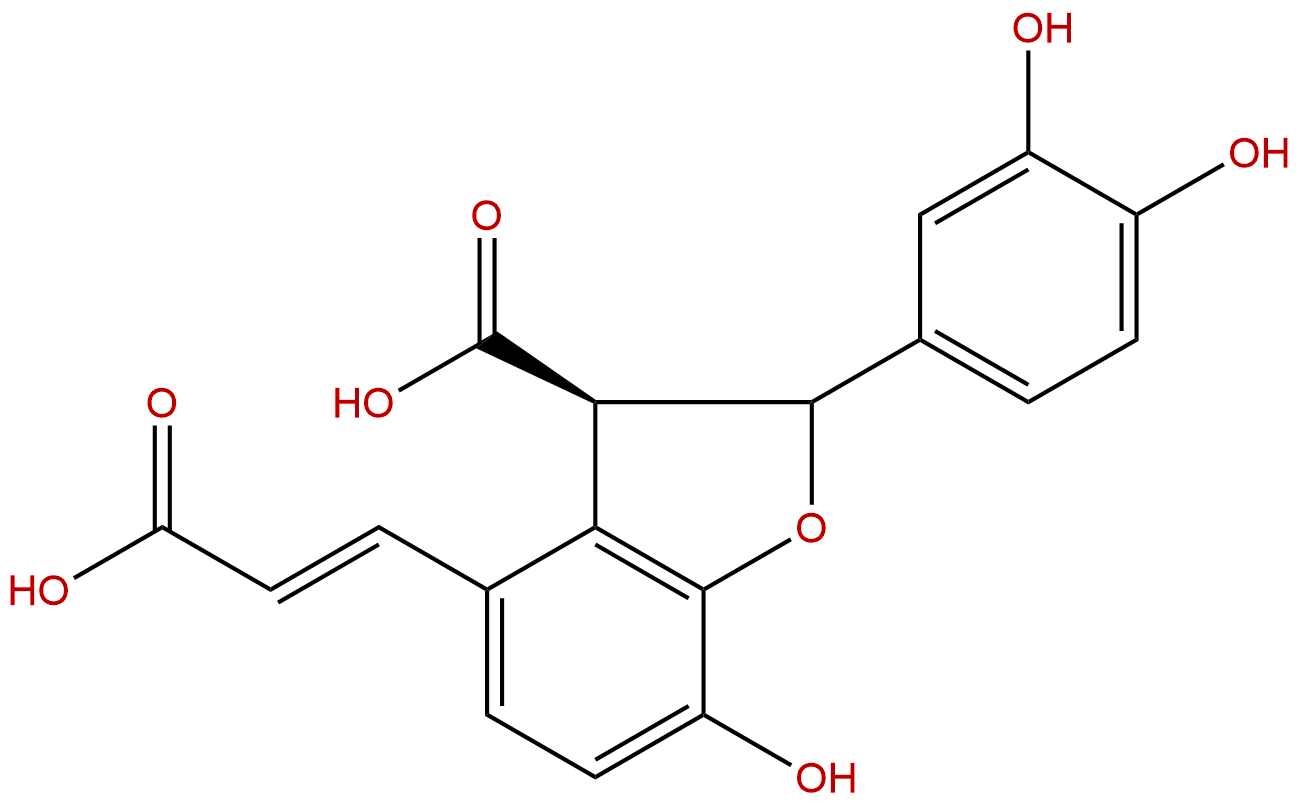
The molecular formula of Ganxi Salvia acid A is C18H14O8 The molecular weight is 358.3020 g/mol From the SMILES structural formula (O=C (O)/C=C/c1ccc (O) c2c1 C@@H C (c1ccc (O) c (O) c1) O2) can be analyzed for its core structural features: the molecule contains a Dihydrofuran ring(also known as benzodihydrofuran skeleton), which is connected to Caffeic acid(Caffeine acid) structural fragments and multiple phenolic hydroxyl groups. There is a chiral center in the molecule (represented by [C @ @ H]), indicating that it is Chiral molecule Its three-dimensional configuration may have a significant impact on its biological activity. This structure, which combines caffeic acid units with a dihydrobenzofuran skeleton, is distinctive in natural products and serves as the structural basis for its high activity.
Analyze its physicochemical properties based on the provided pharmacological parameters:
- Fat water partition coefficient The calculated LogP value is 1.6512, while the LogD value (at physiological pH) is -1.4296. LogD is significantly lower than LogP, indicating that under pH conditions close to physiological environment, due to the presence of multiple phenolic hydroxyl and carboxyl groups in the molecule ionization, its Greatly enhanced hydrophilicity This is consistent with the characteristic of "water solubility" described.
- Polar Surface Area The topologically polar surface area (TPSA) is as high as 144.52 Å ², mainly attributed to the 2 carboxyl groups and multiple phenolic hydroxyl groups High TPSA typically indicates a strong ability for molecules to form hydrogen bonds with solvents, further explaining their good water solubility, but may also affect their transmembrane permeability.
- solubility The water_stolubility value is 0.4591 (usually measured in mg/mL or log mol/L, not specified here, but can be understood as having good solubility in context).
- molecular weight:358.30 g/mol, Below 500 Da, it falls within the common range of small molecule drugs.
These physicochemical properties determine the basic behavior of Ganxi rat tail oxalate in vivo: it is easy to dissolve in body fluids, but its ability to cross lipid bilayer biofilms (such as intestinal epithelial cell membranes and blood-brain barriers) may be limited.
3. Plant sources and traditional applications
The direct plant source of Salvia miltiorrhiza acid methyl is Salvia przewalskii(Salvia przewalskii Maxim), It is a closely related plant of Salvia miltiorrhiza, also belonging to the Lamiaceae family and Salvia genus. Sage plants have a wide variety of species worldwide, many of which have a long history of medicinal use.
However, what is more worth exploring in depth is its association with plants——Salvia miltiorrhiza Danshen, also known as "Red Root" or "Red Ginseng", is a commonly used medicinal herb in clinical Chinese medicine for its dried roots and rhizomes. According to traditional Chinese medicine theory, Salvia miltiorrhiza has a slightly cold nature, a bitter taste, and is associated with the heart and liver meridians Promote blood circulation and remove blood stasis, unblock meridians and relieve pain, clear the heart and eliminate annoyance, cool blood and eliminate carbuncles The efficacy. Since ancient times, Danshen has been widely used for treatment Chest pain, epigastric pain, accumulation of symptoms, thermal pain, restlessness and insomnia, menstrual disorders, dysmenorrhea and amenorrhea, swelling and pain of ulcers Waiting for symptoms. In modern traditional Chinese medicine preparations, Danshen is the core raw material for cardiovascular disease treatment drugs such as Danshen Dropping Pills, Danshen Injection, and Compound Danshen Tablets.
Modern pharmacological research on Danshen has confirmed that its material basis for promoting blood circulation and removing blood stasis mainly includes two categories:Fat soluble tanshinones(such as tanshinone IIA) and Water soluble phenolic acids(such as salvianolic acid B and rosmarinic acid). As a new member of the phenolic acid family, Ganxi Salvia acid A not only enriches the chemical diversity of water-soluble active ingredients in Danshen, but also suggests that the efficacy of traditional Chinese medicine Danshen in treating "pathological accumulation" (similar to tissue fibrosis and proliferative diseases in modern medicine) may be partially due to the inhibitory effect of such phenolic acid components on the fibrosis process. This reflects the inheritance and innovation from traditional medicinal experience to modern molecular mechanism interpretation.
4. Pharmacological activity and mechanism of action
The pharmacological activity research of Salvia miltiorrhiza acid A is currently in its early stages, but it has shown clear direction, especially focusing on Anti organ fibrosis Especially Anti pulmonary fibrosis The function. Its mechanism of action is related to the regulation of multiple key targets closely related to the fibrosis process.
Related diseases: Pulmonary fibrosis
Pulmonary fibrosis is a condition characterized by Excessive deposition of extracellular matrix (ECM) in pulmonary interstitium and abnormal proliferation and activation of fibroblasts/myofibroblasts Chronic, progressive, and fatal interstitial lung disease characterized by. The pathological core is Abnormal repair of alveolar epithelial cells after repeated injury This leads to sustained release of pro fibrotic factors, ultimately resulting in structural damage to lung tissue and loss of gas exchange function. The prognosis of idiopathic pulmonary fibrosis (IPF) is extremely poor, and existing treatment drugs are limited. There is an urgent need to develop new treatment strategies.
Analysis of Key Targets and Mechanisms of Action:
The target information of Ganxi Salvia acid A points to the classical pro fibrotic signaling pathway——TGF - β 1/Smad pathway This pathway is the 'core engine' that drives the fibrosis process.
1. TGFB1 (Transforming Growth Factor - β 1)This is the most potent pro fibrotic cytokine. In the damaged lung tissue, TGF - β 1 is extensively activated, initiating a fibrotic cascade reaction.
2. SMAD3: is a key intracellular signal transduction protein downstream of TGF - β 1 signaling. Activated TGF - β 1 receptor phosphorylates Smad2/3, causing it to bind with Smad4 to form a complex and be transferred into the nucleus, regulating target gene transcription.
3. COL1A1 (type I collagen alpha 1 chain)It is the most important collagen protein in the extracellular matrix. The TGF - β 1/Smad3 pathway directly upregulates the transcription of COL1A1, leading to excessive collagen synthesis and deposition, resulting in fibrotic scars.
4. CTGF (Connective Tissue Growth Factor)It is an important pro fibrotic factor downstream of TGF - β 1, which can amplify and prolong the pro fibrotic effect of TGF - β 1, directly stimulating fibroblast proliferation and collagen synthesis.
5. TIMP1 (Matrix Metalloproteinase Tissue Inhibitor-1)During the process of fibrosis, not only does ECM synthesis increase, but its degradation is also inhibited. TIMP1 can inhibit the activity of matrix metalloproteinases (MMPs), reduce ECM degradation, and lead to increased net deposition.
Mechanism integration explanation:
Based on the above targets, it can be reasonably inferred that the anti pulmonary fibrosis mechanism of Ganxi Salvia acid A may be through Inhibition of TGF - β 1 expression or signal transduction Furthermore Block downstream Smad3 phosphorylation/activation This upstream intervention resulted in the inhibition of transcription of a series of pro fibrotic downstream genes, such as COL1A1 and CTGF. At the same time, it may also regulate ECM metabolic balance, such as affecting the expression of TIMP1, thereby indirectly promoting abnormal deposition of collagen degradation. Ultimately, these multi-target effects converge into Reduce the excessive synthesis and deposition of ECM such as collagen, inhibit the activation of myofibroblasts, and delay or reverse the progression of pulmonary fibrosis。
In addition, it Powerful antioxidant activity They also play an important role in this process. Oxidative stress is an important trigger and driving factor for pulmonary fibrosis, which can activate signaling pathways such as TGF - β 1. Ganxi Salvia acid A can alleviate epithelial cell damage from the source and indirectly inhibit fibrosis initiation by clearing free radicals and reducing oxidative damage.
5. Evaluation of drug properties
Drug efficacy assessment aims to predict the likelihood of a small molecule compound developing into an oral medication. We combined Lipinski's Rule of Five (Ro5) and other key parameters to analyze Salvia miltiorrhiza acid methyl:
Lipinski's Five Rules Compliance Status:
1. Molecular weight (MW)<500 Da:358.30, in accordance with.
2. Lipid water partition coefficient (calculated LogP)<5:1.65, in accordance with.
3. Number of hydrogen bond donors (HBD)<5: Based on the structure, it contains 2 carboxyl groups (- COOH) and at least 3 phenolic hydroxyl groups (- OH), with a total HBD>5,not conform to。
4. The number of hydrogen bond acceptors (HBA) is less than 10: the molecule contains 8 oxygen atoms (C18H14)O8)Both can serve as hydrogen bond acceptors, with a quantity of 8, which is consistent.
Ganxi Rat Tail Oxalate Number of hydrogen bond donors Violation of Lipinski's Rule (Rule Three of the Five). This usually indicates its Oral bioavailability may be low Because excessive hydrogen bond donors can strongly interact with water molecules in the gastrointestinal tract and affect their ability to penetrate the lipid membrane of intestinal epithelial cells.
In depth interpretation of other key pharmacological parameters:
- Permeability and absorption:
- Caco-2 permeability: 0.9906 (low value), indicating its permeability through the intestinal epithelial model Moderate to weak Consistent with the judgment of high TPSA (144.52) and more hydrogen bond donors/acceptors.
- Effective permeability (Peff)2.2238, this value needs to be judged according to the specific model standards, but combined with other parameters, it is speculated that its oral absorption may be poor.
- Blood-brain barrier (BBB) penetrability Clearly labeled as' low '. This is consistent with its high polarity and low fat solubility characteristics. For the treatment of peripheral diseases such as pulmonary fibrosis, low BBB penetration may not be a disadvantage, but rather can reduce the risk of central nervous system side effects.
- Distribution and protein binding:
- Plasma protein binding rate (PPB)87.37%, belonging to Highly plasma protein binding This will affect its free drug concentration and may require higher doses to achieve effective therapeutic concentrations, but it may also prolong its half-life.
- Metabolism and toxicity:
- Ames test: 0.0 (usually indicating negative), prompt No mutagenicity Low risk of genetic toxicity.
- chromosome aberration Marked as' Yes', this is a Potential genetic toxicity risk signals It needs to be confirmed through more comprehensive experiments (such as in vivo micronucleus test) in subsequent development.
- HERG inhibition No "means there is no significant inhibitory effect on the cardiac potassium ion channel (hERG),Low risk of cardiac toxicity。
- Hepatotoxicity markers Ser_LK, Ser_CGT, Ser_ST, and Ser_LT are all marked as "Yes", indicating that they may be present under experimental conditions Observation of elevated liver enzymes There is a potential risk of liver damage that requires high attention.
- Other toxicities Skin sensitization, respiratory sensitization, and phototoxicity are all negative, which is positive information.
Comprehensive Assessment:
Ganxi Salvia Acid A as lead compound Its advantage lies in its clear Multi target anti fibrotic mechanism and Good water solubility However, its medicinal properties face major challenges:Oral bioavailability may be low Due to its high polarity and multiple hydrogen bond donors, it exists Potential risk of hepatotoxicity and chromosomal aberration These features may make it more inclined to be developed as Injection type(such as intravenous administration, bypassing absorption issues), or as The starting point of structural optimization By using medicinal chemical methods to modify its structure (such as making prodrugs, esterifying some hydroxyl groups to reduce polarity, and reducing hydrogen bond donors), it is expected to improve its pharmacokinetic properties and safety while maintaining its activity.
6. Research Status and Application Prospects
Research status:
At present, there are relatively few publicly available research literature on Salvia miltiorrhiza acid A, and it is still in its infancy Early discovery and mechanism exploration stage The existing data mainly focuses on its chemical structure identification, preliminary in vitro antioxidant activity evaluation, and the association with TGF - β/Smad pathway and pulmonary fibrosis suggested by computational biology or preliminary experiments. There are still many gaps that need to be filled in the in vivo pharmacological validation, detailed pharmacokinetic studies, and systematic safety evaluation of it in animal models, especially pulmonary fibrosis models such as bleomycin induced mouse models. Further chemical analysis is needed to confirm whether it does indeed exist in the commonly used medicinal herb Danshen and constitutes a part of its pharmacological substance basis.
Application Prospects:
1. Development of anti fibrotic drugs Given the significant unmet clinical needs of diseases such as pulmonary fibrosis, Ganxi rat tail oxalate methyl, with its unique multi-target mechanism of action, is worth further investigation Anti fibrotic candidate molecule The focus of future research should be on confirming its anti fibrotic efficacy in vivo and optimizing its pharmacological properties.
2. Modernization of Traditional Chinese Medicine and Quality Markers If subsequent research confirms its stable existence and contribution to the efficacy of Danshen, it may become a medicinal herb and its preparations (used for the treatment of cardiovascular and cerebrovascular diseases and possible anti fibrotic applications) of Danshen Potential quality indicators One of them is to provide new scientific basis for the standardization and internationalization of Danshen.
3. Lead compounds and structural optimization Its chemical structure provides a valuable template for medicinal chemists. By synthesizing its derivatives or analogues, it is expected to obtain more active, orally bioavailable, and less toxic compounds New generation anti fibrotic compounds。
4. Combination therapy strategy Considering the complexity of fibrotic diseases, ganxi salvianolic acid methyl may be combined with existing anti fibrotic drugs (such as nintedanib, pirfenidone) or other drugs with mechanisms of action in the future to explore the possibility of synergistic treatment.
Summary:
Ganxi Salvia acid A is a natural phenolic acid with distinct chemical characteristics and clear biological activity direction discovered from the traditional medicinal plant Salvia miltiorrhiza and its related species. It is like a "multi toothed key" that can simultaneously act on TGF - β 1/Smad, the "core lock core" that drives fibrosis, and its multiple downstream effects "lock springs", demonstrating good potential for intervening in pulmonary fibrosis diseases. Despite facing challenges in drug development such as oral absorption and potential toxicity, its discovery undoubtedly opens a new window for finding anti fibrotic weapons from the treasure trove of natural products. With further in-depth systematic research, whether it is developed as an injectable form or structurally innovated based on it, Ganxi rat tail oxalate may contribute to the fight against major diseases such as pulmonary fibrosis with the wisdom of traditional herbal medicine.