Poricoic acid B: Progress and prospects in pharmacology research of natural products
Introduction/Overview
Natural products, as an important source of drug discovery, play an irreplaceable role in the long history of human fight against diseases. Chinese traditional medicine Poria cocos(Poria cocos (Schw.) Wolf is a dried sclerotium of Poria cocos, a fungus in the family Poriaceae. It was first recorded in the "Shennong Bencao Jing" and is classified as a top-grade product. It has the effects of promoting diuresis and dampness, strengthening the spleen and calming the heart, and is widely used in the treatment of edema, phlegm retention, spleen deficiency diarrhea, palpitations and insomnia. Modern pharmacological research has shown that Poria cocos contains various active ingredients, including triterpenoids, polysaccharides, sterols, etc. Among them, triterpenoid compounds have attracted much attention due to their significant biological activities.
Poricoic acid B (PAB) is a natural product with a triterpenoid skeleton isolated from the mycelium of Poria cocos, belonging to the lanolin type triterpenoid acid compounds. Since its first isolation and identification, Poria cocos acid B has attracted extensive research interest from scholars at home and abroad due to its unique chemical structure and diverse pharmacological activities, especially anti-tumor and immune regulatory activities. In recent years, with the continuous deepening of research on Poria cocos acid B, its mechanism of action in anti-tumor, anti-inflammatory, antioxidant, immune regulation and other aspects has gradually been elucidated, demonstrating great potential as a lead compound or candidate drug.
This article aims to systematically review the chemical structure and physicochemical properties, plant sources and extraction methods, pharmacological activity research, mechanism of action and molecular targets, pharmacological evaluation and pharmacokinetic characteristics of Poria cocos acid B. It also looks forward to its clinical application prospects, in order to provide reference for the in-depth research and development of this natural product.
Chemical structure and physicochemical properties
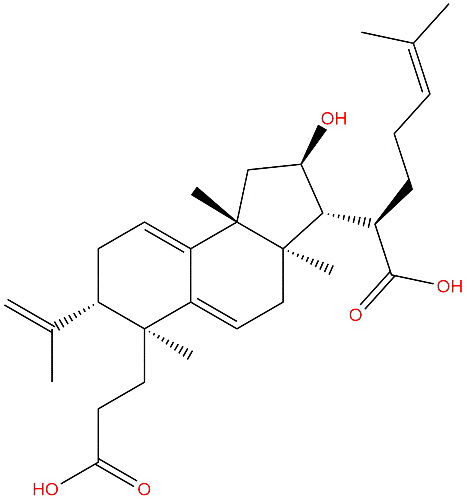
The chemical name of Poria cocos acid B is 3 β, 16 α - dihydroxy-24-methyl-2-lanolanan-8-ene-21-acid, which belongs to the tetracyclic triterpenoid class. Its parent nucleus is lanostane type skeleton. The molecular formula of this compound is C ∝₀ H ₄₆ O ₅, with a molecular weight of 484.6770 g/mol. Structurally, the parent nucleus of Poria cocos acid B contains a tetracyclic system of cyclopentane and polyhydrophenanthrene, with one hydroxyl substitution at each C-3 and C-16 positions, one methylene group (=CH ₂) at C-24 position, and a carboxyl group at C-21 position. This unique structural feature endows Poria cocos acid B with specific physicochemical properties and biological activity.
In terms of physicochemical properties, the lipid water partition coefficient (LogP) of Poria cocos acid B is 5.1376, indicating its strong lipid solubility, which is consistent with the hydrophobic properties of its triterpenoid skeleton. The topological polar surface area (TPSA) is 94.8300 Å ², which is at a moderate level, indicating that the compound may have some oral absorption potential, but may also be limited by intestinal permeability. The water solubility parameter is 0.0246 mg/mL, which belongs to insoluble compounds, which to some extent limits their bioavailability. It is worth noting that the blood-brain barrier penetration ability of Poria cocos acid B is relatively low, indicating that its application in central nervous system related diseases may be limited, but it also reduces the potential risk of neurotoxicity. In addition, the hERG inhibition test result was negative, indicating that the compound has a low risk of causing QT interval prolongation in the heart; The Ames test result is 0.0, indicating no significant mutagenicity, which provides positive evidence for its safety evaluation.
From the perspective of structure-activity relationship, the C-21 carboxyl group of Poria cocos acid B is the key functional group for its interaction with the target protein, which may bind to the target through the formation of hydrogen bonds or ionic bonds. The hydroxyl groups at positions C-3 and C-16 also participate in hydrogen bonding interactions, which are crucial for maintaining the binding affinity between the molecule and the target. The methylene group at position C-24 may affect the conformational flexibility of the molecule, thereby affecting its binding mode with biomolecules. These structural features collectively determine the pharmacological activity spectrum of Poria cocos acid B.
Plant sources and extraction methods
Poria cocos acid B mainly comes from the porous fungus Poria cocos in the family Poriferae(Poria cocos)Dry sclerotia. Fuling is a medicinal and edible fungus with a medicinal history of thousands of years in China, mainly distributed in provinces such as Yunnan, Anhui, Hubei, and Henan. The medicinal part of Poria cocos is its sclerotia. According to different harvesting and processing methods, it can be divided into different product specifications such as Poria cocos, Poria cocos skin, Poria cocos chunks, and Poria cocos. Research has shown that the content of Poria cocos acid B in Poria cocos sclerotia varies depending on factors such as place of origin, harvest season, and processing methods, with higher levels typically found in Poria cocos skin.
The traditional methods for extracting active ingredients from Poria cocos mainly include solvent extraction, ultrasound assisted extraction, microwave-assisted extraction, etc. The most commonly used extraction solvents for triterpenoid compounds such as Poria cocos acid B are aqueous solutions of ethanol or methanol. Research has shown that using a 70% -80% ethanol aqueous solution as the extraction solvent and leaching at room temperature or heating conditions can achieve high extraction efficiency. Ultrasound assisted extraction technology destroys cell wall structure through cavitation effect, which can significantly shorten extraction time and improve extraction rate. Microwave assisted extraction utilizes the thermal and non thermal effects of microwaves to rapidly penetrate the solvent into the interior of medicinal herbs, accelerating the dissolution of target components.
In terms of separation and purification, the acquisition of Poria cocos acid B usually requires multiple chromatographic separation processes. Firstly, the crude extract of Poria cocos is subjected to liquid-liquid extraction using commonly used solvents such as petroleum ether, ethyl acetate, n-butanol, etc. The ethyl acetate extract is rich in triterpenoids. Subsequently, silica gel column chromatography, ODS reverse phase column chromatography, Sephadex LH-20 gel column chromatography and other methods were used for systematic separation. In recent years, high-speed countercurrent chromatography (HSCCC) and preparative high-performance liquid chromatography (pre HPLC) techniques have also been applied to the efficient separation and purification of Poria cocos acid B, which can obtain monomer compounds with a purity of over 98%.
It is worth noting that with the deepening of the concept of green chemistry, supercritical fluid extraction (SFE) technology, as an environmentally friendly extraction method, has also attracted attention for its application in the extraction of active ingredients from Poria cocos. By using supercritical CO ₂ as the extraction solvent and adding an appropriate amount of ethanol as the entrainer, triterpenoids from Poria cocos can be efficiently extracted under mild conditions, avoiding the problem of residual organic solvents. In addition, the enzyme assisted extraction method utilizes cellulases, pectinases, and other enzymes to disrupt the cell wall structure of Poria cocos sclerotia, which can also improve the extraction efficiency of Poria cocos neoacid B.
Pharmacological activity research
Antitumor activity
The anti-tumor activity of Poria cocos acid B is one of its most prominent pharmacological effects. A large number of in vitro and in vivo studies have shown that pachymenac acid B has significantly inhibited the proliferation of a variety of tumor cell lines, including liver cancer cells (HepG2, Huh7), lung cancer cells (A549, H1299), breast cancer cells (MCF-7, MDA MB-231), colorectal cancer cells (HCT116, SW480), prostate cancer cells (PC-3, DU145) and leukemia cells (HL-60, K562). Its anti-tumor activity is dose-dependent and time-dependent, with the half maximal inhibitory concentration (IC ₅₀) typically at the micromolar level.
In terms of its mechanism of action, Poria cocos acid B exerts anti-tumor effects through multiple pathways. Firstly, it can induce tumor cell apoptosis by activating the mitochondrial pathway (endogenous pathway) and death receptor pathway (exogenous pathway), upregulating the expression of pro apoptotic proteins Bax and Bak, downregulating the expression of anti apoptotic proteins Bcl-2 and Bcl xL, promoting the release of cytochrome c, activating the caspase cascade reaction, and ultimately leading to cell apoptosis. Secondly, Poria cocos acid B can induce cell cycle arrest, mainly by upregulating the expression of cell cycle dependent kinase inhibitors (CDKIs) such as p21 and p27, inhibiting the activity of Cyclin CDK complexes, and blocking the cell cycle in the G ₀/G ₁ phase or G ₂/M phase, thereby inhibiting tumor cell proliferation. In addition, Poria cocos acid B can also inhibit the migration and invasion ability of tumor cells by regulating the expression of epithelial mesenchymal transition (EMT) related markers such as E-cadherin, N-cadherin, Vimentin, etc., reducing the activity of matrix metalloproteinases (MMPs), and thus inhibiting tumor metastasis.
Immune regulatory activity
The immunomodulatory activity of Poria cocos acid B is another important pharmacological characteristic of it. Research has shown that this compound can regulate the functions of various immune cells, including macrophages, T lymphocytes, B lymphocytes, and natural killer (NK) cells. In macrophages, Poria cocos acid B can regulate its polarization direction, promote the transformation from M1 type to M2 type, or inhibit the excessive activation of M2 type macrophages, thereby exerting anti-inflammatory and immune regulatory effects. In terms of T cells, Poria cocos acid B can affect the differentiation balance of helper T cells (Th), regulate the ratio of Th1/Th2/Th17/Treg cells, and play an important role in maintaining immune homeostasis.
Specifically, Poria cocos acid B can affect immune response by regulating the Toll like receptor 4 (TLR4) signaling pathway. TLR4, as a pattern recognition receptor, plays a crucial role in recognizing pathogen associated molecular patterns (PAMPs) and damage associated molecular patterns (DAMPs). Poria cocos acid B can regulate the expression of TLR4 and downstream signal transduction, thereby affecting the activation of nuclear factor kappa B (NF - κ B), regulating the expression of inflammatory and immune regulatory factors. In addition, the compound can also affect the phosphorylation levels of signal transduction and transcription activator 3 (STAT3) and STAT4, regulate the secretion of cytokines such as interleukin-2 (IL-2), interleukin-10 (IL-10), interferon gamma (IFN - γ), and transforming growth factor beta 1 (TGF - β 1), thereby finely regulating the intensity and direction of immune response.
It is worth noting that Poria cocos acid B also has a regulatory effect on the expression of immune checkpoint molecule cytotoxic T lymphocyte associated protein 4 (CTLA-4) and forkhead box protein P3 (FOXP3). CTLA-4 is a negative regulator of T cell activation, while FOXP3 is a key transcription factor regulating T cells (Tregs). Fuling Xin Acid B may affect the immune suppression state in the tumor microenvironment and enhance anti-tumor immune response by regulating the expression of these molecules. This discovery provides a theoretical basis for the potential application of Poria cocos acid B as an immune checkpoint regulator.
Other pharmacological activities
In addition to anti-tumor and immune regulatory activities, Poria cocos acid B also exhibits various other pharmacological activities. In terms of anti-inflammatory effects, this compound can inhibit the inflammatory response of macrophages induced by lipopolysaccharide (LPS), reduce the production of inflammatory mediators such as tumor necrosis factor alpha (TNF - α), interleukin-6 (IL-6), nitric oxide (NO), and prostaglandin E ₂ (PGE ₂), and its mechanism is related to the inhibition of NF - κ B and mitogen activated protein kinase (MAPK) signaling pathways. In terms of antioxidant properties, Poria cocos acid B can clear free radicals, increase the activity of antioxidant enzymes such as superoxide dismutase (SOD) and glutathione peroxidase (GSH Px), reduce malondialdehyde (MDA) levels, and protect cells from oxidative stress damage. In addition, the compound also exhibits certain anti fibrotic activity, which can inhibit the activation of hepatic stellate cells, reduce collagen deposition, and improve liver fibrosis.
Mechanism of action and molecular targets
The pharmacological effects of Poria cocos acid B involve multiple signaling pathways and molecular targets, exhibiting characteristics of multi-target and multi pathway action. A deep understanding of its mechanism of action is of great significance for the further development and clinical application of this compound.
TLR4/NF - κ B signaling pathway
Toll like receptor 4 (TLR4) is one of the important targets of Poria cocos acid B. TLR4, as a key receptor of the innate immune system, can recognize various endogenous and exogenous ligands and activate downstream signaling cascades. Research has shown that Poria cocos acid B can directly bind to the extracellular domain of TLR4, regulate its conformational changes, and thus affect downstream signal transduction. In the resting state, TLR4 forms a complex with myeloid differentiation factor 2 (MD-2), and Poria cocos acid B may competitively bind to the ligand binding sites of MD-2 or TLR4, interfering with the recognition of agonists such as LPS, thereby inhibiting the overactivation of TLR4.
After TLR4 activation, signals are transmitted through two pathways: MyD88 dependent and MyD88 independent (TRIF dependent). The MyD88 dependent pathway activates IL-1 receptor associated kinases (IRAKs) and TNF receptor associated factor 6 (TRAF6), ultimately leading to the activation of NF - κ B and MAPK. NF - κ B is an important transcription factor that regulates the expression of various inflammatory factors, chemokines, and immune regulatory factors. Fuling Xin Acid B inhibits the phosphorylation and degradation of I κ B α, preventing the nuclear translocation of NF - κ B and thus suppressing its transcriptional activity. Meanwhile, the compound can also inhibit the phosphorylation of p38 MAPK, JNK, and ERK1/2, further suppressing inflammatory responses.
STAT3/STAT4 signaling pathway
The Signal Transduction and Transcription Activation Factor (STAT) family plays a central role in cytokine signaling and immune regulation. STAT3 and STAT4 are two other important targets of Poria cocos acid B. STAT3 can be activated by various cytokines (such as IL-6, IL-10) and growth factors, and is involved in cell proliferation, differentiation, apoptosis, and immune regulation. The sustained activation of STAT3 in tumor cells is closely related to the occurrence and development of tumors. Fuling Xin Acid B can inhibit the phosphorylation of STAT3, block its dimerization and nuclear translocation, thereby inhibiting the expression of downstream target genes (such as Cyclin D1, Bcl xL, VEGF, etc.) and exerting anti-tumor effects.
STAT4 mainly mediates the signal transduction of IL-12 and plays a key role in Th1 cell differentiation and IFN - γ production. The regulatory effect of Poria cocos acid B on STAT4 affects the Th1/Th2 immune balance. Research has shown that this compound can inhibit the phosphorylation of STAT4, reduce the production of IFN - γ, and thereby regulate excessive Th1 type immune responses. This role may have potential value in the treatment of autoimmune and inflammatory diseases.
Immune regulatory target network
The regulatory effect of Poria cocos acid B on the immune system involves a complex target network. In addition to TLR4, STAT3, and STAT4, this compound can also affect the expression and function of various immune related molecules. Interleukin-2 (IL-2) is a key cytokine for T cell growth and activation, and Poria cocos acid B can regulate the production of IL-2, affecting T cell proliferation and function. Interleukin-10 (IL-10) is an important anti-inflammatory cytokine mainly produced by Treg cells and Th2 cells. Poria cocos acid B can upregulate the expression of IL-10 and exert immunosuppressive effects.
Transforming growth factor beta 1 (TGF - β 1) has multiple functions in immune regulation, cell proliferation, and differentiation. Poria cocos acid B can regulate the expression of TGF - β 1, affecting the differentiation and function of Treg cells. CTLA-4, as an immune checkpoint molecule, negatively regulates T cell activation. The regulatory effect of Poria cocos acid B on CTLA-4 may affect anti-tumor immune response. FOXP3 is a specific transcription factor for Treg cells, and Poria cocos acid B can regulate the expression of FOXP3, affecting the quantity and function of Treg cells. In addition, the compound can also regulate the production of IFN - γ and affect Th1 type immune response.
In summary, Poria cocos acid B regulates the expression of various cytokines such as IL-2, IL-10, TGF - β 1, IFN - γ, and affects multiple signaling pathways such as NF - κ B and MAPK by acting on multiple targets such as TLR4, STAT3, and STAT4, forming a complex immune regulatory network. The multi-target and multi pathway characteristics of Poria cocos acid B make it have potential application value in tumor immunotherapy and autoimmune disease treatment.
Evaluation of drug properties and pharmacokinetics
Drugability assessment
The evaluation of drug properties is a crucial step in the transition of natural products from laboratory research to clinical applications. Based on the physicochemical properties and preliminary pharmacological data of Poria cocos acid B, a systematic evaluation of its pharmacological properties is of great significance.
In terms of molecular weight, the molecular weight of Poria cocos acid B is 484.68 Da, slightly higher than the threshold of molecular weight less than 500 in Lipinski's five rules, but still within an acceptable range. Its LogP value is 5.1376, slightly higher than the ideal range of lipid solubility (LogP 2-5), indicating that the compound may have high lipid solubility, which may lead to poor water solubility and metabolic stability issues. In fact, the water solubility of Poria cocos acid B is only 0.0246 mg/mL, which is a poorly soluble compound. This may be one of the main factors limiting its oral bioavailability.
The topological polar surface area (TPSA) is 94.83 Å ², which is at a moderate level. It is generally believed that compounds with TPSA less than 140 Å ² have good oral absorption potential. The TPSA value of Poria cocos acid B suggests that it may have some intestinal permeability, but poor water solubility may offset this advantage. Low blood-brain barrier penetration ability is a favorable feature that can reduce the risk of central nervous system side effects. The negative inhibition of hERG indicates a low risk of cardiac toxicity, and the negative Ames test indicates no significant genetic toxicity. These safety data provide positive support for the further development of Poria cocos acid B.
Overall, Poria cocos acid B has good target binding activity and selectivity, but there are issues with poor water solubility and high lipid solubility in its physicochemical properties. Therefore, it is necessary to improve its pharmacological properties through formulation techniques or structural modifications. Common strategies include preparing nano formulations, liposomes, cyclodextrin inclusion complexes, etc. to enhance their solubility and bioavailability. In addition, structural modification of Poria cocos acid B, introduction of hydrophilic groups or prodrug design, is also an effective way to improve its pharmacological properties.
Pharmacokinetic characteristics
Pharmacokinetic studies are an important means of evaluating the in vivo processes of candidate drugs. At present, there is insufficient systematic research on the pharmacokinetics of Poria cocos acid B, but some preliminary results are available for reference.
In terms of absorption, due to the poor water solubility of Poria cocos acid B, its oral absorption may be limited. Studies have shown that the oral bioavailability of triterpenoids is usually low, mainly limited by poor solubility and intestinal metabolism. The LogP value of Poria cocos acid B is relatively high, indicating that it may have good intestinal permeability, but poor water solubility may lead to slow dissolution rate and affect absorption. The use of solubilization technology or formulation methods is expected to improve its oral absorption.
In terms of distribution, Poria cocos acid B has high lipid solubility and may be widely distributed in various tissues in the body, especially in adipose tissue and liver. Its plasma protein binding rate may be high, which can affect the concentration and efficacy of free drugs. Low blood-brain barrier penetration ability is an advantageous feature that can reduce central nervous system side effects.
In terms of metabolism, triterpenoids are usually mainly metabolized by the liver cytochrome P450 enzyme system, and may undergo metabolic reactions such as hydroxylation, oxidation, and glucuronic acid binding. The C-3 and C-16 hydroxyl groups, as well as the C-21 carboxyl group, of Poria cocos acid B are potential metabolic sites. The activity and toxicity of metabolites need further research.
In terms of excretion, Poria cocos acid B and its metabolites may mainly enter the intestine through bile excretion, and some may be reabsorbed through the enterohepatic circulation, prolonging their retention time in the body. Renal excretion may not be the main pathway due to its high molecular weight and lipid solubility.
Overall, the pharmacokinetic characteristics of Poria cocos acid B require systematic research, particularly in key parameters such as oral bioavailability, metabolic stability, tissue distribution, and excretion pathways. These data are crucial for evaluating their clinical development potential.
Clinical application prospects and prospects
Antitumor therapy
Based on the significant anti-tumor activity and unique immune regulatory effect of Poria cocos acid B, it has broad application prospects in the field of tumor therapy. Firstly, Poria cocos acid B can be used as a chemotherapy sensitizer, in combination with conventional chemotherapy drugs, to increase the sensitivity of tumor cells to chemotherapy drugs, reduce the dosage and toxic side effects of chemotherapy drugs. Research has shown that Poria cocos acid B can inhibit the expression of multidrug resistance (MDR) related proteins in tumor cells, reverse tumor resistance, and enhance chemotherapy efficacy.
Secondly, Poria cocos acid B has potential application value in tumor immunotherapy. By regulating immune related targets such as TLR4, STAT3, CTLA-4, FOXP3, etc., Poria cocos acid B can reshape the tumor microenvironment and enhance anti-tumor immune response. Especially its regulatory effect on the immune checkpoint molecule CTLA-4 suggests that this compound may serve as an immune checkpoint inhibitor and be used in combination with immunotherapy drugs such as PD-1/PD-L1 inhibitors to enhance the efficacy of immunotherapy.
In addition, Poria cocos acid B can also be used as a tumor metastasis inhibitor, reducing the invasion and metastasis ability of tumor cells by inhibiting the activity of EMT and MMPs, which is of great significance for the treatment of advanced cancer patients.
Immune related diseases
The immunomodulatory activity of Poria cocos acid B makes it potentially applicable in the treatment of autoimmune and inflammatory diseases. By regulating the balance of Th1/Th2/Th17/Treg cells and inhibiting overactivated immune responses, Poria cocos acid B may have therapeutic effects on autoimmune diseases such as rheumatoid arthritis, inflammatory bowel disease, and psoriasis. Its anti-inflammatory activity also helps alleviate symptoms of inflammatory diseases.
In the field of organ transplantation, the immunosuppressive effect of Poria cocos acid B may help prevent transplant rejection. By regulating T cell activation and proliferation, inhibiting the expression of CTLA-4 and FOXP3, Poria cocos acid B may induce immune tolerance and prolong the survival time of transplants.
Combination therapy strategy
Given the multi-target nature of Poria cocos acid B, a combination therapy strategy may be the key to maximizing its therapeutic potential. Combined use with chemotherapy drugs such as cisplatin, paclitaxel, 5-fluorouracil, etc., can enhance anti-tumor efficacy and reduce drug resistance. Combined use with targeted therapeutic drugs such as sorafenib, gefitinib, etc., may synergistically inhibit tumor growth through different mechanisms. Combined use with immunotherapy drugs (such as PD-1/PD-L1 inhibitors, CTLA-4 inhibitors, etc.) can enhance anti-tumor immune response and improve the efficacy of immunotherapy.
Structural modification and drug design
Structural modification and drug design are important strategies to improve the pharmacological properties of Poria cocos acid B, which has poor water solubility and low bioavailability. By chemically modifying the hydroxyl groups at C-3, C-16, and carboxyl groups at C-21, hydrophilic groups (such as phosphate groups, amino acids, sugar groups, etc.) can be introduced to improve the water solubility of the compound. The prodrug design strategy, such as esterifying carboxyl groups into ester prodrugs, can improve intestinal absorption and enhance oral bioavailability. In addition, based on the interaction mode between Poria cocos acid B and target proteins, computer-aided drug design is expected to develop derivatives with stronger activity and higher selectivity.
Challenges and Prospects
Although Poria cocos acid B exhibits various pharmacological activities and good safety characteristics, its clinical development still faces many challenges. Firstly, poor water solubility and low bioavailability are the main bottlenecks restricting its clinical translation, which require the development of advanced formulation technologies or structural modifications to solve. Secondly, the mechanism of action of Poria cocos acid B has not been fully elucidated, especially its interaction patterns with multiple targets and cross regulation of signaling pathways, which require further research. Thirdly, large-scale production and quality control issues also need to be addressed to meet the needs of clinical research.
Looking ahead to the future, with the continuous deepening of research on Poria cocos acid B, its application prospects in tumor therapy and immune regulation will become clearer. Multidisciplinary interdisciplinary research, including collaborative efforts in fields such as medicinal chemistry, pharmacology, pharmacy, pharmacokinetics, etc., will promote the clinical application of Poria cocos acid B from laboratory research. I believe that in the near future, Poria cocos acid B and its derivatives are expected to become new candidate drugs for the treatment of tumors and immune related diseases.
Conclusion
As a natural triterpenoid compound isolated from traditional Chinese medicine Poria cocos, Poria cocos acid B has become one of the hotspots in the field of natural product research due to its unique chemical structure and diverse pharmacological activities. This article systematically reviews the chemical structure and physicochemical properties, plant sources and extraction methods, pharmacological activity research, mechanism of action and molecular targets, pharmacological evaluation and pharmacokinetic characteristics of Poria cocos acid B, and prospects its clinical application prospects.
Research has shown that Poria cocos acid B has significant anti-tumor activity, exerting anti-tumor effects through various mechanisms such as inducing apoptosis, blocking cell cycle, and inhibiting metastasis. At the same time, the compound exhibits important immune regulatory activity by acting on targets such as TLR4, STAT3, and STAT4, regulating the expression of various cytokines such as IL-2, IL-10, TGF - β 1, IFN - γ, and affecting multiple signaling pathways such as NF - κ B and MAPK, forming a complex immune regulatory network. These findings provide a scientific basis for the application of Poria cocos acid B in tumor immunotherapy and autoimmune disease treatment.
In terms of medicinal properties, Poria cocos acid B has good target binding activity and selectivity, with ideal safety characteristics. However, its poor water solubility and low bioavailability are the main bottlenecks restricting its clinical translation. Through formulation technology optimization and structural modification, it is expected to improve its drug properties and promote its clinical development process.
In summary, Poria cocos acid B, as a lead compound in the development of natural product drugs, has important research value and broad application prospects. In the future, it is necessary to further elucidate its mechanism of action, optimize its pharmacokinetic characteristics, develop efficient formulation technologies, and conduct systematic preclinical and clinical studies to fully leverage the potential value of this natural product in human health.