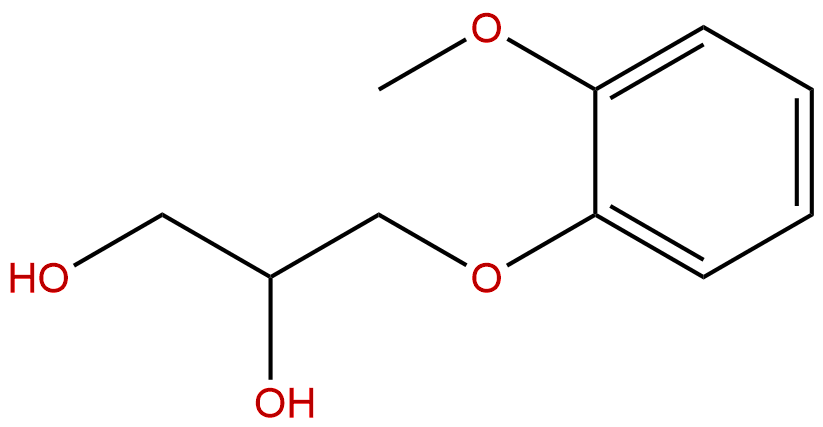


Product name: Guaifenesin
Synonym name: Equicol; Guaiphenesine
Catalogue No.: BP1646
Cas No.: 93-14-1
Formula: C10H14O4
Mol Weight: 198.218
Botanical Source:
Physical Description:
Type of Compound: Terpenoids
Purity: 95%~99%
Analysis Method: HPLC-DAD or/and HPLC-ELSD
Identification Method: Mass, NMR
Packing: Brown vial or HDPE plastic bottle
The product could be supplied from milligrams to grams. Inquire for bulk scale.
We provide solution to improve the water-solubility of compounds, thereby facilitating the variety of activity tests and clinic uses.
For Reference Standard and R&D, Not for Human Use Directly.
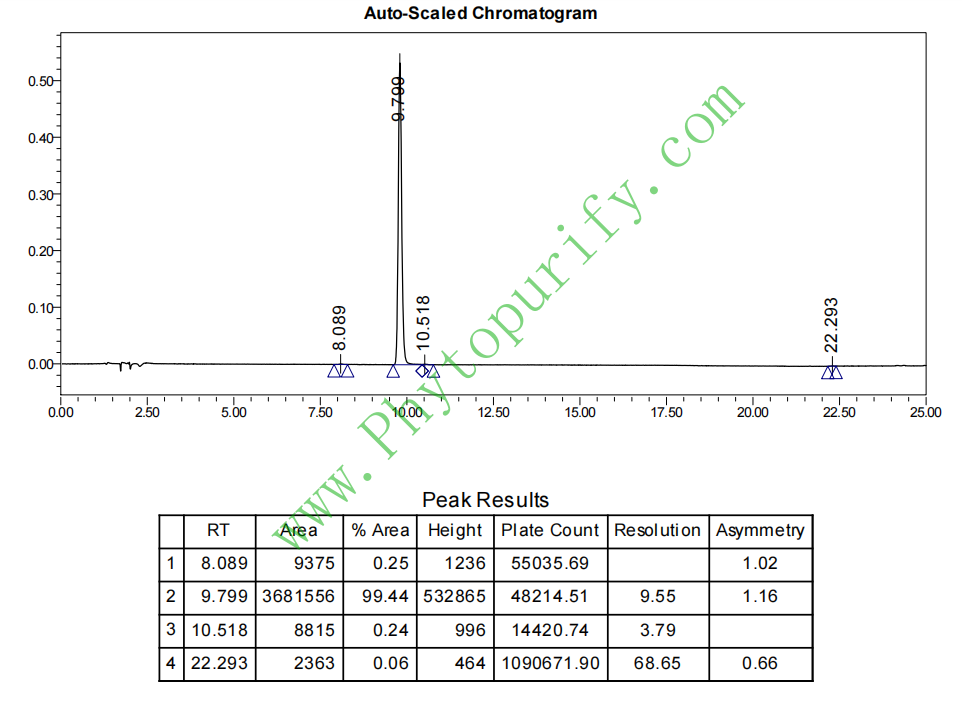
HPLC of Guaifenesin
Storage conditions:Short-term storage at 2~8℃, long-term storage at -20 ~ -80℃
58.9200
.7389
.7389
22.8682
2.8650
17.3589
High
49.0652
2.1007
Yes
No
No
No
No
No
0.0
No
Yes
No
Yes
Cough is one of the most common symptoms of respiratory diseases, which is not only a protective reflex for the body to clear foreign bodies and secretions in the respiratory tract, but also a major clinical manifestation of various acute and chronic diseases. When coughing becomes frequent, severe, or persistent, it seriously affects the patient's quality of life and requires targeted treatment. Expectorant treatment is an important strategy for cough management, which focuses on reducing the viscosity of sputum, promoting its excretion, thereby relieving cough and improving airway patency. Among numerous expectorant drugs, guaifenesin, as a classic drug with a long history and still widely used worldwide, has attracted much attention due to its good safety and definite efficacy. Yuchuang glycerol ether originates from the natural plant Yuchuang wood and is a model for early medicinal chemistry to search for active ingredients from natural products and successfully develop them into modern drugs. This article aims to systematically review the chemical properties, plant sources, pharmacological activities, mechanisms of action, medicinal properties, and clinical applications of guaiacol ether, in order to provide a comprehensive scientific perspective for the in-depth understanding and rational application of this classic drug.
Yuchuang glycerol ether, chemical name 3- (2-methoxyphenoxy) -1,2-propanediol, CAS number 93-14-1. The molecular formula is C10H14O4 and the molecular weight is 198.2180 g/mol. Structurally, guaiacol ether is composed of a guaiacol (o-methoxyphenol) group connected to a glycerol group (glycerol) through an ether bond. This structure combines a lipophilic aromatic ring and a hydrophilic polyol moiety, determining its unique physicochemical properties.
The calculated lipid water partition coefficient (LogP) is about 0.74, indicating that the compound has a certain degree of lipophilicity, but overall tends to be hydrophilic. The topological polar surface area (TPSA) is 58.92 Å ², reflecting the hydrogen bonding acceptance ability provided by oxygen atoms in the molecule. These parameters collectively explain its good water solubility, which has been reported to be around 22.87 mg/mL, providing favorable conditions for rapid absorption and distribution to the site of action after oral administration. The melting point of guaiacol ether is between 78-82 ° C, and it is usually a white or off white crystalline powder. The benzene ring and ether bond in its structure make it stable at room temperature, but it needs to be stored away from light and sealed. This "amphiphilic" structure is considered to be the key to its expectorant effect, allowing it to intervene at the interface between airway mucus and aqueous layer, thereby affecting the rheological properties of sputum.
The natural source of guaiacol ether is plants of the genus Guajacum, especially medicinal guajacum (Guajacum officinale L.) and sacred guajacum (Guajacum sanctum L.), which are mainly distributed in the Caribbean and Central America. The heartwood of Eucommia ulmoides has been used by local residents since ancient times to treat joint pain, syphilis, and other diseases. Its resin (Eucommia ulmoides resin) has also been used as a expectorant and antioxidant.
The initial guaiacol ether was not directly extracted in large quantities from plants, but was prepared by chemical synthesis using the active ingredient guaiacol in plants as the raw material. Guaiacol can be obtained from dried guaiacol or through chemical synthesis. The classic synthetic route is the Williamson ether synthesis reaction between guaiacol and 3-chloro-1,2-propanediol (or epichlorohydrin followed by hydrolysis) under alkaline conditions to produce guaiacol glycerol ether. Modern industrial production mainly adopts the total synthesis process, starting from catechol or o-methoxyphenol, and efficiently preparing through steps such as etherification, epoxidation, and ring opening to meet the huge global market demand. Therefore, although its origin is a natural product, almost all of the guaiacol ethers used today are synthetic, ensuring purity and supply stability.
The core pharmacological activity of guaiacol ether is its expectorant effect, and its effectiveness has been confirmed by numerous preclinical and clinical studies.
Expectorant effect Its expectorant effect is not achieved by stimulating the reflex of gastric mucosa to promote bronchial secretion (such as ammonium chloride), but directly acts on respiratory glands. Research has shown that guaiacol can stimulate goblet cells and mucous glands in the respiratory mucosa, increasing the secretion of low viscosity respiratory epithelial cell secretions (slurry). This "hydration" effect increases the total volume of sputum and dilutes the viscous mucin components; On the other hand, it may accelerate the transport of mucus blankets by promoting ciliary oscillation, thereby more effectively clearing foreign objects, microorganisms, and inflammatory debris in the airway. Animal experiments (such as guinea pig phenol red secretion experiments) and human studies have shown that oral administration of guaiacol can significantly increase the secretion of respiratory fluids and reduce sputum viscoelasticity.
Potential cough suppressant and regulatory effects Traditionally, it is believed that guaiacol is a pure expectorant with no direct central cough suppressant effect. However, recent studies suggest that it may have a wider range of pharmacological regulatory activities. By promoting mucus clearance and reducing the retention of irritants on sensory nerve endings in the airway, it can indirectly alleviate cough caused by sputum stimulation. Even more interestingly, some basic research has begun to explore its direct association with cough reflex sensitivity. For example, there is evidence to suggest that it may have a regulatory effect on certain transient receptor potential (TRP) channels, which may explain its observed cough frequency reduction effect in some patients. In addition, its metabolites or prototype drugs may have a slight relaxing effect on airway smooth muscle, which helps alleviate accompanying bronchospasm symptoms.
safety The pharmacological activity of guaiacol ether has high safety. Acute toxicity is low, and adverse reactions are usually mild at therapeutic doses, mainly including gastrointestinal discomfort (nausea, abdominal pain) and mild dizziness and drowsiness. Its safety makes it one of the most commonly used expectorant ingredients in over-the-counter (OTC) cough and cold compound preparations.
The exact molecular mechanism of action of guaiacol ether has not been fully elucidated, but traditional views and modern research have jointly outlined its multifaceted pathways of action.
1. Traditional phlegm removal mechanism:
Mainly attributed to its direct stimulating effect on respiratory secretory cells. The specific target has not been precisely located, but it may involve regulating the second messenger system within glandular cells (such as cyclic nucleotide levels) to activate serous secretion. Its amphiphilic molecular structure may make it easy to embed into the mucus layer, change the cross-linking between mucin molecules, and reduce the strength and viscosity of sputum gel.
2. Potential association with cough reflex pathway:
In recent years, research has focused on the molecular mechanisms of cough by examining various receptors and ion channels on the sensory nerve endings of the airway. Although guaiacol ether is not a potent agonist or antagonist of these targets, research suggests that it may indirectly or directly regulate cough sensitivity through the following pathways:
* TRP channel adjustment Transient receptor potential vanillic acid subtype 1 (TRPV1) and transient receptor potential anchoring protein subtype 1 (TRPA1) are key sensors mediating cough caused by capsaicin, cold air, inflammatory mediators, and other factors. There is a hypothesis that guaiacol or its metabolites may weakly regulate the activity of these channels, reducing the excitability of sensory nerves. This corresponds to TRPV1 and TRPA1 listed in the "Related Diseases and Targets" information.
* Neuropeptide regulation The cough reflex involves the release of various neuropeptides, such as calcitonin gene-related peptide (CalcA encoded) and substance P (TAC1 encoded). Yuchuang glycerol ether may indirectly affect the release of these neuropeptides by reducing airway irritation and inflammation. The CalcA and TAC1 in the target list represent this pathway.
* Other neurotransmitter/receptor systems The list also mentions the μ - opioid receptor (OPRM1), gastrin releasing peptide receptor (GRPR), neuromodulatory peptide U receptor 1 (NMUR1), and voltage-gated sodium channel Nav1.7 (SCN9A encoded). The evidence that guaiacol directly acts on these central or peripheral cough related targets is not yet sufficient. A more reasonable explanation is that these targets represent the core components of the complex cough regulatory network, and guaiacol may overall reduce the excitatory input of the entire cough reflex arc through its upstream expectorant and airway protective effects, indirectly affecting these downstream signals. For example, clearing sputum reduces the itch cough cascade stimulation mediated by GRPR or NMUR1; Reducing inflammation may decrease the abnormal expression of SCN9A channel on nociceptive sensory neurons.
In summary, the mechanism of action of guaiacol is mainly based on the direct expectorant effect of "increasing serum secretion, diluting sputum, and promoting clearance", and may be supplemented by the regulation of the airway sensory nerve microenvironment to jointly alleviate cough symptoms. Its multi-target correlation reflects more the complexity of cough pathophysiology than its direct effect as a potent ligand.
Based on the provided parameters and existing research, guaiacol ether exhibits excellent pharmacological properties.
Analysis of drug properties parameters:
* Molecular weight (198.2)Less than 500, in compliance with the Rule of Five for generic drugs, beneficial for oral absorption.
* LogP(0.74)Moderate lipophilicity balances intestinal permeability and water solubility requirements.
* TPSA(58.92 Ų)Relatively small, indicating good membrane permeability.
* Water solubility (22.87 mg/mL)High water solubility is beneficial for the dissolution and in vivo distribution of the formulation.
* High blood-brain barrier permeability It can penetrate the blood-brain barrier, which may be related to its small molecular weight and moderate lipid solubility. Although its therapeutic effect is mainly peripheral, central permeability suggests the need to pay attention to central side effects (such as drowsiness), and also provides the possibility of its potential central regulatory effect (although weak).
* HERG inhibition (No)No significant risk of cardiac toxicity, high safety.
* Ames test (0.0)No mutagenicity, low risk of genetic toxicity.
pharmacokinetics:
After oral administration, Yuchuang glycerol ether is rapidly and completely absorbed, with high bioavailability. After oral administration, it takes about 15-30 minutes to take effect, and the peak time of blood drug concentration (Tmax) is about 1 hour. It is widely distributed in the body and can enter respiratory tissues. Its main metabolic pathway is O-demethylation in the liver through the cytochrome P450 enzyme system (mainly CYP1A2, CYP2D6, CYP2E1), producing the main active metabolite β - (2-methoxyphenoxy) - lactate, which may also contribute to some pharmacological activity. The prototype drug and metabolites mainly bind to glucuronic acid and are rapidly excreted from urine through the kidneys. The elimination half-life is relatively short, about 1 hour, so it needs to be administered multiple times a day (usually every 4 hours) to maintain efficacy. Overall, its pharmacokinetic characteristics meet the requirements of an OTC expectorant drug that requires rapid onset and short-term action.
Yuchuang glycerol ether is mainly used in clinical practice to alleviate the symptoms of thick sputum and difficulty in coughing up phlegm associated with respiratory diseases such as acute and chronic bronchitis, bronchiectasis, and asthma. It is often used as a single ingredient or in combination with cough suppressants (such as dexmedetomidine), antihistamines, and decongestants to treat cough and sputum caused by colds and upper respiratory tract infections.
Current application advantages:
1. Long term safety record Widely used for over half a century, it has established its good safety and is suitable for both adults and children (dosage needs to be adjusted according to age).
2. Clear expectorant efficacy For cough with phlegm viscosity as the main contradiction, its therapeutic effect is definite.
3. OTC status Facilitating patients' self medication and improving medication accessibility.
Future prospects and research directions:
Despite being a classic drug, there is still room for further research on guaiacol ether:
1. Mechanism refinement research By utilizing modern molecular biology and neuropharmacology techniques, we aim to more accurately investigate whether and how it directly regulates TRP channels and affects airway sensory nerve activity, and clarify its potential "cough suppression" or "airway protection" mechanisms beyond "expectoration".
2. Clinical positioning optimization Conduct more rigorous randomized controlled trials to clarify its efficacy status in specific populations (such as acute exacerbation of chronic obstructive pulmonary disease, stable phase of bronchiectasis), and compare the advantages and disadvantages of using it as a monotherapy or as a compound ingredient.
3. Formulation innovation Develop sustained-release formulations to extend the duration of action, achieve 1-2 doses per day, and improve patient compliance; Alternatively, exploring inhalation administration methods to achieve local high concentration administration may enhance therapeutic efficacy and reduce systemic side effects.
4. Exploration of Combination Therapy Study the synergistic effect of its combination with new cough suppressants, mucus modulators, or anti-inflammatory drugs to provide new treatment options for complex and refractory cough.
5. Beyond the respiratory system Based on its mechanism of promoting serum secretion, explore its potential application value in other diseases with abnormal mucus secretion, such as certain types of otitis media and sinusitis.
Yuchuang glycerol ether is a classic expectorant derived from natural Yuchuang wood, and its development has witnessed the successful transformation from traditional herbs to modern synthetic drugs. It has a clear pharmacological effect of increasing respiratory mucus secretion and reducing sputum viscosity, and alleviates cough symptoms by directly improving the rheological properties of airway mucus. The excellent pharmacological characteristics, including good oral absorption, suitable pharmacokinetics, and extremely high safety, make it one of the basic drugs for symptomatic treatment of cough and sputum worldwide. With the deepening understanding of the complex neural reflex mechanism of cough, the action of guaiacol may no longer be limited to simple "expectorant", and its potential interaction with the airway sensory nerve signaling pathway is gradually receiving attention. In the future, while consolidating its existing clinical position, this "veteran" is expected to regain new vitality in the field of respiratory disease symptom management through deeper mechanism research, more optimized formulation development, and more precise clinical application exploration, and continue to provide safe and effective treatment options for patients.
