Introduction/Overview
Natural products, as an important source of drug discovery, play an irreplaceable role in the history of human disease treatment. Among them, diterpenes derived from Euphorbiaceae plants have always been a hot topic in medicinal chemistry and pharmacology research due to their structural diversity and significant biological activity. 4-Deoxyphorbol (CAS number: 79083-67-3), as a member of the phorbol alcohol compound family, lacks specific oxygen-containing functional groups in its structure compared to the classic cancer promoting agent phorbol-12-tetradecanoyl-13-acetate (TPA). This key structural difference fundamentally shifts its biological activity spectrum from a potential cancer promoting substance to a lead compound with significant anti-tumor potential. In recent years, with the deepening understanding of the molecular mechanisms of tumor occurrence and development, especially in the study of key signaling pathways and apoptosis regulatory nodes in hematological malignancies such as leukemia, 4-deoxyvopol has attracted much attention for its regulatory effects on multiple leukemia related key targets such as AMPK, MCL1, NOTCH1, STAT3, etc. The purpose of this article is to systematically review the chemical properties, plant sources, pharmacological activities, especially the mechanism of action and molecular target network of 4-deoxyvobol against leukemia, and evaluate and prospect its pharmacological properties and clinical application prospects, in order to provide comprehensive scientific references for the in-depth research and potential drug development of this compound.
Chemical structure and physicochemical properties
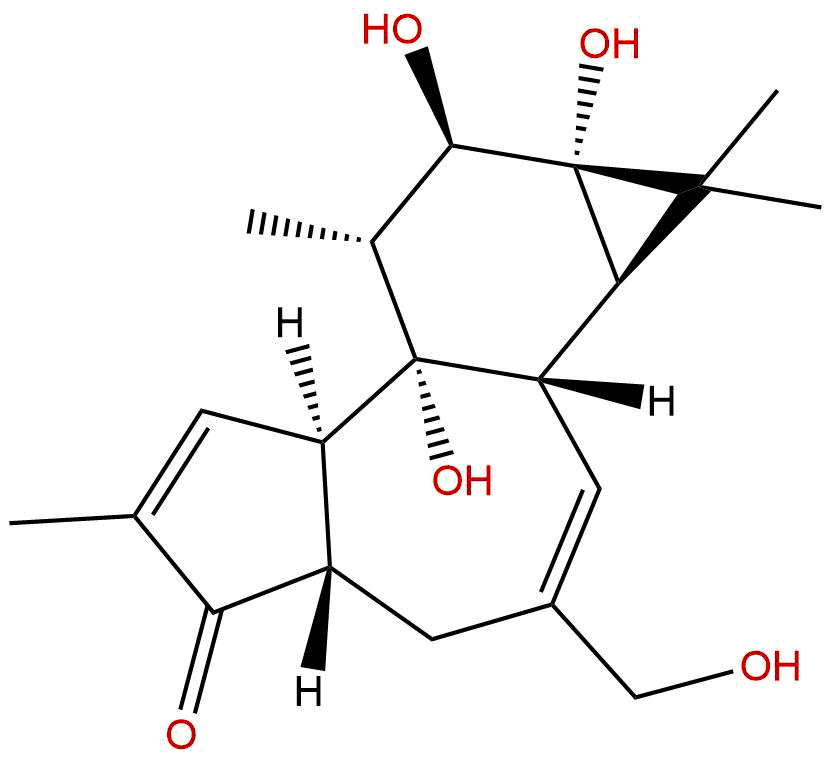
4-Deoxyfumorol is a tetracyclic diterpenoid compound with a highly oxidized tricyclic [4.3.1.0 ^ {3,7}] decane system as its core skeleton, which is a characteristic structure of fumorol compounds. Its molecular formula is C20H28O5 and its molecular weight is 348.4390. Compared with TPA with strong pro cancer activity, 4-deoxyvopol lacks a hydroxyl group at the C-4 position. This "deoxy" modification is the origin of its name and the key structural basis for its loss of classical protein kinase C (PKC) strong excitatory activity and instead exhibiting different biological activities.
In terms of physicochemical properties, the calculated lipid water partition coefficient (LogP) is 1.1318, indicating that the compound has moderate lipophilicity but not high hydrophobicity, which is beneficial for its distribution in biological systems. Its topological polar surface area (TPSA) is 97.99 Å ², reflecting the presence of multiple oxygen atoms (such as hydroxyl and carbonyl groups) in the molecule that can form hydrogen bonds. The predicted value of water solubility is about 0.9312 mg/L, which belongs to the category of slight solubility. This suggests that solubilization strategies may need to be considered in formulation development. Preliminary pharmacological risk assessment shows that its ability to cross the blood-brain barrier is low, which to some extent limits its direct effects on central nervous system related diseases, but may also reduce potential neurotoxic risks. Importantly, in the preliminary computer simulation screening, no significant hERG potassium channel inhibition tendency was shown (hERG inhibition: No), and the Ames test predicted a value of 0.0, indicating a low potential mutagenic risk. These provide preliminary favorable information for its safety as a drug lead compound.
Plant sources and extraction methods
4-Deoxyfumosol mainly comes from Euphorbiaceae plants, which are rich reservoirs of fumosol and its derivatives. Common sources include various plants such as Croton, Euphorbia, and Excoecaria. These plants are widely distributed in tropical and subtropical regions of the world, and are often used in traditional medicine to treat tumors, inflammation and infectious diseases. However, their application is also limited due to the presence of irritant, cancer promoting or toxic ingredients in plants.
The extraction of 4-deoxyvopol from plant materials is usually carried out using organic solvent extraction method. Dried and crushed plant parts (such as roots, stem bark, or seeds) are first degreased with non-polar or moderately polar solvents (such as petroleum ether, dichloromethane) to remove impurities such as oil and chlorophyll. Subsequently, a highly polar solvent (such as methanol, ethanol, or ethyl acetate) is used for repeated leaching or reflux extraction to obtain a crude extract containing the target diterpenoid compound. Due to the extremely complex composition of plant extracts, multiple steps of chromatographic separation and purification are required to obtain high-purity 4-deoxyvopol. Normal phase silica gel column chromatography is often used for preliminary separation, combined with thin layer chromatography (TLC) monitoring, and then reverse phase high performance liquid chromatography (RP-HPLC), preparative thin layer chromatography (PTLC) or gel chromatography (such as Sephadex LH-20) are further used for fine purification. The structural identification of compounds relies on modern spectroscopic techniques such as nuclear magnetic resonance (NMR, including 1H-NMR, 13C-NMR, 2D-NMR), mass spectrometry (MS), and X-ray single crystal diffraction. In recent years, separation strategies based on specific activity orientation, combined with LC-MS/MS analysis, have improved the efficiency of discovering and isolating such active ingredients from complex plant matrices.
Pharmacological activity research
The most notable pharmacological activity of 4-deoxyvopol is its anti-tumor effect, especially its strong cytotoxicity demonstrated in leukemia models. Research has shown that this compound can significantly inhibit the proliferation and induce apoptosis of various human leukemia cell lines, such as acute myeloid leukemia (AML) cells HL-60 and U937, acute lymphocytic leukemia (ALL) cell line, and chronic myeloid leukemia (CML) cell line K562. Its half maximal inhibitory concentration (IC50) is often in the micromolar or even nanomolar range, demonstrating high anti leukemia activity.
Its anti-tumor activity is not limited to hematological tumors. Some studies have also reported the inhibitory effect of 4-deoxyvostol on the growth of some solid tumor cells, such as liver cancer, breast cancer and lung cancer cell lines, although the activity intensity may vary depending on the cell type. In addition to its direct cytotoxic effects, research also suggests that it may have the potential to resist angiogenesis and inhibit tumor cell migration and invasion, which together constitute its multi-level anti-tumor pharmacological basis.
It is worth noting that, unlike the classic PKC agonist TPA, 4-deoxyvopol significantly reduces or alters its activation effect on PKC due to its C-4 deoxygenation, thereby avoiding adverse reactions such as TPA induced cancer and inflammation, laying a chemical foundation for its improved safety. In addition, sporadic studies have explored its anti-inflammatory and immunomodulatory activities, but these aspects of research are not yet systematic and require further exploration.
Mechanism of action and molecular targets
The anti leukemia effect of 4-deoxyvopol involves a complex multi-target regulatory network, and its mechanism research reveals its intervention ability in multiple key links such as leukemia cell survival, proliferation, apoptosis, and metabolism. According to existing research, its mechanism of action mainly revolves around the following core targets and pathways:
-
Inducing apoptosis and regulating Bcl-2 family proteins 4-Deoxyvopol can significantly downregulate the expression of anti apoptotic proteins MCL1 and BCL2. MCL1 is a key dependent factor for the survival of leukemia cells such as AML, and its downregulation directly weakens cancer cells' resistance to apoptotic signals. Meanwhile, this compound may affect the expression or activation of pro apoptotic proteins, thereby disrupting the balance of Bcl-2 family proteins and inducing cell apoptosis through the mitochondrial pathway.
-
Activate AMPK signaling pathway Adenosine activated protein kinase (AMPK) is a core regulatory factor in cellular energy metabolism. 4-Deoxyvopol has been shown to activate AMPK (PRKAA1), which may lead to inhibition of downstream mTORC1 signaling pathway, thereby inhibiting protein synthesis and cell growth, while promoting autophagy. Continuous activation of AMPK in tumor cells under energy stress may lead to growth inhibition and cell death.
-
Inhibition of oncogenic signaling pathways:
- NOTCH1 signal The NOTCH1 signaling pathway is often abnormally activated in leukemia such as T-ALL. 4-Deoxyvopol can inhibit the activation of NOTCH1 or the expression of its downstream target genes (such as Hes1, c-Myc), thereby interfering with the proliferation and survival of leukemia cells driven by this pathway.
- STAT3 signal Signal transducer and activator of transcription factor 3 (STAT3) is an important inflammatory and oncogenic signaling hub that is continuously activated in leukemia. Research has shown that 4-deoxyvopol can inhibit the phosphorylation (activation) and nuclear translocation of STAT3, thereby downregulating the expression of cell cycle (such as Cyclin D1) and anti apoptotic (such as Bcl-2, Survivor) genes regulated by it.
-
Affects epigenetic and oxidative stress regulation:
- SIRT1 The deacetylase SIRT1 is involved in the regulation of metabolism, stress response, and aging, and its role in cancer is complex. 4-Deoxyvopol may participate in cell fate determination by regulating SIRT1 activity and affecting the acetylation status of downstream targets such as p53 and FOXOs.
- NFE2L2(NRF2)Nuclear factor E2 related factor 2 is the main regulator of antioxidant response. In some cancer cells, sustained activation of NRF2 helps to resist oxidative stress and chemotherapy drugs. 4-Deoxyvopol may interfere with the NRF2 pathway, weaken the antioxidant defense system of cancer cells, and enhance their sensitivity to oxidative stress-induced death.
-
Other potential targets The compound has also been reported to potentially affect the phosphorylation of microtubule associated protein TAU (MAPT), suggesting that it may interfere with cytoskeletal function. The potential roles of isocitrate dehydrogenase 1 (IDH1) and topoisomerase I (TOP1) have also been mentioned, but the specific mechanisms still need to be clarified. IDH1 mutation is a characteristic of some AML, while TOP1 is an important target for chemotherapy drugs.
In summary, 4-deoxyvopol does not act on a single target, but rather attacks multiple fatal weaknesses of leukemia cells through a synergistic "multi-target" network. This may be the fundamental reason for its high anti leukemia activity and provides new ideas for overcoming the problem of drug resistance to single target drugs.
Evaluation of drug properties and pharmacokinetics
Based on its physical and chemical parameters and preliminary biological data, a preliminary evaluation of the pharmacological properties of 4-deoxyvopol was conducted. Its molecular weight is moderate (348.4), meeting the basic requirements of small molecules with similar drug properties. Moderate LogP values (~1.13) and TPSA (~98 Å ²) make it within the reasonable range of Lipinski's "Five Rules", indicating good membrane permeability and oral absorption potential. However, its low water solubility (<1 mg/L) is the primary challenge facing formulation development, which may require delivery systems such as salt formation, inclusion complex formation (such as cyclodextrin), nanocrystals, or liposomes to improve its solubility and bioavailability.
At present, there is a lack of pharmacokinetic studies on the 4-deoxyvopol system in public literature, which is a key gap that urgently needs to be filled in its drug conversion process. Based on its structural characteristics, it can be inferred that its metabolism in vivo may involve oxidation, reduction, and binding reactions of the liver cytochrome P450 enzyme system (such as glucuronic acid binding and sulfate binding). The prediction of its lower cerebral blood distribution coefficient suggests that the amount of it entering the central nervous system after systemic exposure is limited.
Potential drug interaction risks need to be addressed, especially if it serves as a substrate or inhibitor of CYP enzymes. Its initial safety warning (no hERG inhibition and Ames mutagenicity alert) is a positive signal, but a comprehensive preclinical toxicology assessment, including acute toxicity, subchronic toxicity, genetic toxicity, reproductive toxicity, etc., is a necessary path to promote its development. In addition, as a limited source of natural products, the development of fully synthetic or semi synthetic routes is crucial for ensuring stable drug supply in the future.
Clinical application prospects and prospects
4-Deoxyvopol has shown unique application prospects in the field of leukemia treatment. Its multi-target mechanism of action may lead to therapeutic effects on leukemia subtypes with different genetic backgrounds, especially on leukemia cells that rely on MCL1, STAT3, or NOTCH1 signaling. It is expected to be used as a single drug or in combination with existing chemotherapy drugs (such as cytarabine, anthracycline drugs) and targeted drugs (such as BCL-2 inhibitor Venetoclax) to produce synergistic effects, overcome drug resistance, and reduce the dosage of each drug to alleviate toxic side effects.
Looking ahead to the future, research and development on 4-deoxyvopol should focus on the following directions:
1. Deepening the mechanism of action Using chemical biology methods such as affinity fishing and proteomics to further accurately identify its direct target proteins and draw a more complete pharmacological action network map.
2. structural optimization Reasonable structural modifications are carried out using it as the parent nucleus, aiming to improve its water solubility, metabolic stability, target selectivity, and potency, while reducing potential toxicity and obtaining derivatives with better drug properties.
3. Preclinical development Carry out systematic pharmacokinetic, toxicological, and pharmacodynamic evaluations as soon as possible, establish appropriate animal models of diseases (such as human tumor xenograft mouse models), and verify their in vivo anti leukemia activity and safety.
4. Exploration of Combination Therapy Strategies Systematically evaluate its combination therapy with existing standard therapies or emerging therapies (such as immune checkpoint inhibitors) in preclinical models to find the optimal treatment window.
5. Source and Production Develop efficient and economical fully synthetic or biosynthetic routes, solve the problem of natural source limitations, and provide material guarantees for subsequent development.
Conclusion
4-Deoxyfumorol, as a structurally unique diterpenoid compound derived from Euphorbiaceae plants, has become a promising lead molecule in the research of natural anti-tumor drugs due to its multi-target and high-performance anti leukemia activity. It successfully liberated the phorbol skeleton from the "shackles" of promoting cancer and transformed it into a "weapon" for anti-cancer, fully reflecting the charm of natural product structure subtle changes leading to fundamental reversal of biological activity. Although there are still many challenges in drug development, pharmacokinetics, and systemic toxicity, its clear molecular mechanism and strong cellular activity have laid a solid scientific foundation for its subsequent development. With the continuous deepening of interdisciplinary research, through rational drug chemical modification and scientific formulation strategies, 4-deoxyvopol and its optimized derivatives are expected to provide a new treatment option for leukemia patients, especially those with refractory and recurrent leukemia, and continue to write a new chapter in the human fight against cancer with natural products.