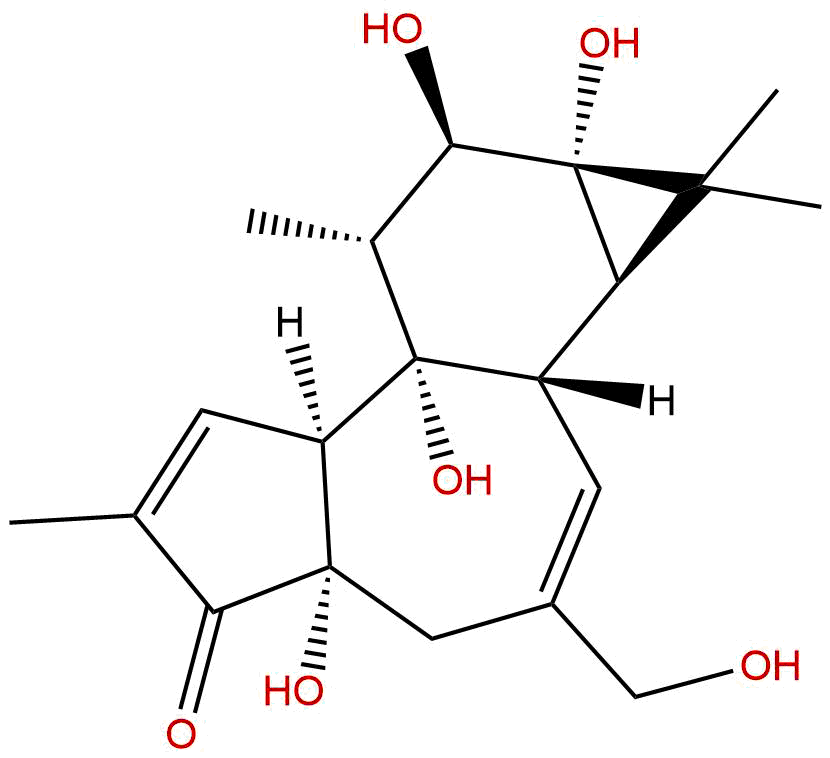


Product name: 4α-Phorbol
Synonym name:
Catalogue No.: BP2242
Cas No.: 26241-63-4
Formula: C20H28O6
Mol Weight: 364.438
Botanical Source:
Type of Compound: Diterpenoids
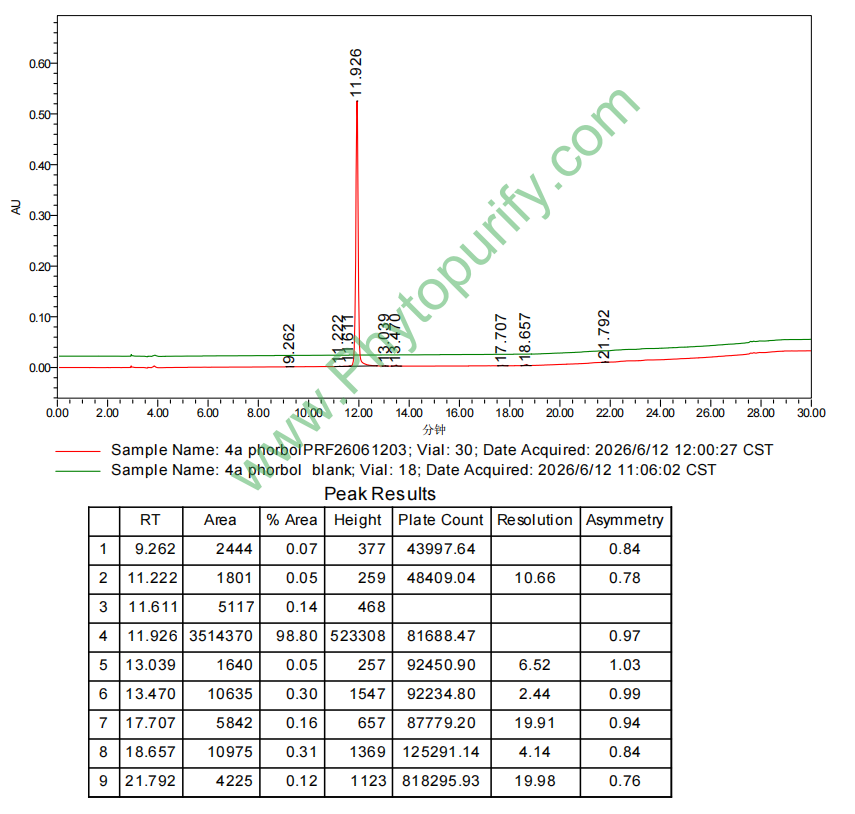
Purity: 95%~99%
Analysis Method: HPLC-DAD or/and HPLC-ELSD
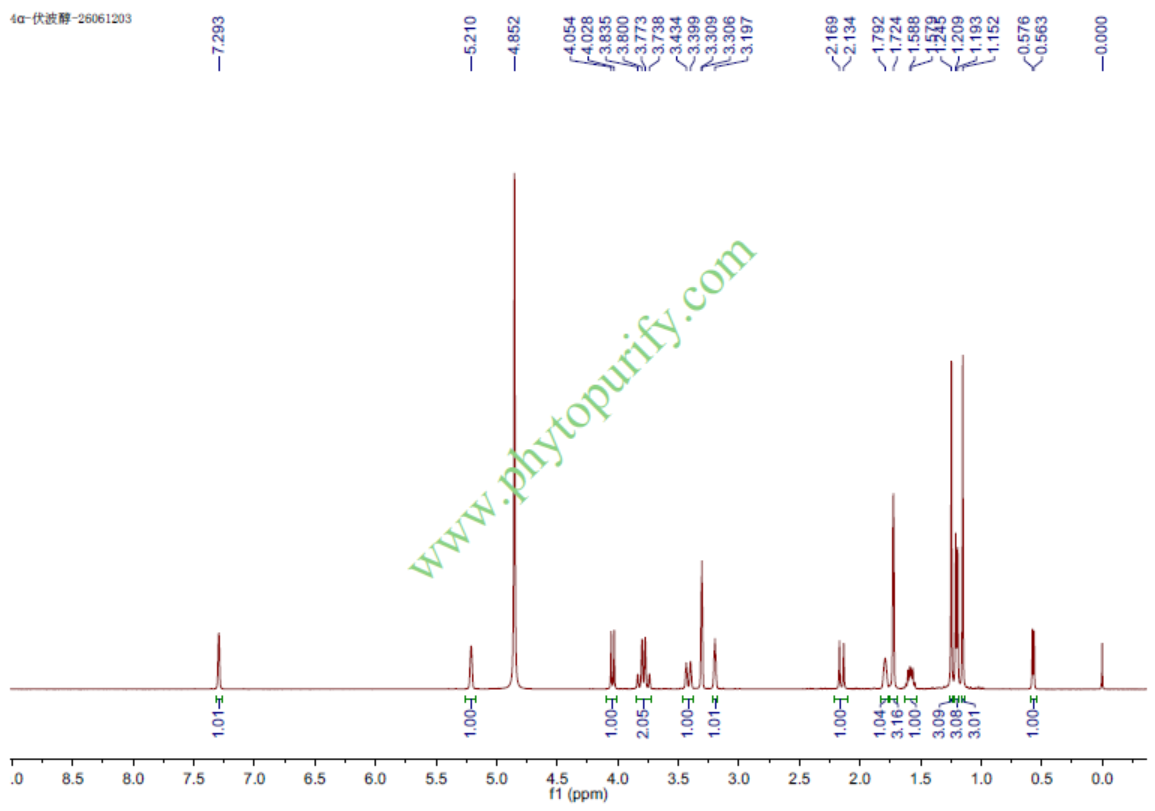
Identification Method: Mass, NMR
Packing: Brown vial or HDPE plastic bottle
Storage: Store in a well closed container, protected from air and light. Put into refrigerate or freeze for long term storage.
Whenever possible, you should prepare and use solutions on the same day. However, if you need to make up stock solutions in advance, we recommend that you store the solution as aliquots in tightly sealed vials at -20℃. Generally, these will be useable for up to two weeks.
The product could be supplied from milligrams to grams
Inquire for bulk scale.
For Reference Standard and R&D, Not for Human Use Directly.
HNMR of 4α-Phorbol
HPLC of 4α-Phorbol
Storage conditions:Short-term storage at 2~8℃, long-term storage at -20 ~ -80℃
118.2200
.7144
.7144
1.4649
1.0998
13.6034
Low
37.8556
5.1798
No
No
No
No
No
No
0.0
Yes
Yes
Yes
Yes
Natural products, as an important treasure trove for drug discovery, have played an irreplaceable role in the long history of human fight against diseases. Among them, diterpenes derived from Euphorbiaceae plants have always been a hot topic in medicinal chemistry and pharmacology research due to their complex and diverse chemical structures and significant biological activities. Foponol and its derivatives, as a classic class of tetracyclic diterpenes, are renowned for their potent protein kinase C (PKC) activation activity. Their prototype compound, 12-O-tetradecanoyl-foponol-13-acetate (TPA), is the gold standard tool for tumor promoter research. However, there are numerous members in the Foponol family, and their biological activity spectrum is closely related to the parent nucleus structure and substituents, which presents a huge research space.
4 α - Phorbol (CAS: 26241-63-4) is a structurally unique and relatively poorly studied member of the Phorbol family. Unlike classical phorbol esters (such as TPA) with strong pro cancer activity, the C-4 hydroxyl configuration of 4 α - phorbol is alpha oriented. This key structural difference often results in its inability to activate PKC and may even exhibit antagonistic effects. In recent years, with the shift in research perspective from "promoting cancer" to "fighting cancer" and the rise of multi-target drug discovery strategies, 4 α - vopol has re entered the field of researchers due to its potential regulatory effects on various lymphoma related key targets, such as MCL1, BCL2, STAT3, TP53 pathways, etc. Its pharmacological parameters, such as good water solubility, no hERG inhibition, and Ames mutagenicity risk, also provide a favorable starting point for its further development. This article aims to provide a systematic review of the chemical properties, plant sources, pharmacological activities, mechanisms of action, and drug properties of 4 α - Fubol, and to explore its potential applications in the treatment of diseases such as lymphoma.
The chemical name of 4 α - Fubol is (1aR, 1bS, 4aR, 7aS, 7bS, 8R, 9R, 9aS) -9- (hydroxymethyl) -1a, 1b, 4, 4a, 5, 7a, 7b, 8, 9, 9a decahydro-4a, 7b dihydroxy-3- (hydroxymethyl) -1,1,6,8-tetramethyl-5-oxo-1H-cyclopropane [3,4] benzo [1,2-e] azulene-9-ol, with a molecular formula of C20H28O6 and a molecular weight of 364.4380. Its core skeleton is a highly oxidized tetracyclic diterpene structure, consisting of a [5.3.0] decane system, a cyclopropane ring, and multiple oxygen-containing functional groups.
Its structural features are mainly reflected in the following points:
1. C-4 hydroxy configuration This is the most crucial characteristic that distinguishes 4 α - Vorbool from highly active phorbol esters (such as TPA, whose C-4 position is in the β - configuration). The hydroxyl group in the α - configuration is spatially unfavorable for binding to the C1 domain of PKC, which is the structural basis for its usual non activation of PKC.
2. Polyhydroxy structure The molecule contains four hydroxyl groups (- OH) located at positions C-4, C-9, C-12, and C-20, which endow the molecule with high polarity. The calculated topological polar surface area (TPSA) is 118.2200 Å ², indicating that it has a large number of hydrogen bond donor and acceptor sites.
3. Hydrophilic lipophilic balance The calculated lipid water partition coefficient (LogP) is 0.7144, indicating that it has moderate lipophilicity but overall leans towards hydrophilicity. This property is related to Water solubility The calculated value is approximately 1.4649 mg/mL, which is consistent and beneficial for its dissolution in aqueous media and formulation development.
4. Reactive functional groups The C-12 and C-13 positions are usually free hydroxyl groups or esterified sites. The naturally occurring 4 α - Fubol often exists in the form of esterification, and its biological activity is closely related to the properties of the esterification group. The removal of ester groups from the 4 α - Fubol core is an important starting point for structural modification and structure-activity relationship research.
Based on its physicochemical properties, 4 α - Fubol exhibits lower blood-brain barrier Through its ability, this is mainly attributed to its higher polarity and TPSA. This may be a limitation for treating central nervous system lymphoma, but it may reduce central nervous system side effects for treating peripheral lymphatic system diseases.
4 α - Fubol and its ester derivatives are widely present in Euphorbiaceae and Thymelaeaceae plants. These plants are distributed in many regions around the world, especially in tropical and subtropical areas, and are often used in traditional medicine to treat tumors, inflammation, and skin diseases. However, their toxicity (mainly derived from the carcinogenic phorbol ester) also needs to be monitored.
Main plant sources:
1. Euphorbia genus 4 α - Fubol derivatives have been detected in the milk or whole plant of various Euphorbia plants. For example, continuing with the child(Euphorbia lathyris)The seed oil contains various phorbol esters, including derivatives with a 4 α - configuration.
2. Croton genus Croton oil is a classic source of phorbol compounds, which contain complex mixtures including various esters of 4 α - and 4 β - phorbol.
3. Daphne genus and Stellera genus Like Rui Xiang Wolf Venom(Stellera chamaejasme)Diterpenoid components with 4 α - vopol as the parent nucleus have been isolated from the roots, which often exhibit anti-tumor and antiviral activities.
Extraction and Separation Methods:
Due to the extremely complex composition of plant extracts and the usually low content of 4 α - fumorol, their separation and purification is a challenge. The standard procedure is as follows:
1. Extract Organic solvents such as methanol, ethanol, acetone, or chloroform methanol mixtures are commonly used for cold soaking or reflux extraction of dried and crushed plant materials. Ultrasound assisted extraction and microwave-assisted extraction can improve efficiency.
2. Preliminary enrichment After vacuum concentration of the extract, liquid-liquid extraction (such as petroleum ether, ethyl acetate, n-butanol segmented extraction) is used to preliminarily separate different polar components. 4 α - Fubol and its highly polar derivatives are mostly concentrated in the ethyl acetate and n-butanol sites.
3. chromatographic separation This is the key step to obtaining pure product. Silica gel column chromatography is commonly used for crude separation, with different ratios of petroleum ether ethyl acetate or chloroform methanol gradient elution. Subsequently, further fine purification was carried out by reversed phase silica gel (such as ODS), Sephadex gel (LH-20) column chromatography and high performance liquid chromatography (HPLC, usually C18 column, with methanol water or acetonitrile water as mobile phase).
4. appraisal The structural identification of pure compounds mainly relies on modern spectroscopic techniques, including nuclear magnetic resonance (NMR, especially 1H NMR, 13C NMR, 2D NMR such as HSQC, HMBC, COSY), mass spectrometry (MS, such as ESI-MS, HR-ESI-MS), and optical rotation determination. X-ray single crystal diffraction is the gold standard for determining absolute configurations.
It is worth noting that during the extraction and separation process, special attention should be paid to avoiding contamination with phorbol esters (such as TPA) that have strong skin irritation and carcinogenic activity, and strict protective measures should be taken.
Although 4 α - Fubol itself does not activate PKC, extensive research has shown that it or its specific esterification derivatives have diverse pharmacological activities, especially in anti-tumor and immune regulation.
1. Antitumor activity
This is the most highly anticipated active area of 4 α - fumorol. Research has shown that its anti-tumor effect has broad-spectrum and multi-target characteristics.
* lymphoma Multiple studies have suggested that 4 α - vopol and its derivatives exhibit growth inhibition and induce apoptosis in various lymphoma cell lines, such as U937, Raji, Jurkat, etc. Its activity is related to its intervention on apoptosis regulatory proteins (such as MCL-1, BCL-2) and cell cycle proteins (such as CDC25B).
* leukemia In addition to lymphoma, it also has inhibitory effects on myeloid leukemia cells (such as HL-60) by inducing differentiation (such as differentiation towards monocytes/macrophages) and apoptosis.
* solid tumor: It also has certain cytotoxicity to solid tumor cells such as liver cancer, breast cancer and lung cancer, but its effect is generally weaker than that on hematological tumors.
2. Anti inflammatory and immune regulatory activity
Fopo alcohol compounds have complex immunomodulatory effects. 4 α - Fubol, as a non activator or weak antagonist of PKC, may exert anti-inflammatory effects by interfering with PKC dependent inflammatory signaling pathways, such as NF - κ B activation. There are studies reporting that it can inhibit lipopolysaccharide (LPS) - induced macrophage production of nitric oxide (NO) and inflammatory factors (such as TNF - α, IL-6). In addition, its potential impact on the T cell surface marker PTPRC (CD45) also suggests that it may regulate T cell function.
3. Antiviral activity
Some derivatives of 4 α - fumosol derived from plants in the Rosaceae family exhibit activity against human immunodeficiency virus (HIV) and respiratory syncytial virus (RSV). The mechanism may be related to interfering with virus entry or replication, but the specific target is not yet clear.
4. Neuroprotection and Toxicity
Unlike 4 β - phorbol ester, which strongly promotes cancer, 4 α - phorbol usually does not exhibit tumor promoting activity. In the nervous system, there have been sporadic studies exploring its interaction with microtubule associated proteins (MAPT, also known as Tau proteins), but the conclusions are inconsistent. Its low blood-brain barrier permeability limits its direct central role. In terms of safety, preliminary Ames test The data (0.0) indicates that it has no direct genetic toxicity, which is a positive signal.
The pharmacological effects of 4 α - Fubol on lymphoma are not achieved through a single pathway, but involve a complex multi-target network. Based on the provided target information, its mechanism of action can be summarized as follows:
1. Inducing apoptosis: targeting BCL-2 family and P53 pathway
* Inhibit anti apoptotic proteins: Direct or indirect reduction MCL1 and BCL2 The expression or disruption of its function is the key to overcoming the apoptosis resistance of lymphoma cells. This may lead to an increase in mitochondrial outer membrane permeability, release of cytochrome C, and activation of the caspase cascade reaction.
* Activate P53 pathway 4 α - Vopolol may stabilize through TP53 Protein or upregulation of its transcriptional activity induces downstream pro apoptotic genes (such as PUMA, NOXA) and cell cycle suppressor genes CDKN2A The expression of (p16INK4a) achieves cell cycle arrest (G1/S phase) and apoptosis.
2. Interference with cell cycle and proliferation signals
* Inhibit CDC25B CDC25B phosphatase is a key positive regulatory factor in the G2/M phase transition of the cell cycle. Inhibition of CDC25B can cause the CDK1/Cyclin B complex to maintain an inhibitory phosphorylation state, leading to cell arrest in the G2/M phase.
* Block STAT3 signal Constituent activation STAT3 It is an important carcinogenic driver for various lymphomas, especially diffuse large B-cell lymphoma. 4 α - Fubol may inhibit the expression of downstream pro survival and proliferation genes (such as c-Myc, Bcl xL) by inhibiting upstream kinases (such as JAK) or directly interfering with STAT3 phosphorylation, dimerization, or nuclear translocation.
* Regulating the NF - κ B pathway:NFKB1(p50) is a member of the NF - κ B transcription factor family. 4 α - Fubol may inhibit IKK complexes or prevent I κ B degradation, reduce NF - κ B nuclear translocation, and thereby suppress its mediated inflammatory, proliferative, and anti apoptotic signals.
3. Affects the cellular microenvironment and differentiation
* Regulating PTPRC (CD45)CD45 is a key tyrosine phosphatase involved in lymphocyte development and activation. Regulating its activity may affect the signal intensity of lymphocyte receptors, thereby altering the fate of cell proliferation and differentiation.
* Potential impact on retinoic acid signal:RXRB It is a retinoic acid X receptor that participates in the regulation of cell differentiation, apoptosis, and metabolism. It is worth further exploring whether 4 α - vopol acts as a ligand or conformational modulator to affect the function of RXR heterodimers (such as PPAR γ).
* Interaction with microtubule system: With MAPT The potential association of (Tau) suggests that 4 α - Fubol may affect microtubule stability, but its role in lymphoma cells is not yet clear and may be related to the maintenance of morphology or signal transduction in non dividing cells.
It should be emphasized that the target networks mentioned above are likely to be interrelated. For example, there is crosstalk between the STAT3 and NF - κ B pathways, while activation of P53 can inhibit NF - κ B. 4 α - Vopolol may act on upstream nodes of these networks or coordinate these effects through a yet to be elucidated direct molecular target (possibly a kinase or phosphatase).
Based on calculations and limited experimental data, the preliminary evaluation of the pharmacological properties of 4 α - Fubol is as follows:
Advantage:
1. Security potential: None HERG inhibition Warning has reduced the risk of inducing QT interval prolongation and apical torsion ventricular tachycardia, which are important reasons for the failure of many drug development.Ames test A negative result indicates no direct mutagenicity and a high safety threshold.
2. Solubility and permeability: Good Water solubility(>1 mg/mL) is beneficial for the dissolution of oral preparations and the preparation of injectable formulations. A moderate LogP value (0.71) indicates that it has a certain degree of membrane permeability, but is not too widely distributed or metabolized due to high lipid solubility.
3. Moderate molecular weight The molecular weight of 364.4 Da conforms to the Rule of Five and is beneficial for oral absorption.
Challenges and unknowns:
1. Metabolic stability As a polyhydroxy compound, 4 α - vopol is likely to undergo extensive phase II metabolism (such as glucuronidation and sulfation) in the body, leading to rapid clearance and low oral bioavailability. The sensitivity of its cyclopropane structure and α - hydroxyl group to phase I metabolism (such as CYP450 enzyme) needs to be experimentally verified.
2. Lack of pharmacokinetic parameters Currently, publicly available research data on its pharmacokinetics (absorption, distribution, metabolism, excretion) in vivo is extremely scarce. its blood-brain barrier Low permeability has been predicted by calculations, but key parameters such as tissue distribution, plasma protein binding rate, and half-life are unknown.
3. Structural decoration space The hydroxyl groups at positions C-12 and C-13 are the main sites for prodrug design or structural optimization. By esterification, etherification, or linking targeting groups, it is possible to improve its pharmacokinetic properties (such as increasing lipid solubility to enhance cell penetration, improving metabolic stability) or enhance selectivity towards specific targets. However, caution must be exercised during modification to avoid introducing toxic groups or accidentally generating PKC activation activity.
Preliminary evaluation 4 α - Fubol is an advantageous scaffold with multi-target anti lymphoma activity, and its core structure exhibits good safety calculation indicators and drug like properties. The current biggest bottleneck lies in its potential metabolic instability and lack of in vivo pharmacological/pharmacokinetic evidence. Future research should prioritize systematic in vitro metabolic stability assessment (such as liver microsomal incubation experiments) and preliminary in vivo pharmacokinetic studies in animals.
As a natural product lead compound with multiple targets and good preliminary safety evaluation, 4 α - Fubol has potential application prospects in the following areas:
1. Complementary or combined strategies for lymphoma treatment
* Overcoming drug resistance For refractory/recurrent lymphomas with overexpression of MCL-1, BCL-2, or sustained activation of STAT3, the multi-target properties of 4 α - vopol may provide a strategy to overcome resistance to single target inhibitors.
* combination therapy When used in combination with existing chemotherapy drugs (such as CHOP regimen drugs), targeted drugs (such as BCL-2 inhibitor Venetoclax, BTK inhibitor), or immunomodulators, it may produce synergistic effects, reduce their respective dosages, and minimize toxic side effects.
* Developing new targeted formulations Using nanocarriers (such as liposomes and polymer micelles) to encapsulate 4 α - vopol can improve its water solubility and stability, and achieve tumor targeted delivery through EPR effect or by connecting lymphoma cell specific antibodies (such as anti-CD20 antibodies), enhancing therapeutic efficacy and reducing systemic exposure.
2. As an immunomodulatory agent
Its potential anti-inflammatory and immunomodulatory activities may also have some value in the treatment of autoimmune diseases or inflammation related diseases (such as rheumatoid arthritis and inflammatory bowel disease), but this requires further immunopharmacological research.
3. Core skeleton of medicinal chemistry optimization
4 α - Fubol is an ideal starting point for structural modification. Future research directions include:
* Study on Structure Activity Relationship Systematically synthesize a series of derivatives modified at C-12, C-13, and C-20 positions, and clarify the effects of each functional group on activity (anti proliferation, pro apoptosis), selectivity, and pharmacokinetic properties.
* Prodrug design To address the potential issue of rapid first pass metabolism, design prodrugs that are enzymatically interpreted and released in specific parts of the body (such as the tumor microenvironment) to improve oral bioavailability or tumor local concentration.
* Protein target fishing Using chemical proteomics techniques such as affinity chromatography combined with mass spectrometry analysis, we aim to identify the direct binding proteins of 4 α - fumorol in cells, in order to more accurately elucidate its mechanism of action and provide a basis for rational drug design based on structure.
Challenges and Prospects Despite its promising prospects, the clinical application of 4 α - Fubol still faces standard challenges, including the need for systematic preclinical pharmacological evaluation (to validate efficacy in more lymphoma animal models, such as xenograft models), comprehensive toxicological evaluation (acute toxicity, chronic toxicity, reproductive toxicity, etc.), and standardized pharmacokinetic studies. Its multi-target nature is a double-edged sword, which may bring therapeutic advantages but also increase the difficulty of off target effects and complex toxicity prediction.
As a structurally unique and biologically diverse member of the phorbol alcohol family, 4 α - phorbol is gradually breaking free from the shadow of its pro cancer "close relatives" and demonstrating great potential as a multi-target lead compound for anti lymphoma. Its mechanism of inducing tumor cell apoptosis and cycle arrest by regulating key nodes such as MCL1, BCL2, STAT3, and TP53 provides new ideas for developing novel lymphoma treatment strategies. Its good calculation of pharmacological parameters (water solubility, absence of hERG inhibition, and genetic toxicity warning) has laid a positive foundation for its further development.
However, the road from natural products to candidate drugs is still long. The current research on 4 α - Fubol is still in a relatively early stage, and its exact direct target of action, detailed in vivo metabolic fate and pharmacokinetic characteristics, as well as long-term safety, all need to be further explored. Future research should integrate multidisciplinary forces such as medicinal chemistry, pharmacology, pharmacy, and toxicology, and carry out systematic work around their structural optimization, mechanism of action elucidation, and formulation innovation. I believe that with the continuous deepening of research, 4 α - vopol or its optimized derivatives have the potential to bring new therapeutic hope to lymphoma patients and further confirm the eternal value of natural products in innovative drug discovery.
