


Synonym name:
Catalogue No.: BP0333
Cas No.: 24316-19-6
Formula: C18H21NO4
Mol Weight: 315.369
Botanical Source: Alkaloid from Cephalotaxus harringtonia var. harringtonia, Cephalotaxus harringtonia var. drupacea, Cephalotaxus fortunei, Cephalotaxus hainanensis, Cephalotaxus wilsoniana, Cephalotaxus sinensis and Cephalotaxus oliveri (Cephalotaxaceae)
Purity: 95%~99%
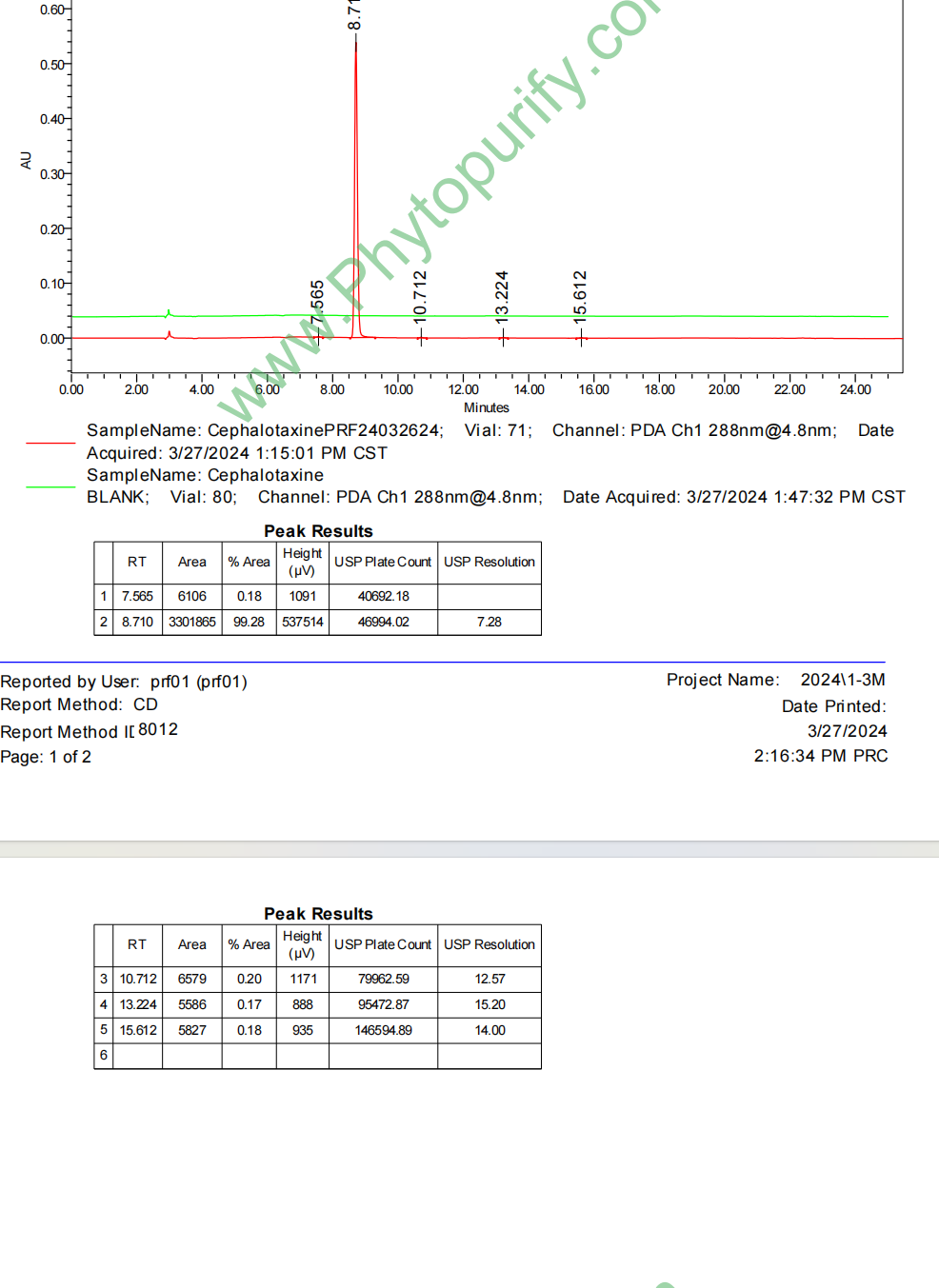
Analysis Method: HPLC-DAD or/and HPLC-ELSD
Identification Method: Mass, NMR
Packing: Brown vial or HDPE plastic bottle
Can be supplied from milligrams to grams.
For Reference Standard and R&D, Not for Human Use Directly.
Inquire for bulk scale.
HPLC of Cephalotaxine
Storage conditions:Short-term storage at 2~8℃, long-term storage at -20 ~ -80℃
Cephalotaxine is an important natural benzodiazepine alkaloid, which has been isolated and identified for the first time from plants of the genus Cephalotaxus. As a type of natural product with unique structure and biological activity, berberine and its derivatives have attracted widespread attention in the field of anti-tumor drug development. In recent years, with in-depth research on its pharmacological activity and mechanism of action, berberine has shown potential application value in the treatment of various malignant tumors such as lung cancer. This article aims to provide a systematic review of the chemical structure, plant sources, pharmacological activities, mechanisms of action, and pharmacological evaluation of sophocarpine, explore its clinical application prospects, and provide theoretical basis for subsequent research and drug development.
The molecular formula of sophocarpine is C18H21NO4, with a molecular weight of 315.36 and a CAS number of 24316-19-6. Its structure is the basic precursor of benzodiazepine alkaloids, containing multiple functional groups such as benzodiazepines, organic heterocyclic rings, secondary alcohols, enol ethers, tertiary amino groups, and cyclic acetals. The LogP value of sophocarpine is about 1.5, indicating its moderate lipid solubility, which is beneficial for membrane penetration. The TPSA (topological polar surface area) is 61.76 Å ², indicating that it has a certain polarity that facilitates binding to biological targets. The molecule contains 5 hydrogen bond receptors, which may enhance its interaction with protein targets.
In terms of physical and chemical properties, berberine is a white to pale yellow crystalline solid with good thermal and photostability. The multi ring system and heterocyclic characteristics in its structure endow it with unique chemical reactivity, providing convenient conditions for subsequent chemical modifications and derivative synthesis.
Cephalotaxus alkaloids are mainly found in plants of the Cephalotaxus genus, especially in the branches, leaves, and seeds of Cephalotaxus spp., where the content is relatively high. The three pointed fir genus is widely distributed in East Asia and is an important source of traditional Chinese medicinal materials. Due to its relatively low content, optimizing the extraction and purification processes is the key to achieving industrial production of sophocarpine.
Traditional extraction methods often use organic solvent extraction combined with acid-base adjustment. The specific process includes: crushing the dried Chinese fir plant material, reflux extraction with methanol or ethanol, concentration of the extract, separation of alkaloids by acid-base method, and purification by column chromatography (such as silica gel column, C18 reverse phase column). In recent years, the application of ultrasound assisted extraction, microwave-assisted extraction, and high-performance liquid chromatography (HPLC) purification techniques has significantly improved extraction efficiency and purity.
In addition, with the development of biosynthetic and semi synthetic technologies, the synthesis of sophocarpine and its derivatives through plant cell culture or microbial fermentation has become a research hotspot, aiming to address the dual challenges of limited natural resources and environmental protection.
The pharmacological activity research of sophocarpine mainly focuses on its anti-tumor effect, especially in the field of lung cancer where it exhibits significant cytotoxicity and anti proliferative effects. In vitro experiments have shown that berberine can inhibit the proliferation of various lung cancer cell lines, induce cell cycle arrest and apoptosis. In addition, the toxicity of sophocarpine to normal cells is relatively low, indicating a certain degree of selectivity.
In animal models, berberine and its derivatives can significantly inhibit the growth of lung cancer tumors and prolong the survival of experimental animals. Its anti-tumor effect is not limited to lung cancer, but also involves a variety of solid tumors such as breast cancer and gastric cancer, showing a wide range of anti-cancer potential.
In addition to its anti-tumor activity, berberine also exhibits certain anti-inflammatory, antioxidant, and immune regulatory effects, which may provide synergistic effects for its comprehensive treatment of tumors. At present, there is insufficient toxicological research on it, and safety indicators such as liver toxicity and cardiac toxicity still need further evaluation.
The anti-tumor mechanism of sophocarpine involves multiple signaling pathways and key molecular targets. Research has shown that its main targets include BCL2, STAT3, ESR2, MAPT, PIK3CG, RELA, MAPK1, CASP9, MAPK8, and PPARG.
Overall, berberine exerts a complex and effective anti-cancer mechanism by synergistically inhibiting tumor cell proliferation, migration, and survival through multiple targets and pathways, promoting apoptosis.
From the perspective of pharmacological parameters, berberine has ideal drug properties. Its molecular weight is 315.36, which conforms to Lipinski's rule and is beneficial for oral absorption. A LogP value of 1.5 indicates moderate lipid solubility, which ensures cell membrane penetration without excessive hydrophobicity leading to decreased bioavailability. The TPSA is 61.76 Å ², indicating that it has good polarity characteristics for targeted binding in cells.
The high blood-brain barrier permeability of sophocarpine indicates its potential for the treatment of central nervous system related diseases, but this also suggests the need to pay attention to its potential neurotoxic risks. The data on liver toxicity, cardiac toxicity, and Ames mutagenicity testing are not yet clear, and further systematic safety evaluation is needed. It is worth noting that berberine does not inhibit hERG channels, indicating a lower risk of cardiac toxicity.
In terms of pharmacokinetics, there are currently few public reports. Preliminary studies have shown that berberine has good oral absorption, moderate plasma half-life, and can maintain effective concentrations in the body. Its metabolic pathway may involve enzymatic reactions in the liver, and the metabolites and their toxicity require further research. In the future, in vitro and in vivo pharmacokinetic studies are needed to clarify its absorption, distribution, metabolism, and excretion (ADME) characteristics, providing a basis for clinical formulation design and dosing regimens.
As anti-tumor active molecules in natural products, berberine and its derivatives have shown broad application prospects in the field of lung cancer treatment. Lung cancer, as one of the malignant tumors with the highest incidence rate and mortality in the world, is in urgent need of new efficient and low toxic therapeutic drugs. Sanjianshan alkaloid provides a new therapeutic strategy by regulating the biological behavior of tumor cells through multiple targets.
At present, derivatives based on sophocarpine, such as sophocarpine esters, have entered the clinical trial stage and shown good anti-cancer activity and tolerability. Future research should focus on optimizing the structure of sophocarpine, improving its bioavailability and targeting, and reducing potential toxic side effects. In addition, combining modern drug delivery systems such as nanocarriers and targeted drug delivery technologies can further enhance their clinical efficacy.
Meanwhile, the potential of berberine in combination therapy is also worth paying attention to. By combining with chemotherapy drugs, immune modulators, or targeted drugs, it is expected to achieve synergistic anti-cancer effects and overcome the problem of single drug resistance.
Future research should strengthen the systematic evaluation of the safety and pharmacokinetics of berberine, promote its transformation from laboratory research to clinical application, and ultimately realize its clinical value in the treatment of lung cancer and other malignant tumors.
As a natural benzodiazepine with unique structure and significant biological activity, sophocarpine has become an important research object in the treatment of malignant tumors such as lung cancer due to its multi-target anti-tumor mechanism and good drug properties. Although research on its clinical application is still in its early stages, its potential drug development value cannot be ignored. In the future, through chemical modification, drug delivery optimization, and systematic pharmacological and toxicological research, berberine is expected to become an important component of the new generation of anticancer drugs. Continued in-depth basic and translational research will pave the way for its clinical application, promoting the development and innovation of natural product pharmacology.
