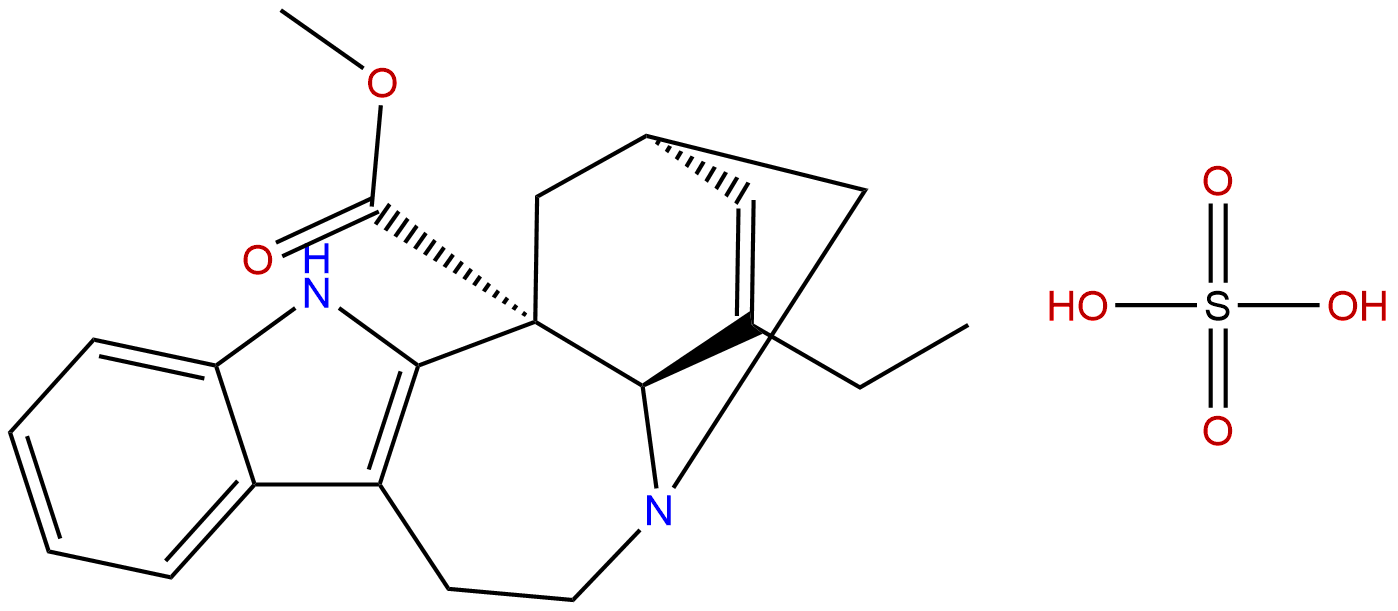
Vinblastine sulfate: a natural anti-cancer candidate molecule derived from Changchun flowers
1. Overview
Catharantine Sulfate (CAS number: 70674-90-7) is a traditional medicinal plant derived from Changchun flower(Catharanthus roseus)Indole alkaloid sulfate derivatives isolated from the middle. Its chemical essence is (+) -3,4-dihydrocoronoid sulfate, which is an important member of the Changchun flower alkaloid family. Changchun flower alkaloids, such as Changchun alkaloids and Changchun alkaloids, have long been indispensable chemotherapy drugs in clinical practice, mainly used to treat various malignant tumors such as leukemia and lymphoma. As a member of this family, vinblastine sulfate also exhibits various biological activities, particularly noteworthy for its antitumor Potential. Existing research has revealed that it not only inhibits voltage driven L-type calcium channels (VOCC), resulting in cardiovascular effects that lower blood pressure and heart rate, but also acts on TP53、CASP3、MYC、BAX、CDKN1A Waiting for a series of key cellular targets to regulate the proliferation, apoptosis, and cell cycle progression of tumor cells. Although its direct anti-cancer efficacy may be weaker compared to classical vinblastine drugs, its unique mechanism of action and relatively clear molecular targets make it a highly valuable lead compound for research, providing new ideas and structural templates for the development of novel anti-tumor drugs.
2. Chemical structure and physicochemical properties
The molecular formula of vinblastine sulfate is C21H26N2O6S, with a molecular weight of 434.5070 g/mol. From its SMILES structural formula (CCC1=C [C @ @ H] 2CN3CCc4c ([nH] c5ccccc45)C@@(C2) [C @ @ H] 13. O=S (=O) (O) O) can be analyzed, and its structural core is a complex polycyclic indole alkaloid skeleton - Catharantine, which is modified by a sulfate bond (- O-SO3H). This sulfation modification significantly alters the physicochemical properties of its parent compound.
According to the provided pharmacokinetic parameters, the molecular weight (MW) of its parent nucleus (sulfate free portion) is 336.44, which falls within the general range of small molecule drugs (<500 Da). The logarithm of its lipid water partition coefficient (LogP) is 3.59, indicating that the compound has Higher lipophilicity This is beneficial for its penetration through the cell membrane, but it may also affect its water solubility. In fact, its water solubility parameter is only 0.0118, indicating its low solubility in water, which may be one of the reasons why its sulfate form is prepared - aimed at improving its solubility and bioavailability. The topological polar surface area (TPSA) is 45.33 Å ², which is relatively small and usually indicates good membrane permeability. The permeability data of Caco-2 cells (10.955) and effective permeability coefficient (Peff: 4.3885) further confirm its good intestinal absorption potential. It is worth noting that it The blood-brain barrier (BBB) penetration is marked as "high"This suggests that the compound or its active metabolite may be able to enter the central nervous system, which is of great significance for treating brain tumors or evaluating their central nervous system side effects.
3. Plant sources and traditional applications
The plant source of vinblastine sulfate is single and well-known——Periwinkle Also known as Madagascar Changchun Flower(Catharanthus roseus (L.) G. Don), Belonging to the Apocynaceae family. Changchun flower is originally from Madagascar and is now widely distributed as an ornamental plant in tropical and subtropical regions around the world.
In the traditional medical system, especially the folk medicine in Madagascar and India, the whole herb of Catharanthus roseus is used to treat many diseases, including diabetes, malaria, dysentery and wound infection. However, its greatest value was only revealed by modern science in the mid-20th century. In the 1950s, scientists accidentally discovered that extracts from Changchun flowers could cause a decrease in white blood cells in experimental animals while screening for hypoglycemic plants. This clue ultimately led to a milestone discovery: the isolation of Changchun flowers Changchun alkali and vincristine These two compounds became the first plant-based drugs approved for cancer treatment in history, completely changing the treatment landscape for certain childhood leukemia and Hodgkin lymphoma, saving countless lives.
As one of the relatively abundant alkaloids in Changchun flowers, the study of vinblastine sulfate is not as in-depth as that of vinblastine and camptothecin, but it is still an important component of the plant's "chemical arsenal". In depth research on it is a further exploration and extension of the value of Changchun flower as a "natural medicine repository".
4. Pharmacological activity and mechanism of action
The pharmacological activity of vinblastine sulfate has the characteristics of multi-target and multi pathway, mainly focusing on antitumor and Cardiovascular regulation Two major cores.
1. Cardiovascular activity:
Early research focused on its impact on the cardiovascular system. Vinblastine sulfate has been identified as an inhibitor of voltage-gated L-type calcium channels (VOCC). VOCC plays a central role in the excitation contraction coupling of myocardial cells and vascular smooth muscle cells. The data shows that its inhibitory ability on VOCC current in vascular smooth muscle cells (VSMC) (IC50=8 μ M) is much stronger than that on cardiomyocytes (IC50=220 μ M). This selective inhibitory effect enables it to more effectively dilate blood vessels, reduce peripheral resistance, and relatively alleviate direct inhibition of the heart, which reasonably explains its observed effects Lowering blood pressure (BP) and slowing heart rate (HR) The effect. This characteristic suggests that it may have the potential to be developed as a novel antihypertensive drug.
2. Antitumor activity and molecular mechanism:
The anti-tumor activity of vinblastine sulfate is currently the focus of its research. Its function is not mainly achieved by inhibiting microtubule polymerization like vinblastine, but involves regulating a series of tumor related genes and proteins. The target information provided by the database outlines its potential functional network:
- TP53 (p53)The famous "genome guardian" is a tumor suppressor protein. Vinblastine sulfate may induce cell cycle arrest or initiate apoptosis by stabilizing or activating p53.
- CASP3 (Caspase-3)It is a key protease in the execution stage of cell apoptosis. Activation of Caspase-3 is one of the last common pathways through which many anticancer drugs induce programmed cell death in tumor cells. The effect of vinblastine sulfate on this target directly points to its ability to promote apoptosis.
- MYC A proto oncogene whose overexpression drives infinite cell proliferation. Inhibiting the transcription or function of MYC is an important strategy for anti-cancer therapy. Vinblastine sulfate may inhibit tumor growth by downregulating MYC expression.
- BAX Bcl-2 family proteins that promote apoptosis. Activation of p53 can upregulate BAX expression, leading to increased mitochondrial outer membrane permeability, release of cytochrome C, and activation of Caspase cascade reactions (such as CASP3), triggering apoptosis. The targeting effect of vinblastine sulfate on BAX forms a coherent pro apoptotic pathway with TP53 and CASP3.
- CDKN1A (p21)It is an important target gene downstream of p53, and its encoded p21 protein is a potent inhibitor of cyclin dependent kinase (CDK), which can cause cell cycle arrest in the G1 phase. Vinblastine sulfate can inhibit tumor cell proliferation by acting on CDKN1A.
In summary, vinblastine sulfate may pass through Activate the TP53/p53 pathway On the one hand, upregulating CDKN1A/p21 causes cell cycle arrest, and on the other hand, upregulating BAX synergistically activates CASP3/caspase-3, ultimately leading to inhibition of tumor cell proliferation and apoptosis. Meanwhile, it may also independently inhibit the expression of the oncogene MYC. This multi-target synergistic mechanism enables it to attack tumor cells from multiple links, which may help overcome the problem of drug resistance that may arise from single target drugs.
5. Evaluation of drug properties
Based on the provided physicochemical and pharmacokinetic parameters, we can conduct a preliminary evaluation of the potential of vinblastine sulfate as a drug. Firstly, refer to Lipinski's Five Rules("Five Principles of Similar Drugs"):
1. Molecular weight (MW): 336.44<500,Comply with。
2. Lipid water partition coefficient LogP: 3.59<5,Comply with(Although approaching the upper limit).
3. Number of hydrogen bond donors (HBDs): Based on the structure, it can be inferred that the mother nucleus may contain 1-2 (such as indole NH), and the sulfate group provides 2 OH groups, totaling about 3-4,May approach or slightly exceed Rule upper limit (≤ 5).
4. Number of hydrogen bond acceptors (HBAs): The structure contains multiple N and O atoms, with sulfuric acid groups contributing 4 O atoms, and the total number may exceed 10,significantly exceed Rule upper limit (≤ 10).
5. Number of rotatable keys: The structure is relatively rigid and there are not many rotatable keys, usually Comply with。
From this, it can be seen that vinblastine sulfate conforms to the rules in terms of molecular weight and lipophilicity, but due to its polar molecule containing sulfate groups, the number of hydrogen bond acceptors is severely exceeded, which directly affects its Membrane permeability and oral bioavailability forecast. Its higher TPSA (45.33) also confirms this. This explains why its water solubility, although modified, is still not ideal (0.0118), and oral absorption may face challenges, although Caco-2 permeability data is still acceptable.
Other key pharmacological parameters suggest its development advantages and risks:
* Advantage Good Caco-2 permeability, high BBB penetration potential (advantageous for brain tumor treatment), plasma protein binding rate (PPB) of 88.73%, which is moderately high and beneficial for drug transport in the body and maintaining a certain blood drug concentration.
* Risks and Challenges:
* Toxicity Warning The data clearly indicates the existence HERG channel inhibition Risk, which may lead to prolonged QT interval in the heart and cause fatal arrhythmias, is a critical toxicity issue that requires extreme vigilance and optimization in drug development. In addition,chromosome aberration Positive Skin sensitization、Phototoxicity And it may also cause an increase in serum levels of aspartate aminotransferase (AST), alanine aminotransferase (ALT), and alkaline phosphatase (ALK)Potential hepatotoxicity All of these constitute significant obstacles to its development.
* Ames test negative(0.0) indicates that there is no direct genetic mutation, which is a positive signal.
In summary, vinblastine sulfate as a lead compound Its core pharmacological framework and clear anti-tumor mechanism are of great value. However, its current sulfate form has significant deficiencies in drug like properties, especially poor oral absorption and the risk of multiple toxicity. Future pharmaceutical chemistry optimization work is crucial, and possible directions include: removing or replacing sulfate groups to improve membrane permeability, reducing the number of hydrogen bond receptors; Structural modification of the mother nucleus to eliminate hERG inhibitory activity and other toxicity, while retaining or enhancing its activity against targets such as TP53 and CASP3.
6. Research Status and Application Prospects
At present, the research on vinblastine sulfate is still in progress Preclinical stage A large amount of research has focused on its extraction and isolation, structural identification, in vitro pharmacological activity screening, and preliminary exploration of its mechanism of action. Its multi-target anti-tumor mechanism, especially its association with the p53 pathway, is currently a research hotspot. However, compared to the successfully marketed vinblastine drugs, the direct cytotoxic activity of vinblastine sulfate may be weaker, which limits its direct development prospects as a single chemotherapy drug.
But its unique value is reflected in the mechanism of differentiation. Its application prospects may expand in the following directions:
- Combination therapy sensitizer Given that it induces cell cycle arrest and apoptosis through pathways such as p53, it may have a synergistic effect with classical chemotherapy drugs (including vinblastine) that directly act on microtubules or other targets, reducing drug resistance and improving efficacy.
- New targeted anti-tumor lead compounds Based on its structure, carry out systematic analysis Pharmaceutical Chemical Modification and Optimization The aim is to obtain a new generation of candidate drugs with lower toxicity, higher oral bioavailability, and stronger selectivity for specific targets such as mutant p53 activators.
- Exploration of cardiovascular drugs Its selective inhibitory properties on vascular smooth muscle VOCC provide clues for the development of novel vasodilators or antihypertensive drugs, although its anti-tumor activity is currently a more focused area.
- Examples of Modernization Research on Traditional Chinese Medicine The in-depth study of vinblastine sulfate is a typical case of explaining the relationship between the traditional medicinal value of Changchun flower and its modern anti-cancer activity at the molecular level, which helps to promote the scientific development and utilization of more natural products.
In summary, vinblastine sulfate is an important chemical entity that connects traditional medicinal plants with modern tumor biology. It is like a multi toothed key that can simultaneously touch multiple key switches for tumor cell growth and death. Although the road to becoming a drug is full of challenges, especially in terms of safety optimization, the unique mechanism of action revealed and the core chemical structure provided undoubtedly inject new vitality into the development of innovative anti-tumor drugs. Future research requires the integration of multidisciplinary forces such as medicinal chemistry, pharmacology, toxicology, and pharmaceutical science in order to translate the potential of this natural gift into truly beneficial treatment methods for patients.