


Synonym name: Hydroquinone-glucose; Arbutoside; Ericolin
Catalogue No.: BP0185
Cas No.: 497-76-7
Formula: C12H16O7
Mol Weight: 272.253
Botanical Source: pear leaves (Pyrus communis). Widespread in the Ericaceae, also found in many other plants. First Arctostaphylos uva-ursi in 1852
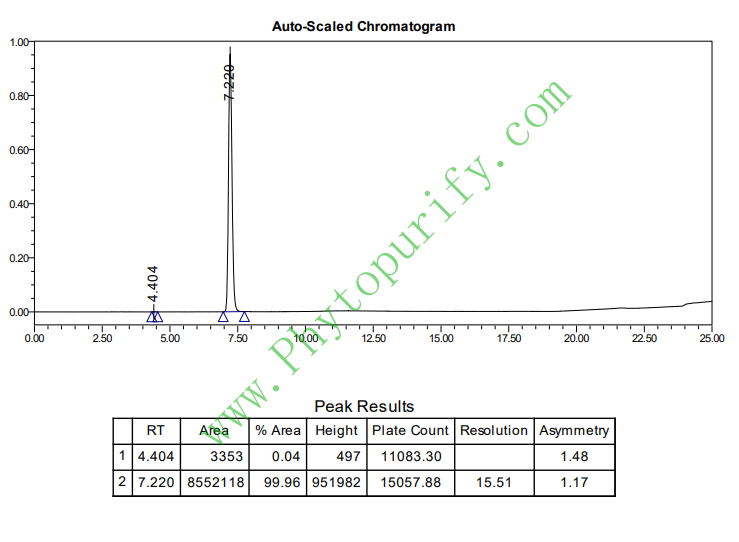
Purity: 95%~99%
Analysis Method: HPLC-DAD or/and HPLC-ELSD
Identification Method: Mass, NMR
Packing: Brown vial or HDPE plastic bottle
Can be supplied from milligrams to grams.
For Reference Standard and R&D, Not for Human Use Directly.
Inquire for bulk scale.
HPLC of Arbutin
Storage conditions:Short-term storage at 2~8℃, long-term storage at -20 ~ -80℃
119.6100
-.7351
-.7354
19.9804
.6432
.0900
Low
21.2479
3.3310
Yes
No
No
No
Yes
No
0.0
Yes
Yes
Yes
Yes
Arbutin, also known as p-hydroxyphenyl - β - D-glucopyranoside, is a natural phenolic glycoside widely found in various plants. Since its first isolation from the genus Ursa in the 19th century, its unique chemical structure and diverse biological activities have attracted sustained attention in the fields of pharmacy, cosmetic science, and plant chemistry. As a glucose derivative of hydroquinone, arbutin cleverly combines the activity of phenolic compounds with the water solubility and stability of glycosides, thereby significantly reducing the cytotoxicity and irritation risks associated with direct use of hydroquinone while retaining its precursor pharmacological potential.
In traditional medicine, plant extracts rich in arbutin have long been used for antibacterial and anti-inflammatory purposes in the urinary system. Modern pharmacological research has greatly expanded our understanding of its activity, confirming its significant multiple effects such as tyrosinase inhibition, antioxidant, anti-inflammatory, anti-tumor, and cardiovascular protection. Especially in the field of dermatology, arbutin, as an efficient and relatively safe whitening agent, has been widely used in cosmetics and topical skin medications worldwide for the treatment of pigmentation diseases such as melasma and freckles. In recent years, with the development of molecular biological technology, the potential therapeutic value and mechanism of arbutin in atherosclerosis, metabolic diseases, cancer and other major chronic diseases have been continuously revealed, making it leap from traditional whitening ingredients to lead compounds with multi target regulatory potential.
This article aims to systematically review the chemical properties, natural sources, pharmacological activities, molecular mechanisms of action, pharmacological characteristics, and clinical application prospects of arbutin, in order to provide comprehensive scientific references for the deep development and rational utilization of this natural product.
The molecular formula of arbutin is C12H16O7, with a CAS number of 497-76-7 and a molecular weight of 272.25 g/mol. Its core structure is composed of two parts connected by β - glycosidic bonds: one is the biologically active hydroquinone glycoside, and the other is the β - D-glucopyranose group as a hydrophilic carrier. This glycosylation modification is the key difference between it and highly irritating hydroquinone, which not only improves the water solubility of the compound, but also changes its bioavailability and metabolic pathways.
From the analysis of physical and chemical properties, arbutin appears as white to off white needle shaped crystals or powder. The calculated LogP value is about -0.74, indicating that the molecule has a high degree of hydrophilicity. The topological polar surface area (TPSA) is 119.61 Å ², further confirming its excellent hydration ability. The experimental data shows that its solubility in water is up to about 20 mg/mL, which facilitates its preparation into water-soluble preparations (such as injection, oral liquid, cosmetic essence). However, its hydrophilicity also means that its ability to penetrate lipid biofilms (such as the blood-brain barrier) is weak, indicating low blood-brain barrier permeability. This to some extent limits its direct effects on central nervous system diseases, but may also reduce the risk of central nervous system side effects.
In terms of stability, arbutin is sensitive to light and heat, especially under acidic or alkaline conditions, where glycosidic bonds may undergo hydrolysis and release hydroquinone. Therefore, in the process of extraction, purification, storage, and formulation, it is usually necessary to control the pH value, avoid light, and use low temperature conditions to maintain its stability. The crystal structure analysis shows that there is a hydrogen bonding network within the molecule, which has a significant impact on its solid-state stability and dissolution behavior.
Arbutin is widely distributed in nature and mainly exists in various plants such as Rhododendron, Rosaceae, and Saxifragaceae. Its name comes from the leaves of one of its main natural sources - Arctostaphylos uva ursi, which contains up to 5% -15% arbutin. In addition, the leaves of pear trees (Pyrus spp.), wheat germ, and some medicinal plants such as Magnolia officinalis and Rehmannia glutinosa also contain a considerable amount of arbutin. In recent years, the production of arbutin through plant tissue culture technology using hairy roots or cell suspension culture systems has become a research hotspot in the field of biotechnology, providing an alternative pathway for sustainable and large-scale production.
The traditional methods for extracting arbutin from plant materials include solvent extraction (commonly using water, methanol, ethanol or their mixed solutions), hot water extraction, etc. These methods are easy to operate, but may have issues such as low extraction rates, high impurities, and high energy consumption. Modern extraction techniques have significantly improved efficiency and selectivity:
1. Ultrasonic assisted extraction Using ultrasonic cavitation effect to destroy plant cell walls, accelerate solvent penetration, shorten extraction time, and improve yield.
2. Microwave assisted extraction By microwave heating, polar substances (such as water and arbutin) inside cells are rapidly heated, leading to cell rupture and achieving efficient and rapid extraction.
3. Supercritical fluid extraction Supercritical CO2 is usually used to change its solubility by adjusting temperature and pressure. This method is environmentally friendly and has no solvent residue, but the equipment cost is high and often requires the addition of entrainers (such as ethanol) to improve the extraction efficiency of polar arbutin.
4. Enzymatic hydrolysis Using cellulases, pectinases, and other enzymes to disrupt the structure of plant cell walls, promoting the release of active ingredients under mild conditions and strong specificity.
The crude extract after extraction needs to be further separated and purified. Common methods include macroporous adsorption resin chromatography (utilizing the adsorption desorption characteristics of resins for phenolic glycosides), silica gel column chromatography, preparative high-performance liquid chromatography (HPLC), etc., to obtain high-purity arbutin monomers. The optimization of extraction and purification processes is the foundation for ensuring product quality, activity, and safety.
Numerous in vitro and in vivo studies have confirmed that arbutin has a wide range of pharmacological activities, demonstrating its potential for application in multiple therapeutic fields.
Skin Whitening and Treatment of Pigmentation Diseases This is the most classic and widely used activity of arbutin. It effectively blocks the conversion of dopa to melanin by competitively inhibiting the activity of tyrosinase (a key enzyme in melanin synthesis), thereby reducing melanin production. Clinical studies have confirmed that topical arbutin preparations can effectively reduce melasma, freckles, and post inflammatory pigmentation, and compared to hydroquinone, their irritability is significantly reduced, making long-term use safer.
Antioxidant and anti-aging The phenolic hydroxyl structure of arbutin enables it to effectively scavenge free radicals such as superoxide anions and hydroxyl radicals, and has reducing ability. It can inhibit lipid peroxidation and protect cell membranes and intracellular macromolecules (such as DNA and proteins) from oxidative damage. In the skin aging model, arbutin can reduce the generation of reactive oxygen species induced by ultraviolet radiation, inhibit the expression of matrix metalloproteinases, thereby protecting collagen and delaying photoaging.
anti-inflammatory effect Arbutin exhibits inhibitory effects on both acute and chronic inflammation models. Its mechanism involves downregulating pro-inflammatory mediators such as tumor necrosis factor - α (TNF - α), interleukin-1 β (IL-1 β), IL-6, prostaglandin E2 (PGE2), and nitric oxide (NO) production, and inhibiting the activation of inflammatory signaling pathways such as nuclear factor kappa B (NF - κ B) and mitogen activated protein kinase (MAPK).
Antitumor activity Research shows that arbutin can inhibit the proliferation and induce apoptosis of many cancer cell lines (such as liver cancer, breast cancer, lung cancer, colon cancer, melanoma, etc.). Its anti-tumor mechanisms are diverse, including inducing cell cycle arrest, activating apoptotic pathways (such as regulating Bcl-2 family proteins), inhibiting migration and invasion, and indirectly inhibiting tumor occurrence and development through antioxidant and anti-inflammatory effects.
Cardiovascular protection (especially for atherosclerosis)In recent years, the protective role of arbutin in cardiovascular diseases, especially atherosclerosis (AS), has attracted much attention. Studies have shown that arbutin can improve lipid metabolism, inhibit endothelial cell injury and foam cell formation induced by oxidized low density lipoprotein (ox LDL), reduce vascular inflammation, and promote reverse cholesterol transport. These effects are closely related to their regulation of multiple AS related targets.
Antibacterial and urinary system protection Traditionally, arbutin is hydrolyzed into hydroquinone by the gut microbiota after oral administration, absorbed and excreted in urine, exerting antibacterial effects in the urethra, especially for urinary tract infections caused by E. coli. However, it should be noted that the potential toxicity of its metabolite hydroquinone limits its long-term high-dose oral use.
Other activities: The study also suggests that arbutin has potential activities such as gastric protection (anti ulcer), neuroprotection, and anti diabetes, but its mechanism and effectiveness need more research and verification.
The multiple pharmacological activities of arbutin stem from its multi-target regulatory ability on cellular signaling networks. Based on its core activity, the key mechanisms of action and molecular targets are explained below:
1. The core target of whitening effect: tyrosinase
Arbutin is a competitive inhibitor of tyrosinase. It directly interacts with the copper ion binding site or substrate binding pocket of the tyrosinase active center, competing with natural substrates L-tyrosine or dopa, thereby inhibiting enzyme catalytic activity. Its inhibition constants (Kiapp) for monophenolase and diphenolase are 1.42 mM and 0.9 mM, respectively. In addition, it can downregulate the expression of tyrosinase related protein-1 (TRP-1) and TRP-2, and interfere with the transfer of melanosomes.
2. Multi target network for anti atherosclerosis
For atherosclerosis, the mechanism of action of arbutin involves a complex target network:
* LOX-1 (lectin like oxidized low-density lipoprotein receptor-1)Arbutin can inhibit the binding of ox LDL to LOX-1 receptors on the surface of endothelial cells, blocking LOX-1 mediated endothelial cell activation, oxidative stress, and inflammatory response, which is its first line of defense in protecting vascular endothelium.
* AMPK (AMP activated protein kinase)Arbutin can activate the AMPK pathway. Activation of AMPK can inhibit key enzymes involved in cholesterol synthesis, such as HMG CoA reductase, promote fatty acid oxidation, and upregulate ABCA1 (ATP binding cassette transporter A1) The expression. ABCA1 is a key protein for cholesterol reverse transport, which can flow cholesterol from cells to apolipoprotein A-I to form high-density lipoprotein (HDL), thus reducing foam of macrophages.
* EHMT2 (Histone Lysine Methyltransferase G9a)Epigenetic regulation plays an important role in AS. There are studies suggesting that arbutin may affect the activity of epigenetic modifying enzymes such as EHMT2, thereby regulating the expression of genes related to inflammation and lipid metabolism.
* Anti apoptotic proteins (MCL1, BCL2)In ox LDL induced endothelial cell apoptosis, arbutin regulates the expression of proteins such as MCL1 and BCL2, inhibits the mitochondrial apoptosis pathway, and maintains endothelial cell survival.
* RECQ1 (RecQ helicase 1)RECQ1 participates in DNA repair. Oxidative stress can lead to DNA damage in vascular cells, and arbutin may enhance the genomic stability of cells by affecting factors such as RECQ1. However, its specific role in AS remains to be elucidated.
3. Anti inflammatory and antioxidant pathways
Arbutin directly exerts antioxidant effects by clearing ROS and inhibiting enzyme sources such as NADPH oxidase. Its anti-inflammatory effect is mainly achieved through inhibition NF-κB and MAPK(p38, JNK, ERK) Activation of signaling pathways is achieved. It prevents the degradation of I κ B α, inhibits the nuclear translocation of NF - κ B p65 subunit, and downregulates the expression of downstream pro-inflammatory cytokines and enzymes such as COX-2 and iNOS.
4. Anti tumor mechanism
In addition to the aforementioned pathways, the anti-tumor effect of arbutin also involves inducing the expression of cyclin dependent kinase inhibitors (such as p21), leading to cell cycle arrest (often in the G1 phase); Activate the caspase cascade reaction and regulate the Bax/Bcl-2 ratio to induce apoptosis through the mitochondrial pathway.
Based on the provided pharmacological parameters and existing research, a comprehensive evaluation of the pharmacological properties of arbutin is conducted
Absorption, distribution, metabolism, excretion (ADME):
safety evaluation:
Advantages and challenges of pharmaceutical properties:
At present, the clinical application of arbutin is mainly focused on external use. As a functional ingredient in cosmetics and topical medication for dermatology, it has become very mature in the treatment of pigmentary diseases. In the future, its clinical applications may expand in the following directions:
Deepening and innovation in the field of dermatology Develop new delivery systems (such as liposomes, nanoparticles, microneedles, and liposomes) to improve the transdermal permeability and targeting of arbutin, enhance its whitening and anti-aging effects, and be used as adjuvant therapy for a wider range of inflammatory skin diseases (such as dermatitis and psoriasis). The development of compound preparations (such as combined use with vitamin C, glycyrrhizin, tranexamic acid, etc.) is also an important trend.
Exploration of prevention of cardiovascular diseases In view of its multi-target pharmacological action in anti atherosclerosis, arbutin is expected to be developed as a natural drug or functional food to prevent or assist in the treatment of atherosclerosis and related cardiovascular and cerebrovascular diseases. But it is necessary to first clarify the effective dosage and long-term safety (especially to avoid the toxicity of hydroquinone) of its oral administration through rigorous preclinical and clinical trials, and verify its actual effect in regulating targets such as LOX-1 and AMPK in the human body.
The potential of anti-tumor adjuvant therapy Although its anti-tumor activity is mostly confirmed at the cellular level, as a low toxicity natural product, arbutin may be studied for combination with existing chemotherapy/radiotherapy to enhance efficacy and reduce side effects. Further research is needed on its in vivo anti-tumor activity and appropriate administration routes (such as local administration for the treatment of skin tumors).
Structural modification and derivative development Chemical structural modification of the prototype arbutin is an important research direction in order to overcome its drawbacks such as metabolic toxicity and stability. For example, synthesizing α - arbutin (isomer, more stable but slightly less inhibitory activity), deoxyarbutin, or esterified/etherified derivatives of arbutin in order to obtain candidate compounds with higher activity, better stability, and safer metabolism.
The tool value as a molecular probe The interaction between arbutin and multiple key targets (such as tyrosinase and LOX-1) is clear, and it can be used as a tool molecule or lead compound for studying the biological functions of these targets and screening new inhibitors.
As a natural product with a long history and full of modern research vitality, arbutin's value has far exceeded the initial whitening category. From a chemical perspective, it is a clever design in nature that endows hydroquinone with new physicochemical properties and biological characteristics through glycosylation. At the pharmacological level, it shows a wide spectrum of activity from local skin to systemic system, from beauty care to major disease prevention, especially its regulation network involving LOX-1, AMPK, ABCA1 and other multi-target points in anti atherosclerosis, revealing the unique advantages of natural polyphenols in the prevention and treatment of complex diseases.
However, its path to wider clinical applications still faces challenges, especially the safety concerns caused by the activation of gut microbiota metabolism and the production of hydroquinone during oral administration. This requires future research to not only deepen mechanism exploration, but also attach great importance to its pharmacokinetic characteristics and long-term toxicological evaluation. Through innovative dosage forms (such as new topical delivery systems), structural optimization (development of new derivatives), and precise indication localization (such as focusing on local or systemic low-risk prevention), arbutin, an ancient natural molecule, is expected to bring new vitality to the development of innovative drugs and health products, and contribute more possibilities to human health.
