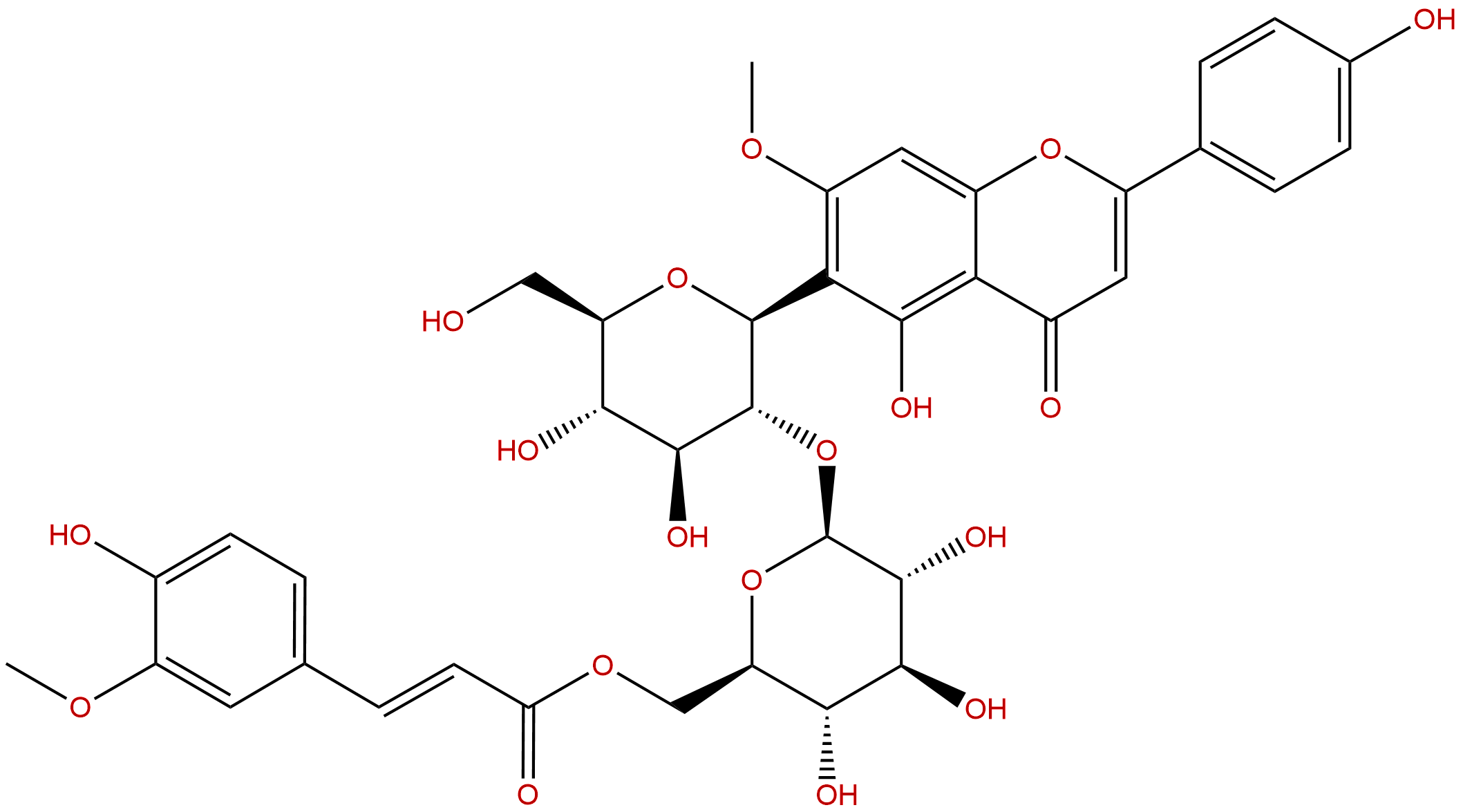


Product name: Spinosin B
Synonym name: 6'''-Feruloylspinosin
Catalogue No.: BP1572
Cas No.: 77690-92-7
Formula: C38H40O18
Mol Weight: 784.72
Botanical Source: Isol. from Zizyphus jujuba (Chinese date)
Physical Description: Yellow powder
Type of Compound: Flavonoids
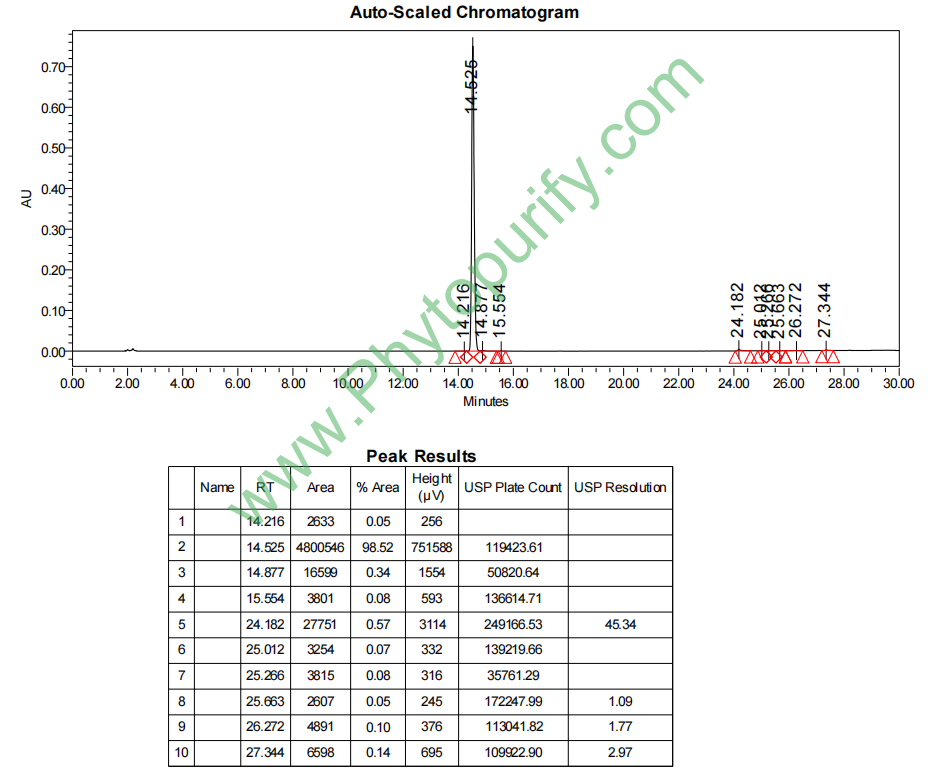
Purity: 95%~99%
Analysis Method: HPLC-DAD or/and HPLC-ELSD
Identification Method: Mass, NMR
Packing: Brown vial or HDPE plastic bottle
The product could be supplied from milligrams to grams. Inquire for bulk scale.
We provide solution to improve the water-solubility of compounds, thereby facilitating the variety of activity tests and clinic uses.
For Reference Standard and R&D, Not for Human Use Directly.
HPLC of Spinosin B
Storage conditions:Short-term storage at 2~8℃, long-term storage at -20 ~ -80℃
284.7300
.8194
.7981
.4798
.4540
.1422
Low
85.8662
5.0592
Yes
No
No
No
Yes
No
0.0
Yes
Yes
Yes
Yes
Alzheimer's disease (AD) is a progressive neurodegenerative disease characterized by senile plaques formed by the deposition of beta amyloid protein (A β), neurofibrillary tangles caused by excessive phosphorylation of tau protein, and neuronal loss and synaptic dysfunction resulting from it. At present, the number of AD patients worldwide continues to rise, bringing a heavy burden to society and families. However, existing therapeutic drugs such as cholinesterase inhibitors and NMDA receptor antagonists can only alleviate some symptoms and cannot effectively prevent or reverse the disease progression. Therefore, the search for new therapeutic strategies that can intervene in the core pathological processes of AD, especially neuroprotective agents targeting A β metabolism and clearance, has become the focus of current drug development.
Natural products have always been an important source of innovative drug discovery due to their structural diversity and rich biological activity. Among them, flavonoids have attracted much attention for their extensive neuroprotective effects. Spinosin B is a C-glycosidic flavonoid isolated from the traditional medicinal plant jujube kernel, with a CAS number of 77690-92-7. Recent studies have shown that spinosin B not only has good oral bioavailability, but also exhibits unique pharmacological activity by activating the nuclear factor E2 related factor 2/heme oxygenase-1 (Nrf2/HO-1) pathway, thereby inhibiting the production and polymerization of A β 1-42. This demonstrates enormous potential in the field of AD prevention and treatment. This article aims to provide a systematic review of the chemical properties, plant sources, pharmacological activities, mechanisms of action, medicinal properties, and clinical application prospects of spinosin B, in order to provide comprehensive scientific references for the in-depth research and development of this compound.
The chemical name of Spinosin B is 2 '' - β - D-glucosyl-7-O - β - D-glucosinolate, with a molecular formula of C39H44O19 and a molecular weight of 784.7200. Structurally, spinosin B belongs to the flavonoid carbon glycoside class, with its core structure being the flavonoid nucleus. Unlike common O-glycosidic flavonoids, the characteristic of spinosin B is that its sugar group (glucose group) is directly connected to the C-6 and C-8 positions of the flavonoid nucleus through carbon carbon bonds, forming stable C-glycosidic bonds. Specifically, its structure consists of an apigenin skeleton connected to a β - D-glucose group at position C-6 and a 2 '' - O - β - D-glucose substituted β - D-glucose group at position C-8. This C-glycosidic structure significantly enhances its stability against acid, base, and enzymatic hydrolysis compared to O-glycosides, which may be an important structural basis for its activity in vivo.
Based on its chemical structure calculation, the physicochemical parameters related to drug properties show that the logarithm of the lipid water partition coefficient (LogP) of spinosin B is 0.8194, indicating its moderate lipophilicity. The topologically polar surface area (TPSA) is as high as 284.7300 Å ², which is mainly attributed to the presence of multiple hydroxyl and sugar groups in the molecule, resulting in high molecular polarity. Its water solubility value is 0.4798, belonging to the category of slight solubility. Based on these parameters, especially the higher TPSA, it is predicted that its ability to penetrate the blood-brain barrier (BBB) is at a "low" level, which poses a challenge for its development as a central nervous system drug. However, it is worth noting that the distribution of natural products in the body may be influenced by various factors such as active transport, metabolic transformation, and their potential regulatory effects on BBB integrity. Simple theoretical predictions need to be validated through in vivo experiments. In addition, preliminary in vitro safety screening showed that spinosin B did not exhibit inhibitory effects on hERG potassium channels at the tested concentration (hERG inhibition: No), and the Ames test result was 0.0, suggesting that it may not have mutagenicity and potential cardiotoxicity risks, providing preliminary safety evidence for its further development.
Spinosu B mainly comes from the dried and mature seeds of Ziziphus jujuba var. spinosa, a plant in the jujube genus of the family Rhamnaceae, which is the traditional Chinese medicinal herb "Ziziphus jujuba var. spinosa". Suanzaoren has a medicinal history of more than two thousand years in China. It was first recorded in the "Shennong Bencao Jing" and is classified as a top-grade product. It has the effects of nourishing the heart and liver, calming the heart and calming the mind, and reducing sweating and generating fluids. It is commonly used in clinical practice to treat symptoms such as restlessness, insomnia, palpitations, and excessive sweating. Modern research has shown that the sedative, hypnotic, and anti anxiety central inhibitory effects of jujube seeds are closely related to the various active ingredients they contain, among which spinosin compounds (including spinosin A, B, C, etc.) are considered one of their key pharmacological substances.
The extraction and separation of spinosin B from jujube seeds usually involves solvent extraction combined with various chromatographic purification techniques. The conventional extraction process is as follows: first, the sour jujube kernel medicinal material is crushed, and then heated and refluxed with methanol, ethanol or its aqueous solution (such as 70% ethanol) or ultrasound assisted extraction is used to fully dissolve the flavonoid components. The extract is concentrated under reduced pressure to obtain a paste. Subsequently, macroporous adsorption resins (such as D101, AB-8, etc.) were used for preliminary enrichment and decolorization. Water ethanol gradient elution is commonly used, and spinosin B is usually enriched in elution sites with moderate polar ethanol concentrations (such as 30% -50%). Further separation and purification rely on column chromatography technology, which often uses silica gel column chromatography, polyamide column chromatography, dextran gel (such as Sephadex LH-20) column chromatography and reversed phase silica gel (such as ODS) column chromatography for repeated separation. In recent years, the application of high-performance liquid chromatography (HPLC) and preparative high-performance liquid chromatography (pre HPLC) technology has greatly improved the separation efficiency and purity of spinosin B. Typically, a C18 reverse phase chromatography column is used, with methanol water or acetonitrile water (pH adjusted with a small amount of formic acid or acetic acid) as the mobile phase for gradient elution, monitored by a UV detector (typically with maximum absorption at 270-280 nm), to efficiently obtain high-purity spinosin B monomer. The optimization of extraction processes, such as extraction solvents, temperature, time, and the application of new technologies (such as microwave and supercritical fluid extraction), is an important research direction for improving the yield of spinosin B.
The pharmacological activity research of Spinosin B mainly focuses on the nervous system, especially its neuroprotective effect, and has shown potential value in sedation, hypnosis, anti anxiety, and other aspects.
1. Neuroprotective effect:
This is the core activity that has received the most attention from Spinosin B. Spiropine B exhibits significant neuroprotective effects in various AD cell and animal models. In the A β 1-42 induced PC12 cell or primary cortical neuron injury model, pre-treatment with spinosin B can dose dependently increase cell survival rate, reduce lactate dehydrogenase (LDH) leakage, and inhibit cell apoptosis (such as reducing Bax/Bcl-2 ratio and caspase-3 activation). In the APP/PS1 dual transgenic AD mouse model, long-term oral administration of spinosin B significantly improved the spatial learning and memory abilities of mice (as demonstrated in the Morris water maze experiment), and alleviated neuronal loss and synaptic damage in the hippocampus and cortex regions. Its neuroprotective effect is closely related to reducing the deposition of A β plaques in the brain.
2. Inhibit A β pathology:
Spinosin B has a multi-target regulatory effect on the core pathological process of AD, A β metabolism. Research has confirmed that spinosin B can inhibit the activity of β - secretase 1 (BACE1), thereby reducing the pathway of A β production from amyloid precursor protein (APP). More importantly, it can directly inhibit the self aggregation process of A β 1-42 monomers and destroy the formed A β fibrils, causing them to dissociate into non-toxic or low toxicity oligomers or amorphous aggregates. In addition, there is evidence to suggest that spinosin B may promote the clearance of A β by regulating the expression of A β degrading enzymes such as insulin-dependent enzyme (IDE) or endothelin converting enzyme (ECE). These effects collectively led to a decrease in the toxicity of A β oligomers and plaque burden in the brain.
3. Antioxidant and anti-inflammatory effects:
Oxidative stress and neuroinflammation are key links in the pathological cascade of Alzheimer's disease. Spinosin B can effectively scavenge free radicals such as DPPH and ABTS, and enhance the activity of endogenous antioxidant enzymes (such as superoxide dismutase (SOD) and glutathione peroxidase (GSH Px)) in cells subjected to oxidative stress damage, while reducing levels of reactive oxygen species (ROS) and malondialdehyde (MDA). In the lipopolysaccharide (LPS) or A β - induced microglial activation model, spinosin B can inhibit the excessive release of pro-inflammatory factors (such as TNF - α, IL-1 β, IL-6) and downregulate the expression of inducible nitric oxide synthase (iNOS) and cyclooxygenase-2 (COX-2). Its anti-inflammatory mechanism is related to the inhibition of NF - κ B signaling pathway activation.
4. Sedative hypnosis and anti anxiety effects:
As one of the main active ingredients of jujube seeds, spinosin B also inherits the central inhibitory effect of its source medicinal material. In the autonomous activity experiment and pentobarbital sodium cooperative sleep experiment, spinosin B can reduce spontaneous activity in mice, shorten sleep latency, and prolong sleep time. In anxiety models such as elevated cross maze and light dark box, Spinosin B shows a certain anti anxiety effect. These effects may be related to the regulation of the gamma aminobutyric acid (GABA) - and 5-hydroxytryptamine (5-HT) - nervous systems, but their specific mechanisms are not fully studied compared to their neuroprotective effects.
The core molecular mechanism by which spinosin B exerts neuroprotective effects is the activation of the cell's defensive transcription program - the Nrf2/ARE signaling pathway.
1. The core role of the Nrf2/HO-1 pathway:
Nuclear factor E2 related factor 2 (Nrf2) is a key transcription factor that regulates cellular oxidative stress response. In the resting state, Nrf2 binds to its negative regulatory protein Keap1 in the cytoplasm and is degraded by ubiquitination. When stimulated by oxidative stress or certain compounds, Nrf2 dissociates from Keap1, translocates into the nucleus, binds to antioxidant response elements (ARE), and initiates the transcription of a series of downstream cell protective genes, among which heme oxygenase-1 (HO-1) is an important target gene. Research has shown that spinosin B can effectively promote the translocation of Nrf2 from the cytoplasm to the nucleus, enhance its binding activity with ARE, and significantly upregulate the expression of HO-1. HO-1 degrades hemoglobin to produce carbon monoxide (CO), biliverdin (subsequently converted into bilirubin), and free iron, which together exert powerful antioxidant, anti-inflammatory, and anti apoptotic effects. The use of Nrf2 specific siRNA knockdown or HO-1 inhibitors (such as ZnPP) pretreatment can almost completely eliminate the protective effect of spinosin B on A β - induced neuronal damage, confirming the core position of this pathway.
2. Direct and indirect regulation of A β metabolism:
The inhibitory effect of spinosin B on A β is the result of multiple synergistic mechanisms.direct action Its molecules may bind to the A β peptide segment through hydrophobic interactions and hydrogen bonds, interfering with the formation of its β - folding structure and thus inhibiting aggregation.Indirect effects By activating the Nrf2/HO-1 pathway, on the one hand, it reduces the damage of oxidative stress to neurons and glial cells, and improves the metabolic environment of cells; On the other hand, upstream products of HO-1 (such as CO) have been shown to regulate the activity of BACE1 and promote the transformation of microglia to the A β phagocytic phenotype (M2 type), enhancing the clearance of A β. In addition, activation of Nrf2 can upregulate other antioxidant enzymes and phase II detoxifying enzymes, forming a broad cellular defense network that indirectly protects neurons from A β toxicity.
3. Interaction with other signaling pathways:
The effect of spinosin B is not isolated to the Nrf2 pathway. Research suggests that its anti-inflammatory effect is closely related to the inhibition of the NF - κ B pathway. It may limit the nuclear translocation of NF - κ B p65 subunit and the transcription of downstream pro-inflammatory genes by inhibiting the activity of I κ B kinase (IKK) and preventing the phosphorylation degradation of I κ B α. In addition, spinosin B can activate cell survival signaling pathways such as PI3K/Akt and ERK1/2, which not only have anti apoptotic effects themselves, but also phosphorylate Nrf2, promote its stability and activation, and form positive feedback regulation. In the apoptotic pathway, spinosin B can regulate mitochondrial function, stabilize mitochondrial membrane potential, inhibit the release of cytochrome C, and activate the caspase cascade reaction.
In summary, Spinosin B activates the Nrf2/HO-1 pathway as a hub, constructing a multidimensional network that encompasses antioxidant, anti-inflammatory, inhibition of A β production and aggregation, promotion of A β clearance, and anti apoptotic effects. This provides a solid theoretical basis for its response to the complex pathological mechanisms of AD.
Although Spinosin B has shown good pharmacological activity in preclinical studies, its pharmacological properties, especially pharmacokinetic characteristics, are the key to determining whether it can be successfully converted into clinical drugs.
1. Absorption, distribution, metabolism, and excretion (ADME):
* absorb As a C-glycosidic flavonoid, spinosin B has better oral absorption than many O-glycosides. Animal pharmacokinetic studies have shown that after oral administration in rats, spinosin B is absorbed relatively quickly in the gastrointestinal tract, with a peak time (Tmax) of about 1-2 hours. Its absolute oral bioavailability varies depending on research, but is generally considered to be at a moderate level, thanks to the resistance of C-glycosidic bonds to gut microbiota and digestive enzyme hydrolysis, which allows it to be partially absorbed into the bloodstream in its original form.
* distribution After entering the systemic circulation, Spinosin B can be widely distributed to various tissues. However, as mentioned earlier, its high polarity and TPSA pose challenges for penetrating the blood-brain barrier. Existing animal experimental data shows that spinoxin B can be detected in brain tissue after oral administration, but its concentration is much lower than plasma concentration, and the brain/plasma ratio is relatively low. This suggests that its efficiency in entering the central nervous system is limited, and it may be necessary to improve brain targeting by designing prodrugs, using delivery systems (such as nanoparticles, liposomes), or utilizing its potential regulatory effect on BBB permeability (such as long-term administration may improve BBB integrity through anti-inflammatory effects).
* Metabolism The metabolic pathways of spinosin B in the body mainly include II binding reactions, such as glucuronidation and sulfation. The liver and intestines are its main metabolic sites. Prototype drugs and their conjugates are the main forms of existence in plasma. At present, there are no reports of its widespread hydrolysis into aglycones, which is consistent with the stability of its C-glycosides.
* excretion Spiropine B and its metabolites are mainly excreted through the kidneys in urine, and bile excretion is also an important pathway. Its elimination half-life (t1/2) varies in different studies, roughly within a few hours, indicating the need for multiple daily administrations to maintain effective blood drug concentrations.
2. Challenges and optimization strategies for drug development:
* Blood-brain barrier penetrability This is the primary challenge for the development of Spinosin B as a central nervous system drug. The strategy includes: ① Structural modification On the premise of retaining the pharmacophore, modify the molecule with esterification, alkylation, etc., appropriately reduce polarity, and improve lipid solubility. ② New drug delivery system Develop brain targeted drug delivery systems based on nanotechnology, such as polylactic acid hydroxyacetic acid copolymer (PLGA) nanoparticles loaded with spinosin B, solid lipid nanoparticles, or nanocarriers surface modified with targeted peptides (such as TAT peptide, Angiopep-2), to enhance their BBB penetration ability. ③ combination therapy When used in combination with reagents that can temporarily and reversibly open the BBB (such as mannitol, bradykinin analogs), caution should be exercised in evaluating safety.
* Solubility and Formulation Design Its slightly soluble properties may affect the dissolution and bioavailability of oral formulations. Solid dispersion, cyclodextrin inclusion, micronization, or preparation into nanocrystals can be used to improve its dissolution rate and degree.
* safety The existing preliminary data (no hERG inhibition, Ames negative) is positive, but a systematic preclinical safety evaluation is still needed, including long-term toxicity, reproductive toxicity, carcinogenicity, etc., to comprehensively evaluate its safety window.
Spinosin B, as a natural active molecule derived from traditional Chinese medicine, has shown unique application prospects in the prevention and treatment of neurodegenerative diseases such as AD.
1. Potential for treating Alzheimer's disease:
The multi-target mechanism of action of Spinosin B, particularly its ability to simultaneously combat oxidative stress, neuroinflammation, and A β pathology through the Nrf2 pathway, is highly compatible with the complex pathogenesis network of AD. It not only has the potential to serve as a disease modifying therapy (DMT) drug to delay or prevent disease progression, but its sedative hypnotic adjuvant effect may also help improve common sleep disorders and behavioral psychiatric symptoms in AD patients. Possible future development directions include: as a single drug for early intervention of Alzheimer's disease; Combined use with existing symptomatic treatment drugs (such as donepezil and memantine) to achieve synergistic effects; Or it can be combined with other DMT drugs with different mechanisms of action (such as A β antibodies, tau protein inhibitors) to form a cocktail therapy.
2. Application exploration in other neurological diseases:
Based on its powerful antioxidant, anti-inflammatory, and neuroprotective effects, the application scope of spinosin B can be extended to other diseases accompanied by oxidative stress and neuroinflammation. For example, in Parkinson's disease (PD), its ability to activate the Nrf2 pathway may help protect dopaminergic neurons; In cerebral ischemia/reperfusion injury, it may alleviate oxidative damage and cell apoptosis; In vascular dementia, benefits may be obtained by improving cerebral blood flow and neuronal survival. In addition, its anti anxiety and sedative activities also deserve further exploration in fields such as anxiety disorders and insomnia.
3. Future research directions and challenges:
* In depth mechanism research Further elucidate the precise mode of interaction between spinosin B and Keap1 protein, and discover its direct molecular target. Using proteomics, metabolomics, and other techniques to comprehensively reveal its systematic pharmacological network.
* Improve brain delivery As mentioned earlier, developing efficient brain targeted delivery strategies is of paramount importance in advancing its clinical translation. More research is needed to design and evaluate the efficiency and safety of various drug delivery systems.
* Preclinical and clinical research Complete preclinical pharmacological, pharmacokinetic, and toxicological studies of GLP standards for the system, and provide a complete data package for its application for clinical trials. Subsequently, rigorous Phase I and Phase II clinical trials were designed to evaluate its safety, tolerability, pharmacokinetic characteristics, and preliminary efficacy in humans.
* Raw material supply and quality control Ensure a stable and sustainable supply of raw materials for Spinoza B. In addition to extracting from natural jujube kernels, exploring chemical synthesis or biosynthetic pathways (such as microbial fermentation and plant cell culture) is also of great significance. At the same time, establish quality control standards for the entire process from medicinal herbs to raw materials and formulations.
Spinosin B is a C-glycosidic flavonoid compound with clear neuroprotective effects discovered from the traditional Chinese medicine sour jujube kernels. Its unique chemical structure endows it with good stability and oral bioavailability. Numerous preclinical studies have confirmed that spinosin B exerts multiple effects, including inhibiting A β pathology, antioxidant, anti-inflammatory, and anti apoptotic effects, by activating the core cellular defense pathway Nrf2/HO-1. As a result, it has shown significant improvement in experimental models of Alzheimer's disease. Although it faces challenges in penetrating the blood-brain barrier, this bottleneck is expected to be overcome through modern pharmaceutical chemistry and formulation optimization strategies. Spinosin B not only provides a modern scientific annotation for understanding the traditional efficacy of sour jujube kernels in calming the mind and enhancing intelligence, but also represents a highly valuable anti AD lead compound for development. In the future, through in-depth interdisciplinary cooperation, continuous efforts will be made in mechanism elucidation, dosage form innovation, and clinical translation, and Spiropine B is expected to move from the laboratory to clinical practice, bringing new hope to patients with neurodegenerative diseases.
