Introduction/Overview
Alzheimer's disease, atherosclerosis, cerebral ischemia and other neurodegenerative and vascular diseases have become a major global public health challenge. The common pathophysiological basis of these diseases involves complex processes such as oxidative stress, mitochondrial dysfunction, chronic inflammatory response, and cell apoptosis. Therefore, finding active molecules that can intervene in these pathological processes with multiple targets is an important strategy for current drug development. Natural products have always been an important source of lead compound discovery due to their structural diversity and rich biological activity. Schisanphenol (CAS number: 69363-14-0), as a lignan compound isolated from traditional Chinese medicine plants of the Schisandra genus, has received widespread attention in the pharmacology community in recent years due to its excellent multiple pharmacological activities such as antioxidant, neuroprotective, anti-inflammatory, and cardiovascular protection. Research has shown that schisandrin not only directly clears reactive oxygen species and inhibits lipid peroxidation, but also improves mitochondrial function by regulating key signaling pathways such as SIRT1/PGC-1 α, and affects multiple targets related to neuroinflammation and cell apoptosis. This article aims to systematically review the chemical properties, plant sources, pharmacological activities, molecular mechanisms of action, pharmacological evaluation, and clinical application prospects of schisandrin in related diseases, in order to provide comprehensive scientific references for the in-depth research and development of this compound.
Chemical structure and physicochemical properties
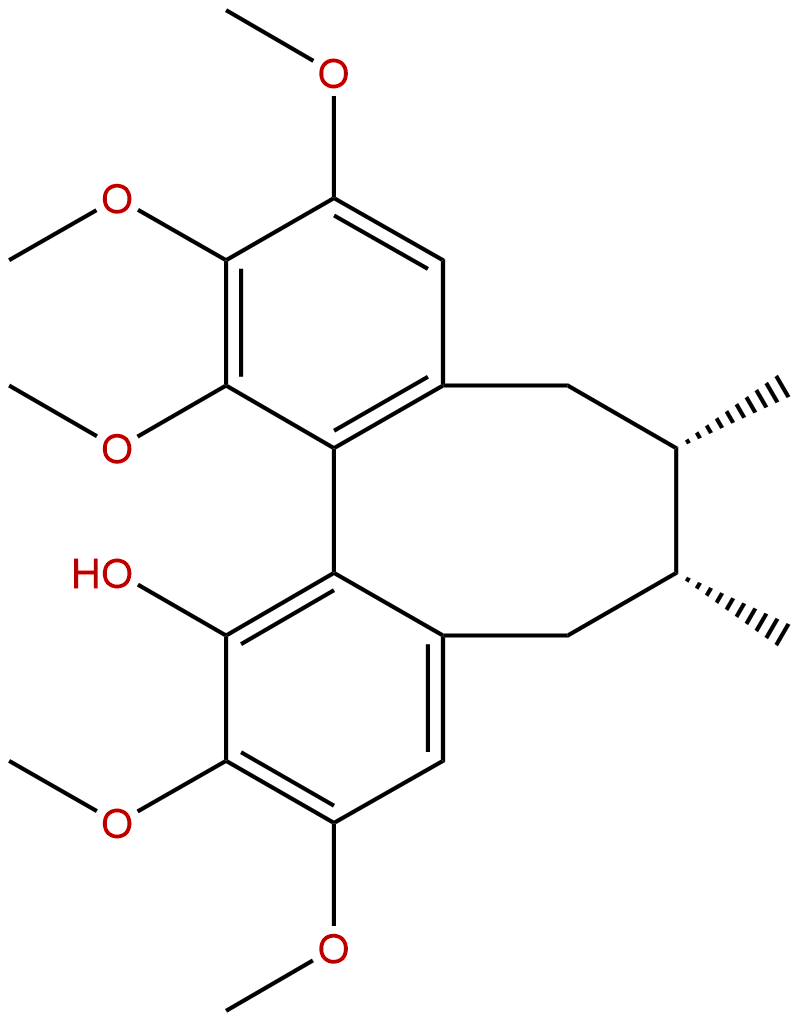
Schisandrin is a biphenyl cyclooctene type lignan, with the chemical name (6S, 7R) -1,2,3,12-tetramethoxy-6,7-dimethyl-5,6,7,8-tetrahydrodibenzo [a, c] cyclooctene-10,11-diol. Its molecular formula is C23H30O6 and its molecular weight is 402.4870. Structurally, it consists of two phenylpropanoid units connected by C-C bonds to form a unique eight membered ring skeleton, with multiple methoxy and hydroxyl substituents attached to it. This complex structure of rigidity and flexibility is the material basis for its biological activity.
From the perspective of physicochemical parameters related to drug properties, the lipid water partition coefficient (LogP) of schisandrin is 4.5443, indicating its strong lipophilicity. Its topological polar surface area (TPSA) is 66.3800 Å ², which is relatively small. The water solubility data is 0.0030 mg/mL, which belongs to insoluble compounds. These parameters collectively determine the absorption and distribution characteristics of schisandrin in organisms. Its high lipophilicity facilitates its penetration through cell membranes and the blood-brain barrier (predicted as high permeability), providing favorable conditions for its central nervous system protective effects. In addition, preliminary toxicity prediction data shows that it has no significant inhibitory effect on hERG potassium channels (predicted as "no"), indicating a low risk of cardiac toxicity; The Ames test predicted a value of 0.6, indicating that its mutagenic risk is also at a low level, laying the foundation for further safety evaluation.
Plant sources and extraction methods
Schisandra mainly comes from plants in the Schisandra genus of the Magnoliaceae family. This genus of plants, especially Schisandra sphenanthera and Schisandra chinensis, have a long history of application in traditional Chinese medicine and are known as important medicines for "astringency and astringency, nourishing qi and fluids, tonifying the kidneys and calming the heart". Schisandrin is another important active lignan component in these plants, in addition to schisandrin and schisandrin.
The extraction of schisandrin from plant materials is usually carried out using organic solvent extraction method. The common process includes crushing the dried Schisandra fruit and performing reflux extraction or ultrasound assisted extraction with polar solvents such as methanol, ethanol, or acetone. The crude extract was obtained by vacuum concentration of the extraction solution. Subsequently, a variety of chromatographic separation technologies were used for purification, such as silica gel column chromatography, reverse phase silica gel column chromatography (such as ODS), Sephadex LH-20 column chromatography and high performance liquid chromatography (HPLC). By gradient elution using solvent systems such as petroleum ether ethyl acetate, chloroform methanol, etc., combined with thin-layer chromatography (TLC) or high-performance liquid chromatography monitoring, schisandrin monomers can be gradually separated and enriched. Modern extraction techniques such as supercritical CO2 fluid extraction have also been attempted for the extraction of lignans from Schisandra chinensis due to their advantages of being green, efficient, and selective, which is expected to improve the extraction efficiency and purity of schisandrin.
Pharmacological activity research
Numerous in vitro and in vivo pharmacological studies have confirmed that schisandrin has broad and significant biological activities, mainly focused on the protection of the nervous system and cardiovascular system.
1. Neuroprotection and anti Alzheimer's disease activity:
The core activity of schisandrin lies in its powerful antioxidant and mitochondrial protective effects. Schisandrin exhibits clear protective effects in various Alzheimer's disease (AD) cell and animal models. It can significantly increase the activity of endogenous antioxidant enzymes such as superoxide dismutase (SOD) and glutathione peroxidase (GPx) in brain tissue, while effectively reducing the content of malondialdehyde (MDA), a final product of lipid peroxidation. More importantly, it can directly inhibit the swelling and disintegration of brain mitochondria, protect mitochondrial membranes from oxidative damage, and maintain cellular energy metabolism homeostasis. Behavioral experiments have shown that schisandrin can improve learning and memory impairments in AD model animals. Its function is closely related to reducing acetylcholinesterase (AChE) activity (increasing acetylcholine levels) and downregulating the levels of hyperphosphorylated Tau proteins (such as p-Tau Ser396).
2. Anti atherosclerosis and vascular endothelial protective activity:
In the cardiovascular field, schisandrin has outstanding anti atherosclerosis potential. Its mechanism is firstly reflected in inhibiting the oxidative modification of low-density lipoprotein (LDL), and ox LDL is the key factor in the initiation of atherosclerosis. At the cellular level, schisandrin can significantly alleviate ox LDL induced apoptosis of human umbilical vein endothelial cells (HUVEC), reduce excessive generation of intracellular reactive oxygen species (ROS), and alleviate cytotoxicity, thereby protecting the integrity and function of the vascular endothelial barrier.
3. Anti cerebral ischemia/reperfusion injury activity:
In the cerebral ischemia model, schisandrin can reduce the volume of cerebral infarction and alleviate neurological deficits. Its protective effect is also attributed to its antioxidant stress resistance, which protects the survival of neurons in the ischemic penumbra by clearing free radicals, inhibiting mitochondrial oxidative damage, and cell apoptosis pathways.
4. Anti inflammatory activity:
In addition to its direct antioxidant effect, schisandrin also has significant anti-inflammatory effects. Research has shown that it can inhibit the release of inflammatory mediators induced by stimuli such as lipopolysaccharides (LPS), such as reducing the levels of tumor necrosis factor - α (TNF - α), interleukin-6 (IL-6), and nitric oxide (NO). This provides support for its multi target therapeutic role in AD (neuroinflammation) and atherosclerosis (chronic vascular inflammation).
Mechanism of action and molecular targets
The multiple pharmacological activities of schisandrin stem from its synergistic regulation of multiple key signaling pathways and molecular targets.
1. Activate the SIRT1/PGC-1 α pathway to improve mitochondrial function:
This is one of the core mechanisms by which schisandrin exerts neuroprotective effects. Silencing information regulatory factor 1 (SIRT1) is a NAD+- dependent deacetylase that plays a central role in energy metabolism and stress resistance. Schisandrin can upregulate the expression and activity of SIRT1. Activated SIRT1 subsequently deacetylates and activates peroxisome proliferator activated receptor gamma co activator 1 alpha (PGC-1 alpha), which is the main regulatory factor for mitochondrial biosynthesis and function. By activating the SIRT1/PGC-1 α axis, schisandrin promotes mitochondrial production, enhances mitochondrial antioxidant defense capabilities, and improves cellular energy metabolism. This may be the fundamental reason for its ability to alleviate brain mitochondrial damage and combat age-related brain function decline.
2. Inhibit neuroinflammatory signaling pathways:
The anti-inflammatory effect of schisandrin involves the regulation of multiple inflammation related targets. Research has shown that it can inhibit the activation of the nuclear factor kappa B (NF - κ B) signaling pathway, including inhibiting the activity of IKK β (IKBKB), preventing I κ B degradation, thereby reducing the nuclear translocation of NF - κ B subunit p65 (RELA), and ultimately downregulating the expression of inflammatory factors such as TNF - α, IL-6, and inducible nitric oxide synthase (iNOS/NOS2). In addition, it can also inhibit the activation of the key component Caspase-1 (CASP1) of inflammasomes, as well as the phosphorylation of signal transduction and transcription activator 3 (STAT3), thereby inhibiting the inflammatory response from multiple pathways. The potential regulatory effects on cyclooxygenase-1 (PTGS1/COX-1) and pain related ion channels TRPV1 and TRPA1 also suggest their potential value in alleviating neuropathic pain.
3. Regulating tau protein pathology and cholinergic system:
In terms of AD pathology, schisandrin can reduce the abnormal phosphorylation level of tau protein at Ser396 site. This effect may be related to SIRT1 activation, as SIRT1 can regulate the activity of various protein kinases and phosphatases. Meanwhile, by inhibiting AChE and increasing the concentration of acetylcholine in the synaptic cleft, the cholinergic neurotransmission function is directly improved.
4. Inhibit drug metabolizing enzyme UGT2B7:
Research has shown that schisandrin can inhibit the activity of uridine diphosphate glucuronosyltransferase 2B7 (UGT2B7). This enzyme is involved in the glucuronidation metabolism of various endogenous substances and exogenous drugs, such as nonsteroidal anti-inflammatory drugs and morphine. This inhibitory effect may pose potential risks for drug drug interactions, but it may also provide new ideas for designing combination therapy regimens.
Evaluation of drug properties and pharmacokinetics
Although schisandrin has shown great potential in preclinical studies, its pharmacological properties still require systematic evaluation.
Pharmacokinetic characteristics: The oral activity of schisandrin has been confirmed in animal experiments, but the specific pharmacokinetic parameters (such as absorption, distribution, metabolism, excretion) are not yet fully available in public data. Based on its physicochemical properties (high LogP, low water solubility), it is predicted that its oral absorption may be limited by solubility. However, once absorbed, its high lipophilicity facilitates widespread distribution, especially its ability to efficiently penetrate the blood-brain barrier and reach effective concentrations in the central nervous system. Its main metabolic pathways in the body may include phase I (oxidation, reduction) and phase II (glucuronidation, sulfation) reactions in the liver. Its inhibition of UGT2B7 suggests that it may affect the disposal process of itself or other drugs metabolized by the enzyme.
Advantages and challenges of pharmaceutical properties:
* Advantage: ① Multi target and multi pathway effects have the potential for comprehensive treatment of complex diseases such as Alzheimer's disease; ② Clear oral activity; ③ Excellent blood-brain barrier penetration ability, beneficial for the treatment of central nervous system diseases; ④ The preliminary prediction suggests a low risk of cardiac toxicity and genetic toxicity.
* Challenge: ① Poor water solubility may affect oral bioavailability and needs to be improved through formulation techniques such as solid dispersions, nanocrystals, and liposomes; ② The pharmacokinetic behavior is not yet clear and requires systematic study of its absorption, distribution, metabolism, and excretion processes; ③ Inhibition of metabolic enzymes such as UGT2B7 may pose potential risks of drug interactions and require close attention in clinical research; ④ The safety, tolerability, and exact treatment window of long-term administration need to be determined through in-depth preclinical and clinical studies.
Clinical application prospects and prospects
The clinical application prospects of schisandrin mainly revolve around its core pharmacological activities.
1. Neurodegenerative diseases: As a disease modifying or adjuvant therapy for AD, schisandrin is the most promising direction. It is expected to delay the disease progression of AD from multiple perspectives through multiple mechanisms such as antioxidant, anti-inflammatory, improvement of mitochondrial function, reduction of tau pathology, and enhancement of cholinergic transmission. In addition, schisandrin also has certain application value for vascular dementia, Parkinson's disease, cognitive impairment after cerebral ischemia, and age-related mild cognitive impairment.
2. Cardiovascular and cerebrovascular diseases: In the prevention and early treatment of atherosclerosis, schisandrin can be used as an antioxidant and anti-inflammatory agent to stabilize plaque and protect endothelial function. In the neuroprotective treatment of stroke (especially ischemic stroke), it may also have a place.
3. Other potential areas: Its anti-inflammatory and antioxidant properties may also be applicable to other diseases related to oxidative stress and chronic inflammation, such as metabolic syndrome and non-alcoholic fatty liver disease.
Future research priorities should include:
* In depth mechanism exploration: Using omics techniques (proteomics, metabolomics) and gene editing tools to more accurately elucidate its network of action and direct targets of action.
* Optimization of drug properties: Develop new drug delivery systems to improve their solubility and bioavailability; Conduct systematic preclinical pharmacokinetic and safety evaluations.
* Clinical translational studies: Design rigorous clinical trials, first conducting Phase I safety, tolerability, and pharmacokinetic studies in healthy volunteers, followed by Phase II efficacy exploration studies in target patient populations such as early-stage AD patients.
* Combination therapy strategy: Explore the combination application of schisandrin with existing standard therapeutic drugs (such as cholinesterase inhibitors) in order to generate synergistic effects.
Conclusion
Schisandrin, as a natural lignan compound derived from traditional Chinese medicine, has shown remarkable application potential in neuroprotection, cardiovascular protection, and anti-inflammatory fields due to its unique chemical structure and multi-target pharmacological mechanism. Its core advantage lies in that it can improve mitochondrial function and redox balance from the source by activating key pathways such as SIRT1/PGC-1 α, and simultaneously inhibit neuroinflammation and apoptosis, providing new ideas for the treatment of complex multifactorial diseases such as Alzheimer's disease and atherosclerosis. Despite facing challenges such as poor water solubility and unclear pharmacokinetics in drug development, these obstacles are expected to be gradually overcome with the continuous advancement of modern pharmaceutical technology and translational medicine research. In summary, schisandrin is a highly valuable lead compound for development, and its subsequent in-depth research and clinical translation may not only lead to the emergence of new therapeutic drugs, but also provide important examples for a deeper understanding of the role of natural products in the treatment of complex diseases.