


Product name: Honokiol
Synonym name:
Catalogue No.: BP0736
Cas No.: 35354-74-6
Formula: C18H18O2
Mol Weight: 266.34
Botanical Source: Magnoliae officinalis cortex
Physical Description:
Type of Compound: Lignans
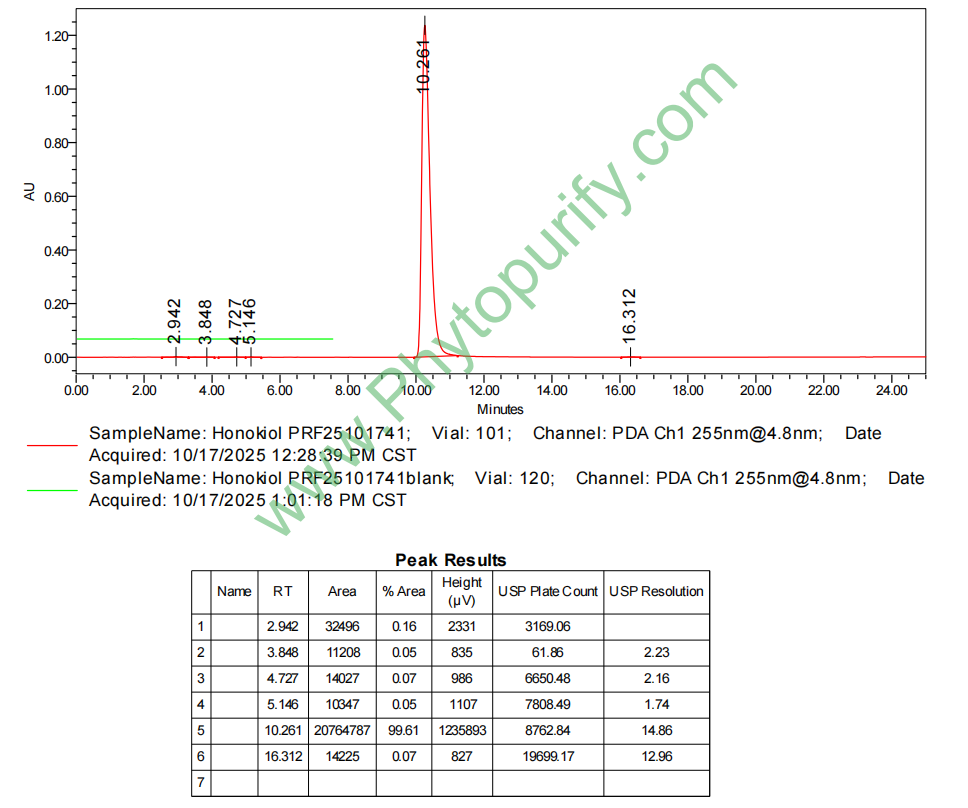
Purity: 95%~99%
Analysis Method: HPLC-DAD or/and HPLC-ELSD
Identification Method: Mass, NMR
Packing: Brown vial or HDPE plastic bottle
Storage: Store in a well closed container, protected from air and light. Put into refrigerate or freeze for long term storage.
Whenever possible, you should prepare and use solutions on the same day. However, if you need to make up stock solutions in advance, we recommend that you store the solution as aliquots in tightly sealed vials at -20℃. Generally, these will be useable for up to two weeks.
The product could be supplied from milligrams to grams
Inquire for bulk scale.
Description:
Honokiol has antibacterial, anti-angiogenesis, antidepressant-like, antioxidant, anti-inflammatory and anti-cancer effects. It inhibited the activation of Akt and enhances the phosphorylation of ERK1/ERK2. It can improve learning, memory impairments and neuroinflammatory processes induced by SCOP in mice, by inhibition of AChE activity.
References:
J. Biol. Chem., 2003, 278(37):35501-7.
Honokiol, a Small Molecular Weight Natural Product, Inhibits Angiogenesis in Vitro and Tumor Growth in Vivo.
Natural products comprise a major source of small molecular weight angiogenesis inhibitors.
METHODS AND RESULTS:
We have used the transformed endothelial cell line SVR as an effective screen of natural product extracts to isolate anti-angiogenesis and anti-tumor compounds. Aqueous extracts of Magnolia grandiflora exhibit potent activity in our SVR proliferation assays. We found that the small molecular weight compound Honokiol is the active principle of magnolia extract. Honokiol exhibited potent anti-proliferative activity against SVR cells in vitro. In addition, Honokiol demonstrated preferential inhibition of primary human endothelial cells compared with fibroblasts and this inhibition was antagonized by antibodies against TNFα-related apoptosis-inducing ligand. In vivo, Honokiol was highly effective against angiosarcoma in nude mice.
CONCLUSIONS:
Our preclinical data suggests that Honokiol is a systemically available and non-toxic inhibitor of angiogenesis and should be further evaluated as a potential chemotherapeutic agent.
Eur J Pharmacol. 2004 Aug 2;496(1-3):189-95.
In vitro antibacterial and anti-inflammatory effects of honokiol and magnolol against Propionibacterium sp.
Honokiol and magnolol, two major phenolic constituents of Magnolia sp., have been known to exhibit antibacterial activities. However, until now, their antibacterial activity against Propionibacterium sp. has not been reported.
METHODS AND RESULTS:
To this end, the antibacterial activities of Honokiol and magnolol were detected using the disk diffusion method and a two-fold serial dilution assay. Honokiol and magnolol showed strong antibacterial activities against both Propionibacterium acnes and Propionibacterium granulosum, which are acne-causing bacteria. The minimum inhibitory concentrations (MIC) of Honokiol and magnolol was 3-4 microg/ml (11.3-15 microM) and 9 microg/ml (33.8 microM), respectively. In addition, the killing curve analysis showed that magnolol and Honokiol killed P. acnes rapidly, with 10(5) organisms/ml eliminated within 10 min of treatment with either 45 microg (169.2 microM) of magnolol or 20 microg (75.2 microM) of Honokiol per ml. The cytotoxic effect of Honokiol and magnolol was determined by a colorimetric (3-(4,5-dimetyl-2-thiazolyl)-2,5-diphenyl-2H-tetrazolium bromide) (MTT) assay using two animal cell lines, human normal fibroblasts and HaCaT. In this experiment, magnolol exhibited lower cytotoxic effects than Honokiol at the same concentration, but they showed similar cytotoxicity when triclosan was employed as an acne-mitigating agent. In addition, they reduced secretion of interleukin-8 and tumor necrosis factor alpha (TNF-alpha) induced by P. acnes in THP-1 cells indicating the anti-inflammatory effects of them. When applied topically, neither phenolic compound induced any adverse reactions in a human skin primary irritation test.
CONCLUSIONS:
Therefore, based on these results, we suggest the possibility that magnolol and Honokiol may be considered as attractive acne-mitigating candidates for topical application.
Prog Neuropsychopharmacol Biol Psychiatry. 2008 Apr 1;32(3):715-25.
Antidepressant-like effects of the mixture of honokiol and magnolol from the barks of Magnolia officinalis in stressed rodents.
Honokiol and magnolol are the main constituents simultaneously identified in the barks of Magnolia officinalis, which have been used in traditional Chinese medicine to treat a variety of mental disorders including depression.
METHODS AND RESULTS:
The mixture of Honokiol and magnolol at 20 and 40 mg/kg significantly attenuated CMS-induced decreases of 5-HT levels in frontal cortex, hippocampus, striatum, hypothalamus and nucleus accumbens. And it markedly increased 5-HIAA levels in frontal cortex, striatum and nucleus accumbens at 40 mg/kg and in frontal cortex at 20 mg/kg in the CMS rats. A subsequent reduction in 5-HIAA/5-HT ratio was found in hippocampus and nucleus accumbens in the CMS rats receiving this mixture. Furthermore, the mixture of Honokiol and magnolol reduced elevated corticosterone concentrations in serum to normalize the hypothalamic-pituitary-adrenal (HPA) hyperactivity in the CMS rats. It also reversed CMS-induced reduction in platelet AC activity, via upregulating the cyclic adenosine monophosphate (cAMP) pathway. These results suggested that the mixture of Honokiol and magnolol possessed potent antidepressant-like properties in behaviors involved in normalization of biochemical abnormalities in brain 5-HT and 5-HIAA, serum corticosterone levels and platelet AC activity in the CMS rats.
CONCLUSIONS:
Our findings could provide a basis for examining directly the interaction of the serotonergic system, the HPA axis and AC-cAMP pathway underlying the link between depression and treatment with the mixture of Honokiol and magnolol.
HPLC of Honokiol
Storage conditions:Short-term storage at 2~8℃, long-term storage at -20 ~ -80℃
40.4600
4.3065
4.3046
.0312
6.5611
23.2824
High
92.1974
2.4424
No
Yes
No
No
Yes
Yes
0.0
Yes
Yes
Yes
Yes
Natural products, as an important source of drug discovery, play an irreplaceable role in the history of human disease prevention and treatment. Among them, active small molecules derived from traditional medicinal plants are increasingly becoming a hot topic in modern pharmacological research due to their structural diversity and multi-target action characteristics. Honokiol (CAS number: 35354-74-6) is an outstanding representative of this type of compound. It is mainly isolated from the bark of Magnolia officinalis or Magnolia obovata in the Magnoliaceae family, and is one of the key components for the pharmacological effects of Magnolia officinalis. As a type of catechol lignan, honokiol not only carries the traditional Chinese medicine's recognition of the efficacy of "drying dampness, eliminating phlegm, and removing excess qi", but also demonstrates remarkable broad-spectrum biological activity in the modern scientific perspective. Research has shown that honokiol has multiple pharmacological effects such as high antioxidant, anti-inflammatory, anti angiogenic, and anti-tumor properties. Its unique ability lies in its ability to target and regulate multiple key signaling pathways and molecular targets within cells, such as AMPK, STAT3, BCL-2 family proteins, etc. What is particularly noteworthy is that honokiol has excellent central nervous system permeability and can efficiently penetrate the blood-brain barrier, providing innate advantages for its application in the treatment of central nervous system related diseases such as neurodegenerative diseases, brain tumors, etc. This article aims to systematically review the chemical properties, plant sources, pharmacological activities, molecular mechanisms of action, pharmacological evaluation, and clinical application potential of magnolol, in order to provide comprehensive academic references for the in-depth development and transformation research of this natural product.
The chemical name of honokiol is 3 ′, 5-diallyl - [1,1 ′ - biphenyl] -2,4 ′ - diphenol, with a molecular formula of C18H18O2 and a molecular weight of 266.34. The core of its structure is a biphenyl skeleton composed of two benzene rings directly connected by a single bond. The two phenolic hydroxyl groups are located at position 2 of one benzene ring and position 4 'of the other benzene ring, respectively. At the same time, allyl groups (- CH2-CH=CH2) are connected at positions 3' and 5 of the two benzene rings, respectively. This unique hydroquinone structure endows it with amphiphilicity (both lipophilic and partially hydrophilic) and significant chemical stability.
Its physicochemical properties are closely related to its biological activity and medicinal properties. The lipid water partition coefficient (LogP) of honokiol is 4.31, indicating its strong lipophilicity, which is consistent with its good cell membrane penetration ability. The topological polar surface area (TPSA) is 40.46 Å ², which is relatively small and conducive to transmembrane transport. The water solubility is poor, about 0.0312 mg/mL, which to some extent limits its direct application in aqueous formulations, but also promotes research on dosage form improvement strategies based on nanocarriers, cyclodextrin inclusion, etc. The key pharmacological parameters show that honokiol has no hERG potassium channel inhibitory activity (indicating a low potential risk of cardiac toxicity), and the Ames test result is negative (indicating no mutagenicity in this testing system), providing preliminary positive data for its safety evaluation. One of the most significant characteristics is its high blood-brain barrier permeability, which is closely related to its moderate molecular weight and lipophilicity, and is its core advantage that distinguishes it from many other natural active ingredients.
The main source of honokiol is the dried bark, root bark, and branch bark of Magnolia officinalis Rehd. et Wils. or Magnolia obovata Thunb. in the family Magnoliaceae. Magnolia officinalis, as a commonly used traditional Chinese medicine, has a long history of application and was first recorded in the "Shennong Bencao Jing". In traditional Chinese medicine theory, Magnolia officinalis is known for its warm nature, bitter and pungent taste, and its ability to regulate the spleen, stomach, lungs, and large intestine meridians. It has the effects of drying dampness, eliminating phlegm, and removing excess qi. It is commonly used to treat conditions such as dampness stagnation, abdominal distension, constipation, phlegm, thirst, wheezing, and cough. Magnolol, a structurally similar compound, is widely recognized as the main active ingredient in Magnolia officinalis.
The extraction of magnolol from plant materials is usually carried out using organic solvent extraction method. Common methods include: 1)Organic solvent reflux extraction Heating reflux extraction of Magnolia bark powder using polar solvents such as ethanol, methanol, and acetone is a simple and efficient method. 2)Ultrasound assisted extraction Utilizing the cavitation effect of ultrasound to accelerate solvent penetration and component dissolution can shorten extraction time and improve extraction efficiency. 3)Supercritical fluid extraction Especially with the use of supercritical CO2 extraction technology, it has the advantages of good selectivity, high extraction efficiency, no residual organic solvents, and environmental friendliness, making it an advanced method for obtaining high-purity natural products. After further separation and purification steps, such as silica gel column chromatography and high-performance liquid chromatography (HPLC) preparation, high-purity honokiol monomer can be obtained from the crude extract. In recent years, there have also been studies exploring biosynthetic and chemical synthesis pathways to meet the needs of large-scale production and structural modification.
A large number of pharmacological studies both in vitro and in vivo have confirmed that honokiol has broad and powerful biological activities, and its potential for application far exceeds traditional knowledge.
anticancer activity This is one of the most in-depth areas of research on magnolol. It exhibits significant inhibitory effects on proliferation, induction of apoptosis, cell cycle arrest, and inhibition of invasion and metastasis in various malignant tumor cells. In colon cancer models, research is particularly focused. Houpo phenol can effectively inhibit the growth of human colon cancer cell lines (such as HCT-116, SW480, HT-29), and can also inhibit the formation and development of colon tumors in animal models. Its anti-cancer effect has the characteristics of multi-target and multi pathway.
Anti inflammatory and immune regulatory activity Houpo phenol exerts a powerful anti-inflammatory effect by inhibiting key inflammatory signaling pathways such as nuclear factor kappa B (NF - κ B), signal transduction and transcription activation factor 3 (STAT3), and downregulating the expression of inflammatory mediators such as cyclooxygenase-2 (COX-2), inducible nitric oxide synthase (iNOS), tumor necrosis factor - α (TNF - α), and interleukin-6 (IL-6). Good results have been shown in animal models of rheumatoid arthritis, inflammatory bowel disease, and neuroinflammation.
Neuroprotection and central nervous system activity Thanks to its excellent blood-brain barrier penetration ability, honokiol has shown great potential in central nervous system diseases. Research has shown that it has multiple neuroprotective effects, including antioxidant, anti neuroinflammatory, inhibition of microglial overactivation, reduction of beta amyloid (A β) deposition, anti tau protein hyperphosphorylation, and promotion of neurotrophic factor expression. Positive therapeutic effects have been observed in preclinical models of Alzheimer's disease, Parkinson's disease, cerebral ischemia-reperfusion injury, depression, and anxiety.
Cardiovascular protective activity: Honokiol has antioxidant stress, anti atherosclerosis, protection of myocardial cells from ischemia-reperfusion injury, anti arrhythmia, vasodilation and other effects, and has potential prevention and treatment value for cardiovascular diseases such as hypertension, myocardial hypertrophy, heart failure and so on.
Other activities In addition, studies have found that honokiol has various pharmacological activities such as anti angiogenesis, anti microbial (including certain bacteria and fungi), anti obesity, improvement of insulin resistance, and protection of the liver and bones.
The pharmacological effects of honokiol stem from its multi-target regulation of the cellular signaling network. In colon cancer and other cancer models, its mechanism of action involves multiple key targets and pathways:
These targets do not exist in isolation, but form a complex network of interactions. Houpo phenol exerts a synergistic effect by simultaneously acting on multiple nodes in the network, ultimately achieving strong inhibition of pathological processes such as tumor growth and inflammatory response.
Although honokiol has excellent in vitro activity and good blood-brain barrier penetration, its drug development still faces some challenges, and relevant pharmacokinetic studies provide important evidence for its clinical translation.
Pharmacokinetic characteristics Animal studies have shown that honokiol is rapidly absorbed after oral administration, but its first pass effect is significant, resulting in relatively low oral bioavailability (about 5-10% in rat models). It is widely distributed in the body, and due to its high lipophilicity, it is easily enriched in adipose tissue and can quickly distribute to various organs including the brain. Houpo phenol is mainly metabolized in the liver through glucuronidation and sulfation reactions, forming corresponding aglycone complexes, which are excreted through urine and bile. Its plasma half-life is relatively short, indicating that frequent administration or use of sustained-release formulations may be necessary to maintain effective blood drug concentrations.
Pharmaceutical advantages:
1. The molecular weight is small (266.34), meeting the basic requirements of the "five rules" for drug properties.
2. Excellent blood-brain barrier penetration ability is a valuable characteristic for developing drugs for the central nervous system.
3. Preliminary safety evaluation is good (no hERG inhibition, Ames negative).
4. The multi-target mechanism of action may bring synergistic therapeutic effects and reduce the risk of drug resistance.
Challenges and improvement strategies for drug development:
1. Poor water solubility: Affects its formulation development and in vivo absorption. Strategy: Develop nano formulations (such as liposomes, nanoparticles, micelles), cyclodextrin inclusion complexes, phospholipid complexes, or prodrugs to enhance solubility and bioavailability.
2. Low oral bioavailability Mainly limited by first pass metabolism and solubility. Strategy: In addition to the above-mentioned dosage form improvements, non oral administration routes (such as transdermal, nasal, and injection administration) can also be explored.
3. Fast metabolism May result in a short duration of drug efficacy. Strategy: Develop sustained-release formulations or search for structurally similar compounds with more stable metabolism.
4. The duality of multi-target characteristics While bringing broad-spectrum therapeutic effects, it may also increase the risk of off target effects and unforeseeable side effects, which requires close monitoring in clinical research.
At present, multiple nano delivery systems based on honokiol have been developed and have shown improved pharmacokinetic properties and enhanced anti-tumor and neuroprotective efficacy in preclinical studies.
Based on solid preclinical research data, the clinical application prospects of honokiol are broad, but its transformation still needs to be steadily promoted.
Potential clinical application directions:
1. Tumor adjuvant therapy and drug resistance reversal As a sensitizer for chemotherapy, radiotherapy, or targeted therapy, it is particularly suitable for solid tumors such as colon cancer and glioma. Its multi-target characteristics, ABCB1 inhibitory activity, and low toxicity give it unique advantages in overcoming tumor multidrug resistance and reducing traditional treatment side effects.
2. Prevention and treatment of neurodegenerative diseases For diseases such as Alzheimer's and Parkinson's, the neuroprotective, anti-inflammatory, antioxidant, and A β/Tau targeting effects of magnolol make it a highly promising candidate drug for disease modifying agents.
3. Inflammatory and autoimmune diseases Such as rheumatoid arthritis, inflammatory bowel disease, neuroinflammatory related diseases, etc., their strong anti-inflammatory and immune regulatory abilities can provide new treatment options.
4. cardiovascular disease As a cardiovascular protective agent for anti oxidative stress and anti inflammation, it is used for the prevention and treatment of atherosclerosis, myocardial ischemia, etc.
5. Other It has also shown potential applications in fields such as anxiety/depression, metabolic syndrome, and skin diseases.
Outlook and Future Research Directions:
1. Formulation Innovation and Delivery System Optimization This is the key to promoting the clinical application of honokiol. We need to continue developing efficient, stable, and highly targeted nano formulations or novel drug delivery systems to completely address their water solubility and bioavailability bottlenecks.
2. In depth clinical research Currently, clinical trial data on honokiol in humans is still limited. It is urgent to conduct standardized Phase I-III clinical trials to systematically evaluate its safety, tolerability, pharmacokinetics, and effectiveness for different indications in humans.
3. Structural modification and development of analogues By rationally modifying the chemical structure of honokiol, it is expected to obtain derivatives with stronger activity, higher selectivity, better pharmacokinetic properties, or targeting specific targets, thereby expanding its therapeutic window and application scope.
4. Deep analysis of the mechanism of action Using methods such as systems biology, chemical biology, and artificial intelligence, further map the precise action network of honokiol at the cellular and global levels, clarify the deep logic of its "multi-target" synergistic effect, and provide a basis for precision medicine.
5. Research on the Integration of Traditional Chinese and Western Medicine In depth exploration of the role of honokiol in compound Chinese medicine (such as classic formulas containing Magnolia officinalis) and its interactions with other components, explaining the scientific connotation of compatibility in Chinese medicine formulas from a modern scientific perspective.
As a natural small molecule of hydroquinone derived from the traditional Chinese medicine Magnolia officinalis, honokiol has become a shining star in natural product pharmacology research due to its unique chemical structure, excellent blood-brain barrier penetration ability, and extensive and powerful multi-target pharmacological activity. From anti-tumor, anti-inflammatory to neuroprotective effects, the research on its mechanism of action has delved into multiple key signaling nodes such as AMPK, STAT3, NF - κ B, BCL-2, revealing its scientific essence of exerting therapeutic effects by regulating complex cellular networks. Despite challenges such as water solubility and bioavailability in drug development, these obstacles are gradually being overcome through the intervention of modern pharmacology and medicinal chemistry methods. In the future, with breakthroughs in dosage form innovation and the advancement of rigorous clinical research, honokiol is highly likely to move from the laboratory to clinical practice and develop into a new drug or highly effective adjuvant therapy for the treatment of various major diseases such as colon cancer, neurodegenerative diseases, and chronic inflammation. It not only reflects the enormous value of excavating modern therapeutic drugs from the treasure trove of traditional medicine, but also provides a classic example for developing innovative drugs from natural sources with multi-target regulatory characteristics. The continuous in-depth research on honokiol will undoubtedly contribute more natural wisdom and solutions to the cause of human health.
