


Synonym name:
Catalogue No.: BP0574
Cas No.: 877822-40-7
Formula: C24H30O9
Mol Weight: 462.495
Botanical Source: Eupatorium lindleyanum
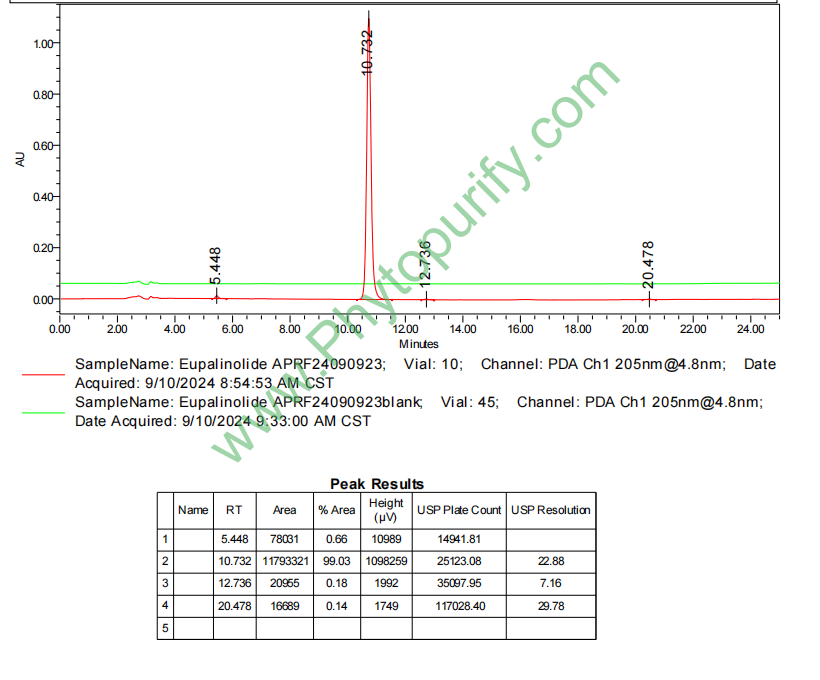
Purity: 95%~99%
Analysis Method: HPLC-DAD or/and HPLC-ELSD
Identification Method: Mass, NMR
Packing: Brown vial or HDPE plastic bottle
Can be supplied from milligrams to grams.
For Reference Standard and R&D, Not for Human Use Directly.
Inquire for bulk scale.
HPLC of Eupalinolide A
Storage conditions:Short-term storage at 2~8℃, long-term storage at -20 ~ -80℃
Eupalinolide A (CAS number: 877822-40-7) is a natural product derived from the genus Eupalinolide, and has received widespread attention in recent years due to its multi-target pharmacological activity. As a Yes related protein (YAP) degrader and heat shock protein 70 (HSP70) inducer, wild horse chase lactone A exhibits unique regulatory effects in various biological processes such as cell apoptosis, autophagy regulation, and stem cell differentiation. Its significant efficacy in the treatment of hepatocellular carcinoma (HCC) and traumatic heterotopic ossification of tendons (HO) disease models suggests its potential clinical application value. This article systematically reviews the chemical structure and physicochemical properties, plant sources and extraction methods, pharmacological activity and mechanism of action, pharmacological evaluation, and future clinical application prospects of wild horse chase lactone A. The aim is to provide scientific basis for basic research and drug development in related fields.
Wild horse chase lactone A belongs to the sesquiterpene lactone class, with a molecular formula of C26H-34O7 and a molecular weight of 462.4950. Its structural features include a lactone ring and multiple oxygen-containing functional groups, endowing it with high polarity and biological activity. In terms of physical and chemical properties, the LogP value of wild horse chase lactone A is 1.5669, indicating moderate lipid solubility and facilitating membrane penetration. Its topological polar surface area (TPSA) is 125.43 Å ², indicating that it has a good polarity distribution, which is conducive to binding with biomolecules such as proteins. The water solubility is 0.7923, indicating that its solubility in the aqueous phase is moderate, making it easy to absorb and distribute in vivo. It is worth noting that wild horse chase lactone A has high blood-brain barrier penetration ability and no hERG channel inhibition activity. The Ames mutagenicity test result is negative, indicating good safety and potential for drug development.
Wild horse chase lactone A is mainly isolated and obtained from plants of the wild horse chase genus, especially from traditional Chinese medicinal materials such as Eupatorium lindleyanum DC, which are rich in content. This genus of plants is widely distributed in China and East Asia, and has always been used to treat various inflammatory and tumor diseases. During the extraction process, organic solvents such as ethanol and methanol are often used to reflux extract dried plant materials, followed by liquid-liquid distribution, column chromatography (silica gel, C18 reverse phase column), and high performance liquid chromatography (HPLC) purification to obtain high-purity wild horse chase lactone A. In recent years, the application of ultrasound assisted extraction and supercritical fluid extraction technology has improved the extraction efficiency and purity, laying the foundation for large-scale production.
Wild horse chase lactone A exhibits significant antitumor effects in hepatocellular carcinoma cell lines (MHCC97-L, HCCLM3). It induces intracellular reactive oxygen species (ROS) generation, activates the extracellular signal regulated kinase (ERK) pathway, promotes autophagy in cancer cells, and thereby inhibits tumor growth. In addition, wild horse chase lactone A can degrade YAP protein, inhibit abnormal activation of Hippo signaling pathway, and reduce the proliferation and migration of tumor cells. In animal experiments, wild horse chase lactone A significantly inhibited the volume of hepatocellular carcinoma xenografts, demonstrating good in vivo anti-tumor activity.
Wild horse chase lactone A can inhibit osteogenic differentiation of tendon derived stem cells (TDSCs) and alleviate trauma induced ectopic ossification of the Achilles tendon. The mechanism of action is related to its regulation of stem cell fate, which may be achieved by inhibiting signaling pathways related to bone formation. This feature provides a new drug target for the treatment of ossification after trauma.
In the skin cell model PAM212, wild horse chase lactone A exhibits a protective effect and can effectively resist oxidative stress induced by ultraviolet B (UVB) and Menadione, as well as cell apoptosis caused by heat shock. This protective effect is closely related to its induction of HSP70 expression. HSP70, as a molecular chaperone protein, can stabilize cellular protein structure and alleviate cellular stress damage.
The pharmacological effects of wild horse chase lactone A involve multiple signaling pathways and key molecular targets, and the specific mechanisms are as follows:
YAP degradation and Hippo pathway regulation
YAP, as a key transcriptional co activator of the Hippo signaling pathway, plays an important role in cell proliferation and tumorigenesis. Wild horse chase lactone A promotes YAP protein degradation, inhibits its nuclear transcriptional activity, and blocks tumor cell proliferation and migration.
ROS/ERK signaling pathway activation
Wild horse chase lactone A induces an increase in intracellular ROS levels, activates the ERK pathway, and promotes autophagy. Autophagy, as a cellular stress response mechanism, helps to clear damaged organelles and proteins, and inhibits the survival of tumor cells.
HSP70 induction
Wild horse chase lactone A upregulates HSP70 expression, enhances cell tolerance to environmental stress, and reduces cell apoptosis. This mechanism plays a key role in protecting skin cells from UV and oxidative stress damage.
Anti apoptosis and gene regulation
Wild horse chase lactone A affects various molecules related to cell apoptosis, including MCL1, BCL2, STAT3, etc., regulating cell survival signals and promoting cancer cell apoptosis.
Matrix metalloproteinase-2 (MMP2) and regulation of tumor microenvironment
By inhibiting MMP2 activity, wild horse chase lactone A reduces the invasion and metastasis ability of tumor cells.
Other targets
Wild horse chase lactone A also interacts with molecules such as TOP1, TOP2A, HIF1A, MAPK1, ESR1, and CYP19A1, reflecting its multi-target regulatory properties.
The pharmacological evaluation of wild horse chase lactone A shows that it has good potential for drug development. Its molecular weight is moderate, and the LogP value indicates that it has a good lipid water balance, which is conducive to oral absorption and cell membrane penetration. The TPSA value suggests that it may have good bioavailability. Moderate water solubility, convenient for formulation development. Importantly, wild horse chase lactone A can penetrate the blood-brain barrier, expanding its potential applications in central nervous system diseases.
In terms of safety, wild horse chase lactone A does not inhibit hERG channels, reducing the risk of cardiac toxicity. The negative result of Ames test indicates that it does not have mutagenicity and has high safety. The current research on its pharmacokinetics is still in its preliminary stage, and the metabolic pathways, half-life, and excretion mechanisms in vivo need to be further systematically elucidated to guide clinical dose design.
Wild horse chase lactone A has shown broad clinical application prospects due to its unique multi-target pharmacological activity. Its anti-tumor effect in the treatment of hepatocellular carcinoma provides a new treatment approach for liver cancer patients, especially with potential advantages in the management of drug resistance and recurrent tumors. In addition, the inhibitory effect of wild horse chase lactone A on traumatic tendon heterotopic ossification provides innovative drug candidates for the fields of orthopedics and rehabilitation medicine.
Future research should focus on the following aspects:
Preclinical safety and pharmacokinetic studies
Systematically evaluate the toxicological characteristics and in vivo metabolic kinetics of wild horse chase lactone A to ensure its safety and efficacy in clinical applications.
In depth analysis of the mechanism of action
By utilizing genomics, proteomics, and metabolomics techniques, comprehensively reveal its multi-target regulatory network and optimize drug design.
Exploration of formulation development and administration routes
Develop efficient and stable formulations based on their physicochemical properties, and explore diverse routes such as oral, injection, and local administration.
Clinical trial design
Based on its pharmacological characteristics, design a reasonable clinical trial plan to verify its efficacy and safety in liver cancer and ossification diseases.
Combination therapy strategy
Explore the synergistic effect of wild horse chase lactone A with existing anti-tumor or anti ossification drugs to enhance therapeutic efficacy and reduce side effects.
Wild horse chase lactone A, as a natural product with multi-target regulatory ability, has become a hot topic in the field of natural medicine research due to its significant activities in tumor inhibition, stem cell differentiation regulation, and cell protection. Its good pharmacological indicators and safety have laid a solid foundation for clinical translation. In the future, through in-depth mechanism research and preclinical evaluation, wild horse chase lactone A is expected to develop into a new drug for treating diseases such as hepatocellular carcinoma and traumatic ectopic ossification, providing effective treatment methods for clinical practice and promoting the development of natural product pharmacology and precision medicine.
