


Synonym name:
Catalogue No.: BP0575
Cas No.: 877822-41-8
Formula: C24H30O9
Mol Weight: 462.495
Botanical Source: Eupatorium lindleyanum
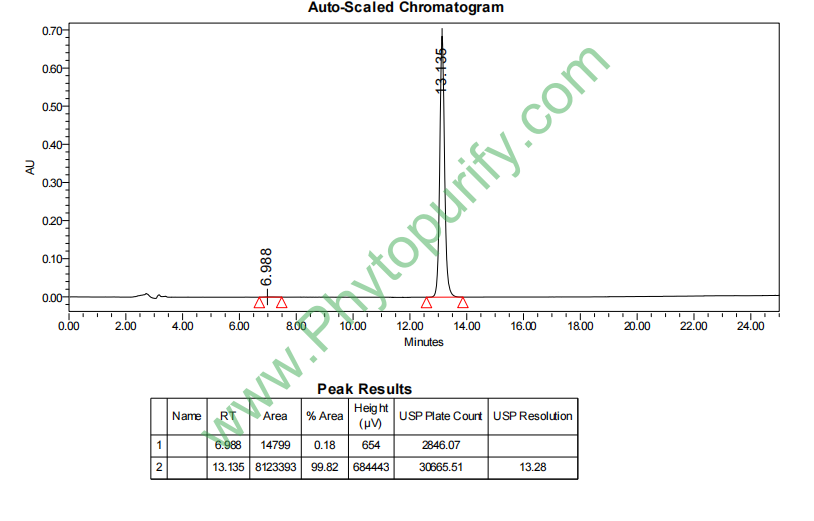
Purity: 95%~99%
Analysis Method: HPLC-DAD or/and HPLC-ELSD
Identification Method: Mass, NMR
Packing: Brown vial or HDPE plastic bottle
Can be supplied from milligrams to grams.
For Reference Standard and R&D, Not for Human Use Directly.
Inquire for bulk scale.
HPLC of Eupalinolide B
Storage conditions:Short-term storage at 2~8℃, long-term storage at -20 ~ -80℃
125.4300
1.5687
1.5688
.8012
2.4888
4.2191
High
66.0195
5.0265
No
Yes
No
No
Yes
No
0.0
Yes
Yes
Yes
Yes
Eupalinolide B (CAS number: 877822-41-8) is a natural sesquiterpene compound derived from the Eupatorium lindleyanum plant in the wild horse genus. As a natural product of sesquiterpenes, wild horse chase lactone B has received widespread attention in pharmacological research in recent years due to its unique chemical structure and multi-target regulatory ability. A large number of studies have shown that Eupatorium martenside B not only has significant anti-tumor activity, especially in the model of pancreatic cancer and liver cancer, but also shows multiple biological effects in inflammatory diseases such as rheumatoid arthritis, acute lung injury, periodontitis and depression. Its mechanism of action involves inducing cell apoptosis, promoting autophagy, regulating oxidative stress response, and regulating multiple signaling pathways, demonstrating a complex and systematic molecular regulatory network. This article aims to systematically review the chemical properties, sources and extraction, pharmacological activity and mechanism of action of wild horse chase lactone B, and explore its clinical application prospects and development directions in combination with drug evaluation. It provides theoretical basis and research ideas for natural product pharmacology and new drug development.
Wild horse chase lactone B belongs to the sesquiterpene class of embryonic sesquiterpenes, with a molecular formula of C27H34O7 and a molecular weight of 462.4950. Its chemical structure contains multiple unsaturated bonds and lactone rings, endowing it with unique biological activity. In terms of physical and chemical properties, the LogP value of wild horse chase lactone B is 1.5687, indicating that it has moderate lipid solubility, which is beneficial for cell membrane penetration and in vivo distribution. The polar surface area (TPSA) is 125.43 Å ², indicating that it has certain polar groups that facilitate the formation of hydrogen bonds and other interactions with biomolecules. The water solubility is 0.8012, indicating that it has a certain solubility in the aqueous phase, which is conducive to absorption in vivo. The high permeability of the blood-brain barrier suggests its potential role in the central nervous system. The hERG channel inhibition experiment showed a negative result, indicating a low risk of cardiac toxicity. The Ames mutagenicity test result is 0.0, indicating that its genetic toxicity risk is extremely low and meets safety requirements.
The chemical structure diagram of wild horse chase lactone B is shown below (schematic):
[此处插入野马追内酯B的化学结构示意图]
The lactone ring and polyunsaturated bonds in this structure are key functional groups for its biological activity, involved in binding to target proteins and regulating signaling pathways.
Wild horse chase lactone B is mainly isolated from the Eupatorium lindleyanum plant in the wild horse chase genus. Eupatorium lindleyanum is a traditional Chinese medicinal herb widely distributed in northern China and East Asia, commonly used to treat respiratory and inflammatory diseases. This plant contains abundant sesquiterpenes, among which wild horse chase lactone B is one of the main active ingredients with high pharmacological activity.
The extraction method usually uses organic solvent extraction combined with chromatographic separation technology. The specific steps include:
In recent years, new technologies such as ultrasound assisted extraction and microwave-assisted extraction have also been applied to the extraction of wild horse chase lactone B, improving extraction efficiency and purity, laying the foundation for its large-scale preparation.
Euphorbia lactide B has shown significant anticancer activity in many tumor models, especially in pancreatic cancer and liver cancer cell lines with strong cytotoxicity. Its anti-tumor effect is mainly reflected in the following aspects:
Wild horse chase lactone B has shown good therapeutic effects in various inflammatory disease models, mainly including:
Wild horse chase lactone B also exhibits various biological activities such as antioxidant, anti fibrotic, neuroprotective, etc., demonstrating its potential as a multifunctional drug candidate molecule.
The pharmacological effects of wild horse chase lactone B involve multiple molecular targets and signaling pathways, forming a complex regulatory network:
The synergistic effect of these multiple targets and pathways enables the effective treatment of wild horse chase lactone B in complex disease states and reduces the risk of drug resistance.
The pharmacological evaluation of wild horse chase lactone B shows that it has good potential for drug development:
At present, the pharmacokinetic studies of wild horse chase lactone B are still in the preliminary stage. In vivo experiments have shown that its oral bioavailability is good, the plasma half-life is moderate, and it can achieve effective therapeutic concentrations. In the future, further systematic research is needed to investigate its absorption, distribution, metabolism, and excretion (ADME) characteristics, optimize dosage forms, and improve in vivo stability and targeting.
Wild horse chase lactone B has broad clinical application prospects in anti-tumor, anti-inflammatory, and neuroprotective fields due to its multi-target and multi mechanism pharmacological properties. The specific outlook is as follows:
Development of anti-tumor drugs: For pancreatic cancer, liver cancer, colon cancer and other malignant tumors, Yemadilide B can be used as a new small molecule drug candidate, or combined with existing chemotherapy drugs to enhance the efficacy and reduce drug resistance.
Anti inflammatory and immunomodulatory agents Wild horse chase lactone B has shown good anti-inflammatory effects in inflammatory diseases such as rheumatoid arthritis, acute lung injury, and periodontitis, and has the potential to be developed as a natural anti-inflammatory drug.
Central nervous system diseases Its blood-brain barrier permeability is high, and it has neuroprotective effects such as antidepressant, which is expected to be applied as an adjuvant therapy for depression and related neurological and psychiatric disorders.
Security advantage Low genetic toxicity and cardiac toxicity risk provide strong guarantees for its clinical translation.
However, the clinical application of wild horse chase lactone B still faces many challenges, such as complex metabolic pathways in vivo, further enhancement of targeting, optimization of dosage forms, and validation of clinical safety and efficacy. In the future, efforts should be made to strengthen pharmacokinetics, toxicology, and preclinical research, and promote their progress towards the clinical trial stage.
Wild horse chase lactone B, as a natural sesquiterpene derived from Eupatorium lindleyanum, exhibits significant pharmacological activities in multiple fields such as anti-tumor, anti-inflammatory, and neuroprotective effects due to its unique chemical structure and multi-target regulatory ability. Its mechanism of action includes inducing apoptosis, promoting autophagy, regulating oxidative stress, and multiple key signaling pathways, reflecting the complex and systematic biological functions of natural products. The drug efficacy evaluation shows that it has good potential for drug development and safety advantages. In the future, through in-depth pharmacokinetic studies and preclinical validation, wild horse chase lactone B is expected to become a new natural medicine for treating various major diseases, providing important demonstrations for natural product pharmacology and modern drug development.
In summary, wild horse chase lactone B is a natural product with great research value and clinical application potential, which deserves continuous attention and in-depth exploration in basic research and translational medicine.
