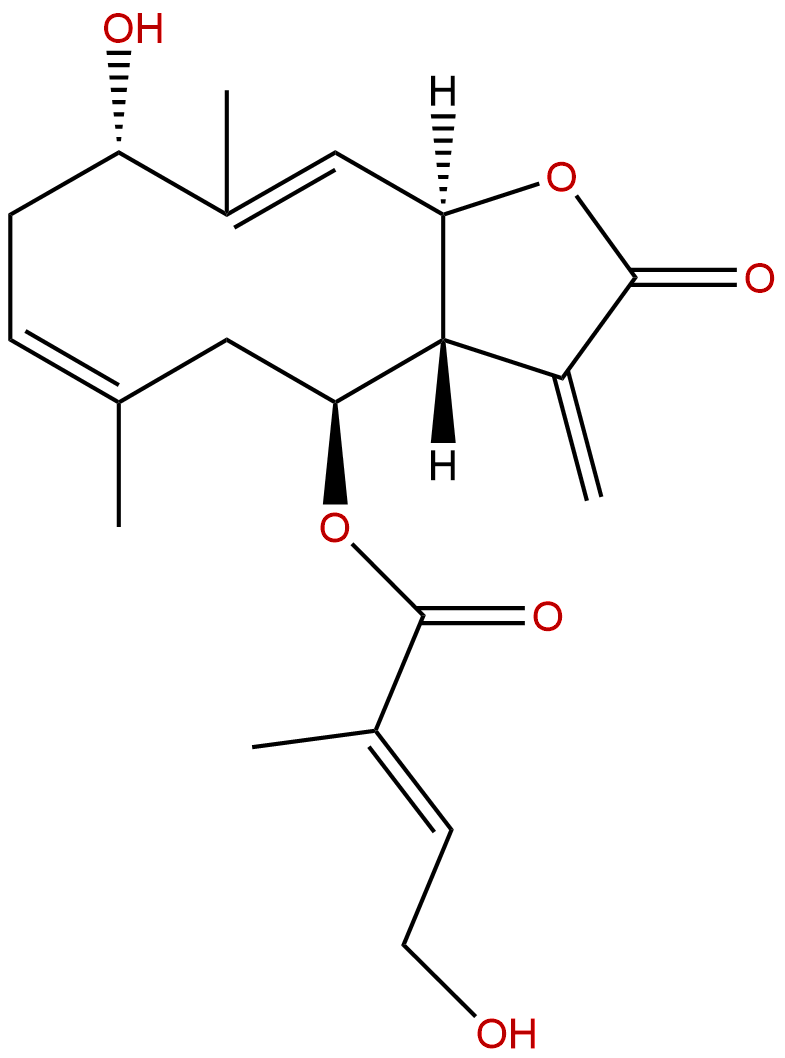


Product name: Eupalinolide K
Synonym name:
Catalogue No.: BP3141
Cas No.: 108657-10-9
Formula: C20H26O6
Mol Weight: 362.422
Botanical Source:
Physical Description: Powder
Type of Compound: Sesquiterpenoids
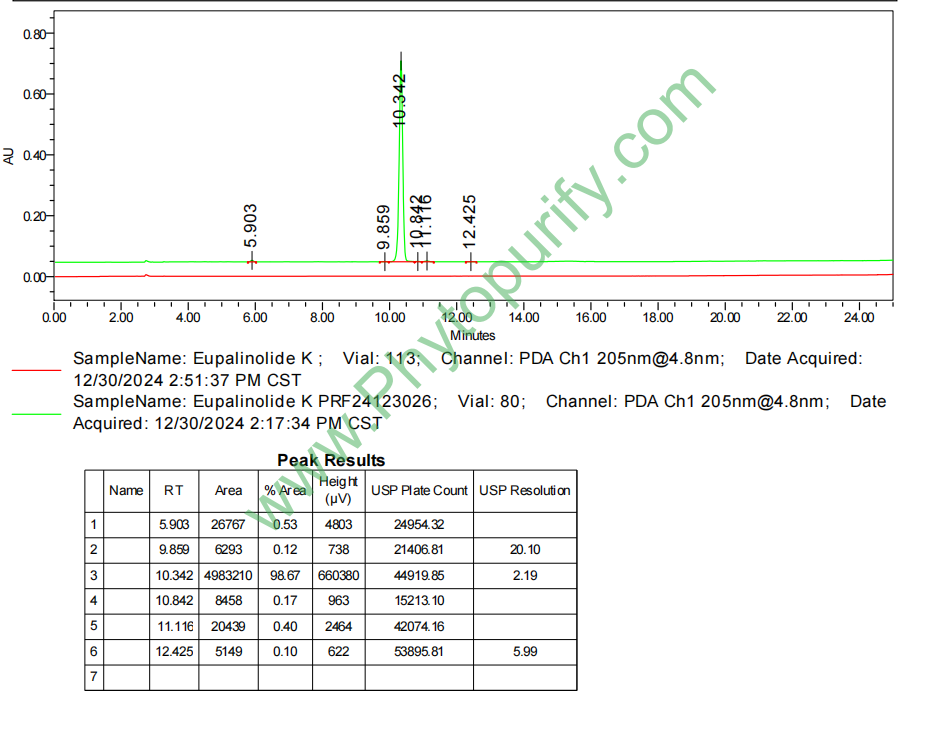
Purity: 95%~99%
Analysis Method: HPLC-DAD or/and HPLC-ELSD
Identification Method: Mass, NMR
Packing: Brown vial or HDPE plastic bottle
The product could be supplied from milligrams to grams. Inquire for bulk scale.
We provide solution to improve the water-solubility of compounds, thereby facilitating the variety of activity tests and clinic uses.
For Reference Standard and R&D, Not for Human Use Directly.
HPLC of Eupalinolide K
Storage conditions:Short-term storage at 2~8℃, long-term storage at -20 ~ -80℃
93.0600
1.4387
1.4386
2.8977
1.7672
6.4886
High
63.7403
4.9660
No
Yes
No
No
Yes
No
0.0
Yes
Yes
Yes
Yes
Natural products have long been an important source of innovative drug discovery, among which sesquiterpene lactones have attracted much attention due to their unique chemical structures and extensive biological activities. Eupalinolide K (CAS number: 108657-10-9) is derived from the traditional medicinal plant Eupalinolide K(Eupatorium lindleyanum)A sesquiterpene lactone with significant pharmacological activity isolated from the middle. In recent years, as the key role of the signal transduction and transcription activator 3 (STAT3) signaling pathway in the occurrence and development of diseases such as inflammation and tumors has been continuously revealed, wild horse chase lactone K, as a natural STAT3 inhibitor, has attracted widespread interest from pharmacological researchers. Its structural characteristics as a Michael Reaction Acceptor (MRA) enable it to covalently bind with nucleophilic groups (such as thiol groups) in biomolecules, thereby regulating key cellular signaling pathways. This article aims to systematically review the chemical properties, plant sources, pharmacological activities, mechanisms of action, pharmacological properties, and application prospects of wild horse chase lactone K in related diseases, especially inflammatory diseases such as pneumonia, in order to provide comprehensive scientific references for the in-depth research and development of this compound.
Wild horse chase lactone K is a typical guaiaceae sesquiterpene lactone. Its molecular formula is C20H26O6 and its molecular weight is 362.4220. Its core structure contains a seven membered lactone ring (α, β - unsaturated - γ - lactone), which is the key pharmacophore of its Michael reaction receptor. α. β - unsaturated carbonyl groups (enone structures) have high electrophilicity and can undergo Michael addition reactions with thiol groups on protein cysteine residues, which is an important chemical basis for their various biological activities.
From the analysis of physical and chemical properties, the lipid water partition coefficient (LogP) of this compound is 1.4387, indicating that it has moderate lipophilicity, which is beneficial for transmembrane transport and cell permeation. Its topological polar surface area (TPSA) is 93.0600 Å ², reflecting the presence of multiple hydrogen bond acceptors in the molecule, such as lactone rings and oxygen atoms in hydroxyl groups. The water solubility value is 2.8977 (usually measured in mg/L or log mol/L, indicating poor water solubility and belonging to slightly soluble or poorly soluble compounds), which is consistent with its strong lipophilicity. Taking into account its moderate molecular weight and ideal LogP value, wild horse chase lactone K performs well in the evaluation of the Rule of Five and has the basic chemical space to become an oral candidate drug. The active ketone units in its structure are not only advantageous for its pharmacological effects, but may also bring potential chemical instability and non-specific reactions, which are issues that need to be addressed in formulation development.
Wild horse chase lactone K mainly comes from the wild horse chase plant of the Zeeland genus in the Asteraceae family(Eupatorium lindleyanum DC.)。 Wild horse chase is a traditional Chinese medicine in China, which is made entirely of grass and has the effects of clearing heat and detoxifying, resolving phlegm and stopping cough, diuresis and lowering blood pressure. It is commonly used in clinical practice to treat chronic bronchitis, cough and phlegm. This is closely related to its rich content of sesquiterpene lactones with anti-inflammatory activity.
The extraction and separation of wild horse chase lactone K from plant materials are usually carried out using organic solvent extraction combined with various chromatographic techniques. The conventional process is as follows: first, the dried wild horse chase whole grass is crushed, and then subjected to cold soaking or heating reflux extraction with polar organic solvents such as methanol, ethanol, or acetone. After concentration, the total extract is obtained. Subsequently, gradient extraction was performed using solvents such as petroleum ether, ethyl acetate, and n-butanol. Wild horse chase lactone K was mainly enriched in the ethyl acetate extraction site due to its equipolarity. Further purification relies on column chromatography technology, often using silica gel column chromatography with gradient elution using different ratios of petroleum ether ethyl acetate or chloroform methanol systems. High performance liquid chromatography (HPLC), especially preparative HPLC, is the final key step in obtaining high-purity monomers of wild horse chase lactone K. It usually uses a reverse phase C18 chromatographic column with methanol water or acetonitrile water as the mobile phase. Modern technologies such as high-speed countercurrent chromatography (HSCCC) are also applied for efficient separation of such natural products due to their high recovery rate and avoidance of irreversible adsorption caused by solid adsorbents. During the extraction process, attention should be paid to avoiding light and operating at low temperatures to prevent the photolysis or thermal degradation of its alpha, beta unsaturated lactone structures.
Wild horse chase lactone K exhibits various pharmacological activities, particularly outstanding in anti-inflammatory and potential anti-tumor activities.
anti-inflammatory activity This is one of the most highly anticipated activities of wild horse chase lactone K. In various in vitro inflammatory models, it can significantly inhibit the production of nitric oxide (NO) and prostaglandin E2 (PGE2) by macrophages (such as RAW264.7 cells) induced by stimuli such as lipopolysaccharide (LPS), and downregulate the expression of inducible nitric oxide synthase (iNOS) and cyclooxygenase-2 (COX-2). In animal models of acute lung injury (ALI) and pneumonia, administration of wild horse chase lactone K can effectively reduce the infiltration of inflammatory cells in the lungs, lower the levels of inflammatory factors (such as TNF - α, IL-1 β, IL-6) in bronchoalveolar lavage fluid, and improve pathological damage to lung tissue. Its anti-inflammatory effect is closely related to the regulation of key inflammatory signaling pathways such as NF - κ B, MAPK, and STAT3.
Antitumor activity As a STAT3 inhibitor, wild horse chase lactone K exhibits growth inhibition and pro apoptotic effects on various tumor cells that rely on continuous activation of STAT3. Studies have shown that it can inhibit the proliferation of breast cancer, lung cancer, liver cancer and other cancer cells, and induce cell cycle arrest and apoptosis. Its MRA characteristics enable it to directly act on STAT3 protein, interfere with its phosphorylation activation and nuclear translocation, thereby downregulating the expression of downstream target genes related to cell survival and proliferation (such as Bcl-2, Cyclin D1).
Other activities Some studies suggest that wild horse chase lactone K may also have antioxidant and immune regulatory effects. It alleviates oxidative stress damage by clearing free radicals and enhancing antioxidant enzyme activity, and affects immune response by regulating the balance of T lymphocyte subsets.
The pharmacological mechanism of wild horse chase lactone K is complex, involving the regulation of multiple signaling pathways and molecular targets. Its chemical properties as an MRA are the core of mechanism research.
Core target: STAT3 signaling pathway STAT3 is a key mediator of cytokine and growth factor signaling, and its abnormal sustained activation is directly related to inflammation and tumor development. Wild horse chase lactone K covalently modifies cysteine residues on STAT3 proteins (such as Cys259, Cys367, Cys426, Cys468, Cys542, etc.) through its alpha, beta unsaturated lactone structure, thereby inhibiting tyrosine phosphorylation (such as Tyr705 site) and dimerization of STAT3, blocking its nuclear translocation and binding ability to DNA, ultimately leading to the inhibition of downstream pro-inflammatory and pro survival gene transcription.
Network regulation of pneumonia related targets In the context of inflammatory diseases such as pneumonia, the action of wild horse chase lactone K exhibits multi-target characteristics
In summary, wild horse chase lactone K has STAT3 as its core target, covalently inhibits through MRA mechanism, and synergistically regulates multiple signaling pathways closely related to the pathological process of pneumonia, such as TLR4/NF - κ B and NLRP3, forming a multi-target and networked pharmacological mode of action.
Based on the provided pharmacological parameters and existing research, the preliminary evaluation of the pharmacological properties of wild horse chase lactone K is as follows:
The clinical application prospects of wild horse chase lactone K mainly focus on the field of diseases related to abnormal activation of the STAT3 signaling pathway.
Inflammatory diseases, especially pneumonia/acute lung injury Given its effective inhibition of multiple pneumonia critical pathways such as TLR4, NF - κ B, and NLRP3, wild horse chase lactone K is expected to be developed as an innovative anti-inflammatory drug for the treatment of bacterial pneumonia, viral pneumonia (including COVID-19 related cytokine storms), acute respiratory distress syndrome (ARDS), and other diseases. Its multi-target effect may have more advantages than single target inhibitors, as it can more comprehensively control complex inflammatory networks.
tumor therapy: For STAT3 dependent malignant tumors, such as certain types of breast cancer, lung cancer, head and neck cancer, multiple myeloma, etc., Yemadilide K can be used as a potential chemosensitizer or alone. Combined use with existing targeted drugs may overcome the problem of drug resistance.
Autoimmune diseases Such as rheumatoid arthritis, inflammatory bowel disease, etc., in which the STAT3 pathway also plays an important role.
However, it faces many challenges and prospects on its development path:
* challenge:① Selective/toxic Improving the selectivity of MRA for target proteins (such as STAT3 specific cysteine) and reducing off target toxicity are the core challenges of research. Structural modification can be used to optimize its reactivity and steric hindrance. ② Pharmacokinetic optimization Improving its water solubility and metabolic stability may require prodrug strategies or novel drug delivery systems (such as nanoformulations). ③ Deep analysis of the mechanism of action It is necessary to use chemical biology methods (such as activity-based protein analysis, ABPP) to comprehensively identify its direct acting proteome in cells and clarify its therapeutic window.
* prospect Future research should focus on: ① conducting systematic preclinical pharmacological, pharmacokinetic, and toxicological evaluations; ② Reasonably modify the structure to obtain derivatives or analogues with better activity, selectivity, and drug properties; ③ Explore its combination therapy with existing anti-inflammatory or anticancer drugs; ④ Using modern network pharmacology and artificial intelligence to assist in design, further elucidate the essence of its "multi-component multi-target multi pathway" action.
Wild horse chase lactone K, as a natural sesquiterpene lactone derived from traditional Chinese medicine, has shown great potential for development in anti-inflammatory and anti-tumor fields due to its unique Michael reaction receptor structure and efficient STAT3 inhibitory activity. It exhibits good therapeutic effects in complex disease models such as pneumonia by covalently modifying STAT3 and synergistically regulating key pathways such as TLR4/NF - κ B. Although there are still challenges in drug development, especially in terms of water solubility and selectivity, its good drug like basis, clear mechanism of action, and preliminary positive safety signals have laid a solid foundation for its further development. Future research should strive to overcome its existing shortcomings and deeply explore its therapeutic value through interdisciplinary strategies. It is expected to transform this ancient natural molecule into a new weapon to combat modern inflammation and tumor diseases, reflecting the sustained vitality of natural products in innovative drug development.
