


Product name: Gastrodin
Synonym name: 4-β-D-Glucopyranosyloxybenzyl alcohol
Catalogue No.: BP0627
Cas No.: 62499-27-8
Formula: C13H18O7
Mol Weight: 286.28
Botanical Source: Gastrodia elata and Galeola septentrionalis
Physical Description: Powder
Type of Compound: Phenols
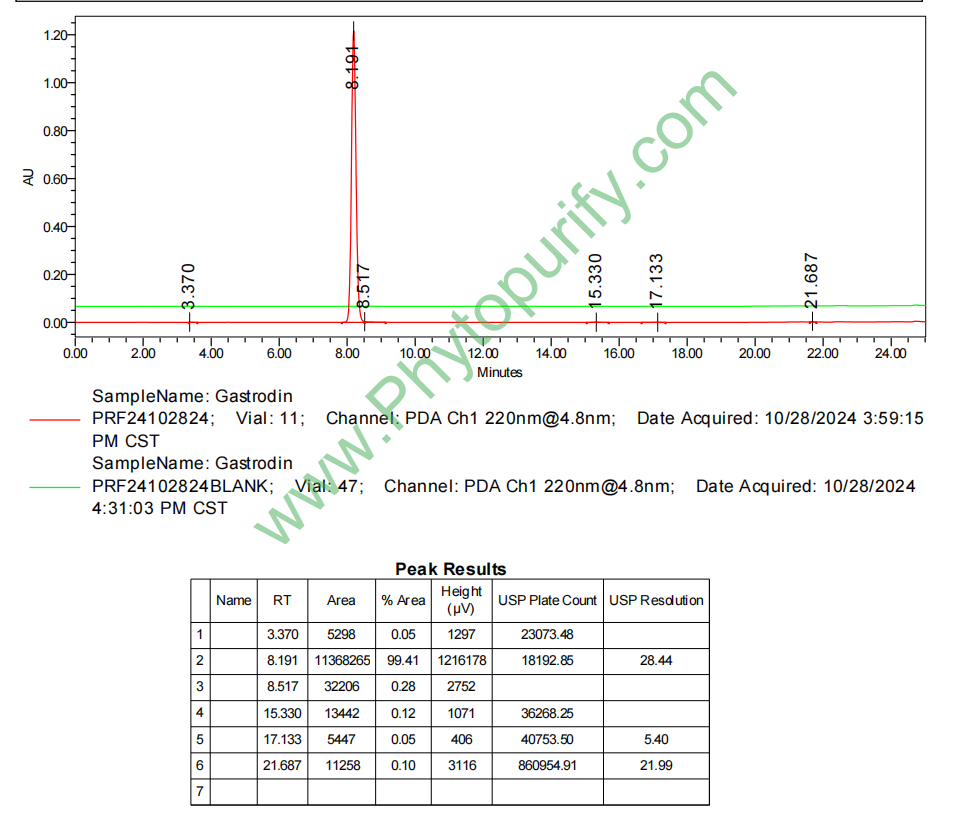
Purity: 95%~99%
Analysis Method: HPLC-DAD or/and HPLC-ELSD
Identification Method: Mass, NMR
Packing: Brown vial or HDPE plastic bottle
Storage: Store in a well closed container, protected from air and light. Put into refrigerate or freeze for long term storage.
Whenever possible, you should prepare and use solutions on the same day. However, if you need to make up stock solutions in advance, we recommend that you store the solution as aliquots in tightly sealed vials at -20℃. Generally, these will be useable for up to two weeks.
The product could be supplied from milligrams to grams, up to kilograms
Inquire for bulk scale.
Descriptions:
Gastrodin has anti-inflammatory activity, can significantly attenuate levels of neurotoxic proinflammatory mediators and proinflammatory cytokines by inhibition of the NF-κB signaling pathway and phosphorylation of MAPKs in LPS-stimulated microglial cells, suggests that gastrodin has a potential as an anti-inflammatory drug candidate in neurodegenerative diseases.[1]
Gastrodin protects midbrain of MPTP-intoxicated mice against oxidative stress, in part, through interrupting ERK1/2–Nrf2 pathway mechanism, which will give us an insight into the potential of gastrodin in terms of opening up new therapeutic avenues for PD.[2]
Gastrodin is one of the natural compound isolated from Gastrodia elata and has anticonvulsant effects, it may cause the elevation of GABA concentration by inhibiting the GABA shunt.[3]
Gastrodin activates PI3-K/Akt signaling and that inhibition of this pathway reverses the inhibitory effects of gastrodin on NF-κB and MAPKs activation in H9c2 cardiomyocytes.[4]
Gastrodin can inhibit allodynia and hyperalgesia in painful diabetic neuropathy rats by decreasing excitability of nociceptive primary sensory neurons.[5]
Gastrodin has protective effect to the prevention of neurotoxicity induced by ischemic stroke, the mechanism is by improving anti-oxidant and anti-inflammation activities, inhibiting apoptosis pathway, and increasing Akt phosphorylation and Nrf2 expression.[6]
References:
[1] Dai J N, Zong Y, Zhong L M, et al. Plos One, 2011, 6(7):e21891.
[2] Wang X L, Xing G H, Hong B, et al. Life Sci, 2014, 114(2):77-85.
[3] An S J, Park S K, Hwang I K, et al. J Neurosci Res, 2003, 71(4):534–43.
[4] Yang P, Han Y, Gui L, et al. Biochem Pharmacol, 2013, 85(8):1124-33.
[5] Sun W, Miao B, Wang X C, et al. Plos One, 2012, 7(6):e39647.
[6] Peng Z, Wang S, Chen G, et al. Neurochem Res, 2015, 40(4):661-73.
[7] Ju X H, Shi Y, Liu N, et al. J Chromatogr B , 2010, 878(22):1982-6.
HPLC of Gastrodin
Storage conditions:Short-term storage at 2~8℃, long-term storage at -20 ~ -80℃
119.6100
-.8667
-.8673
34.1458
.6714
.1203
Low
22.5541
3.3210
Yes
No
No
No
No
No
0.0
Yes
Yes
Yes
Yes
Tianma(Gastrodia elata Blume, as a traditional and precious traditional Chinese medicine, has a history of application dating back more than two thousand years to the "Shennong Bencao Jing". It is classified as a top-grade medicine and is mainly used for "killing ghosts and essence, Gu poison and evil qi. Long term consumption can invigorate qi and promote yin, fat and health". Modern pharmacological research has revealed that the various pharmacological activities of Tianma are closely related to its main water-soluble active ingredient, Gastrodin (4-hydroxybenzyl alcohol - β - D-glucopyranoside). Tianma Su (CAS number: 62499-27-8) is a phenolic glycoside compound that has become a key bridge connecting traditional Chinese medicine wisdom with modern biomedical research.
With the acceleration of global aging, neurological diseases such as Alzheimer's disease, Parkinson's disease, stroke, epilepsy, and vascular dementia have become severe public health challenges. These diseases are often accompanied by common pathophysiological processes such as oxidative stress, neuroinflammation, mitochondrial dysfunction, and cell death. Tianma extract has attracted much attention due to its extensive neuroprotective effects, and its research has expanded from early sedation and anticonvulsant effects to in-depth exploration of the mechanisms underlying complex neurodegenerative and cerebrovascular diseases. This article aims to systematically review the chemical properties, pharmacological activities, molecular mechanisms of action, medicinal properties, and clinical application prospects of gastrodin, in order to provide comprehensive scientific references for the deep development and transformation of this natural product.
The chemical name of gastrodin is 4- (hydroxymethyl) phenyl - β - D-glucopyranoside, with a molecular formula of C13H18O7 and a molecular weight of 286.28. Its structure is composed of a β - glycosidic bond between a molecule of glucose and p-hydroxyphenylmethanol (aglycone). This glycosidic structure significantly changes the physicochemical properties of the aglycone, which is the basis for its unique pharmacological activity and pharmacokinetic characteristics.
From the perspective of physical and chemical parameters, gastrodin exhibits typical hydrophilic characteristics. The calculated lipid water partition coefficient (LogP) is -0.8667, and the topological polar surface area (TPSA) is as high as 119.61 Å ², indicating good water solubility (approximately 34.15 mg/mL). These data indicate that gastrodin is not easily able to penetrate the lipid bilayer, which is consistent with its prediction of low blood-brain barrier permeability. However, in vivo studies have shown that gastrodin can still enter the central nervous system at a certain concentration, which may be attributed to its role as a glucose analog and its transmembrane transport mediated by glucose transporters (GLUTs). In addition, gastrodin is easily hydrolyzed by gut microbiota and β - glucosidase in the liver in the body, producing its glycoside -4-hydroxybenzyl alcohol (Gastrodin), which is considered a key active form that crosses the blood-brain barrier and exerts direct neuroprotective effects. In terms of safety, existing computational prediction models suggest that there is no risk of hERG channel inhibition (low arrhythmogenic potential) and the Ames test results are negative (no mutagenicity), providing preliminary theoretical support for its good safety.
Tianma extract mainly comes from the orchid plant Tianma(Gastrodia elata Blume's dried tubers. Tianma is a special heterotrophic plant that relies on the growth of honey fungus(Armillaria mellea)When fungi provide nutrients, this unique symbiotic relationship also affects the accumulation of their secondary metabolites. The content of gastrodin in gastrodia varies significantly depending on the place of origin, cultivation method, harvest season, and processing method (such as "steaming" to kill enzymes and preserve glycosides), usually ranging from 0.3% to 1.2%.
The extraction method of gastrodin has undergone development from traditional to modern. Traditional methods often use water or low concentration alcohols (such as 30-50% ethanol) for reflux or extraction, utilizing their good water solubility for enrichment. Modern extraction and separation technologies have significantly improved efficiency and purity:
1. Ultrasound assisted extraction/Microwave assisted extraction Utilizing physical fields to enhance mass transfer, shorten extraction time, and improve yield.
2. Purification using macroporous adsorption resin This is a key step in the current industrial production of gastrodin. AB-8, D101, HPD-100 and other types of resins are commonly used. Through the process of adsorption water washing alcohol washing, impurities such as polysaccharides and proteins can be effectively removed, and gastrodin can be enriched. After concentration and crystallization, high-purity products can be obtained.
3. High speed countercurrent chromatography and preparative high-performance liquid chromatography Used for laboratory scale preparation of high-purity (>98%) gastrodin standards or conducting in-depth pharmacological research.
Tianma extract exhibits multi-target and multi pathway pharmacological activity, with its core being a wide range of neuroprotective effects that extend to areas such as cardiovascular and hepatic protection.
1. Neuroprotective and cognitive improvement effects
This is the core pharmacological activity of gastrodin. In various animal models, such as the cognitive impairment model induced by scopolamine, D-galactose, and A β injection, as well as the APP/PS1 transgenic Alzheimer's disease model, gastrodin can significantly improve learning and memory abilities. Its functional basis includes: reducing neuronal damage, inhibiting tau protein hyperphosphorylation, reducing β - amyloid (A β) deposition, and promoting the expression of synaptic plasticity related proteins such as PSD-95 and SYN.
2. Sedative, anticonvulsant, and antiepileptic effects
Tianma extract can prolong the sleep time induced by pentobarbital sodium, counteract seizures induced by chemicals such as pentylenetetrazol and indomethacin, and reduce the seizure level and duration in epilepsy models. The mechanism may be related to regulating the central neurotransmitter system, such as increasing GABA levels and reducing glutamate excitotoxicity.
3. Protective effect of cerebral ischemia-reperfusion injury
In stroke models such as middle cerebral artery occlusion (MCAO), gastrodin can reduce the volume of cerebral infarction, alleviate brain edema, and improve neurological deficit scores. Its protective effects involve multiple aspects such as anti apoptosis, anti-inflammatory, antioxidant, and improving brain microcirculation.
4. Anti inflammatory and antioxidant effects
Tianma extract and its glycosides are potent antioxidants that can directly scavenge free radicals (such as DPPH and hydroxyl radicals) and upregulate the endogenous antioxidant system. In the neuroinflammatory model, it can inhibit excessive activation of microglia and downregulate the expression of pro-inflammatory factors such as TNF - α, IL-1 β, IL-6, COX-2, iNOS, thereby blocking the vicious cycle of neuroinflammation.
5. Anti cell death effect
Research has confirmed that gastrodin can inhibit various forms of cell death induced by stimuli:
* anti-apoptotic As stated in the question stem, gastrodin can inhibit ethanol induced hepatocyte apoptosis.
* Anti iron death Tianma extract inhibits H2O2 induced ferroptosis through its antioxidant activity, which is closely related to lipid peroxidation and glutathione depletion, and plays a key role in neurodegenerative diseases and brain injury.
6. Other activities
This includes improving cardiovascular function, protecting against myocardial ischemia, mild blood pressure reduction, and the hepatoprotective effect mentioned in the question stem.
The neuroprotective effect of gastrodin is not achieved through a single target, but through a complex signaling network, and its mechanism of action has penetrated into the molecular and pathway levels, involving multiple key targets:
In summary, gastrodin forms a three-dimensional neuroprotective network through multi-target synergy, from inhibiting exogenous damage (A β, oxidative stress), enhancing endogenous defense (Nrf2, SIRT1), to regulating cell fate (apoptosis, autophagy, ferroptosis).
Although gastrodin has shown excellent activity in preclinical studies, its pharmacological properties, especially pharmacokinetic characteristics, are important factors affecting its clinical translation.
Pharmacokinetic characteristics:
Gastrodin is rapidly but incompletely absorbed after oral administration, with moderate bioavailability. It is widely distributed in the body, but as mentioned earlier, the prototype drug has limited ability to penetrate the blood-brain barrier. Tianma extract can be rapidly hydrolyzed by β - glucosidase in blood and tissues to form aglycone 4-hydroxybenzyl alcohol, which has higher lipid solubility and tissue penetration, especially for more effective entry into the central nervous system. Therefore, gastrodin is often regarded as a "prodrug" in the body, and its pharmacological effects are largely attributed to nucleosides. Tianma extract and its metabolites are mainly excreted in urine through the kidneys, with a fast metabolism and excretion process and a relatively short half-life. This suggests that multiple administrations or the use of sustained-release formulations may be necessary in clinical applications to maintain effective blood drug concentrations.
Advantages and challenges of pharmaceutical properties:
* Advantage Natural source, high safety (supported by long-term clinical application history and toxicology research); Good water solubility, easy to make into injections (such as Tianma Su injection for clinical use); Multi targeted mechanism of action, suitable for treating complex diseases; The calculation prediction shows no risk of cardiac toxicity and genetic toxicity.
* challenge:
1. Blood-brain barrier permeability The prototype drug has a low BBB permeability, although aglycones can compensate for it, there is still room for improvement in overall central bioavailability.
2. Pharmacokinetic properties Short half-life, requiring frequent administration.
3. Complexity of mechanism of action Multi targeting is both an advantage and a challenge. In drug registration and approval, clear main action targets and clear pharmacological biomarkers are key.
4. Formulation development To improve therapeutic efficacy, new drug delivery systems such as liposomes, nanoparticles, prodrug modifications (such as synthesizing ester derivatives with higher lipid solubility), or coupling with peptide segments that promote BBB penetration are being studied to enhance their brain targeting.
At present, gastrodin has been widely used in clinical practice for treatment Dizziness, headache, tinnitus, epilepsy adjuvant therapy, sequelae of cerebrovascular disease (such as stroke recovery period), and neurasthenia Symptoms include injections, oral tablets, and capsules. A large number of clinical observational studies and some randomized controlled trials support its improvement effect on the above symptoms.
In the future, there are several important directions for the research and clinical application of gastrodin:
Tianma extract originated from Tianma, a traditional Chinese medicine. After decades of modern scientific research, it has evolved from a single active ingredient to a model for understanding the multi-target treatment of complex diseases with natural products. Its pharmacological effects range from macroscopic symptom improvement to microscopic molecular network regulation, covering multiple cutting-edge fields of modern pharmacology such as anti-inflammatory, antioxidant, anti apoptotic, anti ferroptosis, autophagy regulation, and mitochondrial protection. Despite facing challenges in terms of blood-brain barrier permeability and pharmacokinetics in terms of drug efficacy, these challenges are gradually being overcome through innovative formulation technology, structural modifications, and rational clinical combination therapy strategies.
Looking ahead to the future, gastrodin and its derivatives are not only expected to provide better solutions for existing indications such as dizziness and epilepsy adjuvant therapy, but also show broad prospects in unmet medical needs such as Alzheimer's disease, Parkinson's disease, and post-stroke nerve repair. It symbolizes the enormous potential of excavating modern therapeutic drugs from the treasure trove of traditional Chinese medicine, and its continuous in-depth research will contribute unique "Chinese wisdom" and effective natural medicine solutions to the prevention and treatment of neurological and psychiatric diseases worldwide.
