


Product name: Caftaric acid
Synonym name: Monocaffeoyltartaric acid; Caffeoyltartaric acid
Catalogue No.: BP0302
Cas No.: 67879-58-7
Formula: C13H12O9
Mol Weight: 312.23
Botanical Source: Echinacea purpurea (Linn.) Moench
Physical Description:
Type of Compound: Phenylpropanoids
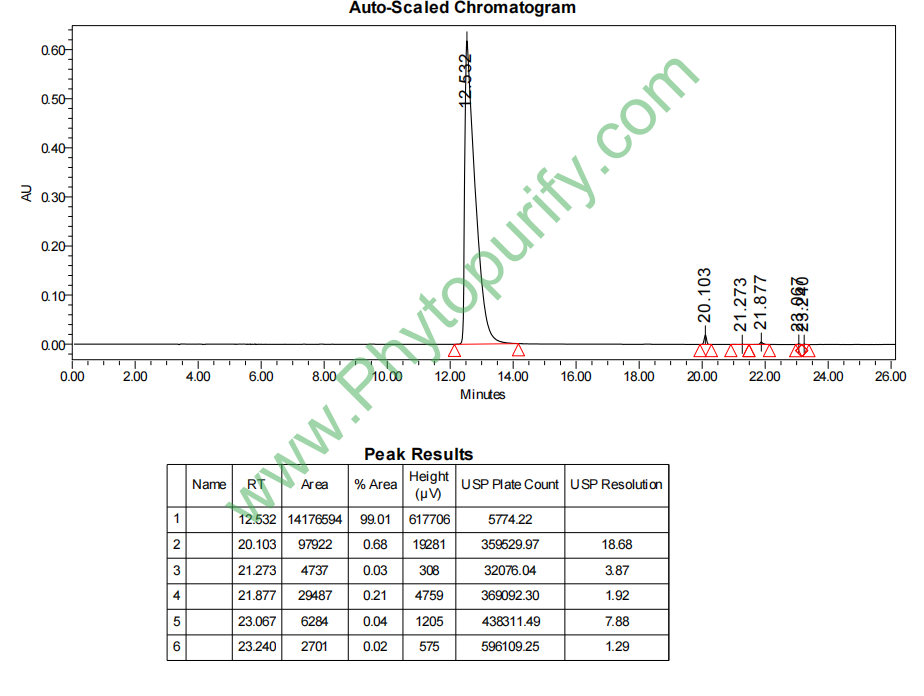
Purity: 95%~99%
Analysis Method: HPLC-DAD or/and HPLC-ELSD
Identification Method: Mass, NMR
Packing: Brown vial or HDPE plastic bottle
Storage: Store in a well closed container, protected from air and light. Put into refrigerate or freeze for long term storage.
Whenever possible, you should prepare and use solutions on the same day. However, if you need to make up stock solutions in advance, we recommend that you store the solution as aliquots in tightly sealed vials at -20℃. Generally, these will be useable for up to two weeks.
The product could be supplied from milligrams to grams
Inquire for bulk scale.
Description:
Caftaric acid is an inhibitor of the protein-protein interactions mediated by the Src-family kinases, which has anti-mutagenicity. Caftaric acid is the major dietary polyphenol present in various foods, it before methamphetamine injections can prevent liver toxicity and oxidative stress.
References:
J Agric Food Chem. 2007 Feb 21;55(4):1604-11.The fate of trans-caftaric acid administered into the rat stomach.
trans-Caftaric acid is the most abundant nonflavonoid phenolic compound in grapes and wines. It occurs in chicory and is one of the bioactive components of Echinacea purpurea. In order to fill the gap of knowledge about its bioavailability in mammals, we investigated its absorption, tissue distribution, and metabolism in rats.
METHODS AND RESULTS:
Assuming that the stomach is a relevant site of absorption of dietary polyphenols, a solution of trans-Caftaric acid was maintained in the ligated stomach of anaesthetized rats for 20 min. Intact trans-Caftaric acid was detected in rat plasma at both 10 and 20 min (293 +/- 45 and 334 +/- 49 ng/mL, respectively), along with its O-methylated derivative trans-fertaric acid, whose concentration rose over time (from 92 +/- 12 to 185 +/- 24 ng/mL). At 20 min, both trans-Caftaric acid and trans-fertaric acid were detected in the kidney (443 +/- 78 and 2506 +/- 514 ng/g, respectively) but not in the liver. Only trans-fertaric acid was found in the urine (33.3 +/- 12.8 microg/mL). In some rats, trans-Caftaric acid was detected in the brain (180 +/- 20 ng/g).J Toxicol. 2014; 2014: 583494.Chlorogenic and Caftaric Acids in Liver Toxicity and Oxidative Stress Induced by Methamphetamine.
Methamphetamine intoxication can cause acute hepatic failure. Chlorogenic and Caftaric acids are the major dietary polyphenols present in various foods. The aim of this study was to evaluate the protective role of chlorogenic and Caftaric acids in liver toxicity and oxidative stress induced by methamphetamine in rats.
METHODS AND RESULTS:
Thirty-two male albino rats were divided into 4 equal groups. Group 1, which was control group, was injected (i.p) with saline (1 mL/kg) twice a day over seven-day period. Groups 2, 3, and 4 were injected (i.p) with methamphetamine (10 mg/kg) twice a day over seven-day period, where groups 3 and 4 were injected (i.p) with 60 mg/kg chlorogenic acid and 40 mg/kg Caftaric acid, respectively, one day before methamphetamine injections. Methamphetamine increased serum aspartate aminotransferase, alanine aminotransferase, alkaline phosphatase, bilirubin, cholesterol, low-density lipoprotein, and triglycerides. Also, malondialdehyde in serum, liver, and brain and plasma and liver nitric oxide levels were increased while methamphetamine induced a significant decrease in serum total protein, albumin, globulin, albumin/globulin ratio, brain serotonin, norepinephrine and dopamine, blood and liver superoxide dismutase, and glutathione peroxidase levels. Chlorogenic and Caftaric acids prior to methamphetamine injections restored all the above parameters to normal values.
CONCLUSIONS:
In conclusion, chlorogenic and Caftaric acids before methamphetamine injections prevented liver toxicity and oxidative stress where chlorogenic acid was more effective.
HPLC of Caftaric acid
Storage conditions:Short-term storage at 2~8℃, long-term storage at -20 ~ -80℃
161.5900
.2196
-1.9573
6.3557
.6432
.4953
Low
77.8322
3.2509
Yes
No
No
No
Yes
No
0.0
Yes
Yes
Yes
Yes
Natural products, as a treasure trove for drug discovery and development, have played an irreplaceable role in the long history of human fight against diseases. Among them, polyphenolic compounds have become a hot topic in modern pharmacological research due to their extensive biological activities, especially their excellent antioxidant and anti-inflammatory properties. Monocaffeoyl tartaric acid, as a member of the hydroxycinnamic acid derivative family, is an important phenolic acid compound in the plant kingdom. Its chemical structure combines caffeic acid and tartaric acid, endowing it with unique physicochemical properties and biological functions. In recent years, with the deepening understanding of the interaction between gut microbiota and host health, mono caffeoyl tartaric acid has attracted much attention due to its role as a precursor of microbial metabolism. Research has shown that it is not only a key active ingredient in various medicinal plants and common fruits and vegetables (such as grapes and chicory), but also exhibits antidiuretic, antioxidant, anti apoptotic, and significant renal protective effects in various experimental models. Especially in the potential therapeutic value of chronic inflammatory diseases such as inflammatory bowel disease, it has become a star molecule connecting natural product chemistry, pharmacology, and translational medicine. This article aims to systematically review the chemical properties, plant sources, pharmacological activities, mechanisms of action, medicinal properties, and clinical application prospects of monocaffeic acid tartaric acid, in order to provide comprehensive scientific references for the in-depth research and development of this compound.
Monocaffeoyl tartaric acid, commonly known as trans monocaffeoyl tartaric acid, has a CAS number of 67879-58-7. Structurally, it is formed by the condensation of one molecule of caffeic acid with one molecule of tartaric acid (usually L - (+) - tartaric acid) through ester bonds. The caffeic acid provides a conjugated structure of phenolic hydroxyl and acrylic acid, which is the core of its antioxidant activity; The tartaric acid portion introduces additional carboxyl and hydroxyl groups, significantly enhancing the water solubility and polarity of the molecule.
Its molecular formula is C13H12O9 and its molecular weight is 312.2300. This molecule has multiple hydrogen bond donors and acceptors, with a topologically polar surface area of up to 161.5900 Å ², indicating its excellent hydrophilicity. The calculated LogP value (octanol/water partition coefficient) is approximately 0.2196, further confirming its hydrophilic properties. The experimental data supports its good water solubility, approximately 6.3557 mg/mL, which is beneficial for its absorption and distribution in organisms. However, higher polarity and TPSA also mean that its ability to penetrate lipid membranes is limited, and its blood-brain barrier permeability is predicted to be "low", indicating that it is not easily able to enter the central nervous system.
In terms of stability, as an ester compound, mono caffeoyl tartaric acid is prone to hydrolysis under acidic or alkaline conditions, especially under the action of esterases secreted by gut microbiota, to produce caffeic acid and tartaric acid. This characteristic has a decisive impact on its bioavailability and metabolic pathways in vivo. The catechol structure in its structure gives it strong reducing ability, which can effectively quench free radicals such as DPPH and ABTS, and has the potential to chelate metal ions.
Monocaffeoyl tartaric acid is widely distributed in the plant kingdom and is a secondary metabolite of various plants, especially abundant in grape and Asteraceae plants.
Main plant sources:
Extraction and Separation Methods:
Due to its strong polarity, polar solvents are usually used for the extraction of mono caffeoyl tartaric acid.
A large number of in vitro and in vivo studies have revealed the diverse pharmacological activities of mono caffeoyl tartaric acid, which revolve around its antioxidant, anti-inflammatory, and organ protective effects.
Antioxidant and anti apoptotic activity Monocaffeic acid tartaric acid is a potent natural antioxidant. The phenolic hydroxyl group in its structure can directly scavenge reactive oxygen species and reactive nitrogen radicals, inhibiting lipid peroxidation. In cell models, it can alleviate cell damage caused by oxidative stress inducers such as hydrogen peroxide and paraquat, reduce intracellular ROS levels, maintain mitochondrial membrane potential, inhibit the activation of apoptosis executing proteins such as caspase-3, and thus exert anti apoptotic effects.
Renal protective effect This is one of the most extensively studied pharmacological activities of monocaffeic acid tartaric acid. In a rat model of albinism induced by cisplatin or ischemia-reperfusion injury, treatment with mono caffeoyl tartaric acid can significantly reduce serum creatinine and urea nitrogen levels, and improve renal histopathological changes. Its protective mechanism is closely related to restoring the activity of antioxidant enzymes (such as superoxide dismutase (SOD), catalase (CAT), glutathione peroxidase (GPx)) in kidney tissue, reducing malondialdehyde (MDA) content, and regulating electrolyte balance.
Anti inflammatory and immune regulatory activity Monocaffeic acid tartaric acid exhibits anti-inflammatory potential in various inflammatory models. In macrophages stimulated by lipopolysaccharide, it can dose dependently inhibit the production of nitric oxide (NO) and prostaglandin E2, downregulate the expression of inducible nitric oxide synthase and cyclooxygenase-2. More importantly, its anti-inflammatory effect is closely related to regulating key inflammatory signaling pathways and cell apoptosis, providing a theoretical basis for its application in diseases such as inflammatory bowel disease.
The impact on intestinal health Monocaffeoyl tartaric acid itself has low oral bioavailability, but it can serve as a substrate for gut microbiota. Esterases in the gut microbiota can hydrolyze it into caffeic acid and tartaric acid, and these metabolites (especially caffeic acid and its further metabolites) may have stronger biological activity and can be absorbed into the systemic circulation. This process not only amplifies its systemic effects, but also directly acts on the local intestinal area, regulating the composition of intestinal microbiota, enhancing intestinal barrier function, and reducing intestinal inflammation. Therefore, it is considered a dietary polyphenol with prodrug properties.
Other activities The study also suggests that mono caffeoyl tartaric acid may have potential antiviral activities (such as against herpes virus), protect the cardiovascular system, and improve insulin resistance, but further research is needed to confirm these aspects.
The pharmacological effects of mono caffeoyl tartaric acid and its metabolites involve a complex regulatory network of multiple targets and pathways. Its anti-inflammatory mechanism, especially in the context of inflammatory bowel disease, has revealed several key molecular targets.
Core mechanism: Inhibition of NLRP3 inflammasome mediated cell pyroptosis pathway
Cellular pyroptosis is a programmed cell death mediated by the gasdermin protein family, closely related to inflammation. The NLRP3 inflammasome is the core platform for sensing multiple danger signals and initiating pyroptosis. Research has shown that mono caffeoyl tartaric acid can effectively inhibit the assembly and activation of NLRP3 inflammasomes.
Regulating the classical inflammatory signaling pathway
Activate endogenous antioxidant defense system
In addition to directly scavenging free radicals, monocaffeic acid tartrate can also exert its effects by activating the Nrf2/ARE signaling pathway. Nrf2 is the dominant transcription factor regulating antioxidant response elements. Monocaffeoyl tartaric acid may promote Nrf2 translocation into the nucleus by modifying the cysteine residue of Keap1, initiating the expression of downstream antioxidant enzymes and phase II detoxifying enzymes such as SOD, CAT, GPx, HO-1, etc., thereby systematically enhancing the cell's ability to resist oxidative stress.
The bridging role of gut microbiota metabolism
Its mechanism of action cannot be separated from the transformation of intestinal microbiota. After being hydrolyzed by microbial esterase, the caffeic acid produced can be further metabolized into coumaric acid, phenylpropanoic acid, etc. These metabolites may have different biological activities and target preferences, collectively forming the material basis for their in vivo effects. At the same time, this metabolic process may selectively promote the growth of beneficial bacteria and inhibit harmful bacteria, exerting indirect protective effects through the "microbiota gut organ axis".
Although mono caffeoyl tartaric acid has clear pharmacological activity, its potential as a drug candidate molecule still needs to be comprehensively evaluated.
Analysis of drug properties parameters:
Pharmacokinetic characteristics:
Existing pharmacokinetic studies (mainly in animal models) have shown that oral administration of mono caffeoyl tartaric acid results in a shorter peak time, lower concentration, and faster elimination of its prototype in plasma. The main detectable substances in plasma are its hydrolysis product caffeic acid and its methylated, sulfated, or glucuronic acid conjugates. These metabolites have longer half lives and different tissue distributions. Its renal excretion may be one of the important elimination pathways, which partially explains its targeted protective effect on renal tissue.Low bioavailability This is the main challenge in its development as an oral system drug delivery.
Formulation strategy:
To improve its bioavailability and efficacy, the following pharmaceutical strategies can be considered:
The multi-target and multi effect properties of mono caffeoyl tartaric acid provide broad application prospects for its prevention and treatment of various diseases, but also face transformation challenges.
Potential clinical application directions:
Future research prospects:
Monocaffeoyl tartaric acid, as a naturally occurring polyphenolic ester compound, has become a highly valuable research object in the field of natural product pharmacology due to its significant antioxidant, anti-inflammatory, and organ protective activities, especially its unique pharmacological properties demonstrated through the metabolic bridging effect of gut microbiota. From chemical structure to plant origin, from various pharmacological effects to molecular mechanisms focused on the NLRP3/CASP1/IL-1 β axis, research has laid a solid scientific foundation for its biological activity. Despite facing the challenge of low bioavailability in terms of drug efficacy, this has also given rise to new drug delivery strategies and structural optimization ideas. In the future, through interdisciplinary collaboration and in-depth exploration of its "ingredient microbiota host" interaction network, and promoting its clinical translation, monocaffeoyl tartaric acid is expected to develop from a dietary ingredient into an innovative drug or functional preparation for the prevention or treatment of inflammatory bowel disease, acute kidney injury, and other diseases, contributing to human health naturally.
