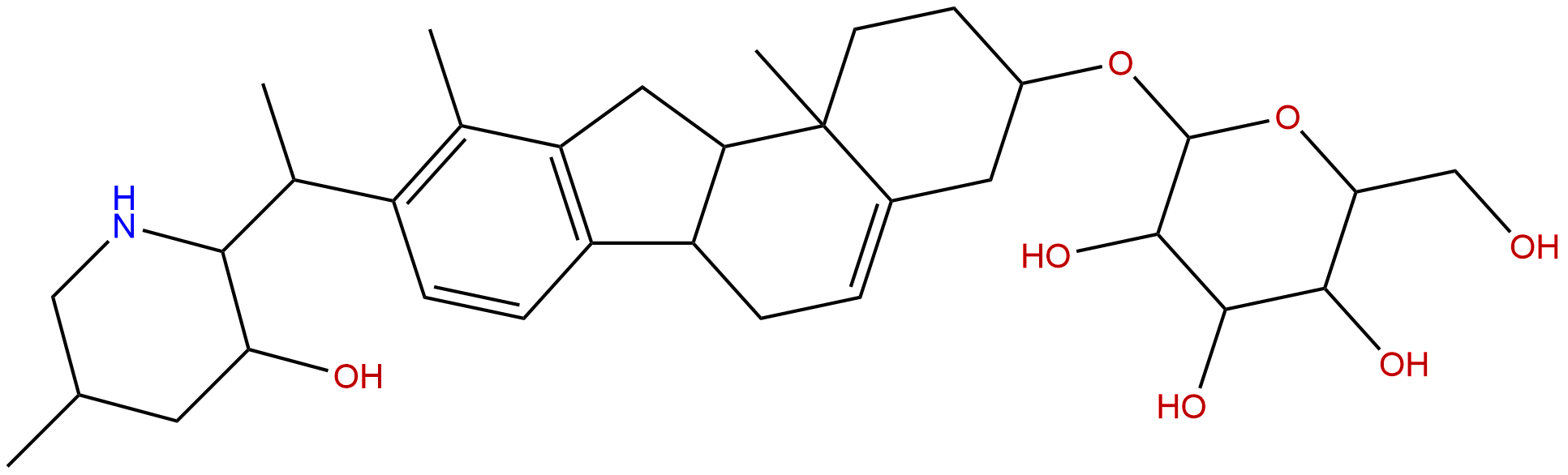


Product name: Veratrosine
Synonym name:
Catalogue No.: BP1661
Cas No.: 475-00-3
Formula: C33H49NO7
Mol Weight: 571.755
Botanical Source:
Physical Description:
Type of Compound: Alkaloids
Purity: 95%~99%
Analysis Method: HPLC-DAD or/and HPLC-ELSD
Identification Method: Mass, NMR
Packing: Brown vial or HDPE plastic bottle
The product could be supplied from milligrams to grams. Inquire for bulk scale.
We provide solution to improve the water-solubility of compounds, thereby facilitating the variety of activity tests and clinic uses.
For Reference Standard and R&D, Not for Human Use Directly.
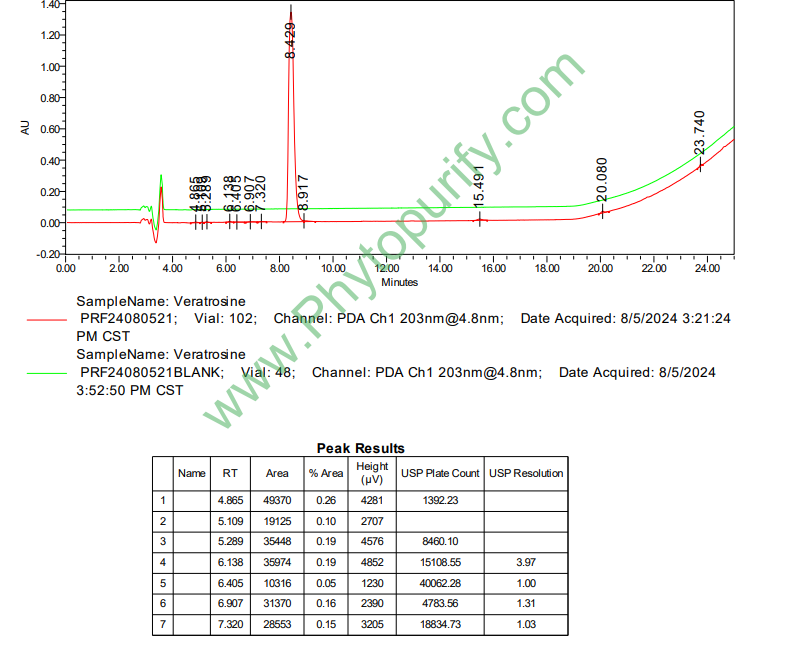
HPLC of Veratrosine
Storage conditions:Short-term storage at 2~8℃, long-term storage at -20 ~ -80℃
131.6400
2.7495
1.3899
.3706
.5470
3.2873
Low
76.8259
5.3423
No
No
No
No
No
No
0.0
Yes
No
No
No
Steroid alkaloids are a class of natural products with unique structures and diverse biological activities, widely distributed in plants such as Solanaceae and Liliaceae, and have various pharmacological effects such as anti-tumor, anti-inflammatory, and insecticidal. Veratrosine (CAS number: 475-00-3) is one of them, mainly derived from the California fruit tree(Veratrum californicum)Separated from the roots and rhizomes. In recent years, with the deepening of the research on the anti-tumor activity of natural products, veratrol has attracted much attention because of its multi-target and multi-channel inhibition potential in breast cancer models. Breast cancer is the highest incidence of malignant tumors among women in the world, and its treatment is facing severe challenges such as drug resistance, recurrence and metastasis. Traditional chemotherapy drugs often come with serious side effects, therefore, it is of great strategic significance to search for efficient and low toxicity new therapeutic drugs or lead compounds from natural products. Veratrol, as a steroid alkaloid with novel structure, its anti breast cancer activity and related molecular mechanism research not only provide scientific basis for clarifying its pharmacological effects, but also provide new candidate molecules and ideas for developing new anti breast cancer drugs. This article aims to systematically review the chemical structure, plant origin, pharmacological activity, mechanism of action, pharmacological evaluation, and clinical application prospects of resveratrol, in order to provide comprehensive references for the in-depth research and development of this compound.
Resveratrol is a C-nor-D-homo steroid alkaloid with the molecular formula C ₂₇ H ₄₅ NO ₈ and a molecular weight of 571.7550. Its core structure is cyclopentane and a fully hydrogenated phenanthrene steroid nucleus, but the C ring is a five membered ring (C-nor) and the D ring is a six membered ring (D-homo), which is a significant feature that distinguishes it from classical steroid skeletons. This structure is connected with multiple oxygen-containing functional groups, including hydroxyl and glycosidic bonds (usually linked with sugar groups), which are crucial for its solubility, biological activity, and interaction with the target.
From the analysis of physical and chemical properties, the lipid water partition coefficient (LogP) of resveratrol is 2.7495, indicating that it has a certain lipophilicity, but not highly hydrophobic. Its topological polar surface area (TPSA) is as high as 131.6400 Å ², mainly attributed to the presence of multiple hydrogen bond acceptors and donors (such as hydroxyl, ether, and amino groups) in the molecule. A higher TPSA is usually not conducive to transmembrane permeation. The predicted value of its water solubility is 0.3706 mg/mL, which belongs to the category of slight solubility. Based on the comprehensive LogP and TPSA values, its membrane permeability may be moderate to weak. Preliminary pharmacological predictions indicate that resveratrol has a lower ability to penetrate the blood-brain barrier, which to some extent limits its potential application in central nervous system related diseases, but may also reduce the risk of central neurotoxicity. Importantly, preliminary toxicity predictions indicate no significant hERG potassium channel inhibitory activity (hERG inhibition: No), suggesting a low potential risk of cardiac toxicity; The Ames test predicted a value of 0.0, indicating that it may not be mutagenic and has a good genetic toxicity safety window. These preliminary pharmacological parameters have laid a certain foundation for its subsequent development.
Resveratrol mainly comes from the Liliaceae family and the genus Resveratrol(Veratrum)Plants, including the California Veratrum(Veratrum californicum)The roots and rhizomes are the most abundant. Resveratrol plants are distributed in many parts of the world and have traditionally been used as insecticides or to treat hypertension due to their toxicity, but strict dosage control is required. The content of alkaloids in plants is significantly affected by factors such as place of origin, harvest season, plant parts, and growth years.
Its extraction and separation usually follow the classic process of natural product chemistry. Firstly, the dried plant rhizomes are crushed and extracted or percolated using polar organic solvents such as methanol, ethanol, or acidified alcohol water mixtures to transfer the alkaloid components into the solvent. After concentrating the extract, dissolve it in an acidic aqueous solution to make the alkaloids salt. Then, use alkalization (such as ammonia water) to free the alkaloids and extract them using organic solvents (such as chloroform and dichloromethane). This process can preliminarily enrich the total alkaloids. Subsequently, a variety of chromatographic techniques need to be used for separation and purification, including silica gel column chromatography, reverse phase C18 column chromatography, gel column chromatography (such as Sephadex LH-20) and high performance liquid chromatography (HPLC). Due to the presence of multiple chiral centers in the structure of resveratrol, its separation and identification require the use of modern spectroscopic techniques such as nuclear magnetic resonance (NMR, including ¹ H-NMR, ¹ ³ C-NMR, 2D-NMR such as HSQC, HMBC), mass spectrometry (MS, especially high-resolution mass spectrometry HRMS), and X-ray single crystal diffraction to accurately determine its planar structure and stereoconfiguration. In recent years, preparative chromatography techniques such as high-speed counter current chromatography (HSCCC) have also been applied for efficient separation of such alkaloids.
At present, the pharmacological activity research of veratrol mainly focuses on the anti-tumor field, especially for breast cancer, showing a variety of inhibitory effects.
1. Anti proliferative and cytotoxic effects: Several in vitro studies have shown that veratrol can significantly inhibit the proliferation of many human breast cancer cell lines (such as MCF-7, MDA-MB-231, T47D, etc.) in a concentration and time-dependent manner. Its half maximal inhibitory concentration (IC ₅₀) value is usually in the micromolar range, indicating strong cytotoxicity. It is worth noting that its toxicity to certain normal breast epithelial cells is relatively low, suggesting that it may have some selectivity.
2. Inducing cell cycle arrest and apoptosis: Veratrol can interfere with the cell cycle process of breast cancer cells. Research has shown that it can block cells in the G0/G1 or G2/M phase, preventing them from entering the stages of DNA synthesis or mitosis, thereby inhibiting their unlimited proliferation. More importantly, veratrol can effectively induce programmed death (apoptosis) of breast cancer cells. It is characterized by typical apoptotic features such as nuclear condensation, DNA fragmentation, and phosphatidylserine eversion, accompanied by activation of apoptosis related proteins such as Caspase-3 and downregulation of anti apoptotic protein BCL2 family members.
3. Inhibit migration, invasion, and metastasis: The migration and invasion of tumors are key factors leading to metastasis and poor prognosis. Veratrol has been proved to inhibit the migration and invasion of breast cancer cells. The mechanism may be related to the downregulation of the expression and activity of matrix metalloproteinases (such as MMP2 and MMP9), which can degrade the extracellular matrix and pave the way for tumor cell migration. In addition, it can also affect the epithelial mesenchymal transition (EMT) process, upregulate epithelial markers (such as E-cadherin) and downregulate stromal markers (such as N-cadherin, Vimentin), thereby reversing the invasive phenotype of cancer cells.
4. Reversing multidrug resistance (MDR): Multidrug resistance is one of the main causes of chemotherapy failure, often mediated by overexpression of ABC transporters (such as ABCB1/P-gp, ABCG2/BCRP). Preliminary studies suggest that veratrol may be used as a modulator of ABC transporter or a competitive inhibitor of substrate to increase the accumulation of traditional chemotherapy drugs (such as doxorubicin and paclitaxel) in drug-resistant breast cancer cells, thus restoring their sensitivity to chemotherapy, and has the potential to be used as a drug resistant reversal agent.
5. Other potential activities: In addition to its anti breast cancer activity, based on the structural characteristics of its steroid alkaloids, veratrol may also have anti-inflammatory, analgesic, neural activity and other potential, but the research in these areas is still in its infancy and needs further exploration.
The anti breast cancer effect of veratrol is not through a single target, but involves a complex signal network regulation, reflecting the characteristics of natural products with multiple targets. Existing research has revealed its association with multiple key targets and pathways:
1. AMPK signaling pathway (target: PRKAA1): AMP activated protein kinase (AMPK) is a core regulatory factor in cellular energy metabolism, and its activation can inhibit tumor growth. Resveratrol may activate AMPK, thereby inhibiting its downstream mammalian rapamycin target protein (mTOR) signaling pathway, thereby suppressing protein synthesis, cell proliferation, and inducing autophagy.
2. Apoptosis regulatory pathway (targets: BCL2, STAT3): B-cell lymphoma 2 (BCL2) is an important anti apoptotic protein. Resveratrol can downregulate the expression of BCL2, disrupt mitochondrial membrane potential, promote cytochrome C release, and activate endogenous apoptotic pathways. Meanwhile, it can also inhibit the phosphorylation and activation of signal transduction and transcription activator 3 (STAT3). STAT3 is an important oncogenic transcription factor that continuously activates to promote cell proliferation, survival, and inhibit apoptosis. Resveratrol can downregulate the expression of downstream survival genes such as Survivor and BCL xL by inhibiting STAT3.
3. Estrogen receptor pathway (target: ESR2): Estrogen receptor beta (ESR2) plays the role of tumor suppressor in some breast cancer. Veratrol may affect estrogen related growth signals by regulating the expression or activity of ESR2, which may have specific significance in hormone receptor positive breast cancer.
4. Drug efflux pump (targets: ABCB1, ABCG2): As mentioned above, veratrol may directly or indirectly act on ABC transporters ABCB1 (P-glycoprotein) and ABCG2 (breast cancer resistant protein), inhibit their efflux function, and thus reverse multidrug resistance.
5. Other related targets:
* PRKCA (protein kinase C alpha): PKC α is involved in the regulation of cell proliferation, differentiation, and apoptosis, and its abnormal activation is associated with tumor progression. Resveratrol may interfere with the activity of PKC α.
* MAPT (microtubule associated protein Tau): The abnormal phosphorylation of Tau protein is related to the stability of the cytoskeleton and neurotoxicity, and is also expressed in some cancers. The specific mechanism of its association remains to be studied.
* MMP2 (Matrix Metalloproteinase 2): Resveratrol weakens the invasive ability of tumor cells by inhibiting the expression and activity of MMP2.
* LCK (lymphocyte specific protein tyrosine kinase): LCK mainly exists in lymphocytes, and its role in breast cancer is less studied, which may involve immune regulation in tumor microenvironment.
In summary, resveratrol regulates multiple signaling pathways such as energy metabolism, cell cycle, apoptosis, and invasion resistance by synergistically targeting key targets such as AMPK, STAT3, BCL2, forming a multidimensional and networked anti-tumor system.
Although veratrol has shown good anti breast cancer activity in vitro, whether it can become a drug still needs to be evaluated through systematic drug potency and pharmacokinetics (PK).
Preliminary analysis of drug properties: According to its physicochemical parameters, the molecular weight of resveratrol is moderate (571.7550), but its TPSA is high (131.6400) and LogP is moderate (2.7495), meeting some requirements of the Rule of Five. However, its high polarity may affect its oral bioavailability. Its water solubility is average, and it may require formulation methods (such as salt formation, solid dispersion, nano formulation) to improve it. Predicting low blood-brain barrier permeability is not a fatal disadvantage for treating peripheral tumors. The key early toxicity warning indicators are relatively optimistic: the absence of hERG inhibition suggests a low risk of prolonged QT interval in the heart; A negative Ames test indicates a low risk of genetic toxicity, which eliminates two common obstacles for its subsequent development.
Pharmacokinetic research gap: Currently, there is a significant lack of pharmacokinetic studies on the resveratrol system, which greatly limits our understanding of its in vivo behavior and safety. Future research urgently needs to clarify the following key PK parameters:
1. Absorption: The degree of absorption (absolute bioavailability), absorption site, and mechanism after oral administration.
2. Distribution: The distribution characteristics of tissues in the body, especially the accumulation capacity of tumor tissues; Plasma protein binding rate.
3. Metabolism: The main metabolic enzymes in the liver, such as the CYP450 enzyme system, and the structure and activity of metabolites.
4. Excretion: Main excretion pathways (bile, urine) and elimination half-life.
5. Toxicology: Preclinical safety pharmacology evaluation of acute toxicity, long-term toxicity, reproductive toxicity, etc.
Due to its steroid alkaloid structure, special attention should be paid to its potential neurotoxicity, gastrointestinal toxicity, and potential impact on cardiac rhythm (although hERG prediction is negative, experimental verification is still needed). Systematic in vivo pharmacodynamics (efficacy in animal models of breast cancer such as transplanted tumor models) and pharmacokinetic/toxicokinetic (PK/TK) studies are the key steps to promote veratrol to advance towards preclinical development.
Veratrol, as a natural steroid alkaloid with multi target anti breast cancer activity, has broad clinical application prospects, but also faces many challenges.
Potential application directions:
1. New anti breast cancer lead compounds: It can be directly used as the core for structural optimization and modification, aiming to enhance activity, reduce toxicity, improve pharmacokinetic properties, and develop new small molecule anticancer drugs with independent intellectual property rights.
2. Chemotherapy sensitizer or resistance reversal agent: By utilizing its potential to inhibit ABC transporters, it can be combined with existing chemotherapy drugs such as paclitaxel and anthracyclines to overcome tumor multidrug resistance and improve the efficacy of conventional chemotherapy.
3. Components of Combination Therapy Strategy: Its mechanism of action is different from targeted therapy, immunotherapy, etc., and may produce synergistic effects. For example, when used in combination with AMPK agonists, STAT3 inhibitors, or other signaling pathway targeted drugs, it is expected to enhance efficacy and delay drug resistance.
4. Developing natural medicines or health products: Under the premise of ensuring safety and effectiveness, it can be developed as a raw material for natural anti-tumor drugs or adjuvant therapy products.
Challenges and future research directions:
1. In depth mechanism research: At present, the known targets still need to be confirmed at the gene level (such as knockdown/overexpression) and protein interaction level. It is necessary to use techniques such as molecular docking and surface plasmon resonance (SPR) to search for direct targets and draw a more detailed signal pathway network diagram.
2. Strengthen in vivo pharmacological and PK/PD research: It is urgent to validate the in vivo anti-tumor effect and dose-response relationship in animal models such as immunodeficient mice or humanized tumor xenografts (PDX) that are closer to clinical practice. Simultaneously conducting comprehensive pharmacokinetic and pharmacodynamic (PK/PD) studies to provide a basis for dosage form design and dosing regimens.
3. System security evaluation: Standardized preclinical toxicology studies must be completed to clarify the safe dose window and potential toxic target organs.
4. Structural optimization and formulation development: Based on structure-activity relationship (SAR) research, its structure is reasonably modified to improve solubility, metabolic stability, and targeting. At the same time, new delivery systems such as nanoliposomes and polymer micelles will be developed to improve their tumor targeted delivery efficiency and reduce systemic exposure toxicity.
5. Explore a wider range of indications: Based on its target of action, its therapeutic potential for other types of cancer (such as lung cancer, liver cancer) and non cancerous diseases (such as inflammatory diseases) can be explored.
Resveratrol is a structurally novel steroid alkaloid isolated from the traditional medicinal plant California resveratrol. In recent years, its pharmacological activity in anti breast cancer has aroused extensive interest of researchers. Studies have shown that veratrol can effectively inhibit the proliferation of breast cancer cells, induce their apoptosis, block cell cycle, inhibit migration and invasion, and possibly reverse multidrug resistance through multiple targets and pathways. Its role involves several key molecules such as AMPK, STAT3, BCL2, ABC transporter, etc. Preliminary pharmacological predictions indicate that it has a low risk of early toxicity. However, current research mostly remains at the cellular level in vitro, and there is a severe lack of in vivo pharmacological, pharmacokinetic, and toxicological data, which limits its translation into clinical applications. In the future, through in-depth mechanism analysis, comprehensive preclinical evaluation, reasonable structure optimization and innovative preparation development, veratrol is expected to develop from a potential natural active molecule into a new star in the field of anti breast cancer drug research and development, providing new treatment options for breast cancer patients. The continuous research on resveratrol not only explores the compound itself, but also provides valuable examples for discovering multi-target anticancer drugs from complex natural products.
