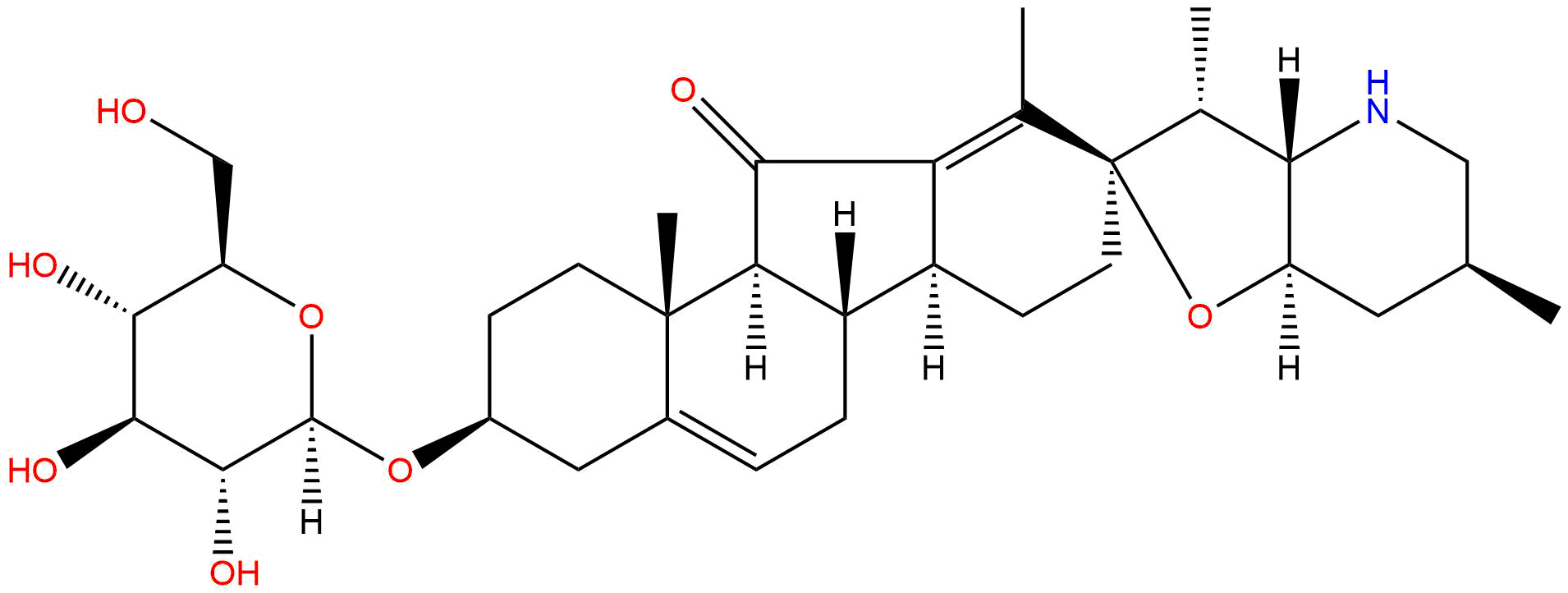


Product name: Pseudojervine
Synonym name: Jervine 3-O-β-D-glucopyranoside;Pseudojervin
Catalogue No.: BP4502
Cas No.: 36069-05-3
Formula: C33H49NO8
Mol Weight: 587.754
Botanical Source:
Type of Compound:
Purity: 95%~99%
Analysis Method: HPLC-DAD or/and HPLC-ELSD
Identification Method: Mass, NMR
Packing: Brown vial or HDPE plastic bottle
Storage: Store in a well closed container, protected from air and light. Put into refrigerate or freeze for long term storage.
Whenever possible, you should prepare and use solutions on the same day. However, if you need to make up stock solutions in advance, we recommend that you store the solution as aliquots in tightly sealed vials at -20℃. Generally, these will be useable for up to two weeks.
The product could be supplied from milligrams to grams
Inquire for bulk scale.
For Reference Standard and R&D, Not for Human Use Directly.
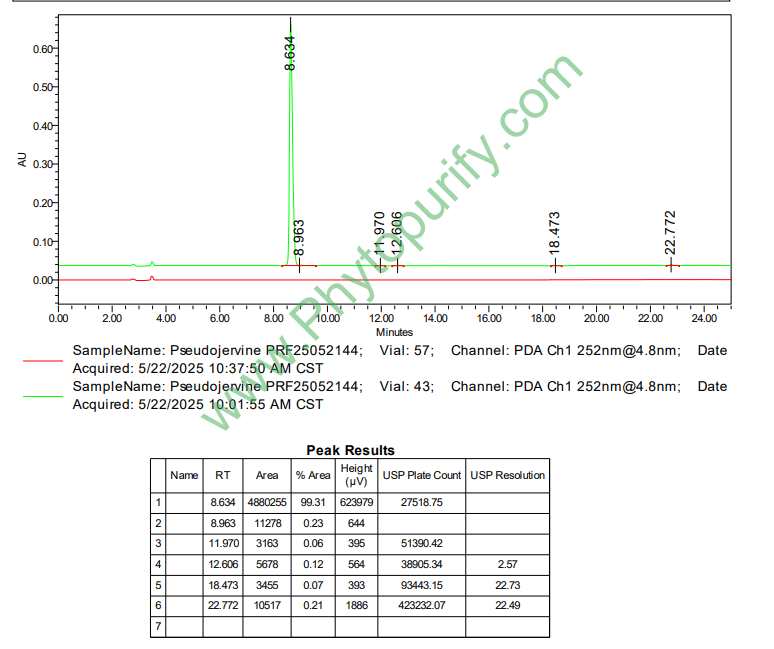
HPLC of Pseudojervine
Storage conditions:Short-term storage at 2~8℃, long-term storage at -20 ~ -80℃
137.7100
2.0147
1.2571
.7818
.5930
4.4666
Low
58.4754
6.0028
No
No
No
No
No
No
0.0
Yes
No
Yes
No
Natural products are an important treasure trove for the discovery and development of new drugs, among which alkaloids have always been a hot topic in medicinal chemistry and pharmacology research due to their structural diversity and significant biological activity. Pseudojervine, as a steroid glycosylated alkaloid, has a CAS number of 36069-05-3. Early studies have revealed that it has weak inhibitory activity on platelet aggregation, suggesting that it may have a certain regulatory effect on the cardiovascular system. However, in recent years, with the deepening of molecular biology and tumor pharmacology research, cytarabine 3-glucoside has shown broader pharmacological prospects, especially in the field of anti-tumor. Research has shown that this compound may participate in regulating malignant biological behaviors such as tumor cell proliferation, apoptosis, invasion, and metastasis by acting on multiple key targets, such as MCL1, BCL2, STAT3, MMP2, etc. The purpose of this article is to systematically review the chemical structure, plant origin, pharmacological activity, mechanism of action, and pharmacological properties of cyhalothrin glucoside, and to provide a comprehensive academic reference for its development as a candidate anti-tumor drug.
Jiefenamide-3-glucoside belongs to the C-norveratrol steroid alkaloids, with a molecular formula of C33H53NO8 and a molecular weight of 587.7540. Its basic skeleton is cyclopentane and a fully hydrogenated phenanthrene steroid nucleus, which is connected to a glucose group through a glycosidic bond at the C-3 position. This is the origin of its "glucoside" name and a key structural feature that affects its water solubility and biological activity. This glycosylation modification significantly increases its polarity compared to non glycosylated parent alkaloids.
From the analysis of physical and chemical properties, the calculated lipid water partition coefficient (LogP) is 2.0147, indicating that the compound has a certain lipophilicity but is not highly lipophilic. Its topological polar surface area (TPSA) is 137.7100 Å ², reflecting the larger surface area occupied by polar atoms (such as oxygen and nitrogen) in the molecule, which is consistent with its presence of multiple hydroxyl and sugar ring structures. The theoretically calculated water solubility value is 0.7818 mg/mL, which belongs to the range of slightly soluble to soluble, mainly due to the introduction of glucose groups. These basic physicochemical parameters (LogP, TPSA, molecular weight) preliminarily meet the requirements of the Rule of Five, indicating their potential chemical space to become oral drugs. However, its complex steroid glycoside structure also means that it may face challenges in terms of metabolic stability in vivo.
Jiefenamide-3-glucoside is mainly derived from plants in the Liliaceae family, including the genus Veratrum. Although plants of this genus, such as Veratrum album L. and Veratrum viride Ait., have been used in traditional medicine, their use requires extreme caution due to the presence of various highly toxic steroid alkaloids, such as resveratrol. Jiefenamide-3-glucoside is often present as one of the secondary metabolites in these plants, with low levels and often coexisting with other structurally similar alkaloids, which poses difficulties for its isolation and purification.
At present, its extraction and separation mainly rely on classical natural product chemical methods. Usually, alcohol (such as methanol, ethanol) or alcohol water mixed solvents are used for cold soaking or reflux extraction of dried plant rhizomes to preliminarily enrich alkaloid components. Subsequently, the total alkaloid extract was preliminarily purified using the acid water extraction alkaline precipitation method. Further separation and purification heavily rely on modern chromatographic techniques. Silica gel column chromatography and reverse phase silica gel (such as C18) column chromatography are commonly used for crude separation, and combined with high-performance liquid chromatography (HPLC) or preparative thin layer chromatography (PTLC) for final monomer preparation. Given its glycosidic structure, it is important to control pH and temperature during the extraction and separation process to prevent acid or enzymatic hydrolysis of glycosidic bonds. In recent years, liquid-liquid distribution chromatography techniques such as high-speed counter current chromatography (HSCCC) have also been applied in the separation of glycoside compounds due to their excellent separation efficiency. Structural identification involves the comprehensive use of spectroscopic techniques such as nuclear magnetic resonance (NMR, including 1H, 13C, 2D-NMR), mass spectrometry (MS), and optical rotation.
The pharmacological activity research of Jiefenamide-3-glucoside has expanded from its initial weak effect on the cardiovascular system to a more promising anti-tumor field.
Antiplatelet aggregation activity Early literature reports have shown that gerafenamide-3-glucoside has a weak inhibitory effect on platelet aggregation induced by inducers such as adenosine diphosphate (ADP) and arachidonic acid in vitro experiments. This activity may be related to the slight interference of its steroid structure on cell membrane fluidity or certain signaling pathways, but its intensity is much lower than that of commonly used antiplatelet drugs in clinical practice, so it is not its main development direction.
Antitumor activity This is the core focus of current research on this compound. Multiple in vitro studies have shown that gerafenamide-3-glucoside has growth inhibitory and apoptosis inducing effects on various human tumor cell lines.
The anti-tumor effect of Jiefenamide-3-glucoside involves the synergistic regulation of multiple targets and pathways, which may be related to its complex chemical structure with multiple interaction sites. Existing research (including computational simulations and partial experimental verification) suggests that the molecular targets it may act on include:
Regulating the apoptotic pathway (BCL2 family and MCL1)B-cell lymphoma 2 (BCL2) and myeloid leukemia 1 (MCL1) are important anti apoptotic proteins. Jiefenamide-3-glucoside may downregulate the expression or interfere with the function of BCL2 and MCL1 directly or indirectly, thereby relieving their inhibition of pro apoptotic proteins such as BAX and BAK and initiating mitochondrial pathway cell apoptosis.
Intervention signal transduction (STAT3, MAPK1)Signal transduction and transcription activator 3 (STAT3) is a key regulatory factor for tumor cell proliferation, survival, and immune escape. This compound may inhibit the phosphorylation activation of STAT3 and block the transcription of its downstream target genes (such as Cyclin D1, Survivor). Meanwhile, it may also have a regulatory effect on mitogen activated protein kinase 1 (MAPK1, ERK2), affecting cell growth signals.
Affects extracellular matrix degradation (MMP2)Matrix metalloproteinase-2 (MMP2) plays a crucial role in tumor invasion and angiogenesis. Jiefenamide-3-glucoside is predicted to inhibit the activity or expression of MMP2, thereby reducing the ability of tumor cells to degrade the basement membrane and extracellular matrix, and inhibiting their invasion and metastasis.
Interference with DNA metabolism and hypoxia response (TOP1/TOP2A, HIF1A)Topoisomerase I and II α (TOP1, TOP2A) are key enzymes involved in DNA replication and transcription, as well as classic chemotherapy targets. This compound may cause DNA damage by interfering with the function of these enzymes. In addition, it may also inhibit the stability or activity of hypoxia inducible factor-1 alpha (HIF1A), disrupting the adaptability of tumor cells in hypoxic microenvironments.
Regulating hormone related pathways (ESR1, CYP19A1)For estrogen receptor alpha (ESR1) positive breast cancer, sinapine 3-glucoside may play a role as a modulator of estrogen receptor. Meanwhile, its potential inhibitory effect on aromatase (CYP19A1) may reduce the biosynthesis of estrogen, which is of significance for the treatment of hormone dependent tumors.
It should be emphasized that the above target associations are mostly based on computational simulations (such as molecular docking) and preliminary protein/gene expression detection. The exact direct target, binding mode, and dominant pathway still need to be verified through more in-depth biochemical and cell biology experiments such as surface plasmon resonance (SPR), isothermal titration calorimetry (ITC), gene knockout/overexpression, etc.
Based on the provided pharmacological parameters and existing knowledge, a preliminary evaluation of the pharmacological properties of gerafenamide-3-glucoside is conducted
drug-likeness The molecular weight (587.75) is slightly above the ideal upper limit of 500, but still within an acceptable range. LogP (2.01) is moderate and TPSA (137.71) is high, which is consistent with its glycoside structure. It is predicted that its oral absorption may be moderate, but not completely impossible. Theoretical water solubility is acceptable, which is beneficial for the development of formulations.
Absorption, distribution, metabolism, excretion (ADME) prediction:
Preliminary safety warning:
At present, there are very few public reports on the pharmacokinetic studies of the mustard fenapyr 3-glucoside system, such as in vivo drug time curves, absolute bioavailability, tissue distribution, and metabolite identification. This is a key data gap that must be filled in the process of promoting drug development.
Jiefenamide-3-glucoside, as a natural product with multi-target anti-tumor potential, has both clinical application prospects and challenges.
Potential advantages and prospects:
1. Multi target mechanism of action In today's trend towards combination therapy and multi-target therapy in tumor treatment, its natural multi-target characteristics may bring synergistic efficacy and delay the development of drug resistance.
2. New structural framework Its unique steroid glycoside structure provides a novel lead compound template for medicinal chemists, which can be used for structural optimization and structure-activity relationship research.
3. Potential for combination with existing therapies It may be used in combination with traditional chemotherapy drugs (such as topoisomerase inhibitors), targeted drugs, or immunotherapy to enhance efficacy or reduce side effects.
4. Exploration of indications: In addition to general solid tumors, based on its potential role in ESR1 and CYP19A1, its value in hormone dependent breast cancer and prostate cancer deserves further exploration.
Challenges faced and future research directions:
1. Enhancement of activity intensity and selectivity At present, the anti-tumor activity is mostly at the micromolar level, and structural modifications (such as modifying sugar groups and steroid nuclei) are needed to improve its efficacy and selectivity towards tumor cells, reducing potential toxicity.
2. Pharmacokinetic optimization Improving its oral bioavailability and metabolic stability is the key to drug development. The strategy includes preparing prodrugs, developing novel drug delivery systems (such as nano formulations), etc.
3. Clarify the mechanism of action It is necessary to use modern chemical biology methods to clarify its direct molecular targets, precise pathways of action, and role in the tumor microenvironment.
4. System preclinical evaluation Conduct standardized in vivo pharmacological (more models, longer duration), pharmacokinetic, and toxicological studies to comprehensively evaluate its therapeutic index.
5. Sustainable sources and synthesis Plant extraction is limited by resources, content, and symbiotic impurities. Developing fully synthetic or semi synthetic routes, or producing them in microorganisms through synthetic biology methods, is the fundamental way to ensure their sustainable supply.
Jiefenamide-3-glucoside, a natural glycosylated alkaloid with weak platelet inhibitory activity, has gradually demonstrated its potential as a multi-target anti-tumor candidate. Its unique chemical structure and pharmacological activity involve regulating multiple key tumor biological processes such as apoptosis, signal transduction, and cell invasion. Despite facing common challenges such as activity intensity, pharmacokinetic properties, and safety in drug development, its multi-target nature and novel structural framework endow it with important research value. Future research should focus on elucidating the essence of its action through in-depth mechanism studies, and using medicinal chemistry and pharmacology methods to rationalize and optimize it. Only through systematic and rigorous preclinical research can the potential for translational medicine be objectively evaluated, providing new possibilities for the development of novel anti-tumor drugs derived from natural products.
