


Synonym name: Dhelwangin
Catalogue No.: BP1116
Cas No.: 23800-56-8
Formula: C12H16O4
Mol Weight: 224.256
Botanical Source: leaves of Pogostemon cablin (patchouli)
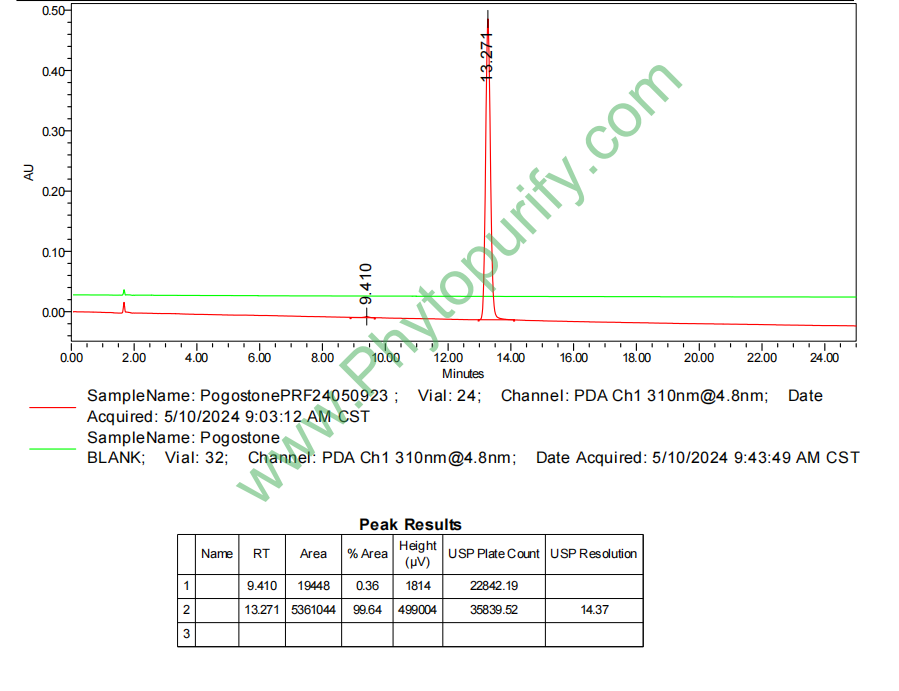
Purity: 95%~99%
Analysis Method: HPLC-DAD or/and HPLC-ELSD
Identification Method: Mass, NMR
Packing: Brown vial or HDPE plastic bottle
Can be supplied from milligrams to grams.
For Reference Standard and R&D, Not for Human Use Directly.
Inquire for bulk scale.
HPLC of Pogostone
Storage conditions:Short-term storage at 2~8℃, long-term storage at -20 ~ -80℃
67.5100
2.2316
.9797
.2670
4.5308
18.6809
Low
82.6073
2.4860
Yes
No
No
No
No
Yes
0.6
No
No
No
No
In the vast field of natural product medicinal chemistry, terpenoids have attracted much attention for their structural diversity and extensive biological activity. Pogostenone (CAS number: 23800-56-8), a plant in the family Lamiaceae, is commonly known as patchouli(Pogostemon cablin Blanco Benth. is one of the key active ingredients in volatile oils and is a highly valuable representative of this type of compound for research. As a traditional Chinese medicine, patchouli has long been used in clinical practice for its effects of "aromatizing turbidity, stopping nausea, and relieving summer heat". Modern research has revealed that the substance basis of its pharmacological effects is largely derived from its rich volatile oils, and patchouli ketone is the core molecule that contributes to modern pharmacological activities such as antibacterial, anti-inflammatory, and anti-tumor effects.
The scientific research on patchouli ketone began with the discovery of its antibacterial activity. With the deepening of research, its powerful and broad-spectrum antibacterial ability, especially its inhibitory effect on various pathogenic microorganisms including drug-resistant bacteria, makes it a potential natural solution to address the increasingly severe problem of bacterial resistance. In addition, its activities in anti-tumor, anti-inflammatory, neuroprotective and other aspects have been reported successively, demonstrating the characteristics of multi-target and multi pathway action. Especially its dual mechanism of inducing tumor cell apoptosis and autophagy provides new ideas for the development of novel anti-tumor drugs.
This article aims to provide a systematic review of the chemical structure, plant sources, extraction methods, various pharmacological activities, proven mechanisms of action and molecular targets, pharmacological potential, and clinical application prospects of patchouli ketone, in order to provide comprehensive scientific references for the deep development and utilization of this natural product.
The chemical name of patchouli ketone is 4-hydroxy-3-methyl-6- (1-methylethyl) -2H-pyran-2-one, which is a monoterpenoid lactone compound. Its molecular formula is C12H16O4 and its molecular weight is 224.2560 g/mol.
Structurally, the core of patchouli ketone is an alpha, beta unsaturated gamma lactone ring (2H-pyran-2-one), which is the key pharmacophore for its various biological activities. The 3rd position of the lactone ring is connected to a methyl group, the 4th position is a hydroxyl group, and the 6th position is connected to an isopropyl group through a methylene group. This relatively simple monoterpene skeleton endows it with unique physicochemical properties.
According to the provided pharmacological parameters, the lipid water partition coefficient (LogP) of patchouli ketone is 2.2316, indicating its moderate lipophilicity, which facilitates its penetration of cell membranes but may also affect its distribution in the aqueous phase. Its topological polar surface area (TPSA) is 67.51 Å ², which is relatively small and further supports its good membrane permeability. The water solubility value is 0.2670 mg/mL, which belongs to the category of slight solubility. This suggests that solubilization strategies may need to be considered in formulation development, such as making cyclodextrin inclusion complexes, nano formulations, or prodrugs.
Other key parameters show that the ability of patchouli ketone to cross the blood-brain barrier is relatively low, which to some extent limits its direct application in central nervous system related diseases, but may also reduce the potential risk of neurotoxicity. Its hERG inhibition is' no ', which is a positive signal indicating a lower risk of cardiac toxicity such as QT interval prolongation at therapeutic doses. The Ames test result is 0.6 (usually considered negative if the ratio is less than 2), indicating a low risk of mutagenicity, but a more comprehensive genetic toxicity assessment is still needed.
The main source of patchouli ketone is patchouli, a plant in the family Lamiaceae and the genus Crassulaceae(Pogostemon cablin)The dry aboveground part. Patchouli is mainly cultivated in Guangdong, Hainan, Taiwan and other regions of China, as well as Southeast Asian countries. Its rich volatile oil (patchouli oil) is an important raw material for the spice industry and traditional medicine.
In the plant body, patchouli ketone does not exist in large quantities in free form, but is an important transformation product of patchouli oil during oxidation and aging processes. The main component of freshly extracted patchouli oil is Pogostol, which can be oxidized to form patchouli ketone during storage. Therefore, the extraction method directly affects the content of patchouli ketone in the final product.
Patchoulinone exhibits extensive and significant pharmacological activity, and its research has expanded from its initial antibacterial properties to multiple fields such as anti-tumor, anti-inflammatory, and antioxidant effects.
1. Antibacterial activity
The most prominent activity of patchouli ketone is its strong and broad-spectrum antibacterial effect. Research has shown that it has significant inhibitory effects on various Gram positive bacteria (such as Staphylococcus aureus, methicillin-resistant Staphylococcus aureus MRSA, Bacillus subtilis) and Gram negative bacteria (such as Escherichia coli, Pseudomonas aeruginosa, Salmonella typhi). It is effective against dry bacteria(Bacillus siccus)The minimum inhibitory concentration (MIC) was as low as 0.098 μ g/mL, demonstrating extremely strong antibacterial efficacy. In addition, patchouli ketone also exhibits inhibitory effects on various fungi, such as Candida albicans. More noteworthy is that it still maintains activity against some clinically resistant strains, suggesting that it may have a mechanism of action different from existing antibiotics, bringing hope for overcoming bacterial resistance.
2. Antitumor activity
Recent studies have revealed the potential anti-tumor properties of patchouli ketone. It can inhibit the proliferation of a variety of human cancer cell lines in vitro, including liver cancer (HepG2), breast cancer (MCF-7), lung cancer (A549), colon cancer (HCT-116) and leukemia (HL-60), in a dose and time-dependent manner. Its anti-tumor effect is mainly achieved by inducing cell apoptosis and autophagy. Research has shown that treatment with patchouli ketone can cause cancer cell cycle arrest (such as G2/M phase arrest), activate caspase cascade reactions, regulate the Bcl-2/Bax protein ratio, and thus initiate mitochondrial pathway apoptosis. At the same time, it can also upregulate the expression of autophagy related protein LC3-II, induce protective autophagy, and in some cases, excessive activation of autophagy may also promote cell death.
3. Anti inflammatory and antioxidant activity
Pogostemon has good anti-inflammatory effects. In the macrophage inflammation model induced by lipopolysaccharide (LPS), it can significantly inhibit the production of nitric oxide (NO), prostaglandin E2 (PGE2), and pro-inflammatory cytokines such as TNF - α, IL-1 β, IL-6. Its mechanism of action is closely related to the inhibition of the activation of nuclear factor kappa B (NF - κ B) and mitogen activated protein kinase (MAPK) signaling pathways. In addition, patchouli ketone also exhibits the ability to scavenge DPPH free radicals, hydroxyl radicals, and has certain antioxidant activity, which complements its anti-inflammatory effect.
4. Other activities
Preliminary studies have also found that patchouli ketone may have potential applications in protecting nerves, antiviral (such as against influenza virus), and improving metabolic syndrome, but further research in these areas is still ongoing.
The multiple pharmacological activities of patchouli ketone stem from its interactions with multiple molecular targets in the body. Its core structure, α, β - unsaturated γ - lactone ring, is an electrophilic Michael reaction receptor that is easily covalently bound to nucleophilic groups (such as thiol and amino groups) in proteins, which may be the chemical basis for its various biological effects.
Targeting antibacterial activity targets:
The antibacterial mechanism of patchouli ketone may be multi-target, which is different from the traditional single target mode of action of antibiotics and helps to delay the development of drug resistance. The potential targets suggested by relevant research include:
* DNA gyrase (GYRA) and topoisomerase IV (GYPB)This is a classic target of quinolone drugs. Pogostemon may interfere with the replication and repair of bacterial DNA.
* Cell division protein FtsZ Similar to the action of benzimidazole, inhibiting the polymerization of this protein can hinder bacterial division.
* Acyl Carrier Protein Reductase (FABI)Participating in bacterial fatty acid biosynthesis is a target of triclosan.
* Dihydrofolate reductase (DHFR)Participating in folate metabolism is a target of trimethoprim.
* Penicillin binding protein (PENA) and MECA gene products Related to resistance to β - lactam antibiotics.
* Fungal targets Like lanosterol 14 α - demethylase (ERG11/CYP51A1), which is the target of azole antifungal drugs, as well as efflux pump protein CDR1. Pogostemon may exert antifungal effects by inhibiting these targets.
The mechanism of anti-tumor activity:
* Apoptotic pathway By upregulating pro apoptotic proteins Bax and Bad and downregulating anti apoptotic proteins Bcl-2 and Bcl xL, mitochondrial membrane potential decreases, cytochrome C is released, and Caspase-9 and Caspase-3 are activated, inducing intrinsic apoptotic pathways. It may also involve external pathways mediated by death receptors.
* Autophagy pathway By inhibiting the PI3K/Akt/mTOR signaling pathway or activating the AMPK signaling pathway, the inhibition of autophagy can be relieved and autophagosome formation can be induced.
* cell cycle regulation By regulating the expression of cell cycle related proteins such as Cyclin B1, CDK1, and p21, cells are arrested at specific cycle checkpoints.
* oxidative stress Inducing excessive accumulation of reactive oxygen species (ROS) in cells, leading to oxidative damage and triggering apoptosis or autophagy.
Regarding the mechanism of anti-inflammatory activity:
Mainly through inhibition of the NF - κ B and MAPK signaling pathways. Pogostemon can inhibit the phosphorylation and degradation of I κ B α, prevent the nuclear translocation of NF - κ B p65 subunit, and thus downregulate the transcription of downstream inflammatory mediators. Meanwhile, it can also inhibit the phosphorylation activation of MAPKs such as p38, JNK, and ERK.
Based on its physicochemical parameters and preliminary biological data, patchouli ketone has shown certain potential as a drug, but also faces some challenges.
Advantage:
1. Strong activity Especially in terms of antibacterial activity, the MIC value is extremely low and the activity is significant.
2. Multi-target effect May delay the development of drug resistance and be applicable for the treatment of complex diseases such as cancer.
3. Preliminary safety indicators are good No hERG inhibition warning, Ames test preliminary negative, treatment window may be large.
4. Clear structure and natural source Easy to modify and optimize the structure.
Challenges and unknowns:
1. Poor water solubility The main obstacle to its development into injectable or high-dose oral formulations is its water solubility of 0.267 mg/mL. It is necessary to use nanotechnology, liposomes, prodrug strategies, etc. to improve its solubility and bioavailability.
2. Lack of pharmacokinetic data Currently, there is very limited systematic research on the absorption, distribution, metabolism, and excretion (ADME) process of patchouli ketone in the body. Its moderate LogP value suggests that oral administration may have some absorption, but key parameters such as first pass effect, plasma protein binding rate, major metabolic pathways, half-life, etc. are still blank.
3. Low blood-brain barrier permeability It limits its application in central nervous system infections or tumors, but can also be considered as a targeted feature.
4. Potential toxicity needs to be comprehensively evaluated Although the initial genetic toxicity risk is low, systematic preclinical safety evaluations such as long-term toxicity, reproductive toxicity, and immunotoxicity still need to be conducted. Its alpha, beta unsaturated lactone structure may also non specifically bind to certain proteins, posing off target toxicity risks.
The future optimization of drug properties should focus on: ① improving its solubility and stability through pharmaceutical methods; ② Conduct systematic preclinical pharmacokinetic studies to clarify their in vivo fate; ③ Conduct a comprehensive toxicological evaluation; ④ When necessary, make reasonable structural modifications to it to improve its pharmacokinetic properties while maintaining its activity.
The multiple biological activities of patchouli ketone depict broad prospects for its application in multiple therapeutic fields.
1. As a lead compound for novel antibacterial drugs
In the face of the global antibiotic resistance crisis, the powerful, broad-spectrum, and potentially multi-target antibacterial properties of patchouli ketone make it an excellent lead compound for developing a new generation of antibiotics. Its research and development directions include:
* Topical preparations for local use In view of its water solubility limitation and strong antibacterial activity, the gel, cream, suppository and other topical preparations developed for the treatment of skin and mucous membrane infections (such as acne, wound infection, oral ulcer, vaginitis) are the most likely clinical applications in the near future.
* Systemic antibacterial drugs Develop injectable or oral formulations for the treatment of systemic drug-resistant bacterial infections by improving their water solubility and in vivo stability through structural modifications or advanced drug delivery systems such as liposomes and polymer micelles.
* Antibacterial enhancer Studying its combined efficacy with existing antibiotics may restore the sensitivity of drug-resistant bacteria to traditional antibiotics.
2. As a candidate molecule for anti-tumor drugs
Its dual mechanism of inducing apoptosis and autophagy, as well as its inhibitory effect on various cancer cells, make it promising in the field of tumor therapy. It can be explored as a single drug or in combination with existing chemotherapy drugs to treat specific types of cancer. Further research is needed on its in vivo anti-tumor efficacy and selectivity towards normal tissues.
3. Application in inflammation related diseases
Its anti-inflammatory and antioxidant effects can be used to treat chronic inflammatory diseases such as inflammatory bowel disease, arthritis, dermatitis, etc. It can also be used as a functional ingredient in the development of health products or cosmetics with anti-inflammatory and antioxidant effects.
4. Application in Agriculture and Food Industry
As a natural antibacterial agent, patchouli ketone can be used in agriculture to develop plant-based fungicides, and as a natural preservative in the food industry, it has the advantages of safety and environmental protection.
Outlook:
Future research should focus on the following directions: ① Deep analysis of the mechanism of action Accurately identify the protein targets it directly acts on using chemical and biological methods, such as active molecular probes. ② Research on Structural Optimization and Structure Performance Relationship Systematically modify its molecular structure and search for derivatives with better activity and drug properties. ③ Advanced delivery system development Design an intelligent nano drug delivery system to address its shortcomings and achieve targeted delivery and controlled release. ④ Conduct standardized preclinical and clinical research On the basis of fully completing pharmacological, pharmacokinetic, and toxicological evaluations, promote its translation into clinical applications.
Pogostemon ketone, a natural monoterpenoid lactone derived from traditional Chinese medicine Pogostemon patchouli, has become a highlight molecule in natural product pharmacology research due to its unique chemical structure and excellent multiple pharmacological activities such as antibacterial, anti-tumor, and anti-inflammatory. Its multi-target mode of action provides a new strategy for addressing bacterial resistance and complex diseases. Although there are still challenges in drug formulation, especially in terms of water solubility and systemic pharmacokinetics, these challenges are precisely the breakthroughs that modern medicinal chemistry and pharmacy can focus on addressing.
With a deeper understanding of its molecular mechanism, as well as the application of structure based rational drug design and advanced formulation technology, patchouli ketone is highly likely to be successfully transformed from an active natural product into an innovative drug or lead compound with clinical application value. It not only carries the mission of exploring modern value from traditional medical wisdom, but also presents a hopeful prospect for the development of new therapeutic drugs derived from nature. Continuous and in-depth research is expected to bring new brilliance to this ancient "aromatic" molecule in the field of modern medicine.
