


Synonym name: Patchoulol; Patchouli camphor
Catalogue No.: BP1067
Cas No.: 5986-55-0
Formula: C15H26O
Mol Weight: 222.372
Botanical Source: patchouli oil (Pogostemon patchouli). Also in Pogostemon plectranthoides and Valeriana wallichii
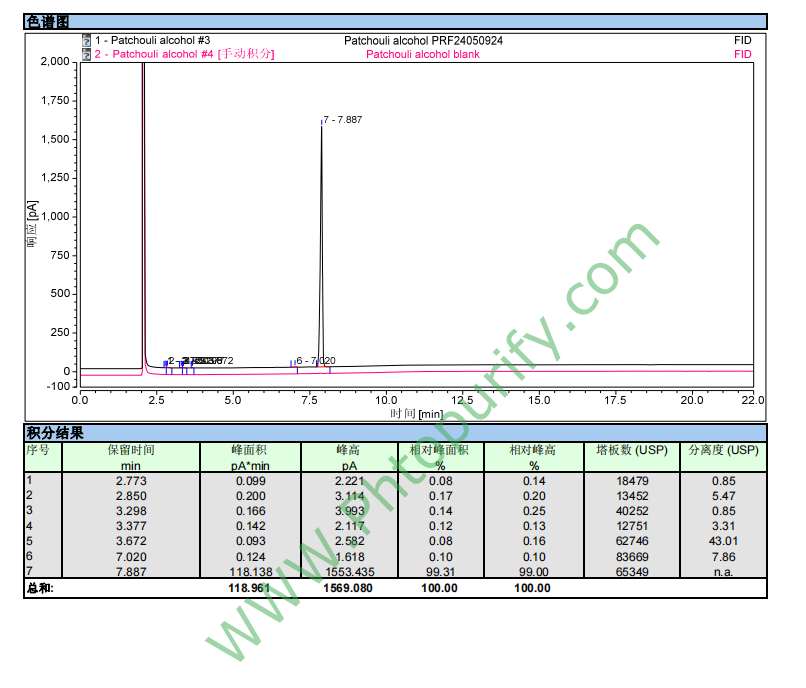
Purity: 95%~99%
Analysis Method: HPLC-DAD or/and HPLC-ELSD
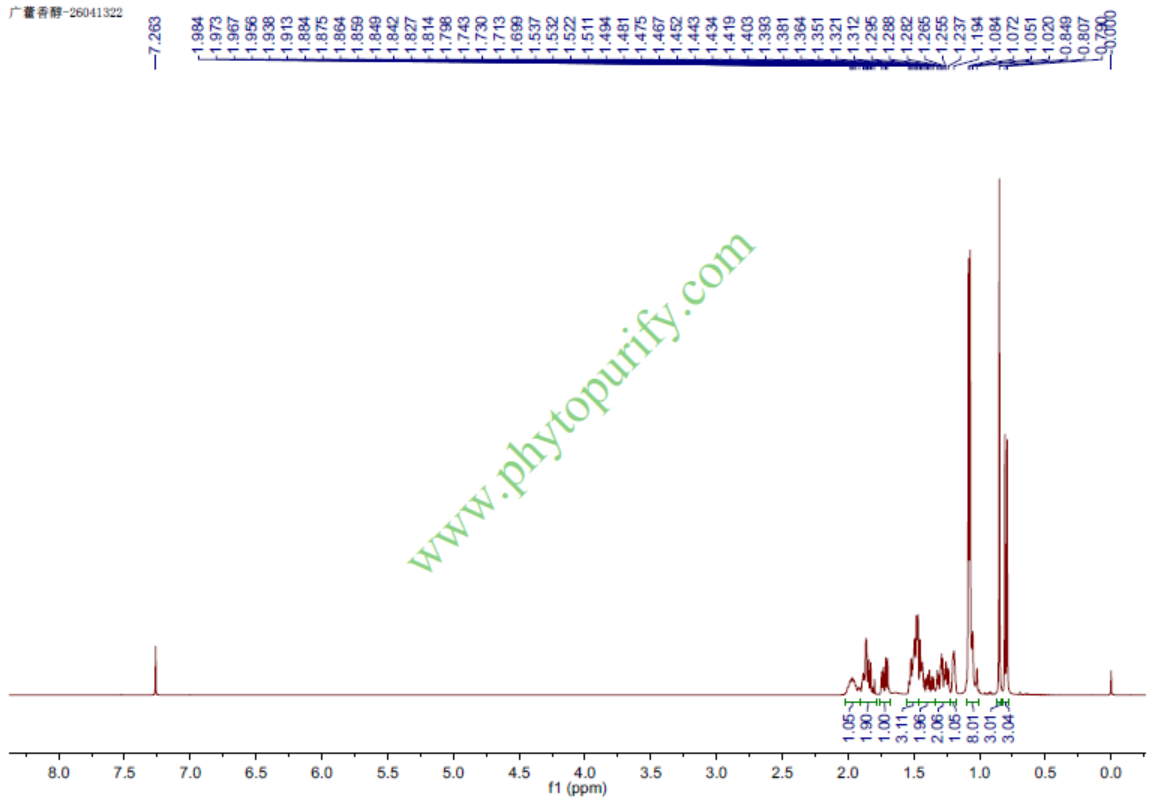
Identification Method: Mass, NMR
Packing: Brown vial or HDPE plastic bottle
Can be supplied from milligrams to grams.
For Reference Standard and R&D, Not for Human Use Directly.
Inquire for bulk scale.
HPLC of Patchouli alcohol
HNMR of Patchouli alcohol
Storage conditions:Short-term storage at 2~8℃, long-term storage at -20 ~ -80℃
20.2300
4.1431
4.1431
.0138
8.6140
13.8480
High
79.5083
5.2501
No
No
No
No
No
No
0.0
No
No
No
No
Patchouli alcohol, also known as patchouli alcohol, is a sesquiterpene compound with a unique tricyclic skeleton, and its CAS number is 5986-55-0. As the main active ingredient and characteristic aroma substance in the volatile oil of traditional Chinese medicine Pogostemon cablin (Blanco) Benth., patchouli alcohol not only endows Pogostemon with unique "earthy" and "woody" aromas, but also demonstrates extensive therapeutic potential in the long practice of traditional medicine. In traditional Chinese medicine theory, patchouli is commonly used for aromatizing dampness, stopping nausea, and relieving heatstroke. Modern pharmacological research has gradually revealed its scientific connotation and found that patchouli alcohol exhibits significant biological activity in multiple fields such as antibacterial, anti-inflammatory, antioxidant, neuroprotective, and anti-tumor. Especially its activity against pathogenic microorganisms such as Helicobacter pylori provides new candidate molecules for the development of novel antibacterial drugs. This article aims to systematically review the chemical properties, plant sources, pharmacological activities, mechanisms of action, pharmacological evaluation, and clinical application prospects of patchouli alcohol, in order to provide comprehensive scientific references for the deep development and utilization of this natural product.
The chemical name of patchouli alcohol is tricyclic [5.3.1.0 ³, ⁸] undecane-3-ol, which is substituted with methyl groups at positions 2, 2, 6, and 8. Its dominant configuration is the (1R, 3R, 6S, 7S, 8S) configuration. It is a tricyclic sesquiterpene tertiary alcohol with the molecular formula C ₁₅ H ₂₆ O and a molecular weight of 222.3720. The core of its structure is a unique tricyclic [5.3.1.0 ³, ⁸] undecane skeleton, with three rings fused together and multiple chiral centers, giving it complex stereochemical characteristics, which are also the structural basis of its biological activity.
In terms of physical and chemical properties, patchouli alcohol is an oily liquid with a strong characteristic aroma. Its lipid solubility is high, and the calculated lipid water partition coefficient (LogP) is 4.1431, indicating its strong hydrophobicity. Consistent with this, its water solubility is extremely low, only 0.0138 mg/mL, which to some extent limits its direct application in aqueous systems. Its topological polar surface area (TPSA) is relatively small, at 20.23 Å ², which is consistent with its molecular structure characteristics. Preliminary predictions of its pharmacological properties indicate that patchouli alcohol has high blood-brain barrier permeability, suggesting its potential therapeutic value for central nervous system diseases. In addition, its hERG inhibition risk prediction is negative, and the Ames test prediction value is 0.0, indicating a low risk of cardiac toxicity and genetic toxicity, which provides a preliminary safety basis for further drug development.
Pogostemon cablin, a plant in the family Lamiaceae, is mainly derived from the dried aboveground part of Pogostemon cablin. It is the most abundant and representative component in the oil of Pogostemon cablin, usually accounting for 30% -50% of the total volatile oil. Patchouli is native to Southeast Asia and is now widely cultivated in China (Guangdong, Hainan), Indonesia, the Philippines, India, and other places. The content and composition of volatile oils in its medicinal parts (stems and leaves) are significantly affected by factors such as place of origin, cultivated variety, harvest season, and processing methods.
The extraction of patchouli alcohol from plant materials mainly relies on volatile oil extraction technology. The traditional and most commonly used method is steam distillation, which uses steam to remove volatile components from plant tissues. After condensation and oil-water separation, patchouli oil is obtained, and further separation and purification (such as column chromatography, preparative gas chromatography, etc.) can obtain high-purity patchouli alcohol. This method has simple equipment, low cost, and is suitable for large-scale production, but may have the disadvantage of long heating time leading to degradation of thermosensitive components. Supercritical CO ₂ extraction method is another efficient and environmentally friendly extraction method. It operates at lower temperatures, which can better preserve the full composition and aroma of essential oils. The extraction efficiency is high, and the purity of the obtained patchouli alcohol is also high. However, the equipment investment and operating costs are relatively expensive. In addition, technologies such as microwave-assisted extraction and simultaneous distillation extraction have also been applied in optimizing the extraction process. In recent years, biotechnology methods such as plant cell culture and synthetic biology pathways for the production of patchouli alcohol have also been explored, aiming to achieve sustainable and controllable production of this high-value compound.
Numerous in vitro and in vivo studies have confirmed that patchouli alcohol has diverse pharmacological activities, which is the core manifestation of its medicinal value.
The pharmacological effects of patchouli alcohol are achieved by intervening in multiple signaling pathways and targeting specific molecular targets.
In Antibacterial mechanism On the one hand, patchouli alcohol does not act on a single target, but exhibits multi-target inhibition characteristics, which helps to delay the development of bacterial resistance. Prediction and research indicate that its potential targets may involve:
* Nucleic acid synthesis related Examples include DNA gyrase (GYRA) and topoisomerase IV (GYPB), which interfere with bacterial DNA replication.
* Cell division related Like the cell division protein FtsZ (FTSZ), it inhibits bacterial division.
* Metabolic pathway related Such as acyl carrier protein reductase (FABI, involved in fatty acid synthesis) and dihydrofolate reductase (DHFR, involved in folate synthesis).
* Cell wall synthesis related Such as penicillin binding protein (PENA).
* Fungal specific targets Such as lanosterol 14 α - demethylase (ERG11/CYP51A1, a key enzyme in fungal cell membrane ergosterol synthesis) and efflux pump proteins (such as CDR1).
Its antibacterial effect may be achieved through multiple synergistic pathways, such as disrupting cell membrane integrity, inhibiting key enzyme activity, and energy metabolism.
In Anti inflammatory and antioxidant mechanisms In terms of aspect, the core function of patchouli alcohol is to inhibit the overactivation of nuclear factor kappa B (NF - κ B) and mitogen activated protein kinase (MAPK) signaling pathways. It can inhibit the degradation of I κ B α, prevent nuclear translocation of NF - κ B p65 subunit, and thus downregulate the expression of inflammatory cytokine genes. Meanwhile, it can also inhibit the phosphorylation of MAPK family members such as p38, JNK, ERK. By activating the nuclear factor E2 related factor 2 (Nrf2) pathway, patchouli alcohol upregulates the expression of phase II detoxifying enzymes such as heme oxygenase-1 (HO-1) and antioxidant proteins, enhancing cellular antioxidant capacity.
In Neuroprotective mechanism In addition to the anti-inflammatory and antioxidant pathways mentioned above, patchouli alcohol has also been found to regulate the cholinergic system (such as inhibiting acetylcholinesterase activity), inhibit excessive activation of microglia, and reduce neuronal apoptosis (such as regulating the Bcl-2/Bax ratio and inhibiting caspase-3 activation).
Although patchouli alcohol exhibits rich biological activity, its pharmacological potential as a drug candidate molecule still needs to be comprehensively evaluated.
from drug-likeness From a perspective, its molecular weight is moderate, but its high LogP value (>4) and extremely low water solubility are the main challenges it faces in drug conversion, which may lead to poor oral absorption and low bioavailability. Its high blood-brain barrier permeability is advantageous for central nervous system drugs, but potential central side effects also need to be considered. The preliminary toxicity prediction (no hERG inhibition, Ames negative) provides optimistic clues for its safety, but complete preclinical toxicology experiments are still needed for validation.
In pharmacokinetics In terms of research, existing studies are relatively limited. Animal experiments have shown that patchouli alcohol is rapidly absorbed after oral administration, but its absolute bioavailability may be limited due to first pass effects and low solubility. It is widely distributed in the body and can enter brain tissue. Metabolic studies suggest that patchouli alcohol mainly undergoes oxidation and binding reactions (such as glucuronidation) in the liver through cytochrome P450 enzyme systems (such as CYP2C19, CYP3A4), generating various metabolites. Its excretion pathway may mainly be through urine and feces. Clarifying the process of ADME (absorption, distribution, metabolism, excretion) in its body, especially the main active metabolites, is crucial for understanding its efficacy and toxicity.
In order to improve its medicinal properties, researchers are exploring various strategies:Formulation improvement Such as making it into cyclodextrin inclusion complexes, liposomes, nanoemulsions, solid dispersions, etc., to improve solubility and bioavailability;Structural modification By using semi synthetic methods to modify its molecules and optimize its physicochemical properties while retaining its activity; And development New drug delivery system Such as transdermal administration, nasal administration, etc.
The clinical application prospects of patchouli alcohol are broad, and its development can be carried out in multiple directions:
Future research priorities should include:Thoroughly elucidate the molecular mechanism Using chemical biology methods to identify its direct target proteins;Systematically conduct preclinical research Complete standardized pharmacological, pharmacokinetic, and toxicological evaluations;Vigorously break through the bottleneck of formulation Develop practical dosage forms that can significantly improve their bioavailability; and Explore combination therapy strategies Utilize its multi-target synergistic advantages. Meanwhile, achieving green and efficient biomanufacturing of patchouli alcohol through synthetic biology technology is also an important direction to ensure its sustainable supply.
As a natural sesquiterpene compound with unique structure and diverse biological activities, patchouli alcohol has emerged from traditional medicinal plants and is demonstrating enormous drug development value through modern scientific research. Its significant efficacy in antibacterial, anti-inflammatory, neuroprotective and other aspects, as well as preliminary good pharmacological predictions, make it an attractive candidate molecule in the field of natural product new drug development. Despite challenges in solubility, bioavailability, and other aspects, these obstacles are expected to be gradually overcome with the continuous advancement of formulation technology, medicinal chemistry, and pharmacology research. Looking forward to the future, patchoulol is expected to move from laboratory to clinic, not only providing new options for the treatment of infectious diseases, inflammatory diseases and neurodegenerative diseases, but also opening up a new world in the field of functional cosmetics and mass health products, fully reflecting the eternal charm and practical value of natural products in the discovery of innovative drugs.
