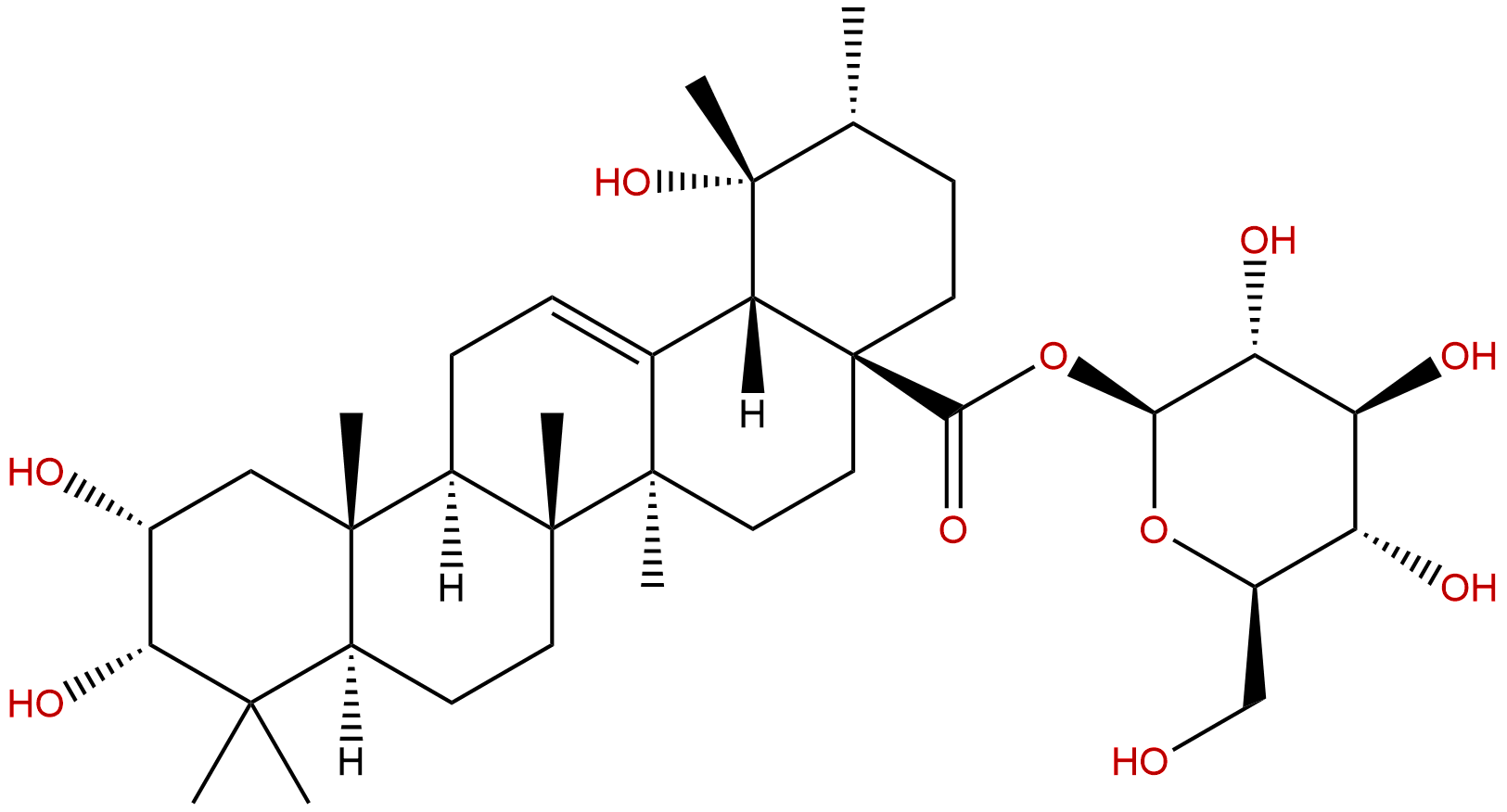


Product name: Kajiichigoside F1
Synonym name: Euscaphic acid glucoside;Euscaphic acid glucosyl ester;
Catalogue No.: BP3634
Cas No.: 95298-47-8
Formula: C36H58O10
Mol Weight: 650.85
Botanical Source:
Physical Description:
Type of Compound:
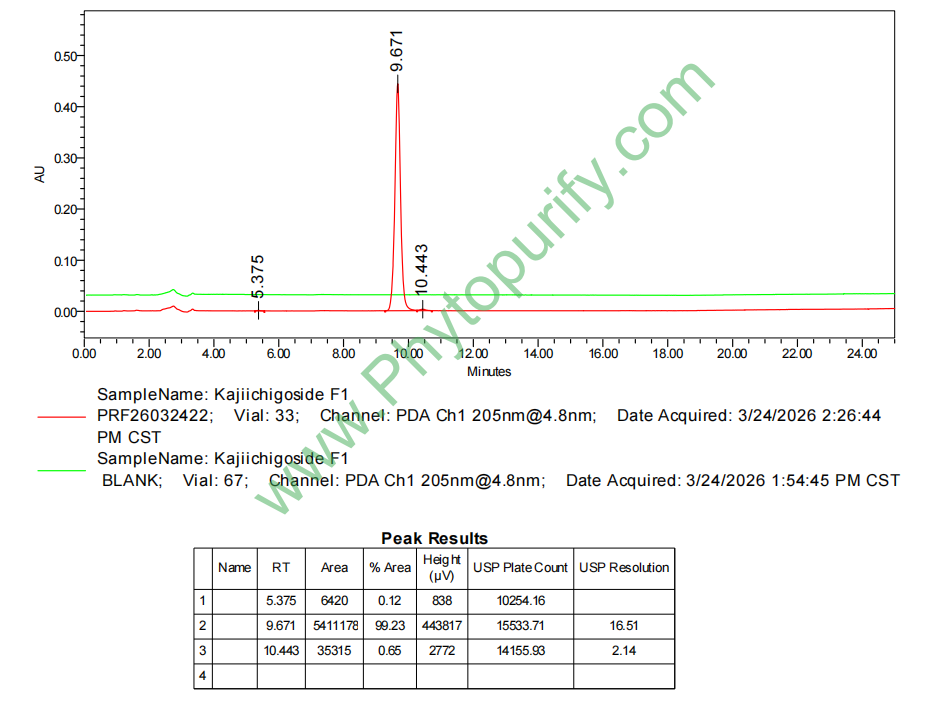
Purity: 95%~99%
Analysis Method: HPLC-DAD or/and HPLC-ELSD
Identification Method: Mass, NMR
Packing: Brown vial or HDPE plastic bottle
The product could be supplied from milligrams to grams. Inquire for bulk scale.
We provide solution to improve the water-solubility of compounds, thereby facilitating the variety of activity tests and clinic uses.
For Reference Standard and R&D, Not for Human Use Directly.
HPLC of Kajiichigoside F1
Storage conditions:Short-term storage at 2~8℃, long-term storage at -20 ~ -80℃
177.1400
2.8143
2.8143
.0301
.6601
1.0031
Low
74.3367
5.5502
No
No
No
No
No
No
0.0
Yes
No
Yes
Yes
Kajiichigoside F1 is a natural triterpenoid saponin derived from plants, which has gradually become a hot topic in natural product pharmacology research due to its significant biological activity. In recent years, with the in-depth exploration of the role of natural products in disease prevention and treatment, naringin has shown broad application potential due to its excellent antioxidant properties and multi-target regulatory effects. Antioxidant stress is an important pathological basis for various chronic diseases such as cardiovascular disease, neurodegenerative diseases, tumors, and inflammatory diseases. Prickly pear glycoside plays a key role in protecting cells from oxidative damage by regulating multiple antioxidant related targets, making it a research focus.
This article will provide a systematic review of the chemical structure and physicochemical properties, plant sources, and extraction methods of naringin, with a focus on its pharmacological activity and mechanism of action. The pharmacokinetic characteristics of naringin will be analyzed based on its pharmacological parameters. Finally, the clinical application prospects and future research directions will be explored, in order to provide theoretical basis and research guidance for the in-depth development of naringin.
Prickly pear glycoside (CAS number: 95298-47-8) has a molecular weight of 650.85 and belongs to the triterpenoid saponin class of natural products. Its molecular structure contains a typical pentacyclic triterpenoid skeleton, connecting multiple sugar groups, giving it high polarity and water solubility characteristics. The LogP value is 2.8143, indicating that it has moderate lipid solubility, which is beneficial for membrane penetration and bioavailability. The total polar surface area (TPSA) is 177.14 Å ², and a higher TPSA value usually indicates that molecules have certain limitations when passing through the cell membrane, especially the low permeability of the blood-brain barrier (BBB), which is consistent with its biological distribution characteristics.
The water solubility is 0.0301, indicating limited solubility in water, but its bioavailability can be improved through appropriate formulation techniques. The hERG channel inhibition experiment result was negative, indicating that naringin has a low risk of cardiac toxicity. The result of Ames mutagenicity test is 0.0, indicating that its genotoxicity risk is extremely low and its safety is good.
In summary, the physicochemical properties of prickly pear glycoside indicate that it is a natural product with good biological activity potential and high safety. However, its water solubility and blood-brain barrier permeability are low, and it needs to be optimized in drug design and formulation development.
Prickly glycoside is mainly distributed in the Rosaceae plant Rosa roxburghii Tratt. Rosa roxburghii Tratt is a wild fruit tree widely distributed in the mountainous areas of southwestern China. Its fruit is rich in various bioactive components, including polysaccharides, flavonoids, and triterpenoid saponins. As one of its important triterpenoid saponins, prickly pear glycoside has significant biological activity value.
The common methods for extracting saponins from prickly pear include solvent extraction, ultrasound assisted extraction, and high-performance liquid chromatography (HPLC) separation and purification. Generally, ethanol or methanol is used as the extraction solvent, and the extraction efficiency is improved by reflux extraction or ultrasound assisted extraction. After concentration, liquid-liquid distribution, silica gel column chromatography, and reverse phase HPLC purification of the extract, high-purity naringin was finally obtained. In recent years, microwave-assisted extraction and supercritical fluid extraction technologies have also been applied to the extraction of naringin, significantly improving extraction efficiency and purity, and more in line with the concept of green environmental protection.
The optimization of extraction process not only affects the yield and purity of naringin, but also directly relates to the quality assurance of its subsequent pharmacological activity research and clinical application.
The pharmacological activity research of prickly pear glycoside mainly focuses on its antioxidant, anti-inflammatory, anti-tumor, and cell protection aspects, especially its antioxidant effect is the most significant.
Prickly pear glycoside significantly enhances the body's antioxidant defense system through multi-target regulation. It can activate the nuclear factor E2 related factor 2 (NFE2L2/NRF2) signaling pathway, promote the expression of downstream antioxidant enzymes such as superoxide dismutase (SOD1, SOD2), catalase (CAT), glutathione peroxidase (GPX1), and heme oxygenase 1 (HMOX1), enhance the ability of cells to clear reactive oxygen species (ROS), and alleviate cellular damage caused by oxidative stress.
In addition, naringin can inhibit the activity of matrix metalloproteinases (MMP1, MMP3), reduce extracellular matrix degradation, protect tissue structure stability, and indirectly exert antioxidant and anti-inflammatory effects. Its regulatory effect on tyrosinase (TYR) also suggests its potential applications in melanin synthesis and skin protection.
Prickly pear glycoside inhibits oxidative stress-induced inflammatory response, reduces the expression of pro-inflammatory factors, and alleviates tissue inflammatory damage. Both in vitro cell models and animal experiments have shown its inhibitory effect on inflammatory factors such as TNF - α and IL-6, indicating its potential application in inflammatory diseases.
Some studies have shown that naringin can exert anti-tumor effects by inducing apoptosis, inhibiting proliferation and migration of tumor cells. Its antioxidant and anti-inflammatory effects may provide basic support for its anti-tumor activity, but the specific mechanism still needs to be further studied.
The mechanism of action of prickly pear glycoside mainly revolves around its antioxidant and cell protective functions, involving multiple signaling pathways and key molecular targets.
NFE2L2 (nuclear factor E2 related factor 2) and its encoded NRF2 protein are core regulatory factors for intracellular antioxidant defense. Rosin can promote the translocation of NRF2 from the cytoplasm to the nucleus, bind to antioxidant response elements (ARE), initiate the transcription of antioxidant enzyme genes, enhance the ability of cells to clear ROS, and alleviate oxidative damage.
Prickly pear glycoside upregulates the expression and activity of antioxidant enzymes such as SOD1, SOD2, CAT, GPX1, and HMOX1, synergistically clearing superoxide anions, hydrogen peroxide, and other reactive oxygen species to maintain intracellular redox balance.
MMP1 and MMP3 are the main collagen degrading enzymes, and excessive activation leads to tissue structure damage and exacerbation of inflammation. Rosin inhibits the activity of MMP1 and MMP3, protects the extracellular matrix, and slows down tissue damage and inflammation progression.
The regulatory effect of naringin on TYR suggests that it may affect melanin synthesis and skin protection mechanisms, and has potential application value in skin antioxidant and whitening.
The pharmacological parameters of prickly pear glycoside show that it has certain potential for drug development, but there are also challenges.
The molecular weight is 650.85, which belongs to the category of medium to large molecules. The LogP is 2.81, indicating moderate lipid solubility and facilitating cell membrane penetration. A high TPSA (177.14 Å ²) suggests strong polarity, which may affect oral absorption and brain tissue distribution. Low water solubility (0.0301), solubility needs to be improved through formulation technology.
The hERG channel inhibition experiment was negative, indicating a low risk of cardiac toxicity from saponins. The Ames test result is 0, indicating no mutagenicity and good safety.
At present, there is limited research on the pharmacokinetics of naringin in vivo, but its low blood-brain barrier permeability suggests limited application in the treatment of central nervous system diseases. In the future, systematic ADME (absorption, distribution, metabolism, excretion) research is needed to clarify its metabolic pathways and bioavailability in vivo, providing a basis for clinical development.
Prickly pear glycoside has shown broad application prospects in the prevention and treatment of various diseases due to its significant antioxidant and anti-inflammatory activities.
Oxidative stress is an important pathological mechanism of cardiovascular disease, diabetes, neurodegenerative disease, tumor and other chronic diseases. Prickly pear glycoside enhances the body's antioxidant capacity by activating the NRF2 signaling pathway, and is expected to become a natural drug candidate molecule for the prevention and treatment of these diseases.
The regulatory effect and antioxidant properties of naringin on tyrosinase make it potentially applicable in the fields of anti-aging, whitening, and sun protection of the skin. Can be developed as a functional skincare ingredient.
Its anti-inflammatory effect provides new ideas for the treatment of inflammatory diseases, and in the future, it can be combined with modern drug formulation technology to develop therapeutic formulations for specific inflammatory diseases.
As a natural triterpenoid saponin with multi-target antioxidant activity, prickly pear glycoside exhibits significant cell protection and anti-inflammatory potential by activating the NRF2 signaling pathway, regulating the antioxidant enzyme system, and inhibiting matrix metalloproteinases. Its good safety and pharmacological parameters lay the foundation for further drug development. In the future, through systematic pharmacokinetic studies and preclinical validation, combined with innovation in modern formulation technology, naringin is expected to become an effective natural medicine for the prevention and treatment of oxidative stress-related diseases, providing new directions and opportunities for pharmacological research and clinical applications of natural products.
