


Product name: Atractylenolide II
Synonym name: Asterolide
Catalogue No.: BP0215
Cas No.: 73069-14-4
Formula: C15H20O2
Mol Weight: 232.323
Botanical Source: Atractylodes macrocephala
Physical Description:
Type of Compound: Sesquiterpenoids
Purity: 95%~99%
Analysis Method: HPLC-DAD or/and HPLC-ELSD
Identification Method: Mass, NMR
Packing: Brown vial or HDPE plastic bottle
Storage: Store in a well closed container, protected from air and light. Put into refrigerate or freeze for long term storage.
Whenever possible, you should prepare and use solutions on the same day. However, if you need to make up stock solutions in advance, we recommend that you store the solution as aliquots in tightly sealed vials at -20℃. Generally, these will be useable for up to two weeks.
The product could be supplied from milligrams to grams
Inquire for bulk scale.
Description:
Atractylenolide II has antiinflammatory activity, it can inhibit platelets activities and thrombus formation. Atractylenolide II has cytotoxic/apoptotic effects may via p38 activation ,ERK and Akt inactivation, p53 dependent, it also has antimelanoma effect by inhibiting STAT3 signalling.
References:
J. Am. Coll. Cardiol., 2015, 66(16):C44-C44.
GW26-e1245 Atractylenolide II and Atractylenolide III Inhibit Platelets Activities and Thrombus Formation
Atractylenolide II and Atractylenolide III Inhibit Platelets Activities and Thrombus Formation.
Biomed Chromatogr. 2007 Mar;21(3):299-303.
Determination of atractylenolide II in rat plasma by reversed-phase high-performance liquid chromatography.
METHODS AND RESULTS:
A method for quantitative determination of Atractylenolide II in rat plasma using reversed-phase high-performance liquid chromatography (RP-HPLC) coupled with UV spectrometry was established. From a variety of compounds and solvents tested, Atractylenolide III was selected as the internal standard (IS) and ethyl acetate was found to be the best solvent for extracting Atractylenolide II from plasma samples. RP-HPLC analysis of the extracts was performed on an analytical column (DIKMA ODS, 150 x 4.6 mm; i.d., 5 microm) equipped with a security guard pre-column system. There was good linearity over the range 0.05-5.0 microg/mL (r > 0.99). The recoveries were more than 90.0% in plasma, and the intra- and inter-day coefficients of variation were less than 10.0% in all cases. The limit of detection (LOD) was 0.025 microg/mL and the lower limit of quantification (LLOQ) was 0.05 microg/mL.
CONCLUSIONS:
The RP-HPLC method was applied to quantitate Atractylenolide II in rat plasma within 24 h in a pharmacokinetics study where experimental rats received a single dose of Atractylenolide II (60 mg/kg).
Phytotherapy Research, 2007, 21(4):347-353.
Antiinflammatory Principles of Atractylodes Rhizomes.
The crude drug"jutsu"prepared from Atractylodes rhizomes has been used for antiinflammatory purposes in Oriental medicine.
METHODS AND RESULTS:
In fact, a preparation from A. japonica was found to show significant inhibition of the increased vascular permeability induced by acetic acid. Fractionation of the extract, monitoring by bioassay, resulted in the isolation of two active principles, (+)-eudesma-4 (14), 7 (11)-dien-8-one (VI) and atractylenolide I (VII).
CONCLUSIONS:
The structurally related principles Atractylenolide II and III (VIII and IX) also had the tendency to show antiinflammatory activity.
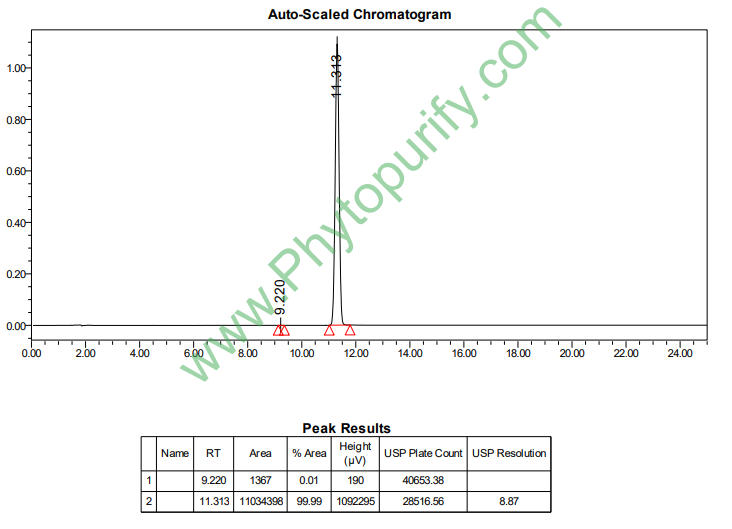
HPLC of Atractylenolide II
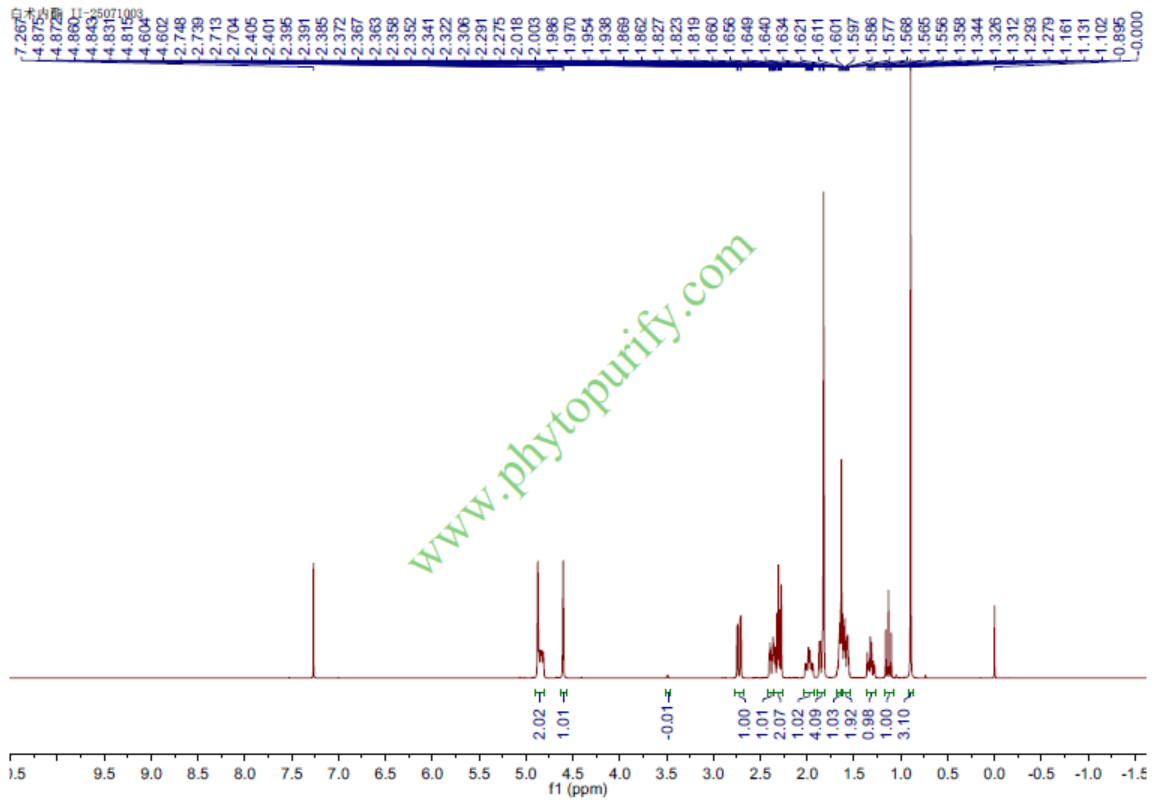
HNMR of Atractylenolide II
Storage conditions:Short-term storage at 2~8℃, long-term storage at -20 ~ -80℃
26.3000
3.4707
3.4707
.0511
7.7637
20.3369
High
76.0495
4.2270
No
Yes
No
No
Yes
No
0.0
Yes
No
Yes
No
Natural products, as an important source of drug discovery, play an irreplaceable role in the history of human disease prevention and treatment. Among them, sesquiterpenes have always been a hot topic in medicinal chemistry and pharmacology research due to their structural diversity and wide range of biological activities. Atractylenolide II, as a traditional Chinese medicine derived from Atractylodes macrocephala(Atractylodes macrocephala The sesquiterpene lactones isolated from Koidz. have attracted much attention in recent years due to their significant anti-tumor, anti-inflammatory, antioxidant, and organ protective pharmacological activities. Its CAS number is 73069-14-4, and its molecular formula is C15H20O2.
Traditionally, Atractylodes macrocephala has been used to invigorate the spleen, invigorate qi, dry dampness, and promote diuresis. Modern research has gradually revealed the scientific connotation of its active ingredients. As one of its main active ingredients, early research on Atractylodes macrocephala II mainly focused on its anti-inflammatory and gastrointestinal regulatory effects. However, with the deepening of research, especially the discovery that it exerts anti melanoma effects by inhibiting the signal transduction and transcription activation factor 3 (STAT3) pathway, it marks that its research focus has shifted to the field of cancer treatment. In addition, its potential in improving myocardial fibrosis, combating oxidative stress, and neuroprotection has opened up new perspectives for its application in cardiovascular and neurological diseases. This article aims to systematically review the chemical properties, pharmacological activity, mechanism of action, drug properties, and clinical application prospects of Atractylodes macrocephala II, in order to provide comprehensive academic references for the in-depth research and development of this compound.
Atractylodes macrocephala II belongs to the eucalyptol type sesquiterpene lactone, characterized by a fused structure of a decahydronaphthalene skeleton and a pentagonal lactone ring (α, β - unsaturated γ - lactone). This unique structure is the material basis for its biological activity. Its molecular weight is 232.3230, which is relatively small and conducive to its penetration through the cell membrane.
In terms of physicochemical properties, the calculated lipid water partition coefficient (LogP) is 3.4707, indicating that the compound has moderate lipophilicity, which is consistent with its ability to effectively penetrate biofilms. The topologically polar surface area (TPSA) is 26.3000 Å ², which is a relatively low value, further indicating its good membrane permeability. The water solubility parameter shows 0.0511, which belongs to slightly soluble or poorly soluble in water, which is in line with the characteristics of most sesquiterpene lactones and is also a key factor to consider in their formulation development. It is worth noting that its blood-brain barrier (BBB) penetration is predicted to be "high", which provides an important pharmacokinetic basis for its central nervous system protective effect. In addition, preliminary pharmacological risk assessment shows that the hERG inhibition risk is "no", and the Ames test result is 0.0 (negative), indicating that its potential risk of arrhythmia and genetic toxicity is low and has a good safety starting point.
Atractylodes macrocephala II is mainly derived from the Asteraceae plant Atractylodes macrocephala(Atractylodes macrocephala Dry rhizomes of Koidz. As one of the famous "Eight Flavors of Zhejiang", Baizhu is mainly produced in Zhejiang, Hunan, Anhui and other places in China. In addition to Atractylodin II, this plant also contains various active ingredients such as Atractylodin I, III, and Atractylodin, which together form the basis of its multifunctional pharmacological effects.
The extraction of Atractylodes macrocephala II is usually carried out using organic solvent extraction method. The common process includes: reflux extraction of Atractylodes macrocephala root powder with ethanol or methanol, concentration to obtain a paste; The extract was then subjected to gradient extraction using solvents such as petroleum ether and ethyl acetate, with Atractylodes macrocephala II mainly enriched in the ethyl acetate fraction. Subsequently, high-purity Atractylodes macrocephala II can be obtained through chromatographic techniques such as silica gel column chromatography and preparative high-performance liquid chromatography (HPLC). In recent years, modern technologies such as supercritical CO2 extraction and microwave-assisted extraction have also been applied in its extraction process to improve extraction efficiency and target product yield. The optimization of extraction process is crucial for ensuring stable supply of compounds and subsequent research.
A large number of pharmacological studies both in vitro and in vivo have shown that Atractylodes macrocephala II has broad and significant biological activities.
1. Antitumor activity: This is currently the most extensively researched field. Research has shown that Atractylodes macrocephala II has inhibitory effects on proliferation and induces apoptosis in various tumor cells. Of particular note is its potent activity against B16 melanoma cells, which can induce cell cycle arrest in the G1 phase and activate the apoptotic pathway. Animal experiments have confirmed that orally administered Atractylodes macrocephala II can significantly inhibit the growth of melanoma in mice with low toxicity, indicating that it is a promising oral anti-cancer candidate drug. In addition, its inhibitory effects on cell lines such as gastric cancer, liver cancer, and lung cancer have also been reported.
2. Anti fibrotic and organ protective activity: In terms of cardiovascular system, Atractylodes macrocephala II can significantly improve isoproterenol or angiotensin II induced myocardial fibrosis models, reduce myocardial collagen deposition, and protect cardiac function. In liver disease models, it shows potential for anti liver fibrosis. These effects are closely related to their anti-inflammatory and antioxidant properties.
3. Antioxidant stress and neuroprotective activity: With its high blood-brain barrier penetration ability, Atractylodes macrocephala II has shown promising application prospects in neurological disease models. Research has shown that it can alleviate neuronal oxidative damage and apoptosis induced by β - amyloid protein, and has a protective effect in Alzheimer's disease cell models. Its antioxidant mechanism involves activating the cell's own defense system.
4. Anti inflammatory and immune regulatory activity: As a component of traditional anti-inflammatory Chinese medicine, Atractylodes macrocephala II can inhibit the excessive production of inflammatory factors (such as TNF - α, IL-6) in macrophages stimulated by lipopolysaccharides and other factors. Its anti-inflammatory effect is one of the important foundations for improving fibrosis and protecting organs.
The multiple pharmacological effects of Atractylodes macrocephala II stem from its regulation of multiple key signaling pathways and molecular targets. Its mechanism of action is complex and interconnected.
1. Inhibition of STAT3 signaling pathway: This is the core mechanism of its anti-tumor (especially anti melanoma) effect. STAT3 is an important oncogenic transcription factor that is continuously activated in various tumors. Atractylodes macrocephala II can effectively inhibit the phosphorylation (activation) of STAT3, prevent its nuclear translocation and binding to DNA, thereby downregulating the expression of downstream target genes (such as Bcl-2, Cyclin D1, MMP-2, etc.), ultimately achieving the effects of inhibiting cell proliferation, inducing apoptosis, and suppressing invasion and metastasis.
2. Regulating the NF - κ B and MAPK pathways: During anti-inflammatory and anti fibrotic processes, Atractylodes macrocephala II can inhibit the activation of nuclear factor kappa B (NF - κ B) and reduce the release of pro-inflammatory factors. At the same time, it also regulates mitogen activated protein kinase pathways such as p38 MAPK and JNK, which are closely related to cellular stress, inflammation, and apoptosis.
3. Activate the Nrf2/ARE antioxidant pathway: Regarding its antioxidant stress activity, studies have shown that Atractylodes macrocephala II can promote the transfer of nuclear factor E2 related factor 2 (Nrf2) from the cytoplasm to the nucleus, activate antioxidant response elements (ARE), and thereby upregulate the expression of phase II detoxifying enzymes and antioxidant proteins such as heme oxygenase-1 (HO-1) and quinone oxidoreductase 1 (NQO1), enhancing the cell's antioxidant defense ability.
4. Affects specific disease-related targets: In studies related to fibrotic diseases such as cirrhosis, the role of Atractylodes macrocephala II involves multiple targets: inhibiting matrix metalloproteinase 2 (MMP2) and inflammatory mediators (such as TNF), regulating hypoxia inducible factor 1 alpha (HIF1A) and sex hormone binding globulin (SHBG) related metabolism, affecting the activity of 11 β - hydroxysteroid dehydrogenase 1 (HSD11B1), and possibly exerting protective effects by activating SIRT1 (deacetylase). The potential regulatory effect of epoxyeicosaenoic acid hydrolase (EPHX2) suggests that it may affect arachidonic acid metabolism and vascular function.
In summary, Atractylodes macrocephala II forms a synergistic pharmacological network through multi-target and multi pathway mechanisms, which is not only the basis for its multi effect therapeutic effects, but also in line with the characteristics of natural product effects.
Although preclinical studies have shown promising prospects, for Atractylodes macrocephala II to become a true drug, it still requires systematic pharmacological evaluation.
Pharmacokinetic (PK) characteristics: Existing limited animal pharmacokinetic studies have shown that Atractylodes macrocephala II can be absorbed into the systemic circulation after oral administration, but its absolute bioavailability, major metabolic pathways, metabolites, and their activities are not yet complete. Among them, equal LogP values and low TPSA are beneficial for oral absorption and distribution, especially in predicting high blood-brain barrier permeability, which is a significant advantage. However, its low water solubility may limit its dissolution rate in gastrointestinal fluids, thereby affecting absorption, which may be a key issue that needs to be addressed in its formulation development (such as making solid dispersions, cyclodextrin inclusion complexes, or nano formulations).
Drug metabolism and toxicity: The preliminary in vitro safety evaluation (such as hERG inhibition negative, Ames test negative) provides good early signals. However, comprehensive preclinical safety evaluations, including long-term toxicity, reproductive toxicity, carcinogenicity, and other studies, have not been systematically reported yet. As a lactone structure, its metabolic stability in vivo and whether it irreversibly binds to plasma proteins also need to be further studied.
Formulation development challenges: Developing solid or semi-solid dosage forms suitable for oral administration based on their physicochemical properties to improve their solubility and bioavailability is a necessary step in promoting their clinical translation. Preparing it into injectable liposomes or nanoparticles may also be used to explore its potential for intravenous administration in the treatment of malignant tumors.
The various pharmacological activities of Atractylodes macrocephala II provide possibilities for its application in multiple disease fields.
1. In the field of tumor treatment: As a STAT3 inhibitor, it has clear application prospects in tumors with abnormally active STAT3 signaling, such as melanoma, liver cancer, and gastric cancer. It can be considered as a single drug or in combination with existing chemotherapy drugs and immune checkpoint inhibitors to enhance efficacy and reduce drug resistance. Its oral efficacy is particularly suitable for chronic disease management.
2. Treatment of fibrotic diseases: For diseases such as myocardial fibrosis, liver fibrosis (pre cirrhosis state), and pulmonary fibrosis that currently lack specific drugs, the anti-inflammatory, antioxidant, and anti fibrotic effects of Atractylodes macrocephala II demonstrate unique advantages. It may become a new candidate drug for the prevention and treatment of organ fibrosis.
3. Neurodegenerative diseases: Its neuroprotective activity and high BBB penetration make it highly potential for the prevention and treatment of diseases such as Alzheimer's disease and Parkinson's disease, possibly by reducing oxidative stress and neuroinflammation to delay disease progression.
Future research direction outlook:
- In depth mechanism research: Using chemical biology methods such as affinity fishing and molecular probes to search for its direct target proteins and elucidate its precise initial mechanism of action.
- Structural optimization and derivative development: Using it as the parent nucleus, structural modification is carried out with the aim of improving water solubility, activity strength, or targeting selectivity, reducing potential toxicity, and obtaining derivatives with better drug properties.
- Preclinical development and translation: The system completes pharmacokinetic and toxicological studies that comply with the guidelines for preclinical research of new drugs, and conducts effective formulation studies.
- Explore combination therapy strategies: Evaluate its synergistic effect with standard treatment drugs in various disease models, providing a basis for future clinical combination therapy regimens.
As a sesquiterpene lactone derived from traditional Chinese medicine, Atractylodes macrocephala II exhibits remarkable pharmacological activities in anti-tumor, anti fibrosis, antioxidant stress, and neuroprotection due to its unique chemical structure and multi-target mechanism of action. The mechanism network of action is becoming increasingly clear, from inhibiting the STAT3 pathway to combat tumors, to activating the Nrf2 pathway to resist oxidative damage. Despite facing challenges such as low water solubility in drug development, its good initial safety and high blood-brain barrier penetration have laid a positive foundation for its subsequent development.
The current research has gradually progressed from simple activity validation to molecular mechanism exploration and preliminary translational studies. In the future, through interdisciplinary collaboration, based on elucidating its precise targets, optimizing its chemical structure, improving its pharmacokinetics and safety evaluation, and developing suitable clinical dosage forms, Atractylodes macrocephala II is expected to be successfully transformed from an excellent natural product molecule into an innovative drug for the treatment of major diseases such as tumors, fibrotic diseases, and neurodegenerative diseases, achieving a magnificent transformation from traditional medical wisdom to modern medical achievements, demonstrating the lasting vitality of natural products in drug development.
