Double Atractylodes macrocephala: Research progress from natural products to neuroprotective and anti-tumor candidate drugs
Introduction/Overview
Natural products, as an important source of drug discovery, play an irreplaceable role in the long history of human struggle against diseases. The treasure trove of traditional Chinese medicine contains abundant active natural products, including Atractylodes macrocephala(Atractylodes macrocephala Koidz., as an important traditional Chinese medicine for tonifying qi and strengthening spleen, has always been a hot topic in the fields of natural product chemistry and pharmacology in terms of its chemical composition and pharmacological activity research. Atractylodes macrocephala mainly contains various chemical components such as volatile oils, lactones, polysaccharides, amino acids, etc. Among them, lactone compounds of Atractylodes macrocephala have attracted much attention due to their significant biological activity. Biatractylolide, as a dimeric sesquiterpene lactone isolated from the ethyl acetate extract of Atractylodes macrocephala, has gradually become an important object of natural product pharmacology research since its first report due to its unique chemical structure and diverse pharmacological activities, especially anti-tumor, antioxidant, and neuroprotective effects.
The discovery of Shuangbaizhu lactone originated from the systematic isolation and identification of active ingredients in Atractylodes macrocephala. With the advancement of modern separation techniques and structural analysis methods, researchers have been able to accurately identify this compound with potential medicinal value from complex natural product mixtures. Preliminary studies have shown that resveratrol not only inhibits the proliferation of various tumor cells, but also exhibits a protective effect on nerve cells, providing a scientific basis for its application in tumor treatment and neurodegenerative disease intervention. However, as a natural product, the research on bisoprololide is still in its early stages, and its mechanism of action, pharmacokinetic properties, and clinical application potential still need to be further explored. This article aims to provide a systematic review of the chemical structure, physicochemical properties, plant sources, extraction methods, pharmacological activity, mechanism of action, pharmacological evaluation, and clinical application prospects of shuangtao lactone, in order to provide reference for further research and development of this compound.
Chemical structure and physicochemical properties
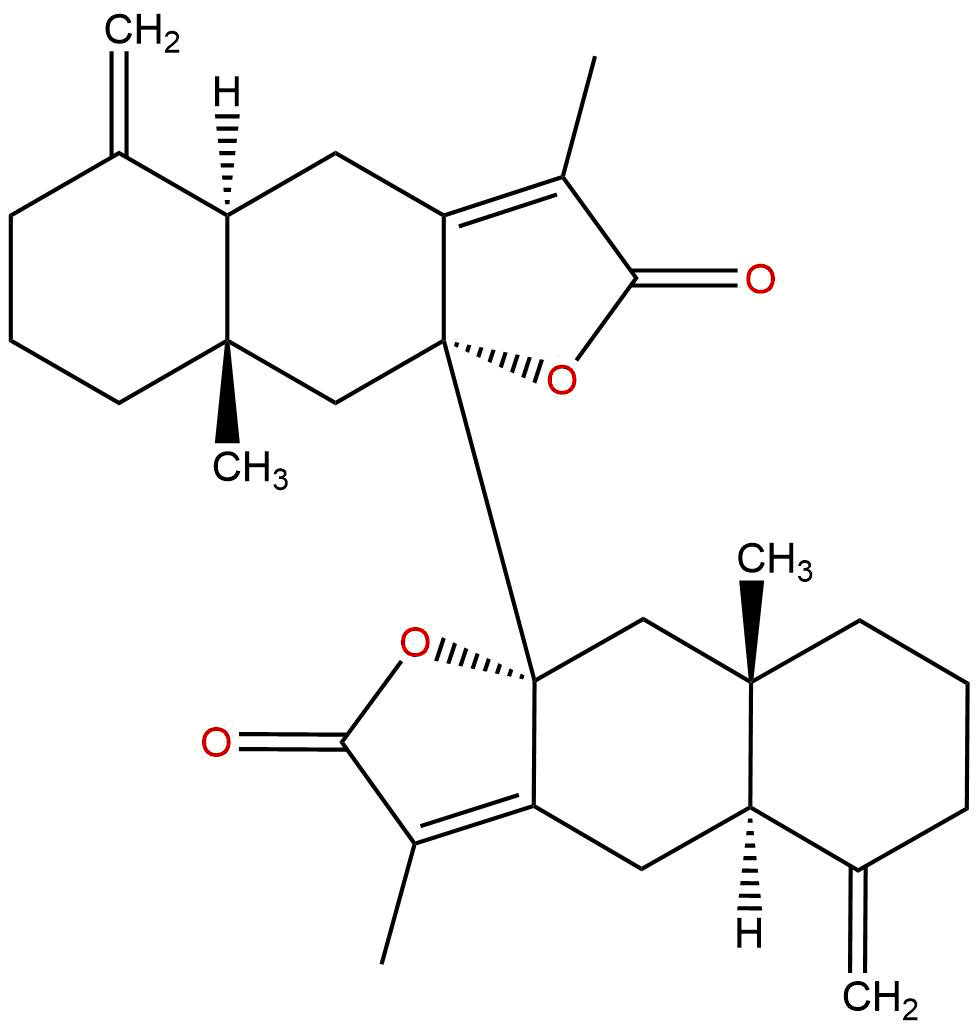
The chemical structure of Bis Bai Zhu lactone belongs to the class of dimeric sesquiterpene lactones, with a molecular formula of C ∝₀ H ∝₈ O ₄ and a molecular weight of 462.6300 g/mol. From a structural perspective, bisatractylodes lactone is composed of two sesquiterpene lactone units connected by specific carbon carbon bonds, giving it a unique spatial configuration and biological activity due to its dimerization structure. Specifically, the core skeleton of bisoprololide contains two gamma lactone rings, which are the key structural groups for its pharmacological activity. The presence of lactone rings enables the compound to interact with various targets in the body, such as binding to cysteine residues in proteins through Michael addition reactions, thereby regulating signal transduction pathways.
In terms of physical and chemical properties, bisatractylodes lactone exhibits typical lipid soluble compound characteristics. Its lipophilic water partition coefficient (LogP) is 6.2122, indicating that the compound has high lipophilicity, which is closely related to its molecular structure being rich in hydrophobic groups such as methyl and methylene. A high LogP value indicates that bisoprolol is easily able to penetrate biological membranes, including cell membranes and the blood-brain barrier, providing favorable conditions for its role in the central nervous system. In fact, the blood-brain barrier penetration assessment shows that bisoprolol has high blood-brain barrier penetration ability, suggesting that it may directly act on targets in the central nervous system and exert neuroprotective effects. However, the high lipophilicity also brings about the problem of poor water solubility. The water solubility of bisoprolol is only 0.0004 mg/mL, which severely limits its in vivo administration route and bioavailability. The topological polar surface area (TPSA) is 52.6000 Å ², which is at a moderate level, indicating that the compound has some exposed polar groups, but overall it is still predominantly hydrophobic.
It is worth noting that the hERG inhibition risk assessment of bisoprolol was negative, which reduces its potential risk of causing cardiac toxicity. In addition, the Ames test result was 0.0, indicating that the compound did not exhibit mutagenicity in the bacterial recovery mutation test, suggesting that its genetic toxicity is relatively low. These pharmacological parameters provide positive signals for the further development of bisoprolol, but the problem of poor water solubility remains a key obstacle to its clinical application.
Plant sources and extraction methods
The main plant source of shuangtao lactone is Atractylodes macrocephala in the Asteraceae family(Atractylodes macrocephala Koidz.)。 Atractylodes macrocephala originated in China and is mainly distributed in provinces such as Zhejiang, Anhui, Hunan, and Hubei. Among them, the Atractylodes macrocephala (commonly known as "Yu Shu") produced in the Yuqian area of Zhejiang has the best quality. The root and stem of Atractylodes macrocephala, when used as medicine, have the effects of invigorating the spleen and qi, drying dampness and promoting diuresis, stopping sweating and stabilizing pregnancy. It is one of the commonly used Qi tonifying medicines in traditional Chinese medicine clinical practice. Modern research has shown that Atractylodes macrocephala contains a variety of chemical components, including sesquiterpenoid lactones (such as Atractylodes macrocephala I, II, III, and Atractylodes macrocephala lactone), volatile oils (mainly composed of Atractylodes macrocephala ketone and Atractylodes macrocephala ketone), polysaccharides, amino acids, vitamins, and more. Among them, the content of Shuangbaizhu lactone is relatively low and belongs to trace active ingredients.
The extraction of lactone from Atractylodes macrocephala is usually carried out using organic solvent extraction method. Given the high lipophilicity of the compound, organic solvents with low polarity such as ethyl acetate, chloroform, dichloromethane, etc. are commonly used for extraction. The classic extraction process is as follows: first, dry and crush the rhizome of Atractylodes macrocephala, and then degrease it with petroleum ether or n-hexane to remove a large amount of fat soluble impurities; The defatted drug residue is then subjected to cold soaking or hot reflux extraction with ethyl acetate, and the ethyl acetate extract is collected; After vacuum concentration, ethyl acetate extract is obtained, which is rich in lactone compounds. Further separation and purification of Shuangbaizhulide requires the combination of various chromatographic technologies, such as silica gel column chromatography, ODS reverse phase column chromatography, Sephadex LH-20 gel column chromatography and preparative high performance liquid chromatography (Prep HPLC). In silica gel column chromatography, a petroleum ether ethyl acetate or chloroform methanol gradient elution system is commonly used, and the fraction containing bisoprolol is collected by monitoring with thin layer chromatography (TLC). Subsequently, further purification was carried out using ODS column chromatography in a methanol water system, and finally high-purity bis (2-ethylhexyl) butyrolactone monomer was obtained by preparative HPLC.
The extraction efficiency is influenced by various factors, including solvent type, extraction temperature, time, solid-liquid ratio, as well as the origin and harvesting period of Atractylodes macrocephala medicinal materials. Research has shown that when ethyl acetate is used as the extraction solvent, the extraction rate of bisatractylodes lactone is better than solvents with higher polarity such as ethanol and methanol. In addition, modern technologies such as ultrasound assisted extraction and microwave-assisted extraction can significantly shorten extraction time and improve yield. It is worth noting that the content of lactone in Atractylodes macrocephala is relatively low, usually only 0.01% to 0.05% of the weight of dried medicinal materials. Therefore, large-scale preparation requires a large amount of medicinal materials and complex separation and purification steps, which to some extent limits its research and development.
Pharmacological activity research
The pharmacological activity research of double atractylodes lactone mainly focuses on three aspects: anti-tumor, antioxidant, and neuroprotective. These activities are closely related to the lactone ring and lipophilic characteristics in its chemical structure.
Antitumor activity
Double white atractylodes lactone exhibits significant inhibitory effects on the proliferation of various tumor cell lines. In vitro experiments have shown that bisoprolol can inhibit the proliferation of gastric cancer cells (such as BGC-823, SGC-7901, etc.) and induce cell apoptosis. Its anti gastric cancer effect involves multiple molecular targets, including BCL2, STAT3, ABCB1, NFE2L2, TOP1, HIF1A, RELA, MAPK1, and CASP9. Specifically, resveratrol can downregulate the expression of anti apoptotic protein BCL2 and activate CASP9 (cysteine aspartic protease 9), initiating cell apoptosis through the mitochondrial pathway. In addition, the compound can also inhibit the phosphorylation of the STAT3 signaling pathway, thereby blocking the transcription of downstream target genes and inhibiting the growth and survival of tumor cells. ABCB1 (P-glycoprotein) is a key transporter protein mediating multidrug resistance in tumors, and the regulatory effect of bisoprolol on ABCB1 may help reverse drug resistance in tumor cells. NFE2L2 (Nrf2) is a key transcription factor for cellular antioxidant stress, and the regulation of its activity by resveratrol may affect the redox balance of tumor cells, thereby inhibiting tumor growth. TOP1 (Topoisomerase I) is an important target for anti-tumor drugs, and bisoprolol may interfere with DNA replication and transcription by inhibiting TOP1 activity. HIF1A (hypoxia inducible factor 1 alpha) plays a crucial role in tumor angiogenesis and metabolic reprogramming, and the regulation of HIF1A by bisoprolol may inhibit tumor invasion and metastasis. RELA (NF - κ B p65 subunit) is an important transcription factor in inflammation and tumorigenesis, and bisoprolol may exert anti-inflammatory and anti-tumor effects by inhibiting the NF - κ B signaling pathway. MAPK1 (ERK2) is a key member of the mitogen activated protein kinase pathway, and the regulation of its activity by resveratrol may affect cell proliferation and differentiation.
antioxidant activity
Double white atractylodes lactone exhibits significant antioxidant activity. Research has shown that the compound can scavenge free radicals such as DPPH free radicals and ABTS cationic free radicals, and inhibit lipid peroxidation. In cell models, bisoprolol can reduce reactive oxygen species (ROS) levels and protect cells from oxidative stress damage. Its antioxidant mechanism may be related to the phenolic hydroxyl or lactone ring in its molecular structure, which can provide hydrogen atoms or electrons, neutralize free radicals, and thus block oxidative chain reactions. In addition, resveratrol may also activate the Nrf2/ARE signaling pathway, upregulate the expression of antioxidant enzymes (such as superoxide dismutase (SOD), glutathione peroxidase (GPx), catalase (CAT), etc.), and enhance the antioxidant defense ability of cells.
Neuroprotective effect
The neuroprotective effect of bisoprololide is one of its most notable pharmacological activities. Research has found that resveratrol can increase the vitality of nerve cells (such as PC12 cells, primary hippocampal neurons, etc.), inhibit glutamate induced apoptosis, and reduce the release of lactate dehydrogenase (LDH). Glutamate is the main excitatory neurotransmitter in the central nervous system, but its excessive release can lead to excitotoxicity, which is a common pathological mechanism in various neurodegenerative diseases such as Alzheimer's disease, Parkinson's disease, cerebral ischemia, etc. Double Atractylodes macrocephala protects nerve cells from excitotoxic damage by inhibiting glutamate induced calcium influx, reducing ROS generation, maintaining mitochondrial membrane potential, and inhibiting CASP3 activation. In addition, bisoprololide may also promote neuronal survival and synaptic plasticity by regulating the expression of BDNF (brain-derived neurotrophic factor).
It is worth noting that the high blood-brain barrier penetration of bisoprolol provides a pharmacokinetic basis for its application in central nervous system diseases. This compound can effectively enter brain tissue and directly act on nerve cells, exerting a protective effect. This characteristic makes it potentially valuable in the treatment of neurodegenerative diseases such as cerebral ischemia, Alzheimer's disease, Parkinson's disease, etc.
Mechanism of action and molecular targets
The pharmacological activity of Shuangbaizhu lactone involves multiple molecular targets and signaling pathways, and its mechanism of action exhibits the characteristics of multi-target and multi pathway. The following elaborates on its mechanism of action from two aspects: anti-tumor and neuroprotective.
Mechanism of anti-tumor action
The anti-tumor mechanism of Shuangbaizhu lactone mainly involves the following aspects:
-
Inducing cell apoptosis Double white atractylodes lactone induces tumor cell apoptosis through mitochondrial and endoplasmic reticulum pathways. In the mitochondrial pathway, this compound downregulates the expression of anti apoptotic protein BCL2 and upregulates the expression of pro apoptotic protein BAX, leading to a decrease in mitochondrial membrane potential, release of cytochrome c into the cytoplasm, and activation of CASP9 and CASP3, ultimately triggering cell apoptosis. In the endoplasmic reticulum pathway, bisoprololide can induce endoplasmic reticulum stress, activate CASP12, and thus initiate the apoptotic program.
-
Inhibiting signal transduction pathways Double Atractylodes macrocephala can inhibit the activation of signaling pathways such as STAT3, NF - κ B, MAPK, etc. STAT3 is a transcription factor that is continuously activated in various tumors, promoting cell proliferation, survival, and angiogenesis. Double white atractylodes lactone inhibits the phosphorylation of STAT3, blocking its nuclear translocation and target gene transcription. NF - κ B is a key regulatory factor in inflammation and tumorigenesis, and bisoprolol can inhibit the phosphorylation and degradation of I κ B α, thereby preventing the activation of NF - κ B. The MAPK pathway (including ERK, JNK, p38) plays an important role in cell proliferation and differentiation, and the regulation of MAPK pathway by resveratrol may affect the growth of tumor cells.
-
Adjust the redox balance Double Atractylodes macrocephala activates the Nrf2/ARE pathway, upregulates the expression of antioxidant enzymes, and reduces the level of ROS in tumor cells. However, in some cases, bisoprolol may also induce oxidative stress in tumor cells by increasing ROS generation, thereby promoting apoptosis. This dual effect may depend on cell type and drug concentration.
-
Inhibiting multidrug resistance Double Atractylodes macrocephala can downregulate the expression of ABCB1 (P-glycoprotein), reduce drug efflux, and reverse multidrug resistance in tumor cells. In addition, the compound may also improve the tumor microenvironment and enhance the efficacy of chemotherapy drugs by inhibiting the expression of HIF1A.
Mechanism of neuroprotective effect
The neuroprotective mechanism of Shuang Bai Zhu lactone mainly involves the following aspects:
-
Inhibit excitotoxicity Overactivation of NMDA receptors by glutamate leads to a large influx of calcium ions, causing neuronal damage. Double Atractylodes macrocephala can inhibit glutamate induced calcium influx, reduce calcium overload, and thus protect neurons. In addition, the compound can also reduce glutamate induced ROS generation, inhibit lipid peroxidation and protein oxidative damage.
-
Maintain mitochondrial function Double Atractylodes macrocephala can stabilize mitochondrial membrane potential, inhibit the opening of mitochondrial permeability transition pore (mPTP), reduce the release of cytochrome c, and thus block mitochondrial pathway apoptosis. In addition, the compound can improve mitochondrial respiratory chain function, increase ATP production, and maintain energy metabolism.
-
Inhibit apoptotic signals Double Atractylodes macrocephala can inhibit the activation of CASP3, reduce DNA fragmentation, and thus inhibit neuronal apoptosis. In addition, the compound can upregulate the expression of anti apoptotic protein BCL2 and enhance the survival ability of neurons.
-
Regulating neurotrophic factors Double Atractylodes macrocephala may promote neuronal survival, differentiation, and synaptic plasticity by activating TrkB receptors or upregulating BDNF expression. BDNF is one of the most important neurotrophic factors in the central nervous system, playing a crucial role in learning and memory.
-
anti-inflammatory effect Neuroinflammation is an important pathological feature of neurodegenerative diseases. Double white atractylodes lactone can inhibit the activation of microglia, reduce the release of pro-inflammatory cytokines (such as TNF - α, IL-1 β, IL-6), and thus alleviate neuroinflammatory reactions.
Evaluation of drug properties and pharmacokinetics
The pharmacological evaluation of Shuangbaizhu lactone involves multiple aspects, including physicochemical properties, pharmacokinetic characteristics, safety, etc. Although the compound exhibits good pharmacological activity, its drug development still faces many challenges.
Physical and chemical properties and drug like properties
According to Lipinski's "Rule of Five," the molecular weight (462.63) of Atractylodes macrocephala is slightly greater than 500, the LogP (6.21) is greater than 5, and the number of hydrogen bond donors (possibly 0 or 1) and hydrogen bond acceptors (4) comply with the rules, but the molecular weight and LogP exceed the ideal range. This indicates that there are certain deficiencies in the class of drugs of Atractylodes macrocephala, especially high LogP values that may lead to poor water solubility, metabolic instability, and increased toxicity. TPSA (52.60 Å ²) is at a moderate level, indicating that the compound has some cell membrane penetration ability, but may not achieve ideal intestinal absorption efficiency.
Water solubility
The extremely low water solubility (0.0004 mg/mL) of bisoprolol is the biggest obstacle to its medicinal properties. Low water solubility not only limits the bioavailability of oral administration, but also increases the difficulty of formulation development. When administered intravenously, it is necessary to use solubilizers (such as cyclodextrin, surfactants, etc.) or liposomes to increase solubility. In addition, low water solubility may also lead to drug precipitation in the body, causing adverse reactions such as embolism.
Blood-brain barrier penetrability
Double Atractylodes macrocephala has high blood-brain barrier penetration, which is both an advantage and a challenge. The advantage is that the compound can directly act on targets in the central nervous system, exerting neuroprotective effects; The challenge lies in the high penetrability that may lead to central nervous system toxicity, such as dizziness, drowsiness, cognitive impairment, etc. Therefore, when developing bisoprolol as a neuroprotective drug, it is necessary to carefully evaluate its safety window.
Metabolic stability
A high LogP value usually indicates that the compound is easily metabolized by liver metabolic enzymes (such as CYP450 enzyme system), resulting in a short half-life and low bioavailability. There is still a lack of systematic research on the metabolic stability of lactone in Atractylodes macrocephala, but based on its structural characteristics, it is speculated that the lactone ring may be hydrolyzed by esterases, while the hydrophobic skeleton may be oxidized by CYP450 enzymes. Further research is needed to investigate the activity, toxicity, and species differences in metabolic pathways of metabolites.
safety
Preliminary safety assessment shows that the hERG inhibition risk of Bisoprolol is negative, and the Ames test result is negative, indicating low cardiac and genetic toxicity. However, these data are only based on in vitro experiments, and the in vivo safety (such as acute toxicity, chronic toxicity, reproductive toxicity, carcinogenicity, etc.) still needs to be comprehensively evaluated. In addition, high LogP values may lead to drug accumulation in adipose tissue, causing long-term toxicity.
pharmacokinetics
The pharmacokinetic study of bisoprolol is still in its infancy. Based on its physicochemical properties, it is speculated that after oral administration, the absorption of this compound may be poor and its bioavailability may be low. After intravenous administration, the drug may rapidly distribute to fat rich tissues such as the brain and adipose tissue, and slowly disappear. Metabolism may mainly be carried out through the liver CYP450 enzyme system and esterase, and metabolites may be excreted through bile or urine. The specific pharmacokinetic parameters (such as half-life, clearance rate, distribution volume, etc.) need to be experimentally determined.
Formulation strategy
Multiple formulation strategies can be used to improve the bioavailability of Shuang Bai Zhu lactone due to its poor water solubility. For example, preparing cyclodextrin inclusion complexes, liposomes, nanoparticles, solid dispersions, etc. Cyclodextrin inclusion complexes can enhance the apparent solubility of drugs, liposomes and nanoparticles can improve the targeting and sustained-release properties of drugs, and solid dispersions can increase the dissolution rate of drugs. In addition, prodrug design is also an effective strategy, which improves water solubility by introducing water-soluble groups (such as phosphate esters, amino acids, etc.) and releases the active drug through enzymatic or chemical hydrolysis in vivo.
Clinical application prospects and prospects
Double Atractylodes macrocephala, as a natural product with multi-target activity, has shown broad application prospects in the fields of anti-tumor and neuroprotection. However, its transformation from laboratory research to clinical application still faces many challenges.
Prospects of anti-tumor applications
Double white atractylodes lactone has inhibitory effects on various tumor cells such as gastric cancer, and can reverse multidrug resistance, which makes it potentially valuable in tumor treatment. However, its low water solubility and high LogP value limit in vivo administration. Future research should focus on developing efficient formulation strategies, improving bioavailability, and conducting in vivo anti-tumor activity studies, including xenograft tumor models and in situ tumor models. In addition, the combination therapy of Atractylodes macrocephala with other chemotherapy drugs (such as cisplatin, paclitaxel, 5-fluorouracil, etc.) is worth exploring in order to achieve synergistic and attenuated effects. Given its regulatory effect on ABCB1, bisoprolol can be used as a multidrug resistance reversal agent in combination with chemotherapy drugs to enhance the therapeutic efficacy of drug-resistant tumors.
Prospects of neuroprotective applications
The neuroprotective effect and high blood-brain barrier penetration of Bisoprolol give it unique advantages in the treatment of neurodegenerative diseases such as cerebral ischemia, Alzheimer's disease, and Parkinson's disease. During the acute phase of cerebral ischemia, glutamate excitotoxicity is the main cause of neuronal damage. Bisoprolol can inhibit glutamate induced apoptosis, reduce LDH release, and is expected to become a candidate drug for the treatment of cerebral ischemia. In Alzheimer's disease, the deposition of β - amyloid protein (A β) and excessive phosphorylation of tau protein lead to neuronal damage, and the antioxidant and anti apoptotic effects of resveratrol may delay disease progression. In Parkinson's disease, degeneration and death of dopaminergic neurons are the core pathological features, and resveratrol may improve motor symptoms by protecting dopaminergic neurons. However, neurodegenerative diseases usually require long-term medication, and the chronic toxicity and metabolic stability of bisoprolol need to be evaluated with emphasis.
Structural modification and structure-activity relationship
The chemical structure of shuangtao lactone provides multiple possibilities for structural modification. Water solubility can be improved by introducing water-soluble functional groups such as hydroxyl, carboxyl, phosphate groups, etc; By modifying the lactone ring, its interaction with the target can be regulated; By changing the dimerization mode, new active compounds can be explored. The study of structure-activity relationship helps to clarify the pharmacophores of bis (atractylodes) lactone and provides guidance for designing better derivatives. For example, the lactone ring may be a key functional group for anti-tumor activity, while the hydrophobic skeleton may determine its blood-brain barrier penetration.
Multi target drug development
The multi-target properties of Bisoprolol are in line with the concept of "multi-target therapy" in modern drug development. In tumor treatment, simultaneous action on multiple targets such as BCL2, STAT3, NF - κ B, MAPK, etc. can improve treatment efficacy and reduce drug resistance. In neuroprotection, simultaneous inhibition of excitotoxicity, oxidative stress, apoptosis, and inflammation can comprehensively protect neurons. However, multi-target drugs also face the risks of insufficient selectivity and off target toxicity. Therefore, it is necessary to systematically evaluate the target spectrum and selectivity of bisoprolol to ensure the safety of its therapeutic window.
Challenges and Prospects
The main challenges faced by the clinical translation of bisoprolol include bioavailability issues caused by low water solubility, metabolic instability and potential toxicity caused by high LogP values, lack of systematic pharmacokinetic and toxicological data, and supply limitations from natural product sources. Future research directions should include: developing efficient synthetic or semi synthetic methods to address raw material supply issues; Design reasonable formulation strategies to improve bioavailability; Conduct comprehensive pharmacokinetic and toxicological studies to evaluate their safety and efficacy; Using modern molecular biology techniques such as genomics, network pharmacology, molecular docking, etc. to further elucidate its mechanism of action; Explore its synergistic effects with other drugs and optimize treatment plans.
Conclusion
As a dimeric sesquiterpenoid lactone compound isolated from Atractylodes macrocephala, the unique chemical structure and diverse pharmacological activities of its derivatives have attracted widespread attention. This compound exerts anti-tumor, antioxidant, and neuroprotective effects by regulating multiple molecular targets such as BCL2, STAT3, NF - κ B, MAPK, and Nrf2. Its high blood-brain barrier penetration provides a pharmacokinetic basis for the treatment of central nervous system diseases, while low water solubility and high LogP value are the main obstacles to its drug development. Although the research on bisoprololide is still in its early stages, its potential in the fields of anti-tumor and neuroprotection cannot be ignored. Future research should focus on addressing issues such as poor water solubility and metabolic instability in drug formation, thoroughly elucidating their mechanisms of action, and conducting systematic in vivo pharmacological and toxicological evaluations. With the development of formulation technology and structural modification strategies, bisoprolol is expected to become a new candidate drug for the treatment of gastric cancer and neurodegenerative diseases, providing a new paradigm for the development of natural product drugs.