


Synonym name: Tenacissimoside A
Catalogue No.: BP1371
Cas No.: 191729-43-8
Formula: C42H64O14
Mol Weight: 792.96
Botanical Source: Marsdenia tenacissima
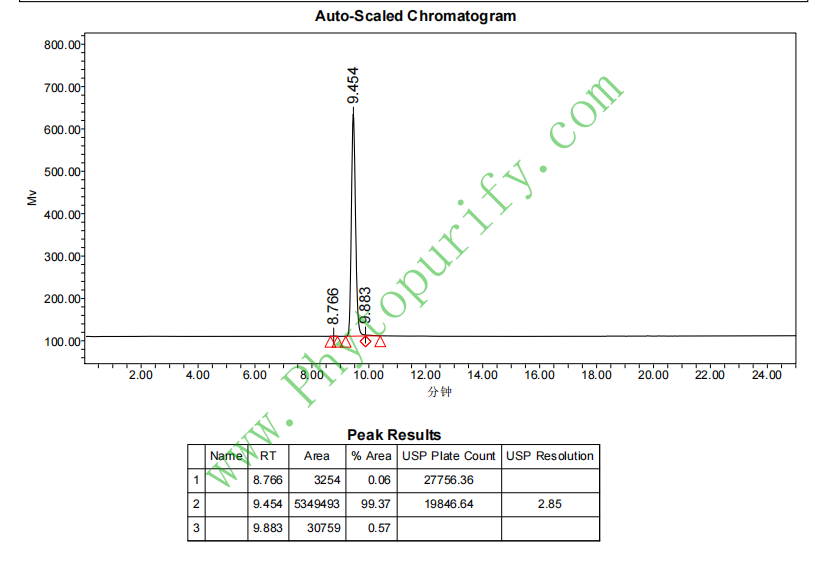
Purity: 95%~99%
Analysis Method: HPLC-DAD or/and HPLC-ELSD
Identification Method: Mass, NMR
Packing: Brown vial or HDPE plastic bottle
Can be supplied from milligrams to grams.
For Reference Standard and R&D, Not for Human Use Directly.
Inquire for bulk scale.
HPLC of Tenacissoside G
Storage conditions:Short-term storage at 2~8℃, long-term storage at -20 ~ -80℃
Tenacissoside G is a C21 steroid natural product derived from the stem of the Chinese medicinal herb Marsdenia tenacissima. In recent years, with the increasingly prominent issue of tumor drug resistance, research on the mechanism of multidrug resistance (MDR) has become a hot topic in the development of anti-tumor drugs. Guanguan Vine Glycoside G has shown significant anti-tumor potential due to its ability to reverse multidrug resistance caused by overexpression of P-glycoprotein (Pgp), making it a key target in the field of natural product anti-cancer research. This article will provide a systematic review of the chemical structure and physicochemical properties, plant sources and extraction methods, pharmacological activity and mechanism of action, pharmacological evaluation and pharmacokinetic characteristics of Guantongteng G, combined with its clinical application prospects, aiming to provide theoretical basis and research direction for the further development and application of this compound.
Guanguan Tengzhi G is a typical C21 steroidal saponin with a molecular formula of C42H66O15 and a molecular weight of 792.96. Its structural core is the steroid skeleton, which contains multiple hydroxyl and sugar modifications, endowing it with high polarity and biological activity. The steroid moiety in the chemical structure provides the spatial configuration basis for its interaction with cell membrane receptors and related proteins, while the glycoside moiety affects its water solubility and pharmacokinetic properties.
In terms of physical and chemical properties, the LogP value of Guantongteng G is 3.0958, indicating that it has moderate lipid solubility and is conducive to membrane penetration. The polar surface area (TPSA) is 178.04 Å ², indicating high molecular polarity and low water solubility (0.0217 mg/mL), which may limit its oral absorption efficiency. This compound is not easily able to pass through the blood-brain barrier, reducing the risk of central nervous system toxicity. The hERG channel inhibition experiment showed a negative result, indicating a low risk of cardiac toxicity. The Ames mutagenicity test result is 0.0, indicating that its genotoxicity risk is relatively low and has a good safety basis.
Guanguan Vine Glycoside G mainly comes from the stem of the Chinese medicinal herb Marsdenia tenacissima. Tongguan Vine is a plant of the Apocynaceae family, widely distributed in southern China and Southeast Asia. In traditional Chinese medicine, it is used to treat diseases such as asthma, rheumatism, and tumors. Its stem is rich in various C21 steroidal saponins, among which Guantongteng G is one of the important active ingredients.
The extraction process usually uses dried rattan stems as raw materials, and uses ethanol or methanol for reflux extraction. Then, separation and purification are carried out through liquid-liquid distribution, column chromatography (such as silica gel column, reverse phase C18 column), and high performance liquid chromatography (HPLC) techniques. In recent years, the application of ultrasound assisted extraction and microwave-assisted extraction technologies has improved extraction efficiency and purity. The purified Guantongteng G was structurally identified by nuclear magnetic resonance (NMR), mass spectrometry (MS), and infrared spectroscopy (IR) to ensure its chemical purity and structural accuracy.
Guanguan Tengzhi G has shown significant anti proliferative effects in various tumor cell lines, especially in reversing the effects on multidrug-resistant tumor cells. It mainly inhibits the overexpression of P-glycoprotein, reduces the resistance of tumor cells to various chemotherapy drugs, and enhances the cytotoxic effect of chemotherapy drugs. This characteristic has attracted much attention for its potential application in combination chemotherapy.
P-glycoprotein, as an important member of the ABC transporter family, can pump multiple drugs out of cells through energy dependence, leading to tumor cells developing resistance to multiple drugs. Guantongteng G can inhibit the expression and function of Pgp, block drug efflux, and restore cell sensitivity to chemotherapy drugs. In vitro experiments showed that after treatment with Guantongteng G, the expression of Pgp in drug-resistant cell lines significantly decreased, the intracellular drug concentration increased, and the apoptosis rate increased.
In addition to its anti-tumor activity, Guantongteng G also exhibits the ability to regulate apoptosis related proteins, inhibit tumor cell migration and invasion. Its inhibitory effect on MMP2 (matrix metalloproteinase 2) helps to block tumor cell matrix degradation and reduce metastatic potential. In addition, Tongguan Tengzhi G also has a regulatory effect on tumor related signaling pathways such as STAT3 and MAPK1, further enhancing its anti-tumor effect.
The anti-tumor mechanism of Tongguan Tengzhi G involves synergistic regulation of multiple targets and pathways, mainly including:
P-glycoprotein (Pgp) inhibition By downregulating Pgp expression and inhibiting its drug efflux function, we can reverse the multidrug resistance of tumor cells and enhance the intracellular accumulation of chemotherapy drugs.
Regulating apoptosis related proteins Guanguan Tengzhi G can downregulate the expression of anti apoptotic proteins MCL1 and BCL2, promoting tumor cell apoptosis. By activating the mitochondrial pathway, inducing cytochrome C release and caspase cascade reaction, promoting programmed cell death.
Inhibiting signal transduction pathways Guantongteng G inhibits the STAT3 and MAPK1 signaling pathways, blocking tumor cell proliferation and survival signals. STAT3, as a transcription factor, regulates the expression of various tumor promoting genes, and its inhibition helps to suppress tumor growth and metastasis.
Inhibit tumor invasion and metastasis By inhibiting MMP2 activity, reducing tumor cell matrix degradation, and blocking tumor cell migration and invasion processes. In addition, the regulation of HIF1A by Tongguan Tengzhi G helps to inhibit tumor hypoxia adaptation, reduce tumor drug resistance and metastasis ability.
Affects the activity of nucleic acid related enzymes Guantongteng G has a certain inhibitory effect on topoisomerase I (TOP1) and topoisomerase II α (TOP2A), blocking DNA replication and transcription processes, and inhibiting tumor cell proliferation.
Regulating hormone receptor related targets The regulation of estrogen receptor (ESR1) and aromatase (CYP19A1) suggests their potential application value in hormone dependent tumors.
In summary, Tongguan Tengzhi G exerts its anti-tumor and multidrug resistance reversal effects through multi-target and multi pathway synergistic effects, providing a solid molecular basis for its use as an anticancer adjuvant drug.
The pharmacological evaluation of Guanguan Tengzhi G shows that it has ideal safety and drug compatibility. Its LogP value is moderate, indicating that it has a certain degree of lipid solubility, which is beneficial for cell membrane penetration. However, its high polar surface area and low water solubility may limit its oral bioavailability. Low blood-brain barrier permeability reduces the risk of central nervous system side effects. The hERG channel has no inhibitory effect and reduces the risk of cardiac toxicity. The Ames test showed negative results and no significant genotoxicity.
In terms of pharmacokinetics, existing studies have shown that the metabolism of Guantongteng G is relatively stable in vivo, mainly processed by the liver metabolic enzyme system, and the metabolites need further identification. Its plasma protein binding rate is high, the half-life is moderate, and it is suitable for multiple administrations. Due to its low water solubility and limited oral absorption, the bioavailability can be improved in the future through formulation modifications such as nanocarriers and liposome encapsulation.
Guanguan Tengzhi G, as a natural source of multidrug resistance reversal agent, has broad clinical application prospects. Its significant effect in reversing Pgp mediated multidrug resistance makes it an ideal candidate for chemotherapy adjuvant therapy. The combination of traditional chemotherapy drugs is expected to improve the efficacy of tumor treatment and delay or overcome the development of drug resistance.
Future research should further conduct preclinical pharmacological and toxicological evaluations of Guantongteng G, clarifying its safe dosage range and potential side effects. Clinical trial design should focus on the efficacy and tolerability of combination therapy in patients with multidrug-resistant tumors. The optimization of formulation technology and innovation in drug delivery routes will also be key to enhancing its clinical application value.
In addition, the regulation of various tumor related targets by Guantongteng G suggests its potential applicability in various tumor types, and its mechanism of action in hormone dependent tumors, metastatic tumors, and tumor microenvironment regulation can be explored in the future. Combining modern molecular targeted therapy and immunotherapy strategies, Guantongteng G is expected to become an important component of natural product anti-tumor therapy.
As a representative C21 steroidal saponin in Marsdenia tenacissima, Guanguan Tengzhi G exhibits significant potential for reversing multidrug resistance due to its unique chemical structure and multi-target anti-tumor activity. Its mechanism of action covers multiple aspects such as Pgp inhibition, apoptosis regulation, signaling pathway intervention, and tumor invasion inhibition, providing new ideas for the development of anti-tumor drugs. Despite certain limitations in its water solubility and oral bioavailability, its good safety and drug efficacy evaluation have laid the foundation for its clinical application. In the future, combining pharmacokinetic optimization and clinical research, Guantongteng G is expected to become an important natural drug in the field of anti-tumor therapy, providing effective strategies for overcoming multidrug resistance in tumors.
