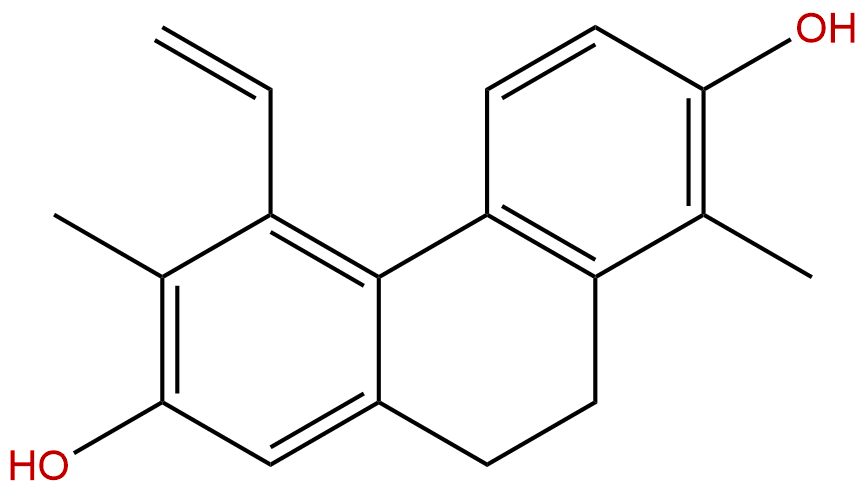
Juncusol: a potential multi-target natural drug molecule derived from Juncusol
1. Overview
Juncusol, a naturally occurring phenanthrene with a unique chemical structure, is gradually transitioning from traditional medicinal plants to the stage of modern pharmaceutical research. Its CAS number is 62023-90-9, molecular formula is C18H18O2, and molecular weight is approximately 266.34 g/mol. This compound was initially isolated from plants of the Lampplant genus, particularly Juncus effusus And its closely related species such as Juncus setchuenensis Lampweed is widely distributed in aquatic or wetland environments in many regions around the world. In the traditional medical system of East Asia, especially in traditional Chinese medicine, its dried stem and marrow (medicinal material name "Lampweed") have a long history of application and are commonly used for clearing heat, promoting diuresis, and calming the mind.
Modern pharmacological research provides scientific annotations for this traditional application. Preliminary research suggests that coumarin exhibits noteworthy properties Antianxiety and Sedative Activities In animal models, doses as low as 10 mg/kg can produce significant anti anxiety effects. Its mechanism of action is related to regulating the metabolic levels of key neurotransmitters in the central nervous system, such as serotonin (5-HT) and dopamine (DA), suggesting that it may exert a stabilizing effect by affecting the monoaminergic nervous system. In addition, the study also revealed its broader spectrum of biological activity, including Antibacterial activity(Especially showing significant inhibitory effects on methicillin-resistant Staphylococcus aureus MRSA) and inducing cell apoptosis (via caspase-3 pathway) cytotoxicity. These diverse activities suggest that coumarin may be a "versatile" molecule that acts on multiple molecular targets. This article will provide a systematic and professional interpretation of this promising natural compound from its chemical essence, sources, pharmacological mechanisms, potential as a drug, and future prospects.
2. Chemical structure and physicochemical properties
The chemical structure of Lampweed Phenol belongs to Derivatives of Phenanthrene From its SMILES expression (C=Cc1c (C) c (O) cc2c1-c1cc (O) c (C) c1CC2), it can be inferred that its core is a phenanthrene skeleton, with methyl (- CH3), hydroxyl (- OH), and a vinyl (- CH=CH2) substituent connected at specific positions. The unique physicochemical properties and biological activity of polycyclic aromatic hydrocarbons are determined by their skeleton and specific substitution patterns.
The key physicochemical parameters related to drug properties provide a quantitative basis for evaluating their 'drug like' properties:
- Molecular weight (MW):266.34 g/mol, Far below the upper limit of 500 Da for conventional oral medications, it meets the basic requirements for small molecule drugs.
- Lipid water partition coefficient (LogP/LogD)The LogP value is approximately 4.59, and the LogD value is similar (4.58). This indicates that cordycepin has Strong lipophilicity A higher LogP value is usually beneficial for compounds to penetrate cell membranes, but it may also lead to poor water solubility.
- Water solubility The calculated value is extremely low, about 0.0131 mg/mL, confirming its hydrophobic properties, which may pose a challenge in formulation development.
- Topological Polarity Surface Area (TPSA)40.46 Å ², which is relatively small and mainly due to the contribution of two phenolic hydroxyl groups. Lower TPSA is usually associated with better membrane permeability.
- Membrane permeability performance The predicted value (Peff) of Caco-2 cell permeability model is 5.72 cm/s × 10 ⁻⁴, which belongs to moderate permeability. Its Caco-2 apparent permeability coefficient (Papp) prediction value is as high as 13.99 × 10 ⁻⁶ cm/s, further supporting its good intestinal absorption potential. More noteworthy is that it The blood-brain barrier (BBB) penetration is predicted to be 'high'This is highly consistent with its observed central nervous system activity (anti anxiety, sedation) in theory, indicating that it can effectively enter the brain and act on relevant targets.
- Plasma protein binding rate (PPB)As high as 91.76%, it means that the vast majority of compounds in the blood bind to plasma proteins (mainly albumin), with only a small amount of free drugs exerting pharmacological effects. This will affect its internal distribution, onset speed, and dosage requirements.
3. Plant sources and traditional applications
The natural sources of Lampweed Phenol are mainly Juncaceae family, Juncus genus A variety of plants. among which,Lampweed (Juncus effusus L.)It is the most common and important source. This is a perennial herbaceous plant that often grows in wetlands, riverbanks, and pond edges. Its stem is upright, slender, and filled with white pith, making it easy to identify.
In the treasure trove of traditional Chinese medicine, the dried stem marrow of Lampherb has been used as "Lampherb" or "Cordyceps" in medicine for thousands of years. It has a sweet and mild taste, slightly cold, and is suitable for the heart, lungs, and small intestine meridians. The traditional benefits mainly include:
1. Clearing the heart and reducing internal heat, diuresis and promoting lymphatic circulation Used for restlessness, insomnia, mouth and tongue sores caused by excessive heart fire, as well as urinary discomfort, dribbling pain caused by dampness and heat. This is potentially associated with the potential antibacterial (against urinary tract infection pathogens) and sedative effects revealed by modern research.
2. Calm down and calm down Used for children's night crying and seizures. This description is consistent with the modern pharmacological performance of cordycepin Anti anxiety and sedative activity Coincidentally, it reflects the wonderful resonance between traditional experience and modern science.
Traditionally, Lampherb is often combined with medicinal herbs such as light bamboo leaves, wood logs, and raw earth, and used in classic prescriptions such as Daochi San. Its usage is mostly oral decoction or topical grinding. As one of the active ingredients in this medicinal herb, Lampweed Phenol is likely to be the material basis for some of its traditional therapeutic effects. From the traditional concept of "clearing the heart fire and calming the mind" to the modern concept of "anti anxiety and regulating neurotransmitters", the research on cordyceps provides a vivid example for the modernization of traditional Chinese medicine and the development of natural medicines.
4. Pharmacological activity and mechanism of action
The pharmacological activity of Lampweed Phenol exhibits multi-target and multi effect characteristics, mainly covering the fields of nervous system, antibacterial and anti-tumor.
1. Central nervous system activity: anti anxiety and sedation
This is one of the most highly anticipated activities of cordycepin. Research has shown that intraperitoneal injection of 10 mg/kg dose of cordyceps can significantly reduce anxiety like behavior in mice during elevated maze and dark box experiments, with effects similar to the classic anti anxiety drug diazepam. Research on its mechanism of action suggests that coumarin can cause Changes in serotonin (5-HT) and dopamine (DA) metabolism levels in mouse cerebral cortex Specifically, it may regulate neural circuits related to emotions and stress by affecting the synthesis, release, reuptake, or metabolism of monoamine neurotransmitters, resulting in anti anxiety and sedative effects. Its excellent predictive BBB penetration ability provides a pharmacokinetic basis for its pivotal role.
2. Antibacterial activity
Lampweed phenol has inhibitory effects on various bacteria, especially on Methicillin resistant Staphylococcus aureus (MRSA) Showing significant activity. MRSA is a clinically challenging multidrug-resistant bacterium that often causes severe skin, soft tissue, and bloodstream infections. Its antibacterial mechanism may be related to its interference with key life processes of bacteria. The potential targets suggested by the database provide clues for this:
- DNA gyrase (GYRA, GYRB)This is a type II topoisomerase necessary for bacterial DNA replication, transcription, and repair. Many quinolone antibiotics, such as ciprofloxacin, target this enzyme. Lampweed phenol may inhibit bacterial proliferation by suppressing the activity of DNA gyrase, preventing the unwinding of bacterial DNA supercoiled structures.
- Dihydrofolate reductase (DHFR) and dihydrobutterfly acid synthase (FOLA)These two are key enzymes in the bacterial folate synthesis pathway. Folic acid is essential for the synthesis of purines and pyrimidines. Antibiotics such as trimethoprim (TMP) target DHFR. Lampweed phenol may block bacterial nucleic acid synthesis by inhibiting these enzymes.
These target information collectively point to the possible interference of cordycepin with bacteria Nucleic acid metabolism The DNA topology and nucleotide synthesis exert antibacterial effects, providing the possibility of multi-target attacks against drug-resistant bacteria.
3. Cytotoxicity and potential anti-tumor activity
Research has shown that resveratrol can induce the development of HT22 cells derived from mouse hippocampal neurons Caspase-3 mediated cell apoptosis Caspase-3 is a key protease in the execution stage of cell apoptosis, and its activation marks the irreversible process of apoptosis. This indicates that Lampyridamole may have selective toxicity to certain types of cells or trigger apoptotic pathways under certain conditions. The database also suggests an important cancer target:
- ERBB2(HER2)This is a member of the epidermal growth factor receptor (EGFR) family, which is overexpressed or mutated in a variety of cancers (such as breast cancer and gastric cancer), and is closely related to tumor proliferation, invasion and poor prognosis. Monoclonal antibodies (trastuzumab) and small molecule inhibitors targeting HER2 have become important targeted therapeutic drugs. It is worth further studying whether cordurol directly or indirectly affects the HER2 signaling pathway, which may open up new directions for its anti-tumor applications.
4. Association with related diseases
The database clearly identifies the relationship between Lampweed Phenol and Urinary tract infection (UTI) Related. This can be understood from two aspects: firstly, its traditional application of "diuresis and gonorrhea" targets similar symptoms; The second is its antibacterial spectrum, especially active against Staphylococcus aureus (including MRSA) that may cause complex urinary tract infections. By inhibiting bacterial DNA gyrase and folate synthesis pathways, cordycepin may have inhibitory or bactericidal effects on urinary tract pathogens.
5. Evaluation of drug properties
Based on the provided pharmacological parameters, we can use standards such as Lipinski's Rule of Five to conduct a preliminary assessment of the development potential of Lampyridamole
-
Lipinski Five Rule Compliance:
- Molecular weight<500 Da (266.34, Comply with)
- LogP < 5 (4.59, Comply with But approaching the upper limit)
- Number of hydrogen bond donors (HBDs): According to the structure, phenolic hydroxyl groups are hydrogen bond donors, with a quantity of approximately 2, Comply with(< 5)
- The number of hydrogen bond acceptors (HBA): the number of oxygen atoms (hydroxyl, ether bonds? Need to be accurately calculated), which may be 2-3 from the molecular formula, Comply with(< 10)
- Number of rotatable keys: The structure is relatively rigid, with fewer rotatable keys, Comply with(Usually<10)
Lampweed phenol Basic compliance Lipinski's five rules indicate that it has good oral absorption potential.
-
Strengths Analysis:
- Good membrane permeability and BBB penetration The moderate Caco-2 permeability and predicted high BBB permeability are significant advantages of it as a candidate for central nervous system drugs.
- Moderate molecular size and polarity Smaller molecular weight and TPSA facilitate passive diffusion through biofilms.
-
Challenge and Risk Analysis:
- Very poor water solubility This is the main development obstacle. Advanced formulation technologies such as nanocrystals, solid dispersions, cyclodextrin inclusion, prodrug modification, etc. are needed to improve its solubility and bioavailability.
- High plasma protein binding rate A binding rate of up to 91.76% means that a higher dosage is required to achieve effective free blood drug concentration, which may increase the risk of toxic side effects.
- Potential toxic signals:
- Genotoxicity Although the Ames test (0.6) did not show a definite positive result chromosome aberration The test indicates a "risk", which is a "red card" signal that needs to be highly valued in drug development and must be confirmed through more in-depth in vitro and in vivo genetic toxicity tests.
- Phototoxicity Predicting 'yes' may limit its clinical application scenarios.
- Skin sensitization Predict 'yes' and conduct a skin allergy test before clinical practice.
- Potential liver injury signals Prediction shows that it may cause an increase in serum alkaline phosphatase (ALK), gamma glutamyltransferase (GGT), aspartate aminotransferase (AST), and alanine aminotransferase (ALT), indicating Potential risk of liver toxicity A systematic liver toxicity assessment is required.
- HERG inhibition Predicted as' no ', this is a positive signal that reduces the risk of causing QT interval prolongation and apical torsion ventricular tachycardia in the heart.
Comprehensive Assessment Lampweed phenol is a lead compound with clear and diverse pharmacological activities, which basically conforms to the class of drugs. its High BBB penetration and multi-target mechanism of action It is its core advantage. However,Extremely poor water solubility, high protein binding rate, especially potential genetic toxicity and hepatotoxicity signals This constitutes the main obstacle to its conversion to drugs. Future research must prioritize addressing these safety concerns and improving their physicochemical deficiencies through pharmaceutical methods.
6. Research Status and Application Prospects
At present, research on the phenolic compounds in Lampweed is still in progress Early preclinical stage Most of the work focuses on activity screening, preliminary mechanism exploration, and compound isolation and identification. Its anti anxiety, antibacterial (anti MRSA), and apoptosis inducing activities have been reported in multiple studies and preliminarily associated with potential targets such as DNA gyrase, folate synthase, and ERBB2. However, the direct binding and mode of action of most targets have not been rigorously confirmed through biochemical or structural biology methods (such as co crystallization, SPR, ITC, etc.).
Future research directions This may include:
1. In depth study on the mechanism of action Using chemical biology methods, confirm its direct interactions with targets such as GYRA, DHFR, and ERBB2, and analyze its binding sites and inhibition modes. Meanwhile, utilizing omics techniques (transcriptome, proteome, metabolome) to comprehensively reveal its network pharmacology effects in cellular and animal models.
2. Security evaluation of the system This is to promote its development Key Steps It is necessary to conduct a complete set of genetic toxicity tests (Ames, micronucleus, chromosome aberration) under standardized GLP conditions, repeat dose toxicity tests (with a focus on liver, skin, and phototoxicity), and clarify their safety window.
3. Structural Optimization and Medicinal Chemistry Using it as the mother nucleus for systematic analysis Structural modification Intended to maintain or enhance its core activity while improving water solubility (such as introducing polar groups, preparing water-soluble salts or prodrugs), reducing LogP, and minimizing genotoxicity and hepatotoxicity warning structures (such as modifying the phenanthrene ring to reduce the risk of DNA embedding caused by planar rigid structures).
4. Formulation development To address the issue of extremely low water solubility, we actively explore new formulations such as nano drug delivery systems, liposomes, and polymer micelles to improve their oral bioavailability or develop topical and injectable formulations.
5. Explore new indications Based on its multi-target characteristics, its application in more disease models can be explored, such as drug-resistant bacterial infections, specific types of cancer (especially HER2 positive or related pathway abnormalities), and other neurological diseases.
Application Prospects If the above challenges, especially safety issues, can be effectively addressed, cordycepin is expected to be developed into:
- New natural anti anxiety drugs Due to its multi-target regulation of neurotransmitters, it may provide a different mechanism of action than traditional benzodiazepines.
- Candidate drugs against multidrug-resistant bacteria Especially for skin, soft tissue infections or complex urinary tract infections caused by MRSA, it can be used as a supplement or combination therapy to existing antibiotics.
- Lead compounds of anti-tumor drugs Especially if its ERBB2 inhibitory activity is confirmed, it may provide new small molecule tools or drug precursors for the treatment of related cancers.
In summary, as a natural molecule discovered from traditional medicinal plants, Lampweed Phenol demonstrates the sustained value of natural products in drug discovery through its unique chemical structure and diverse biological activities. However, the road from lead compounds to candidate drugs is still long, and interdisciplinary researchers need to work together in pharmacology, toxicology, medicinal chemistry, and pharmacy to translate their potential into true clinical value.