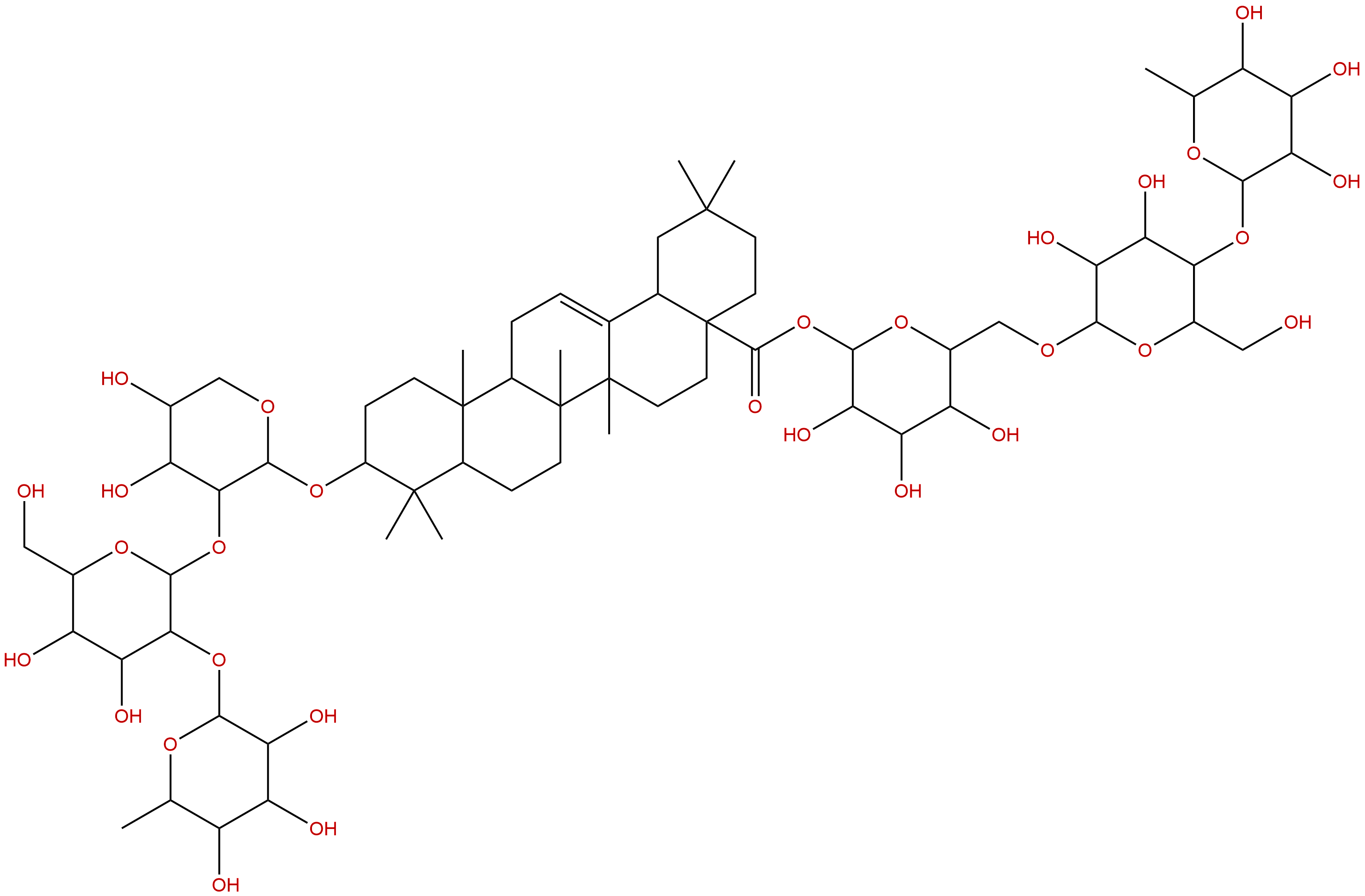


Synonym name:
Catalogue No.: BP1194
Cas No.: 124961-61-1
Formula: C65H106O30
Mol Weight: 1367.53
Botanical Source: Anemone reddeana
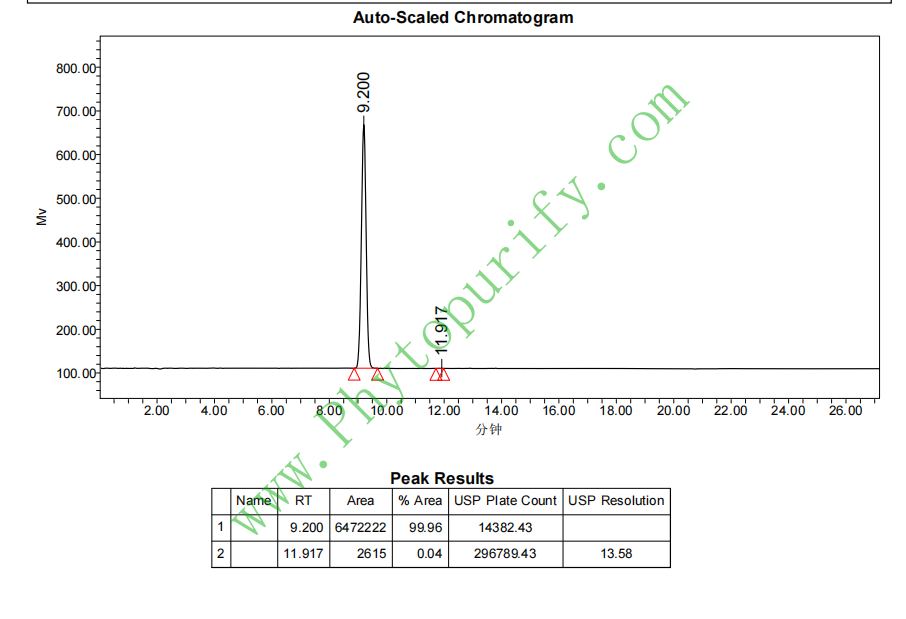
Purity: 95%~99%
Analysis Method: HPLC-DAD or/and HPLC-ELSD
Identification Method: Mass, NMR
Packing: Brown vial or HDPE plastic bottle
Can be supplied from milligrams to grams.
For Reference Standard and R&D, Not for Human Use Directly.
Inquire for bulk scale.
HPLC of Raddeanoside R8
Storage conditions:Short-term storage at 2~8℃, long-term storage at -20 ~ -80℃
471.7400
1.7769
1.7769
.5018
.4961
.1300
Low
66.6126
7.6647
Yes
No
No
No
No
No
0.3
Yes
No
No
Yes
Natural products, as an important source of drug discovery, play an irreplaceable role in the history of human disease treatment. Among them, saponin compounds have attracted much attention in the fields of anti-tumor, anti-inflammatory, and immune regulation due to their structural diversity and extensive biological activity. Many are adorned with silver lotus flowers(Anemone raddeana Regel, as a traditional medicinal plant, its rhizome is often used in folk medicine to treat rheumatism, rheumatism, pain, and injuries caused by falls. Modern plant chemistry research has isolated and identified various saponin components with significant pharmacological activity, among which Raddeanoside R8 is a highly representative one. Since its discovery, the significant anti-tumor activity of this compound has aroused strong interest among pharmacological researchers. Preliminary studies have shown that Raddeanoside R8 can exhibit inhibitory activity against various tumor cells by intervening in cell apoptosis, inhibiting tumor invasion and metastasis, regulating key signaling pathways, and other pathways. Its effects involve multiple key molecular targets such as MCL1, STAT3, MMP2, TOP1/2A. This article aims to systematically review the research progress on the chemical structure, plant origin, pharmacological activity, mechanism of action, and medicinal properties of Raddeanoside R8, in order to provide comprehensive scientific references for the in-depth development and clinical application of this compound.
Duobei Silver Lotus Saponin R8 (CAS Number: 124961-61-1) is a high molecular weight triterpenoid saponin compound with a molecular weight of 1367.5330. Structurally, it belongs to the oleanane type pentacyclic triterpenoid saponin, with its aglycone being oleanolic acid. The sugar chain of this compound is usually connected to the C-3 position of the aglycone, with a complex structure that may contain multiple sugar groups (such as glucose, xylose, arabinose, etc.). The order and position of these sugar groups are the structural basis for its high polarity and specific biological activity.
Its physical and chemical properties are closely related to its structural characteristics. The calculated lipid water partition coefficient (LogP) is 1.7769, indicating that the molecule has a certain degree of lipophilicity, but overall it still leans towards hydrophilicity. Its topological polar surface area (TPSA) is as high as 471.7400 Å ², which is mainly attributed to the abundant hydroxyl and sugar chain structures in the molecule, resulting in strong polarity. The water solubility value is 0.5018 (usually measured in mg/mL or log mol/L, indicating a certain degree of solubility in water, but limited by high molecular weight and complex sugar chains, the solubility may be limited and belong to the category of slightly soluble or poorly soluble). These physicochemical parameters collectively determine the absorption and distribution characteristics of Raddeanoside R8 in living organisms. For example, high TPSA and molecular weight indicate weaker ability to penetrate cell membranes, especially the blood-brain barrier, which is consistent with the prediction of "low blood-brain barrier permeability" in subsequent drug evaluation.
Raddeanoside R8 is mainly derived from plants in the Ranunculaceae family and the Silver Lotus genus(Anemone raddeana Fresh roots and stems. Silver lotus is mainly distributed in Northeast China, North China, Korea, Japan, and other places. Its rhizomes are best harvested in autumn, when the accumulation of saponin components is relatively abundant.
The extraction and isolation of Raddeanoside R8 from plant materials usually follow the conventional process of natural product chemistry, but optimization is needed for its saponin properties. Firstly, crush the fresh or dry stems and rhizomes of the silver lotus flower. Due to the high polarity of saponins, methanol, ethanol, or aqueous ethanol (such as 70% -95%) are commonly used for heating reflux extraction or ultrasound assisted extraction to fully dissolve the saponin components. The extract is concentrated under reduced pressure to obtain a paste.
Subsequently, preliminary enrichment was carried out using the solubility and surface activity of saponins. Water saturated n-butanol is often used for multiple extractions of the aqueous solution of the extract, and the saponin components tend to be distributed to the n-butanol layer, thereby separating from strongly polar impurities such as sugars and proteins. After obtaining the n-butanol fraction, various chromatographic techniques need to be further used for separation and purification. This includes:
1. Positive phase silica gel column chromatography Coarse separation is often carried out using gradient elution systems such as chloroform methanol water.
2. Reverse phase chromatography (such as ODS, C18)For the precise separation of highly polar saponins, methanol water or acetonitrile water systems are commonly used.
3. Gel chromatography (such as Sephadex LH-20)Separation based on molecular size is commonly used for desalination and further purification.
4. High performance liquid chromatography (HPLC)Especially for preparative HPLC, it is the final key step to obtain high-purity Raddeanoside R8 monomer, often using a reverse phase column and acetonitrile water (pH adjusted with a small amount of formic acid or trifluoroacetic acid) as the mobile phase.
The entire separation process requires tracking and detection using thin-layer chromatography (TLC) or liquid chromatography-mass spectrometry (LC-MS). The structure of the final pure product was confirmed by nuclear magnetic resonance (NMR, including 1H-NMR, 13C-NMR, 2D-NMR), mass spectrometry (MS), and comparison with literature data.
The most notable pharmacological activity of Raddeanoside R8 is its extensive anti-tumor effects. Numerous in vitro studies have shown that this compound exhibits significant proliferation inhibition and apoptosis induction activity against various human tumor cell lines.
The anti-tumor effect of Raddeanoside R8 is not achieved through a single pathway, but rather through the synergistic action of multiple targets and pathways. Existing research has revealed its interactions with multiple key target proteins:
Regulating apoptosis related targets:
Intervention in Cell Cycle and DNA Metabolism:
Inhibition of invasion, metastasis, and angiogenesis related targets:
Affects hormone related pathways (for hormone dependent tumors):
In summary, Raddeanoside R8 exerts its effects through a complex "network pharmacology" model, simultaneously affecting multiple malignant phenotypes such as apoptosis, proliferation, invasion, and angiogenesis, which helps overcome the problem of resistance to single target drugs.
Although Raddeanoside R8 has significant in vitro activity, its drug like and in vivo pharmacokinetic (PK) properties are the key bottlenecks that determine whether it can be developed into a drug.
Analysis of drug properties parameters:
Pharmacokinetic challenges and strategies:
At present, there are few reports on the in vivo pharmacokinetic studies of the Raddeanoside R8 system, which is a gap that urgently needs to be filled in its preclinical development.
Raddeanoside R8, as a natural saponin with multi-target anti-tumor activity, has both promising and challenging clinical application prospects.
Potential application directions:
1. Candidate molecules for anti-tumor drugs Its broad-spectrum anti-tumor activity, especially its dual inhibition of apoptosis pathway and metastasis link, makes it have the potential to develop into a new type of chemotherapy or targeted drug for the treatment of solid tumors such as liver cancer, breast cancer, lung cancer, colon cancer, etc. Combined use with existing chemotherapy drugs may result in synergistic effects, reducing their respective dosages and toxic side effects.
2. Adjuvant therapy and anti metastatic drugs Given its strong inhibitory effect on MMPs and angiogenesis, Raddeanoside R8 may be developed for adjuvant therapy after tumor surgery, aimed at clearing micro metastases, preventing recurrence and metastasis.
3. Structural optimization of lead compounds Using it as the parent nucleus, structural modifications (such as simplifying sugar chains and modifying glycosides) are carried out through medicinal chemical methods, aiming to obtain derivatives with higher activity and better drug properties.
Challenges faced and future research directions:
1. In depth mechanism research At present, the understanding of the mechanism of action is still mostly based on phenotype and partial target validation, and more in-depth research is needed to clarify its direct target of action (such as target fishing through chemical biology methods), and systematically elucidate its regulatory signal network.
2. Comprehensive preclinical evaluation It is urgent to conduct standardized in vivo pharmacological experiments to verify its efficacy and safety in tumor bearing animal models, especially in human tumor xenograft PDX models. It is necessary to systematically complete pharmacokinetic and toxicological (acute toxicity, chronic toxicity, reproductive toxicity, etc.) studies and obtain complete preclinical data.
3. Research and development of formulations How to utilize modern pharmaceutical technology to develop formulations that can effectively deliver Raddeanoside R8, improve its bioavailability, and potentially achieve tumor targeting is the core technical challenge in pushing it into clinical practice.
4. Explore combination therapy strategies Study the combination application of Raddeanoside R8 with radiotherapy, immunotherapy (such as PD-1/PD-L1 inhibitors) or other targeted drugs, and explore its position in the new generation of comprehensive cancer treatment.
Duobei Silver Lotus Saponin R8 is a triterpenoid saponin with significant anti-tumor potential isolated from the traditional medicinal plant Duobei Silver Lotus. Research has shown that it can induce tumor cell apoptosis, inhibit proliferation, invasion, and angiogenesis by targeting multiple key molecules such as MCL1, BCL2, STAT3, MMP2, TOP1/2A, exhibiting multi-target and multi pathway characteristics. However, its enormous molecular weight, strong polarity, and poor drug like parameters constitute the main obstacles to its conversion into drugs. Future research needs to focus on solving the pharmacokinetic and formulation delivery challenges based on a deeper understanding of its molecular mechanism. Through drug chemical modification and the development of new drug delivery systems, it is expected to overcome these bottlenecks and truly transform this distinctive natural product into a new anti-tumor drug that benefits patients, continuing the glory of natural products in the history of drug discovery.
