


Product name: Cardamonin
Synonym name: 2′,4′-Dihydroxy-6′-methoxychalcone; Alpinetin chalcone
Catalogue No.: BP0315
Cas No.: 19309-14-9
Formula: C16H14O4
Mol Weight: 270.284
Botanical Source: Alpinia katsumadai Hayata
Physical Description:
Type of Compound: Chalcones
Purity: 95%~99%
Analysis Method: HPLC-DAD or/and HPLC-ELSD
Identification Method: Mass, NMR
Packing: Brown vial or HDPE plastic bottle
Storage: Store in a well closed container, protected from air and light. Put into refrigerate or freeze for long term storage.
Whenever possible, you should prepare and use solutions on the same day. However, if you need to make up stock solutions in advance, we recommend that you store the solution as aliquots in tightly sealed vials at -20℃. Generally, these will be useable for up to two weeks.
The product could be supplied from milligrams to grams
Inquire for bulk scale.
Description:
Cardamonin is a naturally occurring chalcone with strong anti-inflammatory , anticancer, anti-melanogenesis, and vascular activity. It is a novel TRPA1 antagonist with IC50 of 454 nM and also a NF-kB inhibitor. It ameliorates insulin resistance induced by high insulin and high glucose through the mTOR and signal pathway. It also may be a potential whitening agent for use in cosmetics and in the medical treatment of hyperpigmentation disorders.
References:
Biomol Ther (Seoul). 2015 Mar;23(2):141-8.
Cardamonin Suppresses TGF-β1-Induced Epithelial Mesenchymal Transition via Restoring Protein Phosphatase 2A Expression.
Epithelial mesenchymal transition (EMT) is the first step in metastasis and implicated in the phenotype of cancer stem cells. Therefore, understanding and controlling EMT, are essential to the prevention and cure of metastasis.
METHODS AND RESULTS:
In the present study, we examined, by Western blot, reverse transcription polymerase chain reaction (RT-PCR), and confocal microscopy, the effects of Cardamonin (CDN) on transforming growth factor-β1 (TGF-β1)-induced EMT of A549 lung adenocarcinoma cell lines. TGF-β1 induced expression of N-cadherin and decreased expression of E-cadherin. CDN suppressed N-cadherin expression and restored E-cadherin expression. Further, TGF-β1 induced migration and invasion of A549 cancer cells, which was suppressed by CDN. TGF-β1 induced c-Jun N-terminal kinase (JNK) activation during EMT, but CDN blocked it. Protein serine/threonine phosphatase 2A (PP2A) expression in A549 cancer cells was reduced by TGF-β1 but CDN restored it.
METHODS AND RESULTS:
The overall data suggested that CDN suppresses TGF-β1-induced EMT via PP2A restoration, making it a potential new drug candidate that controls metastasis.
Mol Immunol. 2007 Feb;44(5):673-9.
Cardamonin inhibits COX and iNOS expression via inhibition of p65NF-kappaB nuclear translocation and Ikappa-B phosphorylation in RAW 264.7 macrophage cells.
Cardamonin, a chalcone isolated from the fruits of a local plant Alpinia rafflesiana, has Cardamonin, a chalcone isolated from the fruits of a local plant Alpinia rafflesiana, has demonstrated anti-inflammatory activity in cellular models of inflammation.
METHODS AND RESULTS:
In this report, we evaluated the ability of Cardamonin to suppress both NO and PGE2 synthesis, iNOS and COX-2 expression and enzymatic activity, and key molecules in the NF-kappaB pathway in order to determine its molecular target. Cardamonin suppressed the production of NO and PGE2 in interferon-gamma (IFN-gamma)- and lipopolysaccharide (LPS)-induced RAW 264.7 cells. This inhibition was demonstrated to be caused by a dose-dependent down-regulation of both inducible enzymes, iNOS and COX-2, without direct effect upon iNOS or COX-2 enzyme activity. Subsequently we determined that the inhibition of inducible enzyme expression was due to a dose-dependent inhibition of phosphorylation and degradation of I-kappaBalpha, which resulted in a reduction of p65NF-kappaB nuclear translocation.
CONCLUSIONS:
We conclude that Cardamonin is a potential anti-inflammatory drug lead that targets the NF-kappaB pathway.
J Cardiovasc Pharmacol. 2001 May;37(5):596-606.
Vasorelaxant effects of cardamonin and alpinetin from Alpinia henryi K. Schum.
The vascular effects of Cardamonin and alpinetin from Alpinia henryi K. Schum. were examined in the rat isolated mesenteric arteries.
METHODS AND RESULTS:
1H and 13C nuclear magnetic resonance spectra showed that Cardamonin is present in trans-form, and single-crystal radiographic structure revealed that alpinetin is present in S configuration. Both Cardamonin and alpinetin produced a rightward shift in the concentration-response curve for phenylephrine in a noncompetitive manner, and they induced relaxation of phenylephrine-preconstricted arteries with respective mean inhibitory concentrations (IC50) of 9.3+/-0.6 microM and 27.5+/-2.8 microM. Both compounds also relaxed arteries preconstricted by endothelin I or U46619. Their relaxant effects were decreased in endothelium-removed rings. Pretreatment with N(G)-nitro-L-arginine methyl ester or methylene blue inhibited relaxation induced by both agents, and pretreatment with L-arginine reversed the effect of N(G)-nitro-L-arginine methyl ester on Cardamonin-induced endothelium-dependent relaxation. The relaxant effects of Cardamonin and alpinetin were unaffected by indomethacin (3 microM). Cardamonin and alpinetin inhibited 60 mM K+-induced contraction with respective IC50 of 11.5+/-0.3 microM and 37.9+/-3.6 microM. In addition, both agents inhibited the transient contraction induced by 3 microM phenylephrine or by 10 mM caffeine in Ca2+-free Krebs solution. Finally, these two agents also concentration dependently relax the arteries preconstricted by 1 microM phorbol 12,13-diacetate in Ca2+-free Krebs solution.
CONCLUSIONS:
These results indicate that purified Cardamonin and alpinetin from A. henryi K. Schum. relaxed rat mesenteric arteries through multiple mechanisms. They induced both endothelium-dependent and -independent relaxation; the former is likely mediated by nitric oxide whereas the latter is probably mediated through nonselective inhibition of Ca2+ influx and intracellular Ca2+ release and inhibition of the protein kinase C-dependent contractile mechanism.
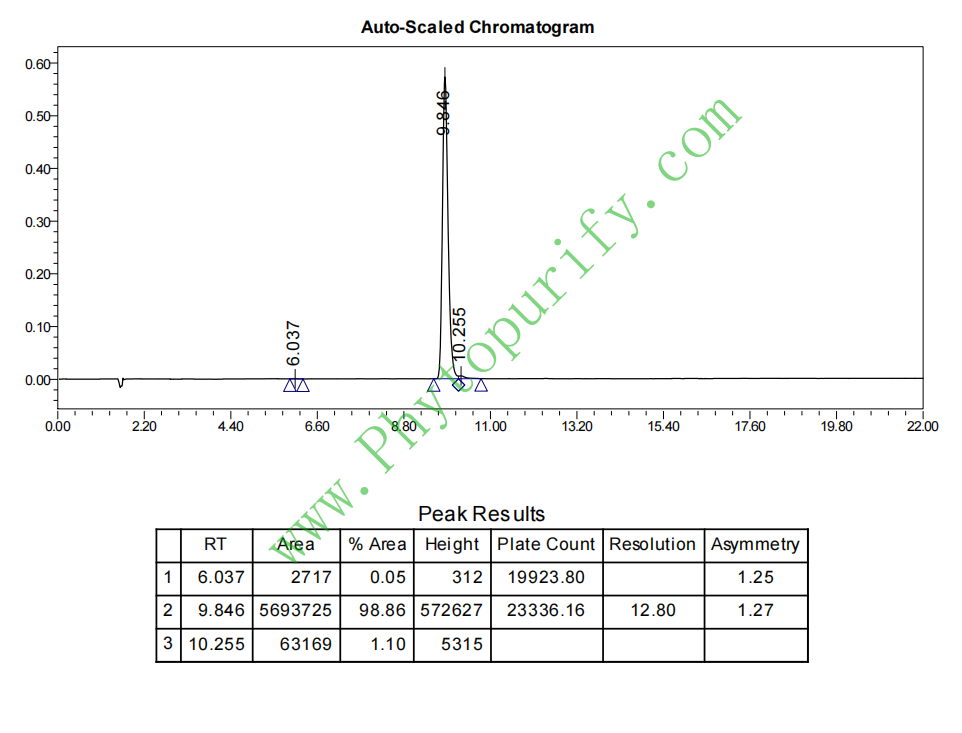
HPLC of Cardamonin
Storage conditions:Short-term storage at 2~8℃, long-term storage at -20 ~ -80℃
66.7600
3.3669
3.2552
.0634
4.9446
28.7147
Low
93.4636
2.0955
Yes
No
Yes
No
Yes
Yes
0.6
No
Yes
Yes
Yes
As an important treasure trove for drug discovery, natural products continue to provide modern medicine with lead compounds with novel structures and diverse activities. Among them, chalcone compounds have attracted much attention due to their wide range of biological activities. Cardamonin, also known as (2'E) -1- (2-hydroxy-4,6-dimethoxyphenyl) -3-phenyl-2-propen-1-one, is a compound derived from ginger plants such as cardamom(Elettaria cardamomum)Typical chalcone derivatives obtained through separation. Its CAS number is 19309-14-9, and early research focused on its traditional pharmacological effects such as anti-inflammatory and antioxidant effects. In recent years, with the deepening of molecular pharmacology research, Kombuconazole has shown a more complex and remarkable biological activity spectrum, especially in the fields of cancer, pain, and neurodegenerative diseases. Of particular importance, research has found that (E) - coumarin is a novel antagonist of the transient receptor potential anchor protein subtype 1 (hTRPA1) cation channel, with an IC50 value of 454 nM, opening up new avenues for its application in pain management and related disease treatment. At the same time, it plays an anti-tumor role in a variety of cancer models, such as breast cancer, by regulating multiple key signaling pathways, such as AMPK, STAT3, and BCL2, highlighting its potential for multi target action. This article aims to provide a systematic review of the chemical properties, plant sources, pharmacological activities, molecular mechanisms of action, pharmacological evaluation, and clinical application prospects of Codonopsis pilosula, in order to provide comprehensive scientific references for the in-depth research and development of this natural product.
Xiaodoukouming is a simple chalcone compound with a molecular formula of C17H16O4 and a molecular weight of 270.2840. Its core structure is composed of an A ring (2-hydroxy-4,6-dimethoxyphenyl) and a B ring (phenyl) connected by an alpha, beta unsaturated carbonyl group (acrylone). The ketene structure of this (E) - configuration is a key pharmacophore for its various biological activities, enabling it to act as a Michael reaction receptor and interact covalently or non covalently with biomolecules such as thiol groups in proteins.
In terms of physical and chemical properties, the calculated lipid water partition coefficient (LogP) of Kombuconazole is 3.3669, indicating its moderate lipophilicity, which is beneficial for its penetration into cell membranes. Its topological polar surface area (TPSA) is 66.7600 Å ², which is relatively small. The water solubility is poor, about 0.0634 mg/mL, which to some extent limits its bioavailability. The predicted blood-brain barrier permeability is "low", indicating that the prototype drug may not easily enter the central nervous system. In early safety screening, its hERG channel inhibitory activity was negative, reducing the risk of inducing QT interval prolongation in the heart; The Ames test result is 0.6 (usually considered negative if the result is less than 2), indicating that there is no significant genetic toxicity. These basic pharmacological parameters provide important basis for its subsequent structural optimization and formulation development.
Cardamom is mainly derived from various plants in the Zingiberaceae family, among which the most well-known is the spice plant cardamom(Elettaria cardamomum)The seeds. In addition, in the Alpinia genus (such as sorghum) Alpinia officinarum)It is also commonly found in plants such as the ginger genus. It usually exists as a secondary metabolite in plants, and its content varies depending on the plant species, parts, place of origin, and harvest season.
Organic solvent extraction is commonly used to extract cardamom from plant materials. The classic process includes: cold soaking or hot reflux extraction of dried and crushed plant materials (such as cardamom seeds) using polar solvents such as methanol, ethanol, or acetone. The crude extract was obtained by vacuum concentration of the extraction solution. Subsequently, purification is carried out using chromatographic separation techniques such as silica gel column chromatography, commonly using gradient elution systems such as petroleum ether ethyl acetate or chloroform methanol. High performance liquid chromatography (HPLC) and preparative thin layer chromatography (PTLC) are also commonly used in the final purification process to obtain high-purity coumarin monomers. In recent years, green extraction techniques such as ultrasound assisted extraction and microwave-assisted extraction have also been applied to improve extraction efficiency and reduce solvent consumption. The identification and purity analysis of extracts usually rely on techniques such as mass spectrometry (MS), nuclear magnetic resonance (NMR, especially 1H-NMR and 13C-NMR), and high-performance liquid chromatography-mass spectrometry (HPLC-MS).
Xiaodoukouming has a wide and significant pharmacological activity, and its research has expanded from traditional anti-inflammatory and antibacterial methods to multiple modern medical frontiers such as anti-tumor and neuroprotective effects.
Anti inflammatory and analgesic activity Xiaodoukouming is an effective antagonist of the hTRPA1 channel (IC50=454 nM). The TRPA1 channel is known as the "mustard oil receptor" and plays a central role in inflammatory pain and neuropathic pain. Xiaodoukou Ming exerts analgesic effects by antagonizing TRPA1, inhibiting calcium ion influx, and downstream neuropeptides (such as substance P and CGRP) release. In addition, it can inhibit the production of nitric oxide (NO), prostaglandin E2 (PGE2), tumor necrosis factor - α (TNF - α), interleukin-6 (IL-6) and other pro-inflammatory factors in macrophages induced by lipopolysaccharide (LPS), and its mechanism is related to the inhibition of nuclear factor kappa B (NF - κ B) and mitogen activated protein kinase (MAPK) signaling pathways.
Antitumor activity Kotokemin has shown strong anti proliferation and pro apoptosis activities in a variety of cancer cell lines, of which breast cancer is the most deeply studied. It can inhibit the migration, invasion and clonal formation of breast cancer cells. In in vivo experiments, Kombuconazole can significantly inhibit the growth of transplanted tumors and exhibit synergistic effects when combined with certain chemotherapy drugs (such as doxorubicin), and can partially reverse multidrug resistance.
Antioxidant and neuroprotective activities By virtue of its phenolic hydroxyl structure, coumarin has the ability to scavenge free radicals. In neurodegenerative disease models such as Alzheimer's disease, coumarin exhibits protective effects, which may be achieved by inhibiting beta amyloid induced neurotoxicity, reducing oxidative stress, and inhibiting tau protein hyperphosphorylation (associated with the target MAPT).
Other activities: The study also showed that Kouming has potential activities such as antibacterial, antiviral, anti diabetes (improving insulin resistance by activating AMPK) and cardiovascular protection.
The core of Xiaodoukoming's multi effect pharmacological effect lies in its regulation of multiple key cell signal pathways and molecular targets, especially in the treatment of breast cancer, which shows multi target characteristics:
In summary, Xiaodoukouming exerts its effects through a complex "multi-target multi-path" network, which is both the advantage of its therapeutic potential and a challenge for fully elucidating its mechanism of action.
Despite the significant in vitro activity of coumarin, its drug like properties still require comprehensive evaluation and optimization.
Absorption, distribution, metabolism, excretion (ADME):
Pharmacokinetic study Currently, there is limited publicly available research data on the pharmacokinetics of the Kombuconazole system. Limited animal studies have shown that after oral administration, the plasma concentration is lower, the peak time is faster, but the elimination is also faster, and there may be a first pass effect. Developing suitable drug delivery systems (such as nano formulations, phospholipid complexes, cyclodextrin inclusion complexes) to improve their solubility and bioavailability is currently a research hotspot.
safety evaluation The preliminary hERG inhibition negative and Ames test negative results provide early support for its safety. However, comprehensive preclinical safety evaluations, including acute toxicity, chronic toxicity, reproductive toxicity, etc., have not been fully reported. Its long-term effects as a TRPA1 antagonist also need attention.
As a multi-target natural active molecule, Xiaodoukouming has broad clinical application prospects, but also faces challenges.
Potential application areas:
Challenges and Prospects Faced:
Xiaodoukouming is a natural chalcone compound with rich biological activity discovered from traditional spice plants. It not only provides a new idea for pain treatment as an effective antagonist of hTRPA1 channel, but also shows outstanding anti-tumor potential in major disease models such as breast cancer by regulating key targets such as AMPK, STAT3, BCL2, etc. Although its multi-target mechanism of action is complex, it may be a powerful weapon for dealing with complex disease networks. Although there are challenges in drug formulation such as poor water solubility and unclear pharmacokinetic properties, this is precisely the direction that modern medicinal chemistry and pharmacy can focus on improving. With further elucidation of its mechanism of action, deepening of structural optimization strategies, and the application of new drug delivery systems, Xiaodoukou Ming is expected to successfully move from a promising natural lead compound to clinical practice and develop into a new drug for treating various diseases such as cancer and pain, fully demonstrating the enduring vitality and value of natural products in innovative drug development. Future research should focus on the translational medicine process, bridging the gap between promising bench-side findings and bedside applications。
