


Product name: Alpinetin
Synonym name: 7-Hydroxy-5-methoxyflavanone
Catalogue No.: BP0160
Cas No.: 36052-37-6
Formula: C16H14O4
Mol Weight: 270.284
Botanical Source: Alpinia speciosa, Alpinia katsumadai, Chrysothamnus nauseosus, Helichrysum herbaceum, Dalea scandens, Alnus, Kaempferia, Eucalyptus and Piper spp.
Physical Description: Powder
Type of Compound: Flavonoids
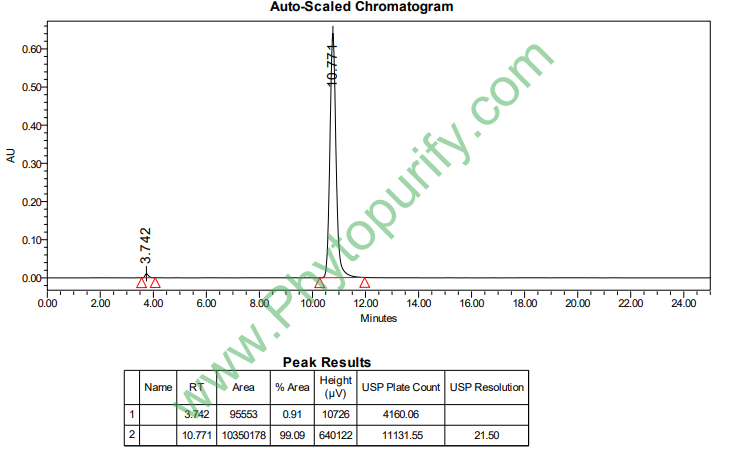
Purity: 95%~99%
Analysis Method: HPLC-DAD or/and HPLC-ELSD
Identification Method: Mass, NMR
Packing: Brown vial or HDPE plastic bottle
Storage: Store in a well closed container, protected from air and light. Put into refrigerate or freeze for long term storage.
Whenever possible, you should prepare and use solutions on the same day. However, if you need to make up stock solutions in advance, we recommend that you store the solution as aliquots in tightly sealed vials at -20℃. Generally, these will be useable for up to two weeks.
The product could be supplied from milligrams to grams, up to kilograms
Inquire for bulk scale.
Descriptions:
Alpinetin is a type of novel plant flavonoid derived from Alpinia katsumadai Hayata, possesses strong anti-hepatoma effects, can suppress HepG2 cell proliferation and arrested cells in the G0/G1 phase by up-regulating the expression levels of p-MKK7, and the antitumor effect of Alpinetin could be reversed by inhibiting the expression of MKK7; suggests that MKK7 may be a putative target for molecular therapy against hepatoma and Alpinetin could serve as a potential agent for the development of hepatoma therapy.[1]
Alpinetin has antiproliferative effect in BxPC-3 pancreatic cancer cells possibly through the regulation of the Bcl-2 family and XIAP expression, release of cytochrome C and the activation of caspases, it may serve as a potential agent for the development of pancreatic cancer cell therapies.[2]
Alpinetin and cardamonin have vascular effects to relax rat mesenteric arteries through multiple mechanisms; they induce both endothelium-dependent and -independent relaxation, the former is likely mediated by nitric oxide whereas the latter is probably mediated through nonselective inhibition of Ca2+ influx and intracellular Ca2+ release and inhibition of the protein kinase C-dependent contractile mechanism.[3]
Alpinetin has anti-inflammatory properties, can activate PPAR-γ, thereby attenuate TLR4 expression and TLR4 mediated NF-κB and MAPK activation and the release of pro-inflammatory cytokines, suggests that it may be a therapeutic agent against inflammatory diseases. [4]
Alpinetin has antioxidant effects, can protect LPS-induced kidney injury through activating Nrf2 and inhibiting TLR4 expression.[5]
Alpinetin suppresses T-cell-mediated delayed-type hypersensitivity reaction in mice, could shock the activation of NF-κB NFAT2 signal transduction pathways, indicates that it has potential effects in downregulating the immune system and might be developed as a useful immunosuppressive agent in treating undesired immune responses.[6]
References:
[1] Tang B O, Jian D U, Wang J, et al. Oncol Rep, 2012, 27(4):1090-6.
[2] Du J, Tang B, Wang J, et al. Int J Mol Med, 2012, 29(4):607-12.
[3] Wang Z T, Lau C W, Chan F L, et al. J Cardiovasc Pharm, 2001, 37(5):596-606.
[4] Hu K, Yang Y, Tu QY, et al. Eur Journal of Pharmacol, 2013, 721(1-3):96–102.
[5] Huang Y, Zhou L S, Yan L, et al. Int Immunopharmacol, 2015, 28(2):1003-8.
[6] Guan S, Fang B, Song B, et al. Immunopharm Immunot, 2014, 36(4):1-7.
[7] Liu J, Feng Z, W U YH . Pharmacy Today, 2009, 19(4):46-8.
HPLC of Alpinetin
Storage conditions:Short-term storage at 2~8℃, long-term storage at -20 ~ -80℃
Alpinein (CAS number: 36052-37-6) is a natural flavonoid compound mainly isolated from ginger plants such as Alpinia katsumadai. As a member of the flavonoid family, mountain ginger extract has attracted widespread attention for its diverse biological activities, especially demonstrating significant pharmacological potential in antibacterial, anti-inflammatory, anti-tumor, and multi organ protection. In recent years, with the in-depth study of the pharmacological mechanisms of natural products, the application prospects of mountain ginger extract in various pathological states such as cardiovascular disease, liver injury, and neurodegenerative diseases have gradually become clear. This article will provide a systematic review of the chemical structure and physicochemical properties, plant sources, and extraction methods of mountain ginger extract. The focus will be on analyzing its pharmacological activity and molecular mechanisms, exploring its medicinal properties and pharmacokinetic characteristics, and finally looking forward to its clinical application potential and future research directions.
The chemical formula of mountain ginger extract is C16H14O4, with a molecular weight of 270.28, belonging to the ether structure of flavonoids. Its basic skeleton is a flavonoid core with methoxy substituents, which endows it with good lipid solubility and stability. In terms of physical and chemical properties, the LogP value of mountain ginger extract is about 2.4, indicating moderate lipid solubility, which is beneficial for cell membrane penetration and bioavailability. Its topological polar surface area (TPSA) is 55.76, and the number of hydrogen bond acceptors is 4, indicating that it has a certain hydrophilicity in intermolecular forces, balancing the characteristics of lipophilicity and hydrophilicity. The high permeability of the blood-brain barrier suggests its potential application value in central nervous system diseases. Toxicological evaluation shows that mountain ginger extract has no significant hepatotoxicity, cardiotoxicity, or hERG channel inhibition effect, and the Ames mutagenicity test is negative, indicating high safety.
Shanjiangsu mainly comes from the ginger plant Alpinia katsumadai, and has also been reported in other Alpinia plants. As a traditional Chinese medicinal herb, cardamom is widely used in the treatment of digestive system diseases, and its active ingredient, gingerol, is rich in content. The extraction method usually uses organic solvent extraction combined with column chromatography separation technology. The specific process includes: crushing dried cardamom, reflux extraction with ethanol or methanol as solvents, concentration, separation by silica gel column chromatography, purification by high performance liquid chromatography (HPLC), and finally obtaining high-purity mountain ginger extract. In recent years, emerging technologies such as ultrasound assisted extraction and microwave-assisted extraction have also been applied to improve extraction efficiency and purity. In addition, researchers have attempted to use methods such as counter current chromatography to achieve efficient separation of mountain ginger extract based on its structural characteristics.
Shan Jiang Su exhibits broad-spectrum antibacterial activity and can inhibit the growth of various Gram positive and Gram negative bacteria. Its antibacterial mechanism mainly involves disrupting the integrity of bacterial cell membranes and interfering with cellular metabolic processes. The inhibitory effect on viral infection has also been reported, especially in respiratory virus models, where resveratrol can exert its effects by regulating host immune response and directly inhibiting virus replication.
Shanjiangsu has shown significant anti-inflammatory activity in various inflammatory models. Its mechanism involves inhibiting the production of inflammatory mediators such as tumor necrosis factor - α (TNF - α), interleukin-6 (IL-6), and nitric oxide (NO). Shanjiangsu can inhibit the inflammatory response induced by lipopolysaccharide (LPS), activate the peroxisome proliferator activated receptor - γ (PPAR - γ) and nuclear factor E2 related factor 2 (Nrf2) signaling pathways, and downregulate the expression of Toll like receptor 4 (TLR4), thereby reducing the release of inflammatory mediators and tissue damage.
The anti-tumor effect of mountain ginger extract has been validated in various cancer cell lines. It mainly works by inhibiting tumor cell proliferation, promoting cell apoptosis, and inhibiting metastasis. The molecular mechanism includes regulating the expression of Bcl-2 family proteins, reducing the anti apoptotic protein Bcl-2, increasing the level of pro apoptotic protein Bax, releasing mitochondrial cytochrome c, activating the caspase cascade reaction, and ultimately inducing programmed cell death. In addition, mountain ginger extract can regulate the expression of XIAP (X-linked inhibitor of apoptosis protein), relieve the inhibition of caspase, and enhance apoptosis signaling.
The protective effects of mountain ginger extract on the liver, cardiovascular system, lungs, and nervous system are increasingly receiving attention. It reduces organ damage through multiple mechanisms such as antioxidant, anti-inflammatory, and regulation of cell apoptosis. For example, in terms of liver protection, mountain ginger extract can inhibit oxidative stress and inflammatory response of liver cells, and alleviate the process of liver fibrosis. The cardiovascular protective effect is manifested by reducing myocardial ischemia-reperfusion injury, regulating related targets such as APP, PTPN1, MAOA, ABCB1, etc., and improving myocardial cell function. The protective effect of the lungs is mainly achieved by inhibiting inflammation and oxidative damage, reducing chronic obstructive pulmonary disease (COPD) and acute lung injury. In terms of neuroprotection, mountain ginger extract can delay neurodegenerative diseases by regulating neuroinflammation and oxidative stress.
The multi-target mechanism of action of mountain ginger extract enables it to exhibit a wide range of pharmacological activities in various disease models. Its main targets and signaling pathways include:
In addition, mountain ginger extract also affects various signaling pathways, such as MAPK, NF - κ B, PI3K/Akt, etc., synergistically regulating cell survival, inflammation, and metabolic processes.
The pharmacological evaluation of Shanjiangsu shows that it has good potential for drug development. Its molecular weight is moderate (270.28), which conforms to Lipinski's rule. A LogP value of 2.4 indicates that it has suitable lipid solubility, which is conducive to oral absorption and cell membrane penetration. The TPSA is 55.76 and the number of hydrogen bond acceptors is 4, both of which are favorable for bioavailability. The high permeability of the blood-brain barrier suggests its potential application in central nervous system diseases. In terms of safety, mountain ginger extract has no significant liver toxicity, cardiac toxicity, or hERG channel inhibition. Its Ames test is negative, indicating a low risk of mutagenicity.
Pharmacokinetic studies have shown that mountain ginger extract is well absorbed after oral administration, with a moderate plasma half-life and widespread distribution, especially in high concentrations in the heart, liver, and brain tissues. Its metabolism is mainly through the phase I and phase II enzyme systems of the liver, and the metabolites are relatively stable. The main excretion pathways are bile and urine. Currently, there is a lack of systematic preclinical pharmacokinetic data, and further research is needed to improve related studies in the future.
Shanjiangsu, with its multi-target and multi mechanism pharmacological properties, has shown broad clinical application prospects in the fields of anti-tumor, anti-inflammatory, cardiovascular protection, and neuroprotection. Its regulation of targets related to myocardial infarction provides new ideas for the prevention and treatment of cardiovascular diseases. The anti-inflammatory and antioxidant effects make it potentially valuable in chronic inflammatory diseases and metabolic syndrome. The neuroprotective effect provides the possibility for the treatment of neurodegenerative diseases such as Alzheimer's disease and Parkinson's disease.
Future research should focus on:
As a natural flavonoid compound with multiple biological activities, mountain ginger extract exhibits unique pharmacological advantages in antibacterial, anti-inflammatory, anti-tumor, and multi organ protection. Its good drug efficacy and safety provide a solid foundation for the development of new drugs. In the future, through in-depth mechanism research and clinical translation, mountain ginger extract is expected to become an important candidate drug for treating various complex diseases. With the continuous development of pharmacology of natural products, the research on mountain ginger extract will promote the rational utilization of natural medicinal resources and innovative drug development, contributing new strength to human health.
