
| Catalog No | Package | Original Price | Price | Inventory | Quantity | Operating |
|---|---|---|---|---|---|---|
| BP1154-100mg | 100mg | $30.00 | Sign in |
|


Product name: Protocatechualdehyde
Synonym name:
Catalogue No.: BP1154
Cas No.: 139-85-5
Formula: C7H6O3
Mol Weight: 138.122
Botanical Source: heartwood of Cassia garrettiana
Physical Description: Powder
Type of Compound: Phenols
Purity: 95%~99%
Analysis Method: HPLC-DAD or/and HPLC-ELSD
Identification Method: Mass, NMR
Packing: Brown vial or HDPE plastic bottle
Storage: Store in a well closed container, protected from air and light. Put into refrigerate or freeze for long term storage.
Whenever possible, you should prepare and use solutions on the same day. However, if you need to make up stock solutions in advance, we recommend that you store the solution as aliquots in tightly sealed vials at -20℃. Generally, these will be useable for up to two weeks.
The product could be supplied from milligrams to grams, up to kilograms
Inquire for bulk scale.
Descriptions:
3,4-Dihydroxybenzaldehyde, isolated from the outer skin of green ,has been shown to inhibit the growth of Gloeosporium musarum, a fungus which causes ripe fruit rot in the banana.[1]
3,4-Dihydroxybenzaldehyde can inhibit oxidative DNA damage and apoptosis via its antioxidant activity.[2]
3,4-Dihydroxybenzaldehyde inhibits the phosphotransferase activity of CKII with IC(50) of about 783 microM, it may function by inhibiting oncogenic disease, at least in part, through the inhibition of CKII activity.3]
3,4-Dihydroxybenzaldehyde inhibits the H2O2-induced apoptosis of granulosa cells, promotes estradiol secretion in granulosa cells and enhanced the mRNA expression levels of steroidogenic factor 1, a promoter of key steroidogenic enzymes. [4]
3,4-Dihydroxybenzaldehyde has tyronase inhibitory effect.[5]
References:
[1] Mulvena D, Webb E C, Zerner B. Phytochemistry, 1969, 8(2):393-5.
[2] Jeong J, Hong S H. Phytomed Intl J Phytother Phytopharm, 2009, 16(1):85-94.
[3] Lee B H, Yoon S H, Kim Y S, et al. Nat Prod Res, 2008, 22(22):1441-50.
[4] Kono R, Nomura S, Okuno Y, et al. Acta Histochem Cytoc, 2014, 47(3):103-12.
[5] Shin Dong-Soo, Paik, Do-Hyeon, Yoon Do-Young, et al. The Korea Jounnal of Herbology, 2006, 21(2):1-7.
[6] Xia C Y, Chen L M, Hu W X. Synthetic chemistry, 2004, 12 (5): 484-6.
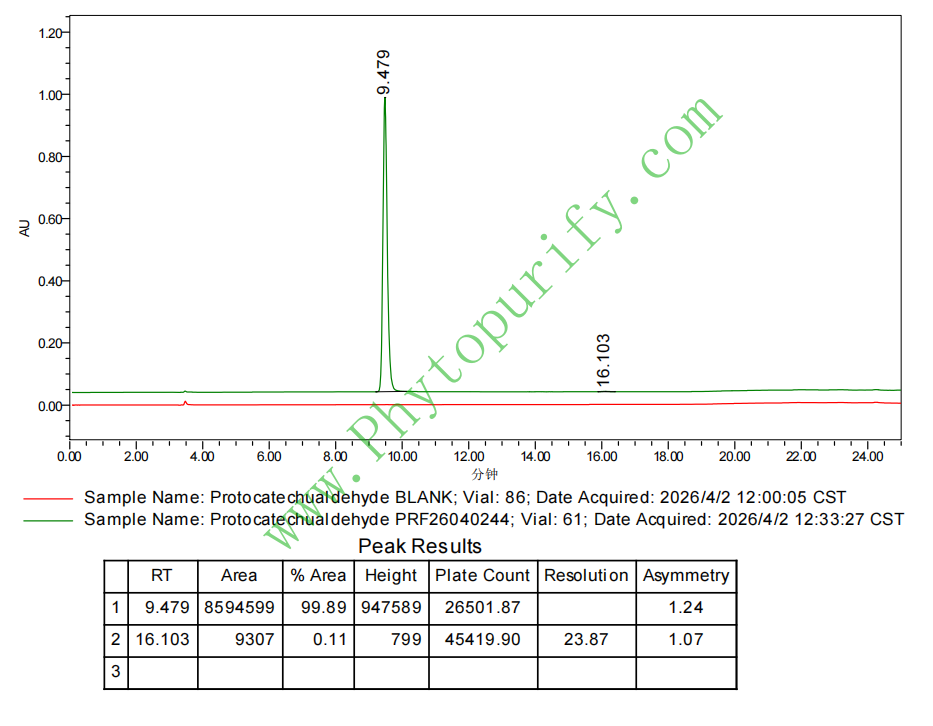
HPLC of Protocatechualdehyde
Storage conditions:Short-term storage at 2~8℃, long-term storage at -20 ~ -80℃
57.5300
.9682
.8783
10.2780
5.9404
17.5787
High
53.8369
2.0500
Yes
No
No
No
Yes
No
1.2
Yes
Yes
Yes
Yes
Natural products, as an important treasure trove for drug discovery, play an irreplaceable role in the history of human disease prevention and treatment. Among them, polyphenolic compounds have attracted much attention due to their extensive biological activity and low toxicity. Protocatechhualdehyde (PCA), also known as 3,4-dihydroxybenzaldehyde, is a simple polyphenolic compound isolated from traditional Chinese medicine plants such as Salvia miltiorrhiza Bunge. Its CAS number is 139-85-5 and its molecular formula is C7H6O3. Despite its relatively simple structure, protocatechuic aldehyde exhibits remarkable and diverse biological activities, including antioxidant, anti-inflammatory, antibacterial, cardiovascular protective, and neuroprotective effects, making it highly applicable in multiple medical fields, especially in the prevention and treatment of cardiovascular and cerebrovascular diseases. This article aims to systematically review the chemical properties, plant sources, pharmacological activities, molecular mechanisms of action, pharmacological evaluation, and clinical application prospects of protocatechuic aldehyde, in order to provide comprehensive scientific references for the in-depth research and development of this natural product.
The chemical structure of protocatechuic aldehyde consists of a benzene ring, with a hydroxyl group (- OH) attached to the 3rd and 4th positions of the benzene ring, forming a catechol structure, and an aldehyde group (- CHO) attached to the 1st position. This structure gives it the chemical properties of both catechins and benzaldehyde. The structure of catechol is a powerful electron donor, endowing protocatechuic aldehyde with excellent antioxidant capacity. It can effectively scavenge free radicals such as superoxide anions and hydroxyl radicals, and may exert antioxidant effects by chelating metal ions. Aldehyde is a highly reactive electrophilic group, making it easy to undergo Schiff base reactions with the amino groups of proteins, which may be related to its partial biological activity and metabolic pathways.
From the perspective of pharmacological parameters, the molecular weight of protocatechuic aldehyde is 138.1220, which belongs to small molecule compounds. The calculated lipid water partition coefficient (LogP) is approximately 0.9682, indicating that it has moderate lipophilicity and is conducive to transmembrane transport. The topological polar surface area (TPSA) is 57.53 Å ², which is relatively small and indicates good membrane permeability. The water solubility data is 10.2780 mg/mL, indicating that it has a certain solubility in water, which is a favorable factor for its absorption and distribution in organisms. It is particularly important that the predictive model shows a high blood-brain barrier permeability, which provides an important material basis for its application in central nervous system related diseases such as neurodegenerative diseases and cerebral ischemia. In addition, the predicted risk of hERG inhibition is' no ', indicating a lower potential risk of arrhythmia; The Ames test value is 1.2, indicating a low risk of mutagenicity, and these preliminary data provide a positive signal for its safety.
Protocatechol is widely distributed in nature, but its most famous and primary plant source is Salvia miltiorroza, a plant in the family Lamiaceae and genus Salvia. Danshen, also known as "red root", is an essential medicine in traditional Chinese medicine that promotes blood circulation, removes blood stasis, and relieves pain. It is commonly used to treat cardiovascular and cerebrovascular diseases. The combination of protocatechuic aldehyde, danshensu, salvianolic acid, tanshinone, and other water-soluble active ingredients in Danshen is one of the important material foundations for its cardiovascular protective effects. In addition to Danshen, protocatechuic aldehyde is also present in various other plants, such as olive leaves, honeysuckle, and some edible fruits and vegetables, but the content is usually low.
The extraction of catecholaldehyde from plant materials mainly depends on its polarity and solubility. Traditional extraction methods include:
1. Solvent extraction method The most commonly used method. Usually, water, methanol, ethanol, or alcohol water mixed solvents with different ratios are used for reflux extraction or ultrasound assisted extraction. Due to the water-soluble nature of catechol, the aqueous extraction method is more economical and environmentally friendly, but the extract contains more impurities. The alcohol extraction method (such as 70% -95% ethanol) has higher efficiency and better selectivity.
2. Modern separation and purification technology After filtration and concentration, the crude extract needs to be further purified to obtain high-purity protocatechuic aldehyde. Common techniques include:
* Macroporous adsorption resin chromatography The adsorption of polar compounds by resin and elution with different concentrations of alcohol solutions can effectively enrich protocatechuic aldehydes.
* Silica gel column chromatography Traditional but effective separation methods commonly use gradient elution systems such as chloroform methanol or petroleum ether ethyl acetate.
* Preparation type high performance liquid chromatography (HPLC): is the final and critical step in obtaining high-purity monomeric compounds, with the advantages of high resolution and efficiency.
* High Speed Counter Current Chromatography (HSCCC)A liquid-liquid distribution chromatography technique that does not require a solid phase carrier and is suitable for the preparation and separation of polyphenolic compounds that are thermally unstable and prone to adsorption loss.
In recent years, green extraction technologies such as supercritical fluid extraction (SFE), microwave-assisted extraction (MAE), and pressurized liquid extraction (PLE) have gradually been applied to the extraction of natural products to improve efficiency and reduce the use of organic solvents.
Numerous in vitro and in vivo studies have confirmed that protocatechuic aldehyde has a wide range of pharmacological activities, with its core functions revolving around antioxidant and anti-inflammatory effects, and extending to multiple systems.
Cardiovascular protective effect This is the most in-depth and promising field of research on protocatechuic aldehyde. Research has shown that protocatechuic aldehyde can:
Antioxidant and anti-aging effects The catechol structure of protocatechualdehyde is the chemical basis for its strong antioxidant capacity. It can directly eliminate various reactive oxygen species (ROS) and reactive nitrogen species (RNS), activate the endogenous antioxidant defense system of cells, such as the nuclear factor E2 related factor 2 (Nrf2) pathway, and upregulate the expression of antioxidant enzymes such as superoxide dismutase (SOD) and glutathione peroxidase (GPx). In anti-aging research, it has been shown to delay cellular replicative aging, protect mitochondrial function, and may act by affecting aging related signaling pathways such as SIRT1 and AMPK.
Anti inflammatory and immune regulatory effects Protocatechol can significantly inhibit the excessive production of inflammatory mediators (such as tumor necrosis factor - α, interleukin-6, nitric oxide) in macrophages induced by stimuli such as lipopolysaccharide (LPS). Its anti-inflammatory mechanism involves inhibiting the activation of key inflammatory signaling pathways such as nuclear factor kappa B (NF - κ B) and mitogen activated protein kinases (MAPKs).
Antibacterial and antiviral activity Research has shown that protocatechuic aldehyde has inhibitory effects on various Gram positive and Gram negative bacteria (such as Staphylococcus aureus and Escherichia coli), and its mechanism may be related to the destruction of bacterial cell membrane integrity and inhibition of biofilm formation. In addition, there are reports that it has certain inhibitory activity against certain viruses, such as influenza virus.
Neuroprotective effect Thanks to its excellent blood-brain barrier permeability, protocatechuic aldehyde has shown potential in neurodegenerative disease models. In the Alzheimer's disease model, it can reduce the neurotoxicity induced by β - amyloid protein; In the cerebral ischemia model, it can alleviate neuroinflammation and cell apoptosis, and protect neurological function.
Other activities: The study also suggests that protocatechuic aldehyde may have anti-tumor (by inducing apoptosis and inhibiting metastasis), anti diabetes (improving insulin resistance), liver protection and other activities, but the research in these fields remains to be in-depth.
The pleiotropic pharmacological effects of protocatechuic aldehyde stem from its regulation of multiple molecular targets and signaling pathways. Based on the provided target information and existing literature, its core mechanism of action can be summarized as follows:
Vascular protection and anti atherosclerosis related targets:
Cardiovascular function regulation related targets:
Metabolic regulatory targets:
Core signaling pathway:
Although protocatechuic aldehyde exhibits excellent pharmacological activity, its success as a drug depends on its pharmacological properties, namely "pseudo pharmacological" and pharmacokinetic properties.
Absorption, distribution, metabolism, excretion (ADME):
Challenges and optimization of drug development:
The diverse biological activities of protocatechuic aldehyde, especially its excellent cardiovascular protection, antioxidant and anti-inflammatory effects, have shown broad application prospects in the prevention and treatment of various diseases.
Main application directions:
Future research prospects:
As a natural polyphenolic compound derived from Danshen, protocatechuic aldehyde has attracted sustained attention from the pharmacological community due to its simple structure and wide range of activities. From a chemical structure perspective, its catechol and aldehyde groups are key pharmacophores that exert biological activity. In terms of pharmacological effects, it demonstrates core value in cardiovascular protection, antioxidant, anti-inflammatory and other fields by regulating multiple key targets and pathways such as NOS3, NF - κ B, Nrf2, PPARG, etc. Despite facing challenges such as rapid metabolism and stability in drug development, its excellent blood-brain barrier permeability and preliminary safety predictions have laid a positive foundation for its development. In the future, through in-depth mechanism exploration, rational structural modification, innovative formulation technology, and rigorous clinical verification, protocatechualdehyde is expected to be successfully transformed from a potential natural active molecule into an innovative drug or key functional ingredient for the prevention and treatment of important human diseases such as cardiovascular and cerebrovascular diseases and neurodegenerative diseases, fully reflecting the immortal value of natural products in modern drug development.
