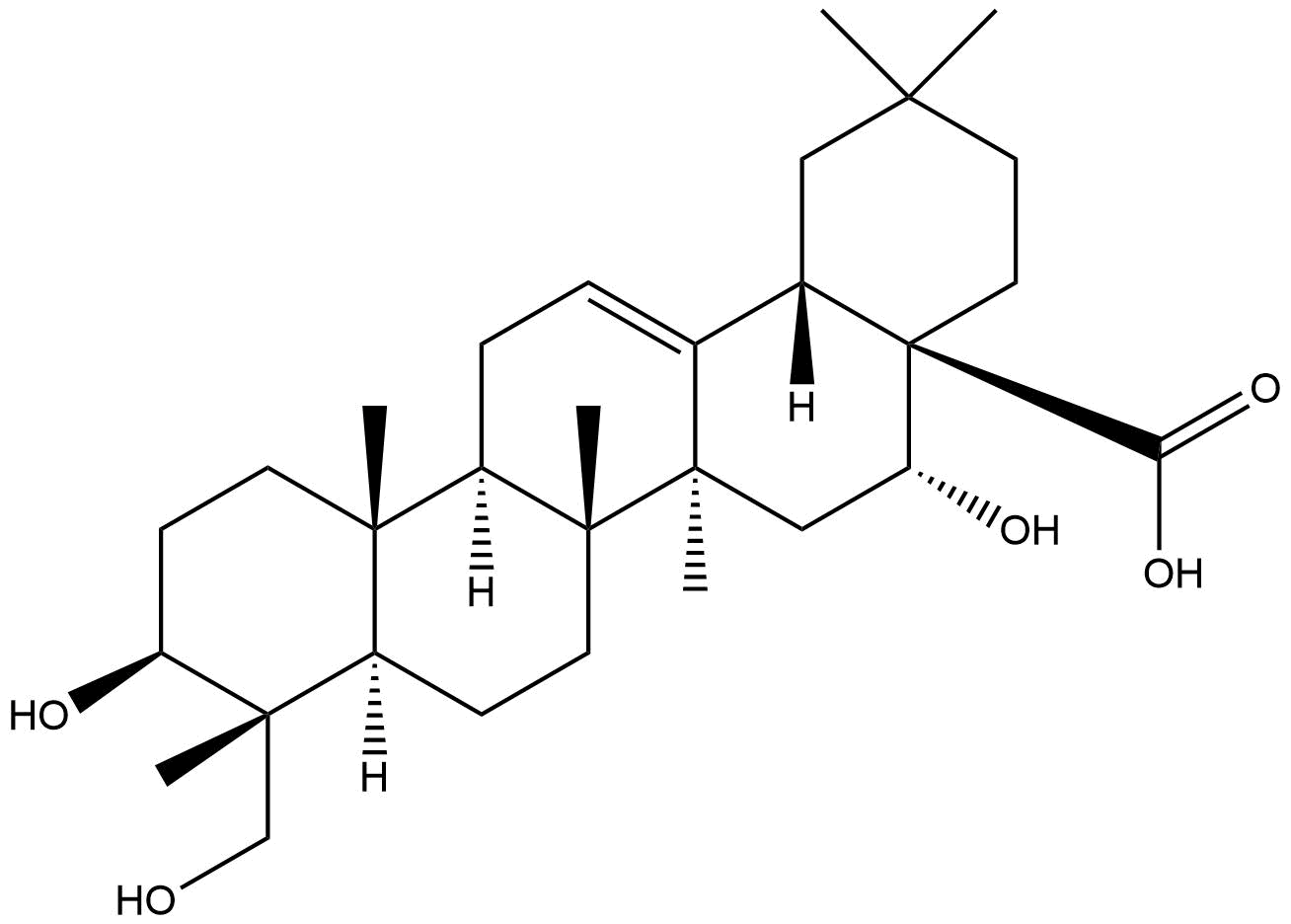


Product name: Caulophyllogenin
Synonym name: Collinsogenin
Catalogue No.: BP4253
Cas No.: 52936-64-8
Formula: C30H48O5
Mol Weight: 488.709
Botanical Source: Acacia catechu (L.f.)Willci.
Type of Compound:
Purity: 95%~99%
Analysis Method: HPLC-DAD or/and HPLC-ELSD
Identification Method: Mass, NMR
Packing: Brown vial or HDPE plastic bottle
Storage: Store in a well closed container, protected from air and light. Put into refrigerate or freeze for long term storage.
Whenever possible, you should prepare and use solutions on the same day. However, if you need to make up stock solutions in advance, we recommend that you store the solution as aliquots in tightly sealed vials at -20℃. Generally, these will be useable for up to two weeks.
The product could be supplied from milligrams to grams
Inquire for bulk scale.
For Reference Standard and R&D, Not for Human Use Directly.
Storage conditions:Short-term storage at 2~8℃, long-term storage at -20 ~ -80℃
97.9900
4.5725
2.7175
.0118
3.1382
3.3914
Low
89.8115
4.9445
No
No
No
No
No
No
0.0
Yes
No
Yes
No
Caulophyllogenin (CAS number: 52936-64-8) is a natural triterpenoid saponin isolated from the plant M. polimorpha. In recent years, with the increasing incidence of metabolic diseases and chronic inflammation related diseases, the research of natural products for these diseases has attracted extensive attention. Caulophyllogenin, as an emerging active compound, has become a research hotspot in the fields of pharmacology and drug development due to its partial activation of peroxisome proliferator activated receptor gamma (PPAR gamma) and its potential pharmacological activities in anti-inflammatory and metabolic regulation. This article provides a systematic review of the chemical structure and physicochemical properties, plant sources and extraction methods, pharmacological activity and mechanism of action, pharmacological evaluation, pharmacokinetic characteristics, and clinical application prospects of Caulophyllogenin. The aim is to provide a theoretical basis and reference for subsequent related research and drug development.
Caulophyllogenin belongs to the triterpenoid saponin class, with a molecular weight of 488.7090. The molecular formula and specific structure have not been fully disclosed, but its core skeleton is a typical triterpenoid structure, which combines with the glycoside part to form saponin molecules. Its LogP value is 4.5725, indicating strong hydrophobicity and high affinity in lipid environments. The polar surface area (TPSA) is 97.9900, indicating that the molecule has certain polar groups that are conducive to binding with biomolecules such as protein receptors.
The low water solubility (0.0118 mg/mL) to some extent limits its solubility and bioavailability in the aqueous phase. The low penetration ability of the blood-brain barrier suggests its limited distribution in the central nervous system, which may reduce the risk of central side effects. The hERG channel inhibition test result was negative, indicating that the compound has a low risk of cardiac toxicity. The Ames mutagenicity test result is 0.0, indicating a low risk of genotoxicity and a good safety basis.
Caulophyllogenin is mainly isolated from M. polimorpha, a traditional Chinese medicinal herb. M. Polimorpha belongs to the Ranunculaceae family and is widely distributed in East Asia. It is traditionally used to treat rheumatism, inflammation, and gynecological diseases. Its rhizome and whole plant contain abundant triterpenoid saponins, which are the main source of Caulophyllogenin.
During the extraction process, alcohols (such as ethanol or methanol) are often used as solvents to improve extraction efficiency through reflux extraction or ultrasound assisted extraction. The extract was purified by concentration, solvent distribution, and multi-stage column chromatography (such as silica gel column, reverse phase C18 column), and finally separated and purified by high performance liquid chromatography (HPLC) to obtain high-purity Caulophyllogenin. Structural identification mainly relies on modern analytical techniques such as nuclear magnetic resonance (NMR), mass spectrometry (MS), and infrared spectroscopy (IR).
Caulophyllogenin, as a partial agonist of PPAR γ, has an EC50 value of 12.6 μ M. PPAR γ is an intranuclear receptor that regulates lipid metabolism, glucose homeostasis and inflammatory response, and is an important therapeutic target for type 2 diabetes, obesity and metabolic syndrome. Caulophyllogenin plays an anti diabetes and anti obesity role by activating PPAR γ, promoting insulin sensitivity, improving adipocyte differentiation, and regulating lipid metabolism pathway.
Caulophyllogenin has regulatory effects on various inflammation related targets, including IL-6, STAT3, CASP1, TRPV1, PTGS1, TNF, TRPA1, NOS2, PTGS2, and NFKB1. By inhibiting the expression of pro-inflammatory cytokines and activating signaling pathways, Caulophyllogenin effectively reduces inflammatory responses and demonstrates good anti-inflammatory potential.
Cell and animal model studies have shown that Caulophyllogenin can reduce the release of inflammatory mediators such as TNF - α and IL-6, inhibit the activity of the nuclear factor kappa B (NF - κ B) signaling pathway, reduce inflammatory cell infiltration and tissue damage. In addition, its regulation of TRPV1 and TRPA1 plasma channels may be involved in the relief of pain and neuroinflammation.
Caulophyllogenin has potential therapeutic value for metabolic syndrome by regulating PPAR γ and related metabolic pathways, improving insulin resistance, reducing blood glucose and lipid levels, and alleviating chronic low-grade inflammation associated with obesity. Its multi-target mode of action provides a new approach for the comprehensive treatment of complex metabolic diseases.
The main mechanism of action of Caulophyllogenin involves partial activation of the nuclear receptor PPAR γ, promoting its binding to PPRE (PPAR responsive element) on DNA, regulating downstream gene expression, and improving metabolic function. In addition, its multi-target intervention in the inflammatory signaling pathway is the molecular basis of its anti-inflammatory effect.
The specific mechanism includes:
These multi-target effects work synergistically, endowing Caulophyllogenin with excellent anti-inflammatory and metabolic regulatory activities.
From the perspective of pharmacological parameters, Caulophyllogenin exhibits certain advantages and challenges. Its high LogP value (4.5725) suggests that it has good membrane permeability, which is beneficial for the action of intracellular targets, but at the same time, its low water solubility (0.0118 mg/mL) may limit its oral bioavailability. Moderate polar surface area (TPSA) facilitates binding with target proteins.
In terms of safety evaluation, the hERG channel inhibition test was negative, indicating a low risk of cardiac toxicity; The Ames test showed 0, indicating no significant genotoxicity and good safety. Low blood-brain barrier penetration ability reduces the risk of central nervous system related side effects.
At present, there is limited pharmacokinetic data on Caulophyllogenin. However, based on its physicochemical properties, it is speculated that its distribution in vivo is mainly concentrated in metabolic organs such as the liver and adipose tissue. The metabolic pathways may involve oxidation of liver enzymes and glycoside hydrolysis. Further in vivo pharmacokinetic and metabolic studies are needed in the future to clarify their absorption, distribution, metabolism, and excretion (ADME) characteristics.
Caulophyllogenin, as a natural triterpene saponin, shows its potential therapeutic value in type 2 diabetes, obesity, metabolic syndrome and inflammatory diseases by virtue of its partial activation of PPAR γ and multi-target anti-inflammatory activity. Its multi-target and multi pathway mechanism of action meets the treatment needs of modern chronic complex diseases and is expected to become a candidate molecule for novel metabolic and anti-inflammatory drugs.
Future research should focus on the following aspects:
Overall, Caulophyllogenin has the potential to become a novel metabolic disease and inflammation treatment drug, with broad prospects for clinical translation in the future.
Caulophyllogenin, as a triterpenoid saponin derived from M. polimorpha, has shown promising application prospects in the fields of metabolic diseases and inflammation treatment due to its unique chemical structure and multi-target pharmacological activity. Its partial activation of PPAR γ and regulation of a variety of inflammation related targets provide an important molecular basis for the development of new anti diabetes, anti obesity and anti-inflammatory drugs. Although there are still shortcomings in pharmacokinetics and clinical research, with the deepening of research, Caulophyllogenin is expected to become a star molecule in the field of natural product pharmacology, promoting the development of natural product drugs to new heights. In the future, through interdisciplinary collaboration and technological innovation, its mechanism of action will be further revealed, its drug properties will be optimized, its clinical application will be promoted, and new natural drug resources will be contributed to human health.
