


Synonym name: Vitexin 2"-o-rhamnoside
Catalogue No.: BP0038
Cas No.: 64820-99-1
Formula: C27H30O14
Mol Weight: 578.523
Botanical Source: Crataegus spp. and other plant spp. Astringent black tea
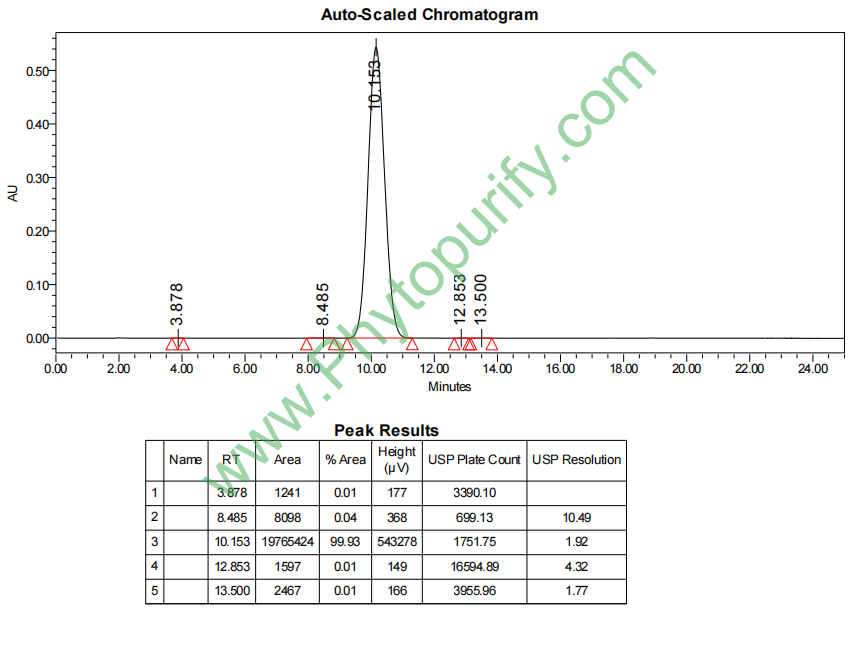
Purity: 95%~99%
Analysis Method: HPLC-DAD or/and HPLC-ELSD
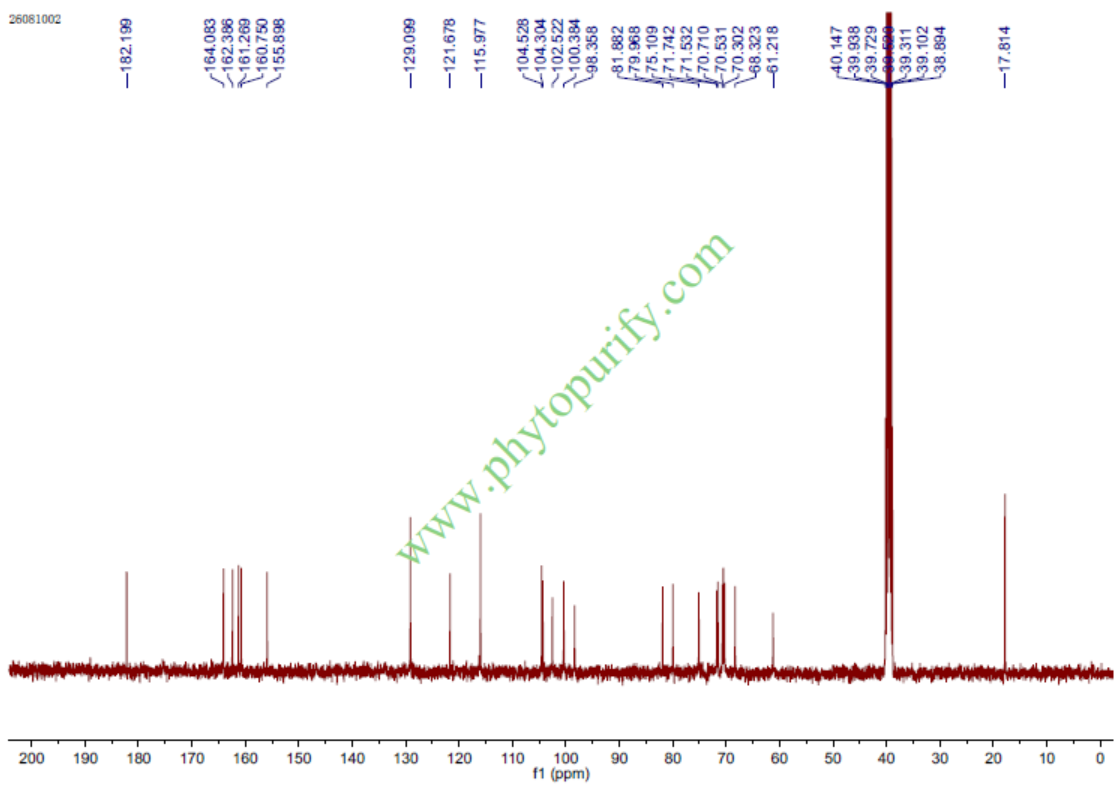
Identification Method: Mass, NMR
Packing: Brown vial or HDPE plastic bottle
Can be supplied from milligrams to grams.
For Reference Standard and R&D, Not for Human Use Directly.
Inquire for bulk scale.
Description:
Vitexin-2''-O-rhamnoside contributes to the protection against H₂O₂ -mediated oxidative stress damage and could be safely used for a wide range of concentrations.It has low bioavailability, mainly related to its poor absorption in the intestine.
References:
J Pharm Pharmacol. 2014 Jul;66(7):988-97.
Effects of vitexin-2"-O-rhamnoside and vitexin-4"-O-glucoside on growth and oxidative stress-induced cell apoptosis of human adipose-derived stem cells.
Vitexin-2''-O-rhamnoside(VOR) and vitexin-4"-O-glucoside (VOG) are the two main flavonoid glycosides of the leaves of Cratagus pinnatifida Bge. var. major N. E. Br. that has been widely used for the treatment of cardiovascular system diseases. In this study, we simultaneously investigated the influence of Vitexin-2''-O-rhamnoside and VOG on human adipose-derived stem cells (hADSCs) injury induced by hydrogen peroxide (H2 O2 ) to further characterize their anti-oxidative and anti-apoptotic activity.
METHODS AND RESULTS:
hADSCs were isolated, cultured in vitro and pretreated with 62.5 μm Vitexin-2''-O-rhamnoside or 120 μm VOG for 24 h and then exposed to 500 μm H2 O2 for an additional 4 h.Pretreatment of hADSCs with Vitexin-2''-O-rhamnoside and VOG was demonstrated to significantly ameliorate the toxicity and apoptosis effects, such as morphological distortion, nuclear condensation, decreased intracellular caspase-3 activity and percentage of cells in apoptosis/necrosis by using morphological assay, immunocytochemistry and flow cytometric evaluation. In addition, Vitexin-2''-O-rhamnoside and VOG caused no cytotoxic effect on hADSCs at concentrations up to 250 and 480 μm, respectively.
CONCLUSIONS:
Our results indicated that both Vitexin-2''-O-rhamnoside and VOG contribute to the protection against H2 O2 -mediated oxidative stress damage and could be safely used for a wide range of concentrations.
HPLC of 2"-Rhamnosylvitexin
NMR of 2"-Rhamnosylvitexin
Storage conditions:Short-term storage at 2~8℃, long-term storage at -20 ~ -80℃
239.9700
-.2032
-.3010
2.1851
.5155
.1054
Low
75.8562
4.7334
Yes
No
No
No
Yes
No
0.6
Yes
Yes
Yes
No
Natural products, as an important treasure trove for drug discovery and development, play an irreplaceable role in the long history of human fight against diseases. Flavonoids, as a major class of secondary metabolites with broad biological activities, have always been a research hotspot in terms of their structural diversity and pharmacological activity diversity. Hamnosylvitexin (2 '' - Hamnosylvitexin), as an important derivative of the flavonoid C-glycoside compound vitexin, exhibits a biological activity spectrum distinct from the parent compound due to its unique chemical modification. In recent years, with the deepening of research on the pathogenesis of cardiovascular diseases, especially atherosclerosis, vitexin rhamnoside has attracted much attention due to its potential role in anti-inflammatory, antioxidant, regulating lipid metabolism and protecting vascular endothelium. Its CAS number is 64820-99-1, and its molecular structure introduces α - L-rhamnose at the 2 '' - position of the vitexin glucose group. This structural change profoundly affects its physicochemical properties, bioavailability, and interactions with specific molecular targets. The purpose of this paper is to systematically review the chemical properties, plant sources, pharmacological activities of vitexin rhamnoside, especially the multi-target mechanism of action against atherosclerosis, and to preliminarily evaluate its pharmaceutical properties, in order to provide a comprehensive scientific reference for the in-depth research and potential drug development of this compound.
Vitexin rhamnoside, commonly known as vitexin 2 '' - O - α - L-rhamnoside, is a glycosylated derivative of vitexin (a type of apigenin 8-C-glucoside). Its core structure is the flavonoid mother nucleus (apigenin), which is connected to a glucose group at position 8 through a C-glycosidic bond, and further connected to an alpha-L-s-triosyl group (6-deoxy-Lmannose) on the 2 '' - hydroxyl group of the glucose group through an O-glycosidic bond. The unique structure of C-glycosides linked to O-glycosides categorizes them as C-glycosyl compounds and disaccharide derivatives.
Its molecular formula is C ₂₇ H ∝₀ O ₁₄, and its molecular weight is 578.5230. From the analysis of parameters related to drug properties, this compound exhibits typical polar molecular characteristics: the calculated lipid water partition coefficient LogP value is -0.2032, indicating its strong hydrophilicity; The topologically polar surface area (TPSA) is as high as 239.9700 Å ², mainly attributed to the large number of hydroxyl groups and oxygen atoms on the sugar ring in the molecule, which are donors and acceptors of hydrogen bonds, determining their strong polarity. The predicted value of water solubility is 2.1851 (usually measured in mg/mL or log mol/L, depending on the specific model), confirming its good water solubility, which is beneficial for its dissolution and distribution in biological fluids. However, high polarity and large TPSA also mean that its ability to penetrate lipid bilayer membranes is limited, and predictions show that its blood-brain barrier permeability is low, mainly distributed in the peripheral system. In terms of preliminary safety prediction, the risk of hERG channel inhibition is "no", indicating a low potential risk of arrhythmia; The Ames test predicted a value of 0.6 (usually a value less than 1 indicates a low risk of mutagenicity), indicating that its genetic toxicity risk may be relatively low. These physicochemical properties and safety predictions provide a fundamental basis for subsequent pharmacological research and formulation design.
Vitexin rhamnoside is widely present in various medicinal plants and is one of the active ingredients in many traditional herbs that exert cardiovascular protective effects. Its main plant sources include:
1. Hawthorn (Crataegus spp.)Hawthorn leaves and fruits are one of the main sources of vitexin and its glycosides, which are considered to be the material basis of hawthorn's "digestion, stomach health, qi circulation, and blood stasis dispersing" effects, closely related to improving cardiovascular function.
2. Vitex spp Such components are also found in the leaves and fruits of plants like Huangjing and Dujing.
3. Other plants In various leguminous plants and some plants used in traditional medicine, such as Guangzao It was also detected during the waiting period.
The extraction of vitexin rhamnoside usually follows the general extraction strategy for plant polyphenols and flavonoids. Common methods include:
- Solvent extraction method The most commonly used method is to use methanol, ethanol, or their aqueous solutions (such as 70% ethanol) for heating reflux or ultrasound assisted extraction. The ethanol water system is widely used due to its moderate polarity, low cost, and high safety, which can effectively extract polar glycoside compounds.
- Purification and Separation After filtration and concentration, the crude extract is often preliminarily enriched using macroporous adsorption resins (such as AB-8 and D101) to remove some impurities through their adsorption desorption characteristics. Further purification relies on chromatographic techniques, including silica gel column chromatography, polyamide column chromatography, as well as high-performance liquid chromatography (HPLC) and preparative liquid chromatography (pre HPLC). In modern analysis, mass spectrometry (MS) and nuclear magnetic resonance (NMR) are often combined for online or offline identification to ensure that the isolated target compound is vitexin rhamnoside.
- emerging technologies Microwave assisted extraction and supercritical fluid extraction technologies have also been applied in research aimed at improving extraction efficiency, shortening time, and reducing the amount of organic solvents used.
A large number of in vitro and in vivo studies have revealed the extensive pharmacological activities of vitexin rhamnoside, which focuses on cardiovascular protection, especially anti atherosclerosis.
The antiatherosclerotic effect of vitexin rhamnoside is not achieved through a single pathway, but involves a network regulation system with multiple targets and pathways. According to existing research, its key mechanism of action and molecular targets can be summarized as follows:
Inhibit LOX-1/oxidative stress/inflammatory axis Lectin like oxidized low-density lipoprotein receptor-1 (LOX-1, encoded by OLR1 gene) is the main receptor for recognizing and uptake of ox LDL on endothelial cells and macrophages, and is a key molecule for atherosclerosis initiation. Vitexin rhamnoside has been proven to have the ability to Downregulate the expression of LOX-1 To reduce the internalization of ox LDL and alleviate oxidative stress and inflammatory response at the source. This process is closely related to the inhibition of the nuclear factor kappa B (NF - κ B) signaling pathway.
Activate AMPK signaling pathway Adenosine activated protein kinase (AMPK, with PRKAA1 as its catalytic subunit) is a core regulatory factor in cellular energy metabolism. Vitexin rhamnoside can Activate AMPK Activation of AMPK brings multiple benefits: a) inhibition of acetyl CoA carboxylase (ACC), promotion of fatty acid oxidation, and improvement of energy metabolism; b) Inhibiting the mammalian target protein of rapamycin (mTOR) pathway and reducing inflammatory response; c) Upregulation of peroxisome proliferator activated receptor gamma co activator 1 alpha (PGC-1 alpha) enhances mitochondrial biosynthesis and function, and combats oxidative stress.
Regulating the balance between cell apoptosis and autophagy Abnormal apoptosis of cells in atherosclerotic plaque (especially endothelial cells and smooth muscle cells) will destroy the stability of plaque. This compound can Upregulation of anti apoptotic proteins Bcl-2 and Mcl-1 At the same time, it may inhibit the expression of pro apoptotic proteins, thereby suppressing ox LDL induced cell apoptosis. In addition, AMPK activation can also induce protective autophagy, clear damaged organelles, and maintain cellular homeostasis.
Promote cholesterol reverse transport Adenosine triphosphate binding cassette transporter A1 (ABCA1) is a key protein that transports intracellular cholesterol to high-density lipoprotein (HDL) and is the rate limiting step in cholesterol efflux. Research has shown that vitexin rhamnoside can Upregulation of ABCA1 expression To promote the outflow of cholesterol from macrophages and inhibit the formation of foam cells. The mechanism may be related to the activation of AMPK or liver X receptor (LXR) pathways.
Potential epigenetic regulation There are studies suggesting that it may regulate the expression of genes related to inflammation and metabolism by affecting the activity of epigenetic modifying enzymes such as histone methyltransferase (EHMT2), providing a new perspective for understanding its underlying mechanisms.
Potential association with DNA metabolism: RECQ1 (a DNA helicase) appearing in the target list indicates that this compound may affect DNA repair or genomic stability, which may be of significance in the context of cell proliferation and apoptosis, but the specific mechanism in the context of atherosclerosis is still unclear and needs to be explored.
To sum up, vitexin rhamnoside forms a synergistic network from reducing lipid intake, enhancing cell protection to promoting cholesterol clearance by acting on LOX-1, AMPK, Bcl-2/Mgl-1, ABCA1 and other key targets, which is the molecular basis of its anti atherosclerosis effect.
Based on its physical and chemical properties and preliminary research, a preliminary evaluation of the pharmacological properties of vitexin rhamnoside is conducted
At present, there are insufficient research reports on the pharmacokinetics of the vitexin rhamnoside system. Future research needs to clarify its drug time curve, absolute bioavailability, major metabolites, and excretion pathways in different animal models. To improve its bioavailability, it may be necessary to use pharmaceutical methods such as preparing phospholipid complexes, nanoparticles, cyclodextrin inclusion complexes, or developing prodrug strategies.
Vitexin rhamnoside shows a clear application potential in the prevention and treatment of atherosclerosis and related cardiovascular and cerebrovascular diseases (such as coronary heart disease, ischemic stroke).
Vitexin rhamnoside, as a natural flavonoid C-O-disaccharide, has shown comprehensive pharmacological activity of multiple pathways and targets in anti atherosclerosis by virtue of its unique chemical structure. Its mechanism of action covers multiple key links, including inhibiting LOX-1 mediated initial damage, activating the AMPK pathway to regulate metabolism and inflammation, regulating apoptosis/autophagy balance, and promoting ABCA1 mediated cholesterol efflux, forming an intrinsic protective network. Although it faces the common challenge of low bioavailability in terms of drug efficacy, its clear cardiovascular protective effects, multi-target properties, and initially predicted good safety make it an attractive lead compound and drug development candidate molecule. Future research should focus on overcoming its pharmaceutical shortcomings, optimizing it through modern pharmaceutical chemistry and pharmaceutics, and carrying out systematic preclinical and clinical research, with a view to transforming this ancient natural molecule into a modern drug for the prevention and treatment of cardiovascular diseases, such as atherosclerosis, for the benefit of human health.
