


Product name: Magnolin
Synonym name:
Catalogue No.: BP0915
Cas No.: 31008-18-1
Formula: C23H28O7
Mol Weight: 416.47
Botanical Source:
Physical Description:
Type of Compound: Lignans
Purity: 95%~99%
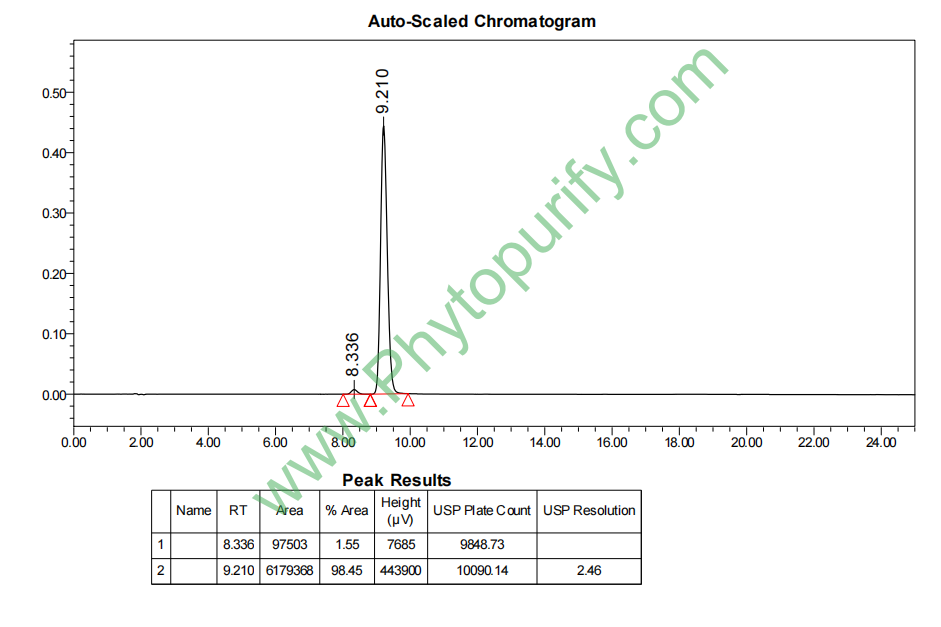
Analysis Method: HPLC-DAD or/and HPLC-ELSD
Identification Method: Mass, NMR
Packing: Brown vial or HDPE plastic bottle
Storage: Store in a well closed container, protected from air and light. Put into refrigerate or freeze for long term storage.
Whenever possible, you should prepare and use solutions on the same day. However, if you need to make up stock solutions in advance, we recommend that you store the solution as aliquots in tightly sealed vials at -20℃. Generally, these will be useable for up to two weeks.
The product could be supplied from milligrams to grams
Inquire for bulk scale.
Chengdu Biopurify Phytochemicals Ltd. is a leading company in the research, development, manufacture and marketing of High Quality Phytochemicals and Extracts(especially Active Ingredients from Traditional Chinese Medicine,TCM), Natural Active Pharmaceutical Ingredients worldwide.
The main services:
A. Supply active ingredients and reference standards of TCM, from mgs to kgs scale
B. Custom extraction and purification, target Herb Active Ingredients
C. Custom synthesis and semi-synthesis for Natural Active Ingredients
D. CR(contract research), CM(contract manufacture) and PD(process development) services from lab scale, pilot scale to commercial scale(GMP is also available)
E. TCM compounds library for drug screen,more than 3000 compounds available, many of them are rare and unique.
HPLC of Magnolin
Storage conditions:Short-term storage at 2~8℃, long-term storage at -20 ~ -80℃
Magnolin is a natural product isolated from the Magnolia Liliiflora plant, belonging to the magnolol class of compounds. In recent years, with the deepening of research on the pharmacological activity of natural products, magnolol has gradually become a hot topic in pharmacology and natural medicinal chemistry research due to its significant biological activity, especially in the fields of antiviral and anti-tumor potential. Its main target signaling pathway is the Ras/ERKs/RSK2 pathway, which can exert various biological effects by inhibiting the activity of ERK1 and ERK2. In addition, magnolol exhibits potential inhibitory effects on various virus related targets, demonstrating a wide range of antiviral activities. This article provides a systematic review of the chemical structure, plant origin, pharmacological activity, mechanism of action, pharmacological evaluation, and clinical application prospects of magnolol, aiming to provide theoretical basis and reference for related research.
The chemical formula of magnolol is C23H28O7, with a molecular weight of 416.4700. Its structural feature is a typical magnolol skeleton, containing multiple methoxy and hydroxyl substituents, endowing it with specific physicochemical properties. The LogP value of magnolol is 3.1698, indicating its moderate lipid solubility, which is beneficial for membrane penetration and in vivo distribution. Its topological polar surface area (TPSA) is 64.6100, reflecting the moderate level of molecular polarity and possessing both hydrophilic and hydrophobic properties. Low water solubility (0.0181 mg/mL) suggests limited solubility in aqueous phase, but good lipid solubility, which is beneficial for oral absorption and blood-brain barrier penetration, as confirmed by experimental data. Magnolialipin does not inhibit hERG channels, and the Ames mutagenicity test result is 0.0, indicating its high safety and low toxicity risk.
Magnolialipids are mainly present in the root bark and flower buds of Magnolia liliiflora, a plant in the Magnolia genus. Magnolia Liliiflora, as a traditional Chinese medicinal herb, has a long history and is widely used in the field of traditional Chinese medicine. The root bark and flower buds contain abundant magnolol compounds, with magnolol being the main active ingredient.
The common methods for extracting magnolol include solvent extraction, liquid-liquid separation, and chromatographic purification. Generally, ethanol or methanol is used as the extraction solvent to obtain crude extracts through reflux extraction or ultrasound assisted extraction. Subsequently, high-purity magnolol was obtained through separation and purification using techniques such as silica gel column chromatography and reverse phase high performance liquid chromatography (RP-HPLC). In recent years, the application of supercritical CO2 extraction and microwave-assisted extraction technology has improved extraction efficiency and purity, and the process is more environmentally friendly.
Magnolialipids have shown extensive activity in the field of antiviral therapy, exhibiting inhibitory effects against various virus related targets. Its targets include myeloperoxidase (MPO), herpes virus proteins UL42, UL54, ICP27, thymidine kinase (TK), viral glycoprotein gD, as well as HIV related targets CCR5, CXCR4, HIV1 protease (HIV1-PR), and integrase (INT). Through multi-target action, magnolol can interfere with virus replication, assembly, and invasion processes, exhibiting significant antiviral effects.
Related in vitro experiments have shown that magnolol has inhibitory effects on viruses such as herpes simplex virus (HSV) and human immunodeficiency virus (HIV), and has low cytotoxicity, demonstrating good selectivity index. In addition, magnolol enhances its antiviral defense ability and further enhances its antiviral potential by regulating the host immune response.
Magnolialipin targets the Ras/ERKs/RSK2 signaling pathway, inhibits ERK1 and ERK2 kinase activity (IC50 of 87 nM and 16.5 nM, respectively), blocks cell proliferation and metastasis related signals, and exhibits anti-tumor activity. This pathway is abnormally activated in various tumor cells, participating in cell cycle regulation, apoptosis inhibition, and cell migration. The inhibitory effect of magnolol effectively blocks the growth and invasion of tumor cells and promotes apoptosis.
Several in vitro cell experiments and animal model studies support the anticancer potential of magnolin in lung cancer, breast cancer, colorectal cancer and other tumors. Its mechanism of action involves inhibiting RSK2 kinase downstream of the ERK signaling pathway, regulating the expression of cell cycle proteins and apoptosis related proteins, and enhancing cell sensitivity to chemotherapy drugs.
In addition to antiviral and anti-tumor effects, magnolol also exhibits anti-inflammatory, antioxidant, and neuroprotective effects. It can inhibit the release of inflammatory mediators, alleviate oxidative stress damage, and protect nerve cells from damage, providing a theoretical basis for its application in neurodegenerative and chronic inflammatory diseases.
The core mechanism of action of magnolol is to target the Ras/ERKs/RSK2 signaling pathway. This pathway plays a critical regulatory role in cell proliferation, differentiation, migration, and survival. Magnolialipin directly binds to and inhibits the activity of ERK1 and ERK2 kinases, blocking their phosphorylation and downstream signaling, thereby inhibiting the activation of RSK2 kinase. RSK2, as a key effector of the ERK signaling pathway, participates in regulating various transcription factors and cell cycle proteins. The inhibitory effect of magnolol leads to cell cycle arrest and apoptosis.
In terms of antiviral activity, magnolol works synergistically through multiple targets, interfering with the function of viral proteins and the process of viral replication. For example, inhibiting UL42 and UL54 proteins affects viral DNA replication, inhibiting ICP27 protein interferes with viral gene expression, and blocking TK and gD proteins affects viral invasion and spread. Inhibition of HIV related targets CCR5 and CXCR4 blocks virus entry into host cells, demonstrating its multidimensional antiviral mechanism.
In addition, magnolol has a regulatory effect on the host immune system, enhancing antiviral immune response and reducing the risk of virus escape.
Mulan lipid has good pharmacological parameters. Its molecular weight of 416.47 conforms to Lipinski's rule, and its LogP value of 3.17 is moderate, indicating that it has good membrane permeability and oral bioavailability. The TPSA is 64.61, which supports its blood-brain barrier penetration ability and is suitable for the treatment of central nervous system diseases.
Low water solubility is a major challenge for its medicinal properties, which may limit its oral absorption and in vivo distribution. To this end, researchers have attempted to improve its solubility and bioavailability through drug delivery systems such as nanocarriers, liposomes, and solid dispersions.
In terms of safety, magnolol does not inhibit hERG channels, reducing the risk of cardiac toxicity. A negative Ames test indicates no significant mutagenicity, indicating high safety. Preliminary pharmacokinetic studies have shown that magnolol has a long half-life and good tissue distribution in vivo, especially at high concentrations in brain tissue, supporting its neuroprotective potential.
Based on the significant activity of magnolol in antiviral and anti-tumor fields, its clinical application prospects are broad. At present, magnolol is still in the preclinical research stage, and in the future, systematic pharmacokinetic, toxicological, and clinical trials need to be conducted to verify its safety and efficacy.
In the field of antiviral therapy, magnolol is expected to become a multi-target antiviral drug, especially for the treatment of herpes virus and HIV. Its multi-target mechanism helps to reduce the risk of drug resistance and improve treatment efficacy.
In terms of tumor treatment, magnolol has the potential to serve as a targeted therapeutic drug by inhibiting key signaling pathways. Combined use with existing chemotherapy drugs may enhance efficacy and reduce side effects. In addition, its excellent blood-brain barrier penetration ability gives it unique advantages in the treatment of brain tumors and neurological diseases.
Future research should focus on the structural modification of magnolol and the development of drug delivery systems to enhance its water solubility and bioavailability; At the same time, in-depth analysis of its molecular mechanism of action and expansion of its indications. Multidisciplinary collaboration will accelerate the process of translating magnolol into clinical practice.
Magnolialipin, as the main active ingredient of Magnolia liliflora, has shown great potential in antiviral and anti-tumor fields due to its unique chemical structure and multi-target pharmacological activity. It exerts anti-tumor effects by targeting the Ras/ERKs/RSK2 signaling pathway, regulating cell proliferation and apoptosis; At the same time, multi-target inhibition of viral proteins enhances host immunity and demonstrates broad-spectrum antiviral ability. Good pharmacological parameters and safety lay the foundation for its clinical development. Although still facing challenges in terms of water solubility and pharmacokinetics, through the application of modern drug design and delivery technologies, magnolol is expected to become a new generation of natural product drugs, providing new strategies and choices for antiviral and anti-tumor treatments. Future systematic research and clinical validation will further reveal its clinical application value and promote its clinical translation.
