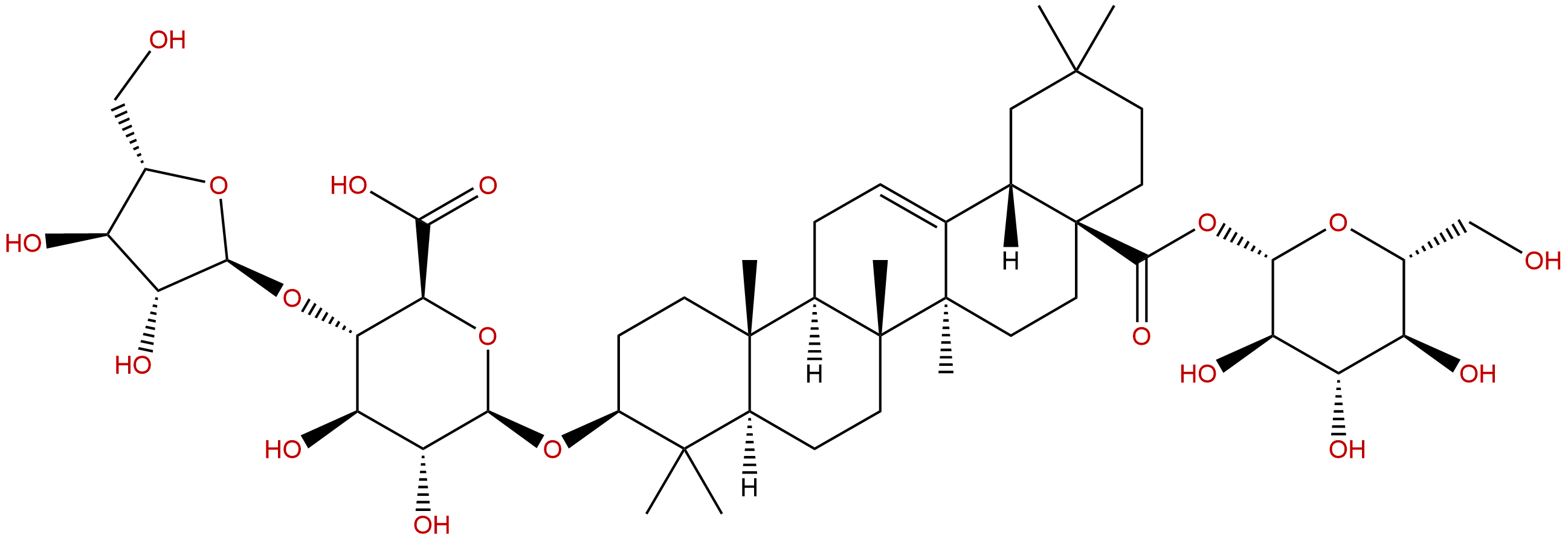


Product name: Araloside A
Synonym name:
Catalogue No.: BP3072
Cas No.: 7518-22-1
Formula: C47H74O18
Mol Weight: 927.091
Botanical Source:
Physical Description: Powder
Type of Compound: Triterpenoids
Purity: 95%~99%
Analysis Method: HPLC-DAD or/and HPLC-ELSD
Identification Method: Mass, NMR
Packing: Brown vial or HDPE plastic bottle
The product could be supplied from milligrams to grams. Inquire for bulk scale.
We provide solution to improve the water-solubility of compounds, thereby facilitating the variety of activity tests and clinic uses.
For Reference Standard and R&D, Not for Human Use Directly.
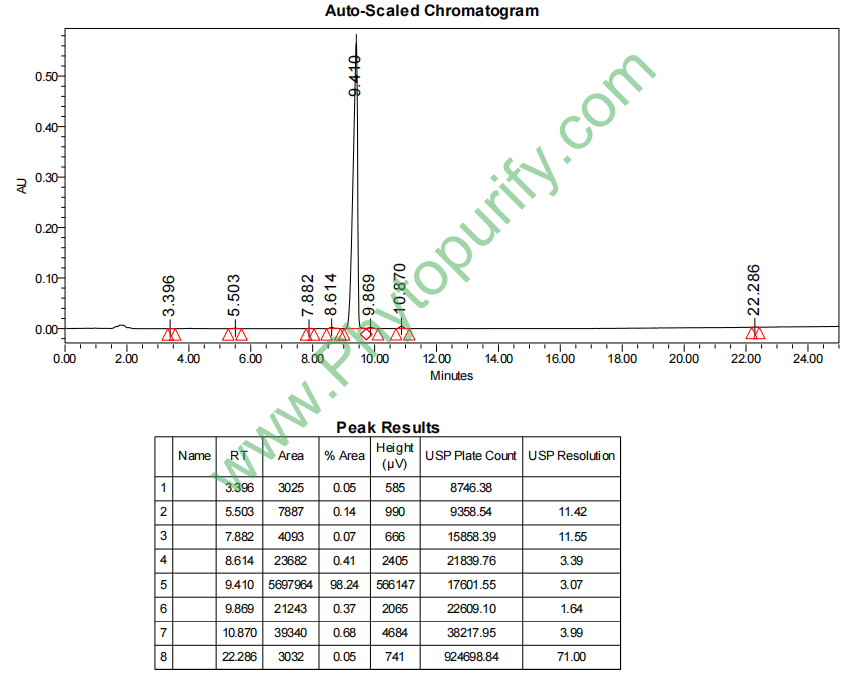
HPLC of Araloside A
Storage conditions:Short-term storage at 2~8℃, long-term storage at -20 ~ -80℃
291.8200
2.3468
-.3513
.1102
.6165
.1593
Low
81.5143
6.2097
Yes
No
Yes
No
No
No
0.0
Yes
No
No
No
Araloside A, also known as Chikusetsu saponin IV, is a type of saponin isolated from plants in the Araliaceae family Oleander type triterpenoid saponins Its CAS number is 7518-22-1, molecular formula is C47H74O18, and molecular weight is as high as 927.09 g/mol. As a natural product with oral activity, Aralia elata saponin A has long been applied in traditional Chinese medicine systems, and modern pharmacological research has gradually revealed its extensive biological activity. Research has shown that Aralia elata saponin A has Weak renin inhibitory activity(IC50 = 77.4 μM), And it can significantly inhibit cell proliferation and induce cell apoptosis. In addition, it can also inhibit the production of key inflammatory factors IL-1 β and IL-6. These characteristics make it cancer(such as gastric cancer, renal cell carcinoma)Inflammatory diseases(such as rheumatoid arthritis) and cardiovascular disease The research field of myocardial ischemia and infarction has shown significant potential. This article will provide a systematic and professional interpretation of this natural product from the aspects of its chemical structure, plant origin, pharmacological mechanism, medicinal evaluation, and research prospects.
The chemical structure of Aralia elata saponin A is complex and belongs to the triterpenoid saponin class. The SMILES string provides a detailed description of its three-dimensional configuration, with the core being Oleander type triterpenoid parent nucleus There are multiple sugar groups (such as glucose, arabinose, etc.) connected to the mother nucleus, forming glycosidic bonds. This glycosylation modification has a decisive impact on its water solubility, biological activity, and target recognition.
Analyze its physicochemical properties based on the provided pharmacological parameters:
- Molecular weight (MW):927.09 g/mol, Far beyond the scope of conventional small molecule drugs (usually<500 Da), this poses a challenge to their oral absorption and membrane permeability.
- Lipid water partition coefficient (LogP/LogD)The calculated LogP is 2.35, while LogD (at physiological pH) is -0.35. A positive LogP indicates that the molecule itself has a certain degree of lipophilicity, but a negative LogD suggests that under physiological conditions (pH 7.4), due to the presence of multiple hydroxyl and carboxyl groups in its structure, the molecule may Ionized form Existence, overall hydrophilicity enhancement. This is often manifested as triterpenoid saponins surfactant The characteristics match.
- Topological Polarity Surface Area (TPSA)Up to 291.82 Å ², far exceeding the threshold commonly believed to be easy to penetrate cell membranes (about 140 Å ²), which directly explains its poor membrane permeability.
- Water solubility The value is 0.1102 (usually measured in mg/mL or mol/L, not specified here, but the relative value is relatively low), indicating that it belongs to a slightly soluble or poorly soluble substance, and may require formulation technology to improve solubility in practical applications.
- Penetration data The Caco-2 cell permeability (Caco2_permeability) is only 0.1593, and the Peff (effective permeability) is 0.6165, both at a relatively low level, confirming its Poor oral absorption The blood-brain barrier penetrability (BBB-permeability) is evaluated as "low", indicating difficulty in entering the central nervous system to exert its effects.
Overall, Aralia elata saponin A is a High polarity, large molecules, low permeability The nature of natural products is more inclined towards medicinal properties lead compound Instead of directly developing drug molecules, subsequent structural optimization or advanced delivery systems are required.
Araliaceae saponins A mainly come from the Araliaceae family aralia Plant The database clearly indicates that its source is Aralia elata(Chinese Angelica Tree), scientific name Aralia chinensis(Note: The existing description mentions Aralia elata Also one of the sources, both are closely related species. Aralia plants are widely distributed worldwide, especially in East Asia, and their root bark, bark, or leaves are Traditional Chinese Medicine Both Japanese and Korean folk medicine have a long history of application.
In traditional Chinese medicine theory, Aralia elata (often referred to as "pricking old buds" or "birds do not rest") is often used for Dispelling wind and dampness, promoting blood circulation and relieving pain, promoting diuresis and reducing swelling It is commonly used in folk medicine to treat conditions such as rheumatism and rheumatism, traumatic injuries, hepatitis, nephritis and edema. Its traditional effects of "promoting blood circulation" and "anti-inflammatory" are combined with the discovery of modern research that Aralia elata saponin A has Anti inflammatory, myocardial protection, anti liver injury The activity is highly consistent. This reflects the mutual verification between traditional empirical medicine and modern pharmacological research, and also provides a classic example for mining active ingredients from traditional herbs. The systematic chemical study of Aralia elata has isolated and identified a series of triterpenoid saponins represented by Aralia elata saponin A, which is considered one of the main material bases for its pharmacological effects.
The pharmacological activities of Aralia elata saponin A are diverse, with the core centered around antitumor and anti-inflammatory The two main lines involve the regulation of multiple key cellular signaling pathways and targets through their mechanisms of action.
4.1 Antitumor activity and related targets
The database clearly defines the relationship between Aralia elata saponin A and Stomach cancer The study is related and provides five key molecular targets: BCL2, TP53, CASP3, BAX, and CDKN1A. These targets form a core network that regulates the cell cycle and apoptosis:
- Regulation of the balance between promoting apoptosis and inhibiting apoptosis BCL2 is important Anti apoptotic protein And BAX is Pro apoptotic protein Research has shown that many natural products can activate endogenous apoptotic pathways by downregulating BCL2 and upregulating BAX expression, disrupting mitochondrial membrane potential, promoting cytochrome C release. Araliaceae saponin A is likely to break the inherent apoptosis resistance of cancer cells through a similar mechanism.
- Activation of p53 pathway The p53 protein encoded by the TP53 gene is a well-known "genome guardian" that is activated under stress such as DNA damage and can induce cell cycle arrest (by upregulating CDKN1A/p21) or apoptosis (by upregulating BAX, etc.). Aralia elata saponin A may activate the p53 pathway, causing cancer cells to stagnate in the G1/S phase (CDKN1A action) and move towards apoptosis.
- Activation of apoptosis executors CASP3 (cysteine protease-3) is a key factor in the process of apoptosis Effector protease Responsible for cutting various cellular substrates, leading to cell disintegration. The apoptosis induced by Aralia elata saponin A will ultimately manifest as the activation of CASP3.
Therefore, the anti-tumor mechanism of Aralia elata saponin A may be a Multi target synergistic effect The process: It regulates the balance of BCL2 family proteins by affecting upstream signals such as p53, ultimately leading to the activation of CASP3, thereby achieving inhibition of proliferation and induction of apoptosis in cancer cells such as gastric cancer.
4.2 Anti inflammatory and organ protective activity
The existing description indicates that saponins A from Aralia elata can inhibit IL-1 β and IL-6 The production of key pro-inflammatory cytokines. IL-1 β and IL-6 are core factors mediating acute and chronic inflammation, autoimmune diseases such as rheumatoid arthritis, and tumor microenvironment inflammation. Inhibiting their production is the molecular basis for their anti-inflammatory and relief of rheumatoid arthritis symptoms.
In addition, Aralosides saponins have been shown to have a protective effect on experimental myocardial ischemia and infarction. Its mechanism may be related to Improving metabolic disorders of free fatty acids and Inhibition of membrane lipid peroxidation induced by oxygen free radicals of This reflects its anti-oxidative stress and metabolic regulation The ability. Meanwhile, its preventive effect on acute alcoholic liver injury is closely related to its anti-inflammatory and antioxidant properties.
4.3 Weak renin inhibitory activity
The renin-angiotensin system is a key pathway for regulating blood pressure. The weak renin inhibitory activity (IC50 77.4 μ M) exhibited by Aralia elata saponin A provides preliminary pharmacological evidence for its potential application in cardiovascular diseases such as hypertension and heart failure. Although its activity is weak, it suggests the diversity of its action directions.
Based on the provided pharmacological parameters, combined with Lipinski's Five Rules Objective evaluation of the potential of Aralia elata saponin A as an oral medication using standards such as Rule of Five (Ro5):
Lipinski's Five Rules Compliance Analysis:
Evaluation of other key parameters:
Comprehensive Assessment Aralia saponin A is a Clear activity but poor medicinal properties Natural lead compounds. Its powerful multi-target pharmacological activity (anti-tumor, anti-inflammatory) is in stark contradiction to its poor drug like properties (poor absorption, high molecular weight). Possible directions for developing it into a drug in the future include: 1) as Prodrug Perform structural modifications (such as simplifying sugar chains, preparing liposomes or glycoside derivatives) to improve their physicochemical properties and pharmacokinetics; 2) Development New drug delivery system Such as nanoparticles, microemulsions, phospholipid complexes, etc., to enhance their solubility and bioavailability; 3) As Drug combination Utilize the multi-target properties of the components in to enhance therapeutic efficacy.
At present, research on saponins A in Aralia elata is still ongoing Preclinical stage Mainly focused on activity screening, mechanism of action exploration, and preliminary in vitro and in vivo pharmacological validation. Its potential in gastric cancer, renal cell carcinoma, rheumatoid arthritis, and myocardial protection has been preliminarily confirmed, but there is a lack of systematic pharmacokinetic, toxicological, and clinical trial data.
Future research directions Possible focus on the following points:
1. Deepening mechanism research By utilizing techniques such as gene knockout/knockdown, proteomics, transcriptomics, etc., we aim to further elucidate the upstream signaling pathways that regulate targets such as BCL2 and p53, and explore their potential roles in regulating the tumor microenvironment and immune regulation.
2. Structural optimization and structure-activity relationship The system aims to study the effects of its sugar chain and glycoside components on activity and drug formation, with the aim of preserving or enhancing its core pharmacological activity while significantly improving its water solubility, permeability, and metabolic stability, and obtaining more valuable derivatives for development.
3. Innovation in formulation technology Actively developing biocompatible nanocarrier systems (such as polymer nanoparticles, solid lipid nanoparticles, exosomes, etc.) to address their physical and chemical defects is a key breakthrough in achieving efficient delivery and therapeutic effects in vivo.
4. Exploration of Combination Therapy The study of the combined application of Aralia elata saponin A with existing chemotherapy drugs, targeted drugs, or immune checkpoint inhibitors may produce synergistic effects and reduce toxic side effects, providing new treatment strategies for complex diseases such as cancer.
In summary, as a natural active molecule discovered from traditional medicinal plants, Aralia elata saponin A provides new candidate compounds and drug design ideas for the treatment of diseases such as tumors and inflammation due to its unique multi-target mechanism of action. Despite facing significant challenges in developing medicinal properties, with the continuous development of modern pharmaceutical chemistry, pharmacy, and biology technologies, it is expected that this ancient plant component can be transformed into modern drugs with clinical application value through rational structural modification and advanced delivery strategies, fully demonstrating the sustained vitality of natural products in innovative drug research and development.
