


Synonym name: Araliasaponin V; Congmuyanoside V
Catalogue No.: BP0386
Cas No.: 340963-86-2
Formula: C54H88O23
Mol Weight: 1105.28
Botanical Source: Aralia elata (Japanese angelica tree)
Purity: 95%~99%
Analysis Method: HPLC-DAD or/and HPLC-ELSD
Identification Method: Mass, NMR
Packing: Brown vial or HDPE plastic bottle
Can be supplied from milligrams to grams.
For Reference Standard and R&D, Not for Human Use Directly.
Inquire for bulk scale.
HPLC of Congmunoside V
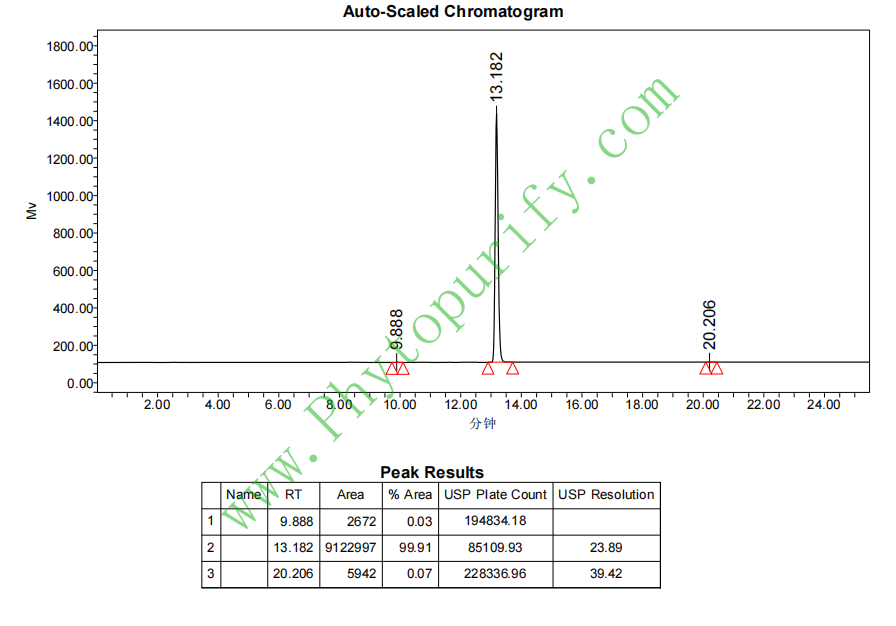
Storage conditions:Short-term storage at 2~8℃, long-term storage at -20 ~ -80℃
Congmnoside V is a type of saponin derived from Aralia elata in Liaodong(Corydalis heterocarpa)The natural product saponins have received widespread attention in recent years due to their potential activity in the field of anti-tumor. Lung cancer, as one of the malignant tumors with the highest incidence rate and mortality in the world, urgently needs new highly effective and low toxic therapeutic drugs. Natural products have become important resources for the development of anti-cancer drugs due to their structural diversity and rich biological activity. Liaodong Aralia saponin V, with its unique chemical structure and multi-target mechanism of action, exhibits significant inhibitory effects on lung cancer cells and has become a hot topic in natural product pharmacology research.
This article will systematically review the chemical structure and physicochemical properties, plant sources and extraction methods, pharmacological activity and mechanism of action, pharmacological evaluation and pharmacokinetic characteristics of Liaodong Aralia saponin V. It will also explore its clinical application prospects and development directions, providing theoretical basis and reference for subsequent related research and drug development.
The molecular formula of Liaodong Aralia saponin V has not been fully disclosed, but its molecular weight is 1085.3, belonging to the class of high molecular weight triterpenoid saponins. Its LogP value is 1.0, indicating that it has moderate lipophilicity, which is conducive to membrane penetration but not excessively hydrophobic. The TPSA (topological polar surface area) is as high as 399.7, indicating strong molecular surface polarity and 23 hydrogen bond acceptors, suggesting that the molecule contains a large number of polar groups such as hydroxyl, carboxyl, or glycosidic moieties. These structural features have a significant impact on its water solubility and binding ability with target proteins.
The structural core of Liaodong Aralia saponin V is a triterpenoid skeleton, which connects multiple glycoside units to form a complex glycoside chain structure. This structure not only endows it with good biological activity, but also affects its pharmacokinetic properties, such as low blood-brain barrier permeability and lower lipid solubility. It has good chemical stability and is suitable for in vitro and in vivo pharmacological research.
The main source of saponin V in Liaodong Aralia elata is from Liaodong Aralia elata(Corydalis heterocarpa)This plant belongs to the poppy family and is a traditional medicinal plant distributed in Northeast China and the Korean Peninsula. Liaodong Aralia elata is commonly used in traditional Chinese medicine for promoting blood circulation, removing blood stasis, relieving pain, and anti-inflammatory effects. Its roots and stems contain abundant alkaloids and saponins.
The extraction of saponins V from Liaodong Aralia elata usually involves the following steps:
This extraction method can obtain high-purity Liaodong Aralia saponin V, which meets the needs of pharmacological and pharmacokinetic research.
Liaodong Aralia saponin V has shown significant anti lung cancer activity in multiple in vitro and in vivo experiments. Its main pharmacological effects include:
In addition, animal model studies have shown that Liaodong Aralia saponin V has good tolerance, no significant hepatotoxicity or cardiotoxicity, and no hERG channel inhibition was observed, indicating high safety.
The anti lung cancer effect of Liaodong Aralia saponin V involves multiple signaling pathways and molecular targets, reflecting its multi-target drug characteristics:
Through multi-target synergistic effects, Liaodong Aralia saponin V effectively inhibits the proliferation, migration, and survival of lung cancer cells, demonstrating good anti-tumor potential.
The pharmacological parameters of Liaodong Aralia saponin V show that it has certain development potential:
In terms of pharmacokinetics, existing research is relatively limited. Preliminary data shows that the oral absorption of Liaodong Aralia saponin V is poor, with a moderate half-life in vivo. It is mainly metabolized through the liver, and the activity of metabolites still needs to be further studied. In the future, systematic pharmacokinetic and toxicological studies need to be conducted to optimize the routes of administration and dosage form design.
Liaodong Aralia saponin V, as a natural product with multi-target anti lung cancer activity, exhibits good pharmacological activity and safety, and has high clinical translation potential. Its multi-target mechanism of action helps overcome the problem of single target drug resistance and is suitable for combination therapy strategies for lung cancer.
Future research directions include:
In addition, the potential of Liaodong Aralia saponin V in regulating tumor microenvironment, immune regulation, and other aspects is also worth further exploration to expand its indications.
Liaodong Aralia saponin V, as a natural triterpenoid saponin derived from traditional medicinal plants, has become a focus of natural product pharmacology research due to its unique chemical structure and multi-target anti lung cancer effects. Its good safety and ability to regulate multiple pathways provide new ideas and candidate drugs for the treatment of lung cancer. Although its pharmacokinetics and clinical research are still in their infancy, with the deepening of research, Liaodong Aralia saponin V is expected to become an important natural drug resource in the field of lung cancer treatment, promoting the process of natural product translation into clinical practice.
In the future, interdisciplinary research combining modern medicinal chemistry, molecular biology, and clinical medicine will further reveal the mechanism of action of Liaodong Aralia saponin V, optimize its drug properties, promote its clinical application, and bring new treatment hope to lung cancer patients.
