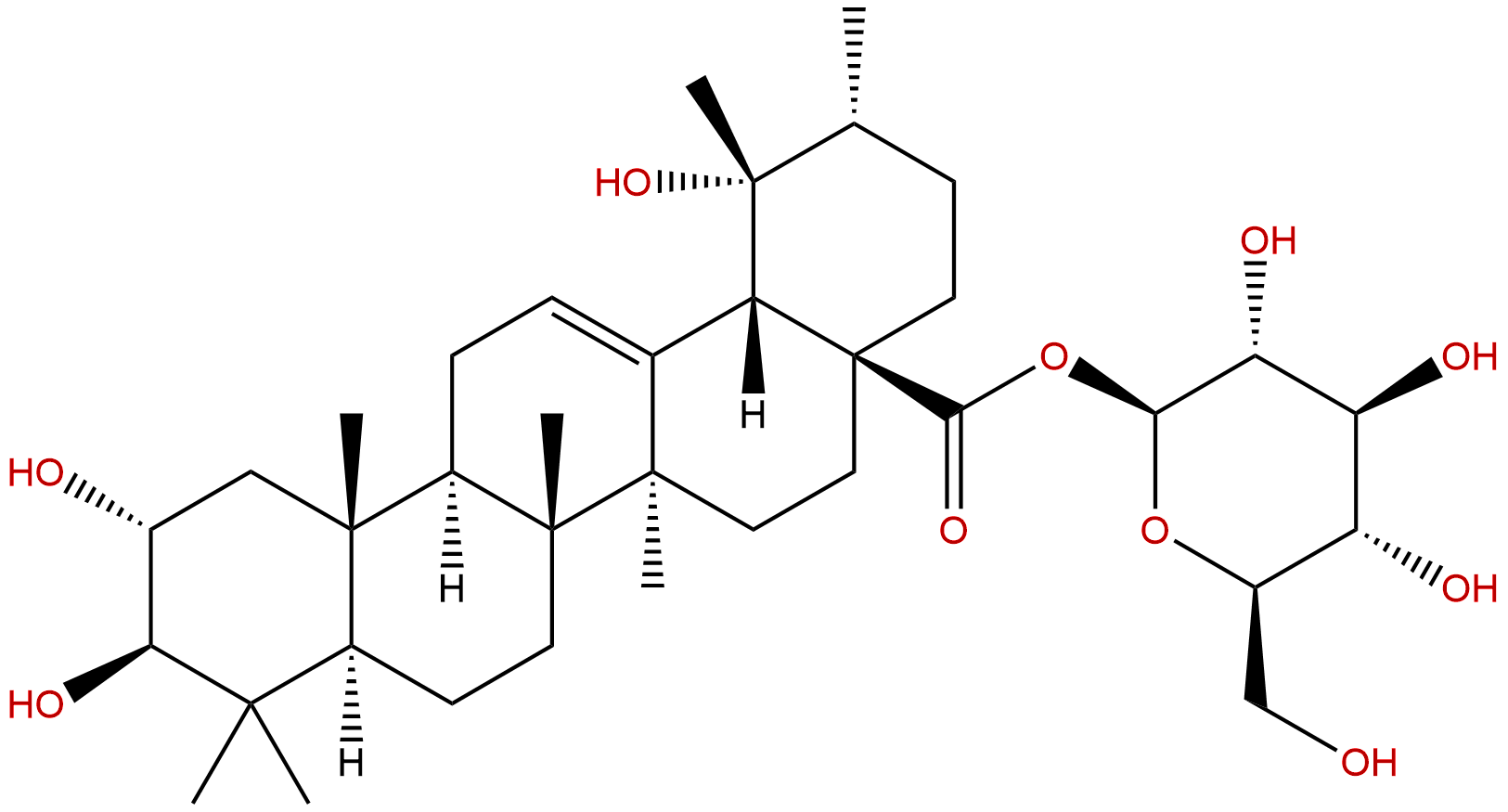


Product name: Rosamultin
Synonym name: Tormentic acid glucosyl ester; Tormentic acid glucoside
Catalogue No.: BP3462
Cas No.: 88515-58-6
Formula: C36H58O10
Mol Weight: 650.85
Botanical Source: Rosa laevigata Michx.
Physical Description:
Type of Compound: Triterpenoids
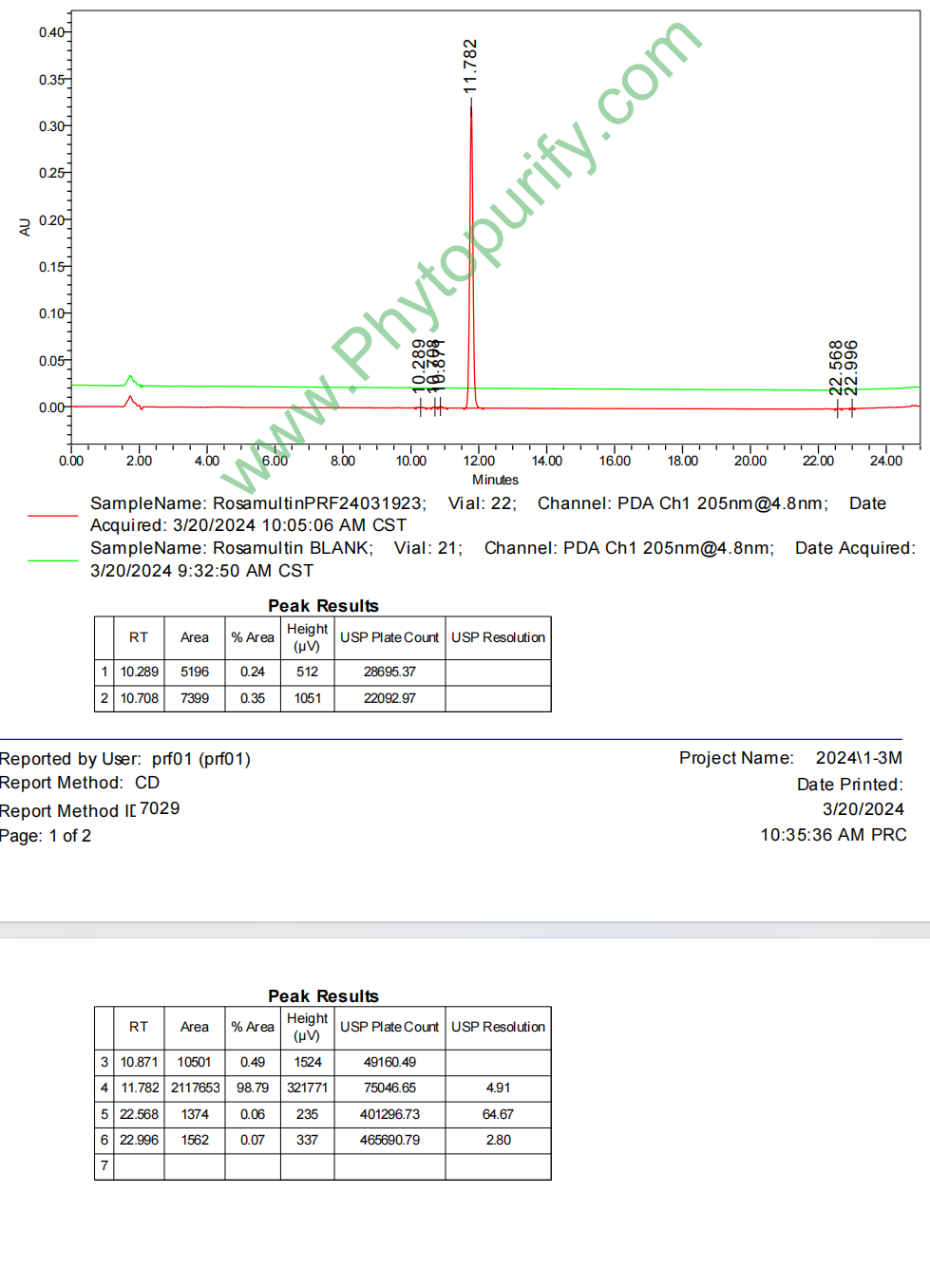
Purity: 95%~99%
Analysis Method: HPLC-DAD or/and HPLC-ELSD
Identification Method: Mass, NMR
Packing: Brown vial or HDPE plastic bottle
The product could be supplied from milligrams to grams. Inquire for bulk scale.
We provide solution to improve the water-solubility of compounds, thereby facilitating the variety of activity tests and clinic uses.
For Reference Standard and R&D, Not for Human Use Directly.
HPLC of Rosamultin
Storage conditions:Short-term storage at 2~8℃, long-term storage at -20 ~ -80℃
177.1400
2.8118
2.8121
.0305
.6601
1.0031
Low
74.2801
5.5502
No
No
No
No
No
No
0.0
Yes
No
Yes
Yes
Rosamultin, a 19 α - hydroxy triterpenoid compound isolated from Rosaceae plants, has a CAS number of 88515-58-6. This compound has attracted much attention in natural product chemistry and pharmacology research, mainly due to its unique chemical structure and extensive biological activity. Wild rose glycoside was initially isolated from Potentilla anserina L., and subsequent studies have found that it also exists in medicinal plants such as Rosa laevigata Michx. As a member of the triterpenoid saponin family, its molecular formula is C36H58O10 and its molecular weight is approximately 650.85 g/mol.
Modern pharmacological research has revealed that wild rose glycosides exhibit various biological activities, among which the most prominent are their significant antioxidant and anti apoptotic effects. Research has shown that it can effectively protect cells from oxidative stress damage induced by hydrogen peroxide (H2O2). In addition, early studies have also found that it has inhibitory activity against human immunodeficiency virus type 1 protease (HIV-1 Protease), with an inhibition rate of up to 53% at a concentration of 100 micromoles, indicating its potential antiviral application prospects. Further research has expanded its activity spectrum, including anti-inflammatory, analgesic, and combating bromobenzene induced liver toxicity by enhancing epoxide hydrolase activity. These findings make wild rose glycoside a potential lead compound or drug candidate molecule for studying oxidative stress-related diseases such as neurodegenerative diseases, cardiovascular diseases, liver injury, etc. This article will provide a systematic and professional scientific interpretation of this natural product from the aspects of its chemical structure, plant origin, pharmacological mechanism, medicinal evaluation, and research prospects.
The chemical structure of Rosa rugosa glycoside is the material basis for its biological activity. Its SMILES string (C [C @ @ H] 1CC [C @] 2 (C (=O) O [C @ @ H] 3O)C@HC@@HC@H[C@H]3O)CC[C@]3(C)C(=CC[C@@H]4[C@@]5(C)CC@@HC@H C (C) (C) [C @ @ H] 5CC [C @] 43C) [C @ @ H] 2 [C @] 1 (C) O) accurately describes its atomic connections and stereoconfiguration. According to the molecular formula C36H58O10, it is a triterpenoid saponin containing multiple hydroxyl groups and glycosidic bonds. Its core is a 19 α - hydroxy triterpenoid parent nucleus, which is linked by glycosidic bonds to a sugar group (inferred from SMILES and molecular formula, possibly glucose or similar sugar units). This structure enhances its water solubility and may affect its interaction with biological targets.
Analyze its physicochemical properties based on the provided pharmacological parameters:
- Molecular weight (MW):650.85 g/mol, Slightly higher than conventional small molecule drugs (usually<500 Da), but still within the range of oral absorption.
- Lipid water partition coefficient (LogP/LogD)The LogP is 2.8118 and LogD is 2.8121, indicating that the compound has moderate lipophilicity, which is beneficial for penetrating cell membranes, but does not lead to rapid metabolism or poor distribution due to excessive lipophilicity.
- Topological Polarity Surface Area (TPSA)Up to 177.14 Å ², mainly attributed to the presence of multiple hydroxyl groups and oxygen atoms on the sugar ring in the molecule. High TPSA is usually not conducive to passive transmembrane transport, especially the penetration of the blood-brain barrier (BBB).
- Water solubility The value is 0.0305 (usually measured in mg/mL or mol/L, not specified here, but the value is relatively small), indicating its low solubility in water, which is consistent with the structural characteristics of its triterpenoid saponins. Solubilization strategies may need to be considered during formulation development.
- Permeability The permeability of Caco-2 cells is 1.0031 (× 10 ⁻⁶ cm/s), and the effective permeability of Peff (human body) is 0.6601 (× 10 ⁻⁴ cm/s), which is in the range of moderate to low, indicating that their intestinal absorption may be moderate. BBB penetration is labeled as' low ', which is consistent with the prediction of high TPSA, indicating that it may not easily enter the central nervous system.
- Plasma protein binding rate (PPB)74.28%, belonging to a moderately high level, will affect its free drug concentration and distribution in the body.
In summary, wild rose glycoside is a triterpenoid saponin with a medium molecular weight, moderate lipophilicity, but a large polar surface area and poor water solubility. These properties collectively determine its pharmacokinetic characteristics.
Wild rose glycosides mainly come from Rosaceae plants. The literature clearly records its origin from Goose velvet sundew (Potentilla anserina L.)Separated from the middle. In addition, database information shows that it also exists in Rosa laevigata Michx Among the fruits. These two plants have a long history of application in traditional medicine.
Cherokee rose Also known as prickly pear or mountain pomegranate, it is a commonly used astringent medicine in traditional Chinese medicine. Its dried and ripe fruit is used as medicine, with a sour, sweet, astringent and mild taste, and is suitable for the kidneys, bladder, and colon meridians. The traditional functions mainly include consolidating essence, reducing urine, stopping collapse, stopping diarrhea and astringency. Commonly used for treating conditions such as nocturnal emissions, slippery semen, frequent enuresis, diarrhea, and dysentery. Modern research shows that Rosa laevigata is rich in polyphenols, flavonoids, triterpenes and polysaccharides, and has many pharmacological activities such as antioxidant, anti-inflammatory, antibacterial, anti diabetes, and kidney protection. Wild rose glycoside, as a triterpenoid component, is likely to contribute to its antioxidant and cell protective effects.
Goose Feather Rice Dumpling There is also a medicinal habit among the people, commonly used to treat diseases such as diarrhea, dysentery, and bleeding. Its pharmacological research has also confirmed its anti-inflammatory, antioxidant, and hepatoprotective effects.
Although traditional applications do not directly target the single component of wild rose glycoside, the overall therapeutic effect of the plant is highly consistent with the antioxidant, anti-inflammatory, and hepatoprotective activities of this compound revealed by modern research. This reflects the importance of the research paradigm of extracting active ingredients from traditional medicinal plants and elucidating their material basis and mechanism of action through modern scientific methods. The discovery of wild rose glycosides is a successful case under this paradigm.
The pharmacological activities of Rosa rugosa glycoside are diverse, but its core mechanism of action is related to Regulating oxidative stress Closely related. The target information provided by the database clearly points to this pathway: NRF2, CAT, GPX1, HMOX1, SOD2. These targets are key components of the cellular antioxidant defense system. Below is a detailed explanation of its mechanism of action based on its known activity:
4.1 Core pharmacological activity
1. Antioxidant and anti apoptotic effects This is the activity of wild rose glycoside that has received the most attention. Research has confirmed that it can effectively counteract oxidative stress damage caused by H2O2. Oxidative stress is a state of excessive production of reactive oxygen species (ROS), which exceeds the clearance ability of the body and leads to oxidative damage of lipids, proteins and DNA. It is an important incentive for apoptosis, aging and many chronic diseases (such as atherosclerosis, diabetes complications, neurodegenerative diseases).
2. Anti-HIV-1 protease activity Early research found that it can inhibit HIV-1 protease in vitro, which is a key enzyme necessary for AIDS virus replication. Although the activity is moderate (53% inhibition at 100 µ M), it provides clues for the antiviral research of triterpenoids.
3. Anti inflammatory and analgesic effects Research has shown that it has anti-inflammatory and anti nociceptive effects, which may be indirectly related to its antioxidant properties, as oxidative stress is an important driving factor in the inflammatory process.
4. Liver protective effect Wild rose glycoside can counteract bromobenzene induced hepatotoxicity, and the mechanism is at least partially related to enhancing the activity of epoxide hydrolase (EH). EH is one of the key enzymes for metabolic detoxification, capable of hydrolyzing toxic epoxide intermediates. Meanwhile, its antioxidant effect is also crucial for protecting liver cells from toxic damage.
4.2 Analysis of target based mechanism of action
The effect of wild rose glycoside is not achieved by inhibiting a single target, but may be achieved by activating or enhancing the endogenous antioxidant defense network in cells. The five associated targets form a synergistic antioxidant system:
- NRF2 (Nuclear Factor E2 Related Factor 2)This is the "master switch" or main regulatory factor for antioxidant reactions. Under oxidative stress, NRF2 dissociates from the cytoplasm and is transported to the nucleus, where it binds to antioxidant response elements (ARE) and initiates the transcription of a series of phase II detoxifying enzymes and antioxidant proteins. Wild rose glycoside is likely to be an NRF2 activator. By activating NRF2, it can upregulate the expression of a series of downstream protective genes.
- Downstream effect targets:
- SOD2 (Superoxide Dismutase 2, Linear Particle Type)Located in the mitochondria, it is responsible for dismutation of superoxide anions (O ₂•⁻) into H ₂ O ₂ and O ₂, and is the first line of defense for clearing ROS.
- CAT (catalase)Mainly located in peroxisomes, it can decompose H ₂ O ₂ into water and oxygen, preventing the accumulation of H ₂ O ₂ and producing more toxic hydroxyl radicals (• OH).
- GPX1 (Glutathione Peroxidase 1)The use of reduced glutathione (GSH) to reduce H ₂ O ₂ or organic peroxides to water or alcohol is a key enzyme for clearing H ₂ O ₂ and lipid peroxides.
- HMOX1 (Heme Oxygenase 1)Decompose hemoglobin to produce biliverdin (a strong antioxidant), carbon monoxide, and iron ions. Bilibilin is further reduced to bilirubin, which is also an effective antioxidant. The induction of HMOX1 is an important protective mechanism for cells to respond to oxidative and inflammatory stimuli.
Speculation on the mechanism of action pathway Wild Rose Glycosides May be Activated Directly or Indirectly NRF2 Signal pathway. After activation of NRF2 into the nucleus, it promotes SOD2、CAT、GPX1、HMOX1 Transcription and expression of genes. The result is:
1. SOD2 Enhanced activity accelerates the clearance of superoxide anions from mitochondrial sources.
2. CAT and GPX1 Enhanced activity, effectively clearing H ₂ O ₂ produced by SOD2 and other pathways, blocking Fenton reaction, and preventing • OH generation.
3. HMOX1 Upregulation of expression leads to the production of biliverdin/bilirubin with antioxidant capacity, and may exert anti-inflammatory and anti apoptotic effects through other mechanisms.
4. The synergistic enhancement of the entire antioxidant enzyme system significantly improves the ability of cells to clear ROS, maintain redox balance, and protect cells from oxidative stress-induced stress apoptosis、 DNA damage and functional impairment.
Therefore, wild rose glycoside systematically enhances the antioxidant defense ability of cells through multi-target and networked approaches, which explains its protective effect against H2O2 damage and may be closely related to its anti-inflammatory and hepatoprotective activities. This strategy of acting on endogenous protective pathways may be more physiological and sustainable than relying solely on exogenous antioxidants such as vitamin C and E.
Based on the provided pharmacological parameters and combined with the classical rules of medicinal chemistry, a preliminary evaluation of the potential development prospects of wild rose glycoside as a drug can be conducted.
5.1 Analysis based on Lipinski's Rule of Five
This rule is commonly used to predict the oral absorption potential of small molecule compounds, requiring at least three of the following: ① MW<500; ② LogP < 5; ③ Hydrogen bond donor (HBD)<5; ④ Hydrogen bond acceptor (HBA)<10.
- MW(650.85)Far greater than 500, not in compliance with the rules.
- LogP(2.81)Less than 5, in compliance with the rules.
- HBD/HBA From the molecular formula C36H58O10 and its structure, it contains multiple hydroxyl groups, and the HBD may exceed 5; The number of oxygen atoms is 10, and with the addition of glycosidic oxygen, HBA also exceeds 10. These two items are likely to not comply with the rules.
Therefore, wild rose glycosides are significantly violate Multiple items in Lipinski's Five Rules (MW, HBD, HBA). This is not surprising, as it is a triterpenoid saponin containing sugar groups and belongs to the category of "natural products" or "compounds beyond Rule Five". Although the oral bioavailability of these compounds is traditionally considered low, there are still many successful drugs (such as digoxin, cyclosporine, etc.). This rule alone cannot completely negate its medicinal properties, but it suggests that its development, especially as an oral medication, will face challenges.
5.2 Interpretation of Key Medicinal Parameters
- absorb Moderate to low Caco-2 and Peff values, combined with high TPSA and larger MW, are predicted Oral absorption may be poor and unstable It may be necessary to improve through prodrug modification, formulation techniques (such as nano formulations, liposomes), or changing the route of administration (such as injection).
- distribution:BBB penetration is low This means that it may not be suitable for direct use in the treatment of central nervous system diseases such as Alzheimer's disease and Parkinson's disease, unless its peripheral antioxidant effects can indirectly benefit the CNS or be modified through formulation methods.Plasma protein binding rate 74% Belonging to the normal range, but attention should be paid to the possible displacement interactions that may occur when combined with high protein binding drugs.
- Metabolism and toxicity:
- Ames test, chromosomal aberration, hERG inhibition, skin/respiratory sensitization, phototoxicity, etc. are all negative or "none/no"This is a very positive signal indicating that wild rose glycosides are Preliminary indications of low genetic toxicity and major acute toxicity risks The safety starting point is good.
- Serum biochemical indicators Ser_LK (alkaline phosphatase), Ser_ST (aspartate aminotransferase), Ser_LT (alanine aminotransferase) are displayed as "yes", which may indicate that under certain experimental conditions (such as high doses)May have a certain impact on the liver It needs to be interpreted with caution. These enzymes are markers of liver cell damage, but in natural product research, sometimes active ingredients can induce liver metabolic enzymes, which may not necessarily represent liver toxicity. This emphasizes the necessity of conducting comprehensive toxicological studies in subsequent development.
- Comprehensive score of drug properties SyneAccessibility is 5.5502 (usually the lower the value, the better the synthesis or acquisition), and MRTD is "no", indicating that there may be some difficulty in synthesis or large-scale acquisition, and natural extraction may be the main source.
5.3 Summary of potential drugs
As a natural active ingredient, wild rose glycoside Advantage In: Clear Multi target antioxidant mechanism、Rich pharmacological activity(antioxidant, anti-inflammatory, hepatoprotective, potential antiviral) and Preliminary indication of good safety(No major risks such as genetic toxicity).
its Main challenges lie in:Poor drug properties(High MW, high TPSA, low water solubility, low BBB penetration, oral absorption may be poor). This limits its direct development as a traditional small molecule oral drug.
Therefore, its pharmacological pathway may include:
1. As a raw material for health products or plant-based medicines Develop health products for alleviating oxidative stress by utilizing its antioxidant activity.
2. As a lead compound for structural optimization Simplify the structure, reduce MW, optimize LogP and TPSA through medicinal chemical methods while retaining its pharmacophore, in order to improve oral bioavailability.
3. Develop a new drug delivery system Develop advanced formulations such as injectable liposomes, nanoparticles, and oral self microemulsions to improve their solubility, stability, and bioavailability in response to their physical and chemical property defects.
4. In depth study of its mechanism of action In particular, the specific molecular targets and modes of activation of the NRF2 pathway may reveal novel drug targets.
6.1 Research Status
At present, research on wild rose glycosides is still in progress Preclinical stage Mainly focused on the following aspects:
- Chemical research The methods for separation and purification, structural identification, and content determination are relatively mature.
- Pharmacological activity screening Its antioxidant, anti-inflammatory, hepatoprotective, and antiviral (HIV protease inhibition) activities have been widely confirmed in vitro and animal models. The study of the mechanism by which it exerts antioxidant effects through the NRF2 pathway is currently a hot topic.
- Preliminary pharmacokinetics and safety evaluation There are some data on its physicochemical properties and preliminary toxicity testing (as listed in this article), but there is still a relative lack of systematic and complete ADMET (absorption, distribution, metabolism, excretion, toxicity) research, especially in vivo pharmacokinetic studies.
6.2 Application Prospects and Future Directions
Despite facing challenges in drug development, the future application prospects of wild rose glycosides are still worth looking forward to, and research directions can focus on:
1. Mechanism deepening and target confirmation Using techniques such as molecular docking, surface plasmon resonance, and gene knockout/knockdown, accurately elucidate the interaction mode between wild rose glycoside and NRF2/KEAP1 complex or other potential direct targets. This not only validates its network pharmacology predictions, but may also discover new mechanisms of action.
2. Research on Structure Modification and Structure Activity Relationship This is the key to enhancing its medicinal properties. A series of derivatives can be synthesized by modifying the sugar moiety and hydroxyl group on the triterpenoid nucleus, and systematically studying the effects of various functional groups on activity (especially NRF2 activation ability) and physicochemical properties (solubility, permeability), in order to obtain candidate molecules with better activity and drug properties.
3. Disease model validation: In animal models closer to human diseases (such as non-alcoholic fatty liver disease, diabetes nephropathy, ischemia-reperfusion injury, chronic inflammatory disease models), verify its therapeutic efficacy, and clarify its therapeutic window and dose effect relationship.
4. Formulation development As mentioned earlier, developing a suitable drug delivery system to address its shortcomings is an important practical path to promote its application.
5. Combination therapy research Exploring the combination of wild rose glycoside with other antioxidants or drugs with different mechanisms of action to treat complex oxidative stress-related diseases, which may produce synergistic effects.
Conclusion
Wild rose glycoside is a triterpenoid saponin with multi-target antioxidant properties found in medicinal plants of the Rosaceae family. It can activate the NRF2 signaling pathway, upregulate the expression of endogenous antioxidant enzymes such as SOD2, CAT, GPX1, HMOX1, and construct a strong cellular defense system, thereby exerting multiple pharmacological effects such as antioxidant, anti apoptotic, anti-inflammatory, and hepatoprotective effects. These characteristics demonstrate potential value in the prevention and treatment of chronic diseases with oxidative stress as the core pathological link. Although its large molecular weight, high polarity, and poor permeability pose challenges to the development of traditional oral drugs, this has not obscured its brilliance as an excellent lead compound or special formulation raw material. In the future, through in-depth mechanism research, rational structural optimization, and innovative formulation strategies, wild rose glycoside is expected to gradually move from an interesting natural product to a drug candidate or functional product with clear application value, contributing the wisdom from traditional plants to human health.
