


Synonym name: Madder purple; Verantin; Oxylizarinic acid
Catalogue No.: BP1183
Cas No.: 81-54-9
Formula: C14H8O5
Mol Weight: 256.213
Botanical Source: Found in madder root as glucoside, common plant pigment. tissue cultures of Galium mollugo and Cinchona ledgeriana
Purity: 95%~99%
Analysis Method: HPLC-DAD or/and HPLC-ELSD
Identification Method: Mass, NMR
Packing: Brown vial or HDPE plastic bottle
Can be supplied from milligrams to grams.
For Reference Standard and R&D, Not for Human Use Directly.
Inquire for bulk scale.
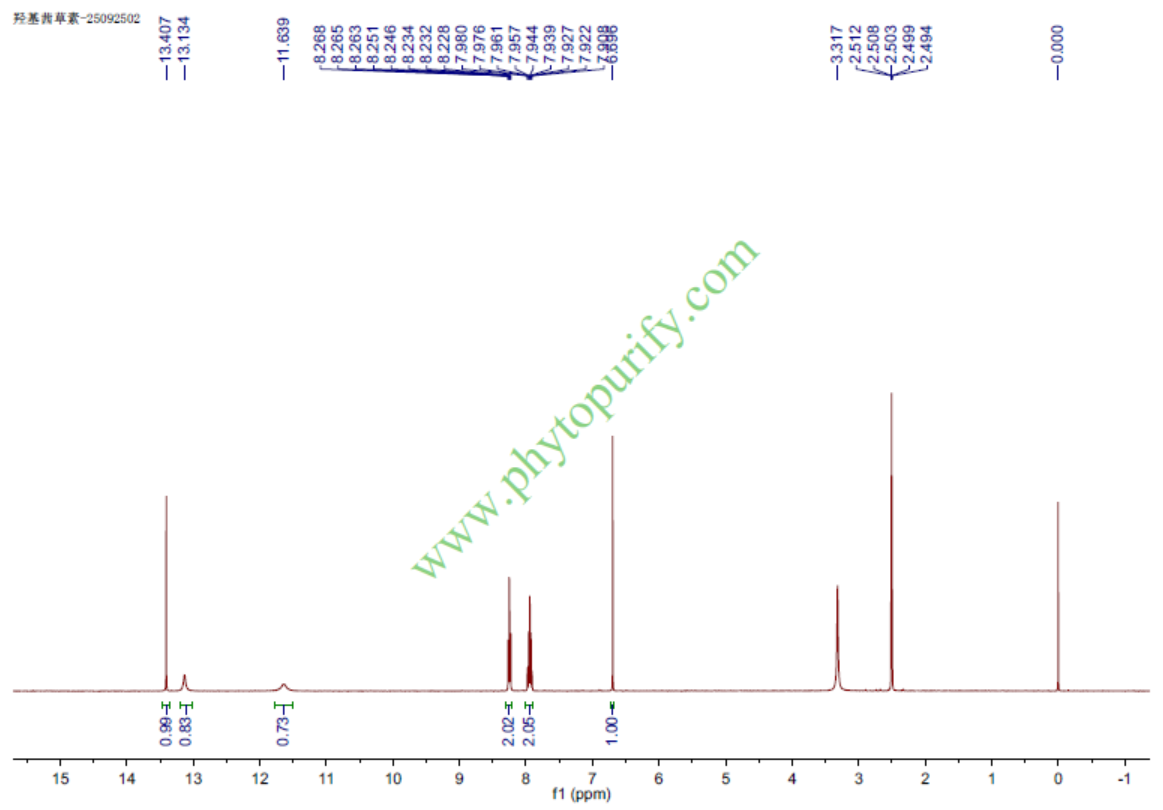
HNMR of Purpurin
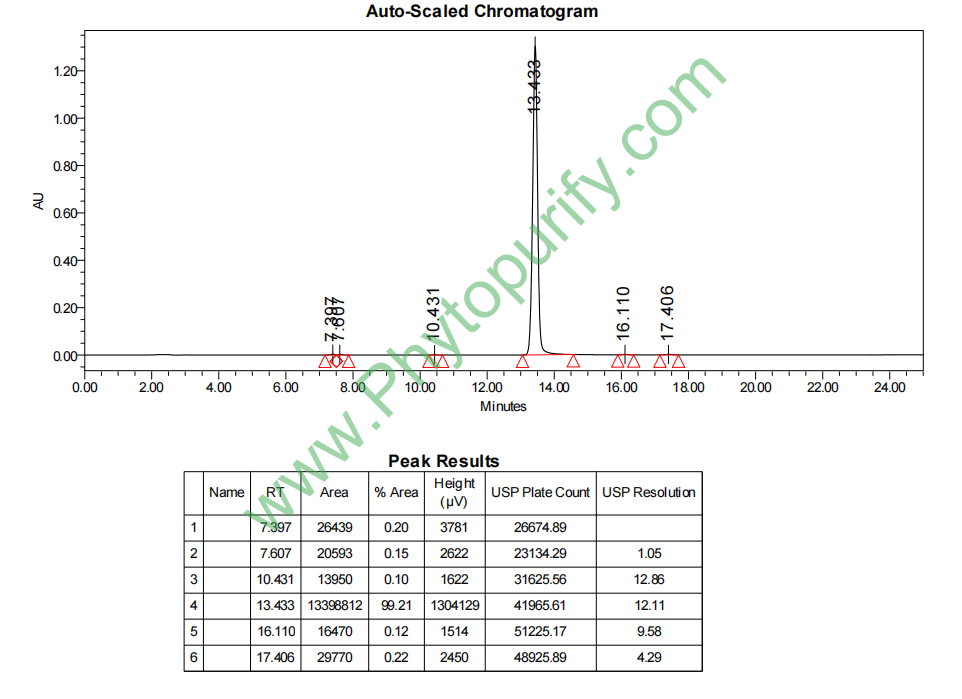
HPLC of Purpurin
Storage conditions:Short-term storage at 2~8℃, long-term storage at -20 ~ -80℃
94.8300
2.5077
.9471
.0314
4.5971
6.9708
Low
89.7716
2.1639
Yes
No
No
No
Yes
Yes
1.8
Yes
No
Yes
Yes
Natural products have long been an important source of innovative drug discovery, among which anthraquinone compounds have attracted much attention due to their wide range of biological activities. Purpurin (CAS number: 81-54-9), derived from the traditional medicinal plant madder(Rubia cordifolia L. In recent years, the natural hydroxyl anthraquinone has gradually shifted from a traditional dye molecule to a hot topic in pharmacological research. Early research has mostly focused on its anti-inflammatory, antioxidant, and antibacterial properties, while the latest scientific evidence reveals that hydroxyrubicin has shown significant potential in multiple disease fields such as anti-tumor and antidepressant effects, especially its multi-target anti-tumor mechanism, which has aroused great interest among researchers. The purpose of this article is to systematically review the chemical properties, plant sources, pharmacological activities of hydroxyrubicin, especially the multidimensional molecular targets and signaling pathways related to its anti-tumor effects, and objectively evaluate and prospect its medicinal properties and clinical application prospects, in order to provide comprehensive academic references for the deep development and transformation research of this natural product.
Hydroxyalizarin, chemical name 1,2,4-trihydroxyanthraquinone, molecular formula C14H8O5, molecular weight 256.2130. The core of its structure is the anthraquinone mother nucleus, which is replaced by hydroxyl groups at positions 1, 2, and 4, respectively. This specific hydroxyl substitution pattern is the key structural basis for its biological activity, giving it unique chemical properties and pharmacological effects compared to other anthraquinone compounds such as emodin and alizarin.
In terms of physicochemical properties, hydroxyalizarin exhibits typical anthraquinone characteristics. Its lipid water partition coefficient (LogP) is 2.5077, indicating that it has a certain degree of lipophilicity, but not highly hydrophobic. The topological polar surface area (TPSA) is 94.83 Å ², reflecting the polarity brought by multiple hydroxyl groups in the molecule. Its water solubility is relatively low, about 0.0314 mg/mL, which may affect its bioavailability to some extent. In terms of spectroscopy, hydroxyalizarin exhibits the characteristic UV visible absorption of anthraquinone compounds and can emit fluorescence under specific conditions. This characteristic has been used for its analysis, detection, and cell imaging research. Crystal structure analysis shows that intramolecular and intermolecular hydrogen bonding networks play an important role in its solid-state stability.
Hydroxy madder mainly comes from the madder plant of the madder family, madder genus(Rubia cordifolia L. The roots and stems of. Madder, also known as "blood madder", has a long history of application in traditional Chinese medicine (referred to as "madder") and Ayurvedic medicine (referred to as "Manjistha"). It is commonly used for promoting blood circulation, removing blood stasis, cooling blood, stopping bleeding, and promoting menstruation. Hydroxyquercetin is one of the main active anthraquinone components in its roots, often coexisting with structurally similar quercetin.
The extraction of hydroxyalizarin from plant materials is usually carried out using solvent extraction method. Traditional methods include using methanol, ethanol, or alcohol water mixed solvents in different ratios for thermal reflux or ultrasound assisted extraction. In order to improve extraction efficiency and selectivity, modern technologies such as microwave-assisted extraction (MAE), supercritical fluid extraction (SFE, commonly CO2), and pressurized liquid extraction (PLE) have been applied. After extraction, the crude extract needs to undergo further separation and purification steps, often using techniques such as silica gel column chromatography, preparative high-performance liquid chromatography (HPLC), or high-speed counter current chromatography (HSCCC) to obtain high-purity hydroxyalizarin monomers. The optimization of extraction process usually relies on the yield and purity of hydroxyquercetin as key evaluation indicators.
Hydroxyquercetin exhibits diverse pharmacological activities, among which anti-tumor effects are currently the most widely and deeply studied field.
1. Antitumor activity A large number of in vitro and in vivo studies have shown that hydroxyalizarin has significant proliferation inhibition and apoptosis promoting effects on a variety of human cancer cell lines, including breast cancer, prostate cancer, liver cancer, colorectal cancer, lung cancer, ovarian cancer and neuroblastoma. Its function is not limited to inducing cell apoptosis, but also includes inhibiting cell migration, invasion, and angiogenesis, indicating its potential for anti metastasis.
2. Antidepressant like effects Preclinical studies have shown that hydroxyrubicin can effectively improve depressive like behavior in animal models of chronic unpredictable mild stress (CUMS), such as increasing sugar water preference and shortening forced swimming immobility time. Its antidepressant mechanism may be related to regulating the monoamine neurotransmitter system, inhibiting neuroinflammation, promoting the expression of neurotrophic factors, and regulating the function of the hypothalamic pituitary adrenal (HPA) axis.
3. Other activities In addition, hydroxyrubicin also exhibits antioxidant, anti-inflammatory, antibacterial (including anti drug resistant bacteria), anti osteoporosis, and neuroprotective activities. Its antioxidant capacity is derived from the characteristics of anthraquinone structure capturing free radicals and chelating metal ions.
The pharmacological effects of hydroxyrubicin, especially its anti-tumor effect, are achieved by intervening in multiple key cellular signaling pathways and directly acting on multiple molecular targets, reflecting the multi-target nature of natural products.
1. Regulating the apoptotic pathway Hydroxyalizarin can directly or indirectly affect members of the Bcl-2 protein family. Research has shown that it can downregulate anti apoptotic proteins MCL1 and BCL2 At the same time, upregulating the expression of pro apoptotic proteins such as Bax leads to a decrease in mitochondrial membrane potential, release of cytochrome C, and activation of the caspase cascade reaction, inducing cell apoptosis.
2. Inhibit transcription factor STAT3 Signal Transduction and Transcription Activation Factor 3(STAT3)It is an important carcinogenic protein. Hydroxyalizarin has been shown to inhibit the phosphorylation (activation) of STAT3, block its nuclear translocation and the transcription of downstream target genes (such as Cyclin D1, Bcl-2, MMP-2), thereby inhibiting tumor cell proliferation, survival, and invasion.
3. Interference with cell cycle and DNA metabolism Hydroxyalizarin can act as a topoisomerase inhibitor. Research shows that it can inhibit TOP1 and TOP2A The activity interferes with DNA replication and repair, leading to DNA damage and cell cycle arrest (usually in the G2/M phase).
4. Inhibit invasion and metastasis Hydroxyalizarin can significantly downregulate matrix metalloproteinases MMP2 The expression and activity of MMP9. MMP2 is a key enzyme that degrades extracellular matrix and promotes tumor invasion and metastasis. By inhibiting MMP2, hydroxyrubicin effectively weakens the invasion and migration ability of cancer cells.
5. Regulating kinase signaling pathway Hydroxyalizarin can regulate the mitogen activated protein kinase (MAPK) pathway, including inhibition MAPK1 Overactivation of ERK2 affects cell proliferation and survival signals.
6. Affects hormone related pathways In hormone dependent tumors such as breast cancer, hydroxyalizarin shows anti estrogen activity. It can interact with estrogen receptors ESR1 Interaction and inhibition of aromatase CYP19A1 The latter is a key enzyme in the conversion of androgens to estrogens, which reduces the biosynthesis of estrogen and inhibits the growth of estrogen dependent tumors.
7. Inhibit hypoxia inducible factor HIF1A In the hypoxic microenvironment of tumors, hydroxyrubicin can inhibit hypoxia inducible factor-1 α(HIF1A)The stability and transcriptional activity of it are regulated, thereby downregulating downstream genes such as vascular endothelial growth factor (VEGF) and exerting anti angiogenic effects.
In summary, hydroxyrubicin forms a synergistic network by simultaneously acting on multiple key targets such as MCL1, BCL2, STAT3, TOP1/2A, MMP2, MAPK1, ESR1, CYP19A1, and HIF1A, collectively leading to tumor cell apoptosis, cycle arrest, invasion and metastasis, and decreased angiogenesis ability.
Although hydroxyrubicin has significant in vitro activity, its pharmacological properties still need to be comprehensively evaluated.
1. Absorption, distribution, metabolism, and excretion (ADME)The oral bioavailability of hydroxyquercetin is expected to be limited by its low water solubility and first pass effect. Its LogP value (2.51) suggests its potential for transmembrane permeation, but a higher TPSA (94.83) may affect its passive diffusion efficiency. It is worth noting that it Prediction of blood-brain barrier permeability as' low 'This is a challenge for treating central nervous system diseases such as depression, but it may also reduce their potential side effects on the central nervous system. In terms of metabolism, hydroxyrubicin may be mainly metabolized through liver glucuronidation and sulfation binding reactions. The prototype and excretion pathways of its metabolites are still unclear.
2. Preliminary safety assessment According to the provided pharmacological parameters, hydroxyalizarin is Ames test The median result is 1.8 (usually considered a ratio>2 for potential mutagenicity,<1.5 for negativity, and 1.5-2.0 for borderline results), indicating a low risk of mutagenicity under standard testing conditions, but further confirmation is still needed.HERG inhibition experiment is negative This indicates a low potential risk of causing QT interval prolongation in the heart, which is a favorable safety feature. However, comprehensive preclinical safety evaluation data for acute toxicity, chronic toxicity, and reproductive toxicity still need to be supplemented.
3. Pharmaceutical challenges The main challenge lies in its poor water solubility, which may affect formulation development and in vivo absorption. Future research may require the use of nanoformulations (such as liposomes, nanoparticles), solid dispersions, cyclodextrin inclusion or prodrug strategies to enhance their solubility and bioavailability.
The multi-target anti-tumor properties of hydroxyrubicin provide new possibilities for its application in the field of tumor therapy, especially in the treatment of multidrug-resistant and metastatic tumors. Its combination with existing chemotherapy drugs may produce synergistic effects, reducing medication dosage and toxic side effects. In terms of antidepressant effects, its multiple mechanisms also provide candidate molecules for the development of new antidepressant drugs.
However, there are still many challenges in transitioning from lead compounds to clinical candidate drugs:
1. In depth mechanism research It is necessary to more accurately clarify the direct intensity, sequence, and network regulatory relationships of its effects on various targets, and clarify the "driving" targets that play a core role.
2. Optimization of drug properties in the system It is necessary to address the issues of poor water solubility and low blood-brain barrier permeability through structural modification or advanced delivery system strategies to improve its pharmacokinetic properties.
3. Comprehensive preclinical evaluation Standardized pharmacodynamic (in disease models closer to clinical practice), pharmacokinetic, and safety evaluations (GLP standards) need to be completed to establish a clear treatment window.
4. Explore combination therapy strategies Studying its potential and regimen in combination with standard chemotherapy, radiotherapy, immunotherapy, or other targeted drugs is a feasible pathway to accelerate its clinical translation.
5. Focus on sources and sustainability As a natural product, it is necessary to consider the sustainability of its plant-based sources and develop synthetic biology or total chemical synthesis methods to ensure stable supply.
Hydroxyquercetin, as a natural anthraquinone compound with a long history of application, is being re recognized and deeply explored for its modern pharmacological value. Especially its multidimensional anti-tumor activity demonstrated by acting on multiple key tumor related targets such as MCL1, STAT3, TOP1/2A, MMP2, makes it an attractive multi-target anti-tumor lead compound. At the same time, its activity in antidepressant and other areas has also expanded its therapeutic application scope. Despite challenges such as water solubility and blood-brain barrier permeability in drug development, these obstacles are expected to be overcome through the intervention of modern medicinal chemistry and pharmacology methods. In the future, in-depth research on hydroxyrubicin should focus on mechanism analysis, optimization of drug formulation systems, and development of innovative treatment strategies, in order to transform this ancient natural molecule into a modern drug with clear clinical value and provide new options for the treatment of major diseases such as cancer.
