


Synonym name: 1,5,8-Trihydroxy-3-methoxyxanthone; Bellidifolium
Catalogue No.: BP0244
Cas No.: 2798-25-6
Formula: C14H10O6
Mol Weight: 274.228
Botanical Source: Gentiana bellidifolia, other Gentiana spp. and Swertia spp.
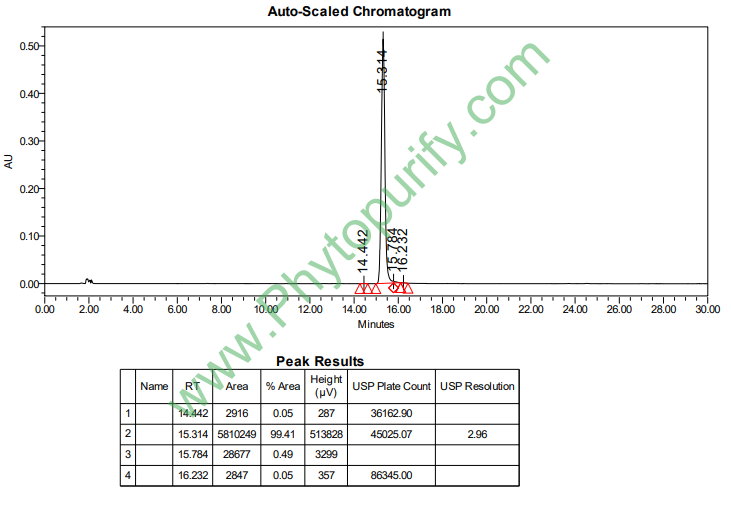
Purity: 95%~99%
Analysis Method: HPLC-DAD or/and HPLC-ELSD
Identification Method: Mass, NMR
Packing: Brown vial or HDPE plastic bottle
Can be supplied from milligrams to grams.
For Reference Standard and R&D, Not for Human Use Directly.
Inquire for bulk scale.
HPLC of Bellidifolin
Storage conditions:Short-term storage at 2~8℃, long-term storage at -20 ~ -80℃
110.3800
1.8000
1.8000
Low
Unknown
Unknown
No
Unknown
Unknown
Unknown
Bellidifolin (CAS number: 2798-25-6) is a typical natural ketone product, first extracted from the stem of Swertia spp. As a multifunctional natural active compound, daisies leaf gentian ketone has attracted much attention in traditional Chinese medicine due to its significant multiple pharmacological effects such as liver protection, blood sugar lowering, antioxidant, anti-inflammatory, and anti-tumor effects. In recent years, with the advancement of molecular biology and pharmacology techniques, the mechanism of action and potential molecular targets of daisies leaf gentian ketone have gradually been revealed, especially in the application prospects of complex diseases such as heart failure, which has aroused widespread research interest. In addition, daisy leaf gentian ketone, as an inhibitor of viral protein R (Vpr), provides a new approach for the development of antiviral drugs. This article aims to systematically review the chemical structure, plant origin, pharmacological activity, mechanism of action, pharmacological evaluation, and clinical application prospects of daisies leaf gentian ketone, with the hope of providing theoretical basis and reference for its subsequent research and development.
Daisy leaf gentian ketone belongs to mountain ketone compounds, with a molecular formula of C15H14O6 and a molecular weight of 274.22. Its structural core is a tricyclic aromatic system, which contains multiple hydroxyl and ketone groups, endowing it with good polarity and biological activity. The specific physicochemical properties are as follows:
The molecular structure of daisies leaf gentian ketone gives it good binding ability and biological activity basis in drug design, especially suitable for multi-target disease treatment.
Daisy leaf gentian mainly comes from the stems of plants in the Swertia genus, especially Swertia japonica and Swertia chirayita. Swertia, as a traditional Chinese medicinal herb, is widely used in the treatment of liver diseases, digestive system diseases, and metabolic disorders. It contains abundant mountain ketone compounds, among which daisies have a higher content of gentian ketone.
The extraction process mainly includes the following steps:
In recent years, the application of supercritical CO2 extraction and molecular imprinting technology has further improved the extraction efficiency and purity of daisies leaf gentian ketone, laying the foundation for its large-scale production.
The pharmacological activities of daisies leaf gentian ketone are extensive, covering various disease models and physiological processes, including:
Multiple in vitro and in vivo experiments have shown that daisies leaf gentian ketone can significantly improve liver injury indicators, alleviate liver cell necrosis and inflammatory reactions. Its mechanism mainly involves antioxidant stress, inhibition of inflammatory cytokine release, and regulation of liver cell apoptosis. Research has shown that daisies leaf gentian ketone can enhance glutathione peroxidase (GSH Px) and superoxide dismutase (SOD) activity, reduce malondialdehyde (MDA) levels, and alleviate oxidative damage.
In the animal model of diabetes, daisy leaf gentianone showed significant hypoglycemic effect. Its mechanism of action involves improving pancreatic beta cell function, enhancing insulin sensitivity, and regulating glucose and lipid metabolism. Some studies suggest that daisies leaf gentian ketone activates the AMPK signaling pathway, promotes glucose uptake and fatty acid oxidation, and achieves hypoglycemic effects.
As a natural antioxidant, daisies leaf gentian ketone can scavenge free radicals, inhibit lipid peroxidation, and alleviate oxidative stress-induced cell damage. At the same time, it has inhibitory effects on various inflammatory mediators such as TNF - α, IL-6, and NF - κ B signaling pathways, demonstrating good anti-inflammatory potential.
In vitro cell experiments and partial in vivo tumor model studies have shown that daidzein can inhibit the proliferation of various tumor cells, induce cell apoptosis, and block the cell cycle. Its anti-tumor mechanism involves the synergistic effect of regulating apoptosis related proteins (such as Bax, Bcl-2), inhibiting tumor related signaling pathways (such as PI3K/Akt, MAPK), and antioxidant activity.
Daisy leaf gentian ketone has been found to act as an inhibitor of viral protein R (Vpr), which is an important accessory protein of HIV-1 virus involved in virus replication and immune escape. By inhibiting Vpr, daisy leaf gentian ketone is expected to interfere with the virus lifecycle and demonstrate potential anti HIV activity.
The multi-target mechanism of action of daisies leaf gentian ketone is the basis of its multiple pharmacological activities. For diseases such as heart failure, the relevant targets mainly include:
Overall, daisy leaf gentian ketone has the potential to treat heart failure by synergistically regulating myocardial metabolism, anti-inflammatory and antioxidant effects, and cell apoptosis through multiple targets and pathways.
The pharmacological parameters of daisies leaf gentian ketone show that it has certain potential for drug development:
At present, there is limited research on the pharmacokinetics of daisies leaf gentian ketone. Preliminary data shows that it has good stability and metabolic characteristics in vivo. In the future, it is necessary to conduct in-depth research on its absorption, distribution, metabolism, and excretion (ADME) characteristics, optimize the dosing regimen and formulation design.
Daisy leaf gentian ketone has shown broad application prospects in multiple disease fields due to its multi-target and multifunctional pharmacological properties
However, the clinical application of daisies leaf gentian ketone still faces many challenges, including its pharmacokinetic properties, toxicological safety, and determination of effective dosage. In the future, it is necessary to strengthen preclinical and clinical research, clarify its safety and efficacy, and promote its translational application.
As a natural mountain ketone compound with multiple pharmacological activities, daisy leaf gentian ketone exhibits a wide range of biological functions and therapeutic potential. Its multi-target mechanism of action provides new strategies for the treatment of complex diseases, especially in the fields of heart failure, liver disease, and metabolic disorders, which have important value. Although its pharmacokinetics and safety evaluation are not yet fully understood, with the development of modern drug research and development technology, daisies leaf gentian ketone is expected to become a representative of the new generation of natural medicines. Future research should focus on mechanism elucidation, dosage form optimization, and clinical validation, promoting its transition from laboratory to clinical application and contributing new natural drug resources to human health.
